Hyacinths are small flowers with a surprisingly strong presence. Their tightly packed blooms, rich colors, and sweet fragrance make them easy to notice, but their symbolism is even more interesting. Across flower traditions and modern color interpretation, hyacinths can represent loyalty, remembrance, regret, affection, beauty, and emotional renewal.However, hyacinth color meanings are not a universal code.
The message attached to a flower can change according to the color, culture, historical period, occasion, and personal experience. A purple hyacinth may suggest regret in one tradition, while someone else may simply see it as an elegant purple spring flower.
This guide explores the meanings behind the major hyacinth colors while separating traditional symbolism from modern color associations. You will also learn how hyacinths are interpreted in psychology, spirituality, relationships, fashion, interior design, gardening, branding, and everyday life.
Quick Answer: What Do Hyacinth Colors Mean?
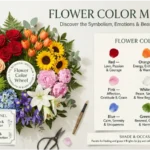
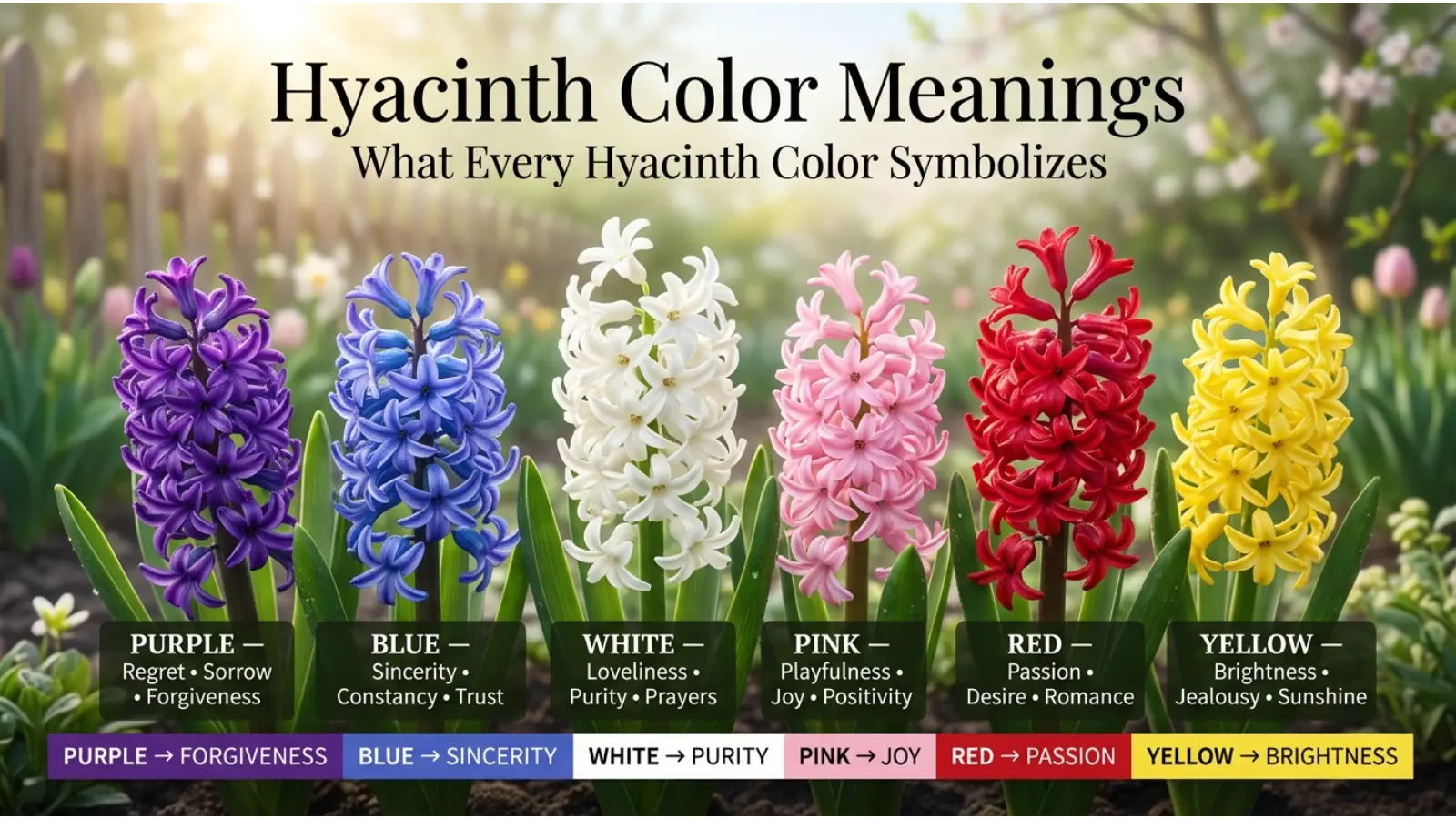
Hyacinth colors can carry different symbolic messages. Purple hyacinths are often linked with regret, sorrow, and forgiveness. Blue hyacinths suggest loyalty, steadiness, and sincerity. White hyacinths are associated with purity, peace, and quiet beauty. Pink hyacinths can express affection, happiness, and tenderness. Yellow hyacinths may represent optimism and energy in modern interpretations, although some older flower symbolism gives yellow a more complicated meaning. Red hyacinths can suggest love, passion, courage, and strong emotion.
The meaning becomes clearer when the flower color is considered together with the occasion and the relationship between the giver and receiver.
Hyacinth Color Meanings Chart
| Hyacinth Color | Common Meaning | Overall Feeling |
|---|---|---|
| 🟣 Purple | Regret, remembrance, reflection | Deep and emotional |
| 🔵 Blue | Loyalty, constancy, sincerity | Calm and dependable |
| ⚪ White | Purity, peace, quiet beauty | Clean and gentle |
| 🩷 Pink | Affection, happiness, tenderness | Warm and cheerful |
| 🟡 Yellow | Optimism, energy, caution | Bright and complex |
| 🔴 Red | Love, passion, strength | Bold and intense |
| 🟠 Orange | Enthusiasm, warmth, creativity | Energetic and lively |
Keep in mind: these meanings are symbolic interpretations rather than scientific rules. Different flower-language traditions can assign different meanings to the same color.
What Does a Hyacinth Symbolize?
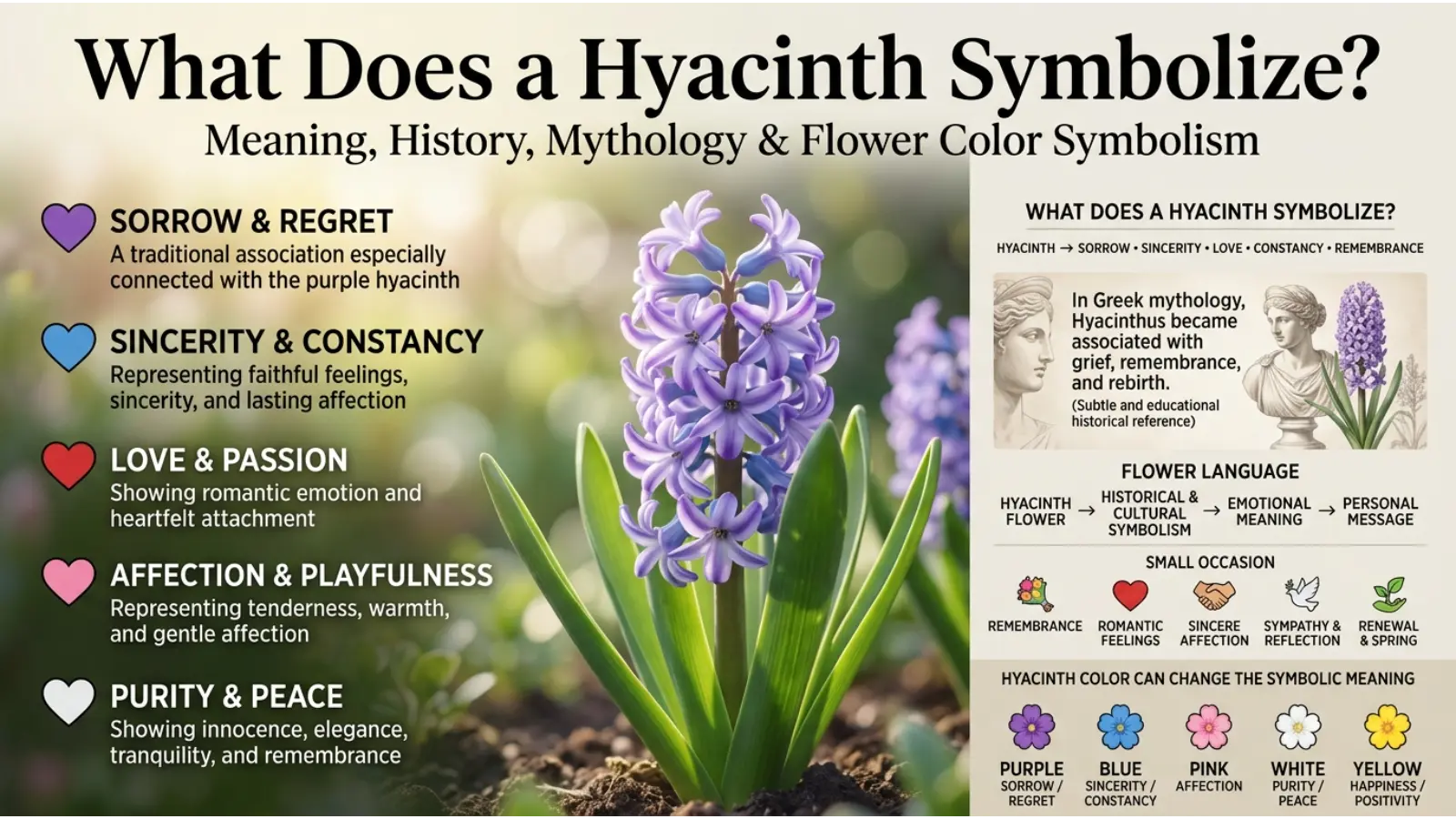
The hyacinth can symbolize constancy, remembrance, emotional depth, beauty, and renewal.
One reason is its natural life cycle. Hyacinths grow from bulbs, remaining hidden beneath the soil before producing colorful flowers. This makes the plant an interesting symbol of something that remains unseen for a time before becoming visible.
The flower also has a strong fragrance. Its meaning is therefore not purely visual. When someone encounters a flowering hyacinth, color, shape, scent, and season all contribute to the experience.
Another important influence is ancient mythology. The name hyacinth is connected with the Greek myth of Hyacinthus, a beautiful youth whose tragic death became associated with the appearance of a flower. This story helped create links between the flower and ideas such as grief, remembrance, and emotional loss.
Over time, flower symbolism became more elaborate. Different colors acquired different associations, creating the rich collection of meanings people use today.
Purple Hyacinth Meaning
🟣 Purple hyacinths are most strongly associated with regret, sorrow, remembrance, and emotional reflection.
Purple is naturally a dramatic color. It sits between the cool character of blue and the warmth of red, giving it a mixture of calmness and intensity.
When this color is combined with the historical associations of the hyacinth, the result is a flower that can express serious emotions.
Purple Hyacinth Symbolism
A purple hyacinth may represent:
- Regret
- Remorse
- Sorrow
- Forgiveness
- Remembrance
- Reflection
- Emotional depth
- Personal growth
The strongest traditional interpretation is connected with regret and asking for forgiveness.
That makes purple hyacinths different from flowers that are mainly used for celebration.
When Is a Purple Hyacinth Appropriate?
A purple hyacinth can be meaningful when someone wants to acknowledge an emotional situation.
For example, it could accompany a message of apology or be included in a remembrance arrangement.
Still, the flower should not be treated as a replacement for honest communication. A bouquet can support an apology, but the words and actions behind that apology matter much more.
Purple Hyacinths and Remembrance
Purple flowers often feel thoughtful rather than casual. Their darker appearance can create a sense of seriousness, making purple hyacinths suitable for moments when memory and emotion are important.
Blue Hyacinth Meaning
🔵 Blue hyacinths are commonly connected with loyalty, consistency, sincerity, and lasting affection.
Blue creates a very different impression from purple.
Its cooler appearance tends to feel stable and peaceful. When used with the hyacinth, that quality can reinforce the idea of feelings that remain steady over time.
What Blue Hyacinths Can Express
A blue hyacinth may suggest:
- Loyalty
- Constancy
- Trust
- Sincerity
- Steadiness
- Faithfulness
- Calm affection
The idea of constancy is particularly fitting because the flower can symbolize feelings that remain rather than disappear quickly.
Blue Hyacinths in Relationships
Blue hyacinths can be especially appropriate for relationships built around trust.
They may work well for:
- Long-term friendships
- Anniversaries
- Family relationships
- Appreciation gifts
- Important milestones
- Supportive messages
Unlike a bright red flower, blue does not demand attention. Its message feels quieter and more dependable.
White Hyacinth Meaning
⚪ White hyacinths are associated with purity, peace, innocence, simplicity, and quiet beauty.
White is one of the easiest flower colors to interpret visually because it creates a clean and open appearance.
A white hyacinth can therefore feel peaceful without becoming emotionally overwhelming.
White Hyacinth Symbolism
White hyacinths may represent:
- Purity
- Innocence
- Peace
- Respect
- Simplicity
- New beginnings
- Quiet beauty
- Spiritual reflection
The exact interpretation depends on the setting.
At a celebration, white can feel fresh and optimistic.
At a memorial, the same color can communicate peace and respect.
White Hyacinths at Home
White hyacinths are also easy to use in interior decoration because they work with almost any neutral palette.
They can soften a room filled with dark furniture or add freshness to a minimalist space.
Pink Hyacinth Meaning
🩷 Pink hyacinths are generally associated with affection, happiness, warmth, tenderness, and playful energy.
Pink creates a softer emotional effect than red. It can express caring feelings without making the message seem overly intense.
Pink Hyacinth Symbolism
Pink hyacinths can suggest:
- Affection
- Happiness
- Tenderness
- Appreciation
- Friendship
- Kindness
- Youthfulness
- Cheerfulness
Because of this lighter emotional character, pink hyacinths are suitable for many different relationships.
You can give them to a friend, family member, partner, or someone you simply want to make smile.
Pink vs. Red Hyacinths
The difference is mainly emotional intensity.
Pink: “I care about you.”
Red: “My feelings are strong and passionate.”
These are not fixed rules, but they provide a useful way to choose between the two colors.
Yellow Hyacinth Meaning
🟡 Yellow hyacinths have a more complicated symbolic history than many other colors.
Yellow is often associated with sunlight, happiness, optimism, and energy. Yet older flower symbolism sometimes gave yellow flowers less positive meanings, including jealousy.
This creates an interesting contrast.
Modern Yellow Meaning
Today, yellow can suggest:
- Happiness
- Friendship
- Optimism
- Energy
- Confidence
- Warmth
- Celebration
Traditional Interpretation
Some older flower-language traditions associate yellow hyacinths with jealousy.
Because these interpretations conflict, context becomes particularly important.
If you are giving yellow hyacinths as a modern gift, most people will probably focus on their cheerful appearance rather than an old symbolic dictionary.
Red Hyacinth Meaning
🔴 Red hyacinths can represent love, passion, strength, energy, and intense affection.
Red is one of the strongest attention-grabbing colors in visual design. It is also widely associated with romantic love and emotional intensity.
Therefore, red hyacinths naturally create a stronger impression than pale pink or white varieties.
Red Hyacinth Symbolism
Red may suggest:
- Passion
- Romantic love
- Desire
- Courage
- Strength
- Energy
- Confidence
- Vitality
The important distinction is that these are largely red-color associations, rather than one universally accepted historical meaning specific to red hyacinths.
That distinction keeps the symbolism accurate.
Orange Hyacinth Meaning
🟠 Orange hyacinths can symbolize enthusiasm, warmth, creativity, excitement, and positive energy.
Orange is visually energetic because it combines characteristics of red and yellow.
It works particularly well when the goal is to create a lively spring display.
Orange Hyacinth Associations
Orange may represent:
- Enthusiasm
- Creativity
- Adventure
- Warmth
- Celebration
- Confidence
- Energy
The Orange hyacinths can be especially attractive in gardens because they create a strong contrast with green leaves.
The Psychology of Hyacinth Color Meanings
Color psychology can help explain why different hyacinths create different impressions, but it should not be confused with a universal emotional formula.
People learn color associations from many sources.
A person’s culture may influence how they interpret a color. Personal memories can also matter. Even the same color may feel different depending on whether it appears in a bedroom, hospital, wedding, garden, or advertisement.
Hue Matters
Blue, purple, pink, and red do not simply look different. They can create different visual temperatures and levels of emotional intensity.
Cooler colors often feel quieter.
Warmer colors can appear more energetic.
But these are tendencies, not guarantees.
Saturation Matters Too
A pale purple hyacinth may feel delicate.
A highly saturated purple may feel dramatic.
The same principle applies to pink, blue, yellow, and red.
Therefore, designers should think about shade and intensity, not just the basic color name.
Spiritual Hyacinth Color Meanings
Hyacinths can have spiritual meaning in personal and symbolic contexts, but there is no single universal religious interpretation for every hyacinth color.
Instead, people may connect the flower with ideas such as:
- Renewal
- Remembrance
- Hope
- Inner growth
- Transformation
- Peace
- Reflection
- Emotional healing
The bulb’s seasonal cycle provides a natural metaphor for renewal. Something remains hidden beneath the soil and later emerges into visible life.
Purple and Spiritual Reflection
Purple can represent contemplation and emotional transformation.
Blue and Inner Peace
Blue can suggest calmness, trust, and emotional stability.
White and Purity
White can symbolize peace, simplicity, and a fresh beginning.
Pink and Compassion
Pink can represent kindness, tenderness, and emotional warmth.
These meanings are best understood as personal or symbolic interpretations, not guaranteed spiritual properties.
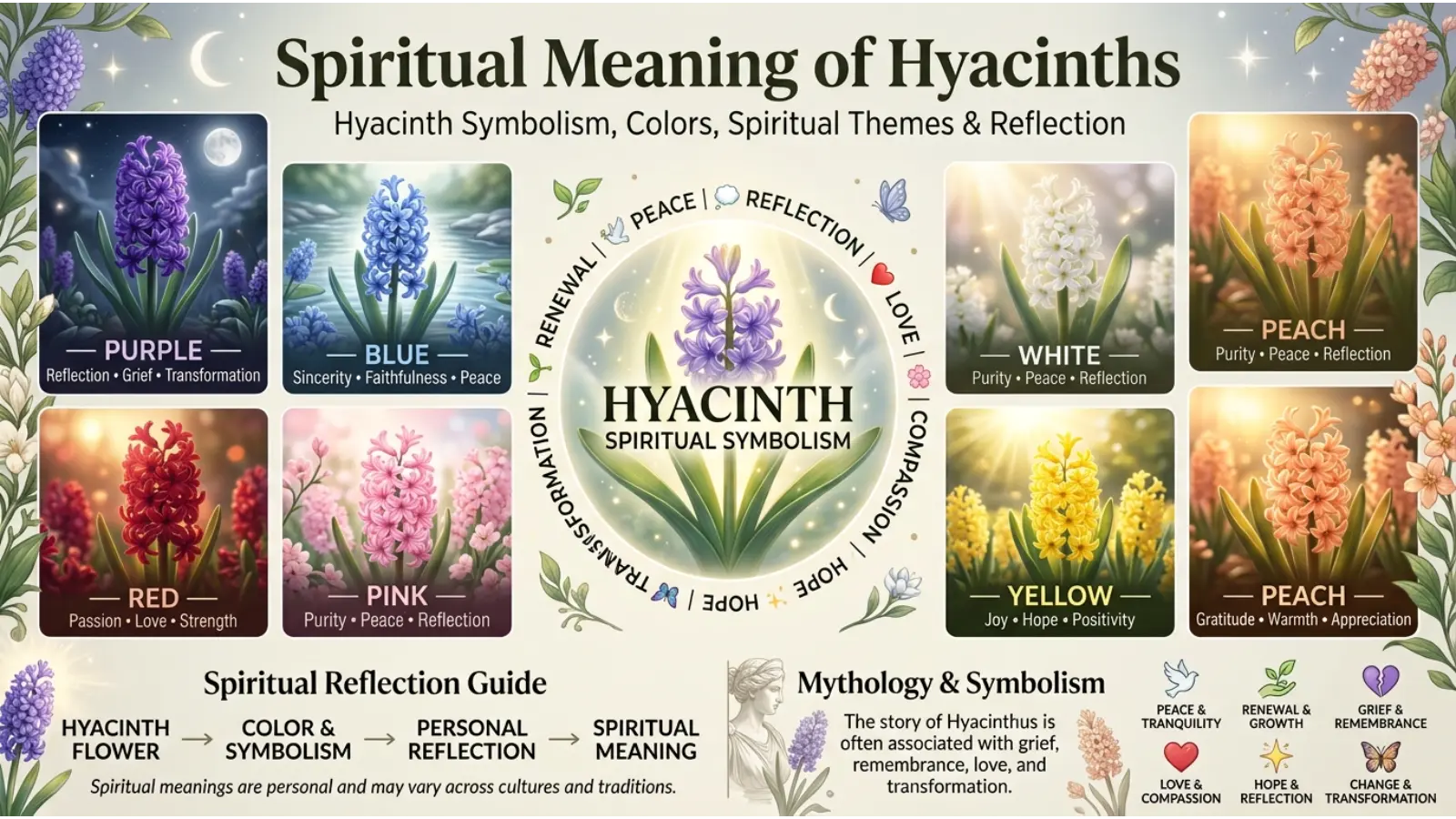
Hyacinths in Greek Mythology
The history of hyacinth symbolism cannot be discussed without mentioning Greek mythology.
In the famous story, Hyacinthus was a young man associated with Apollo. During a game involving a discus, Hyacinthus was accidentally killed. The myth connects his death with the emergence of the hyacinth flower.
This story gave the flower a strong association with:
- Grief
- Loss
- Remembrance
- Beauty
- Fragility
- Mourning
However, mythology should not be treated as a scientific explanation of the plant.
Ancient references to flowers do not always correspond perfectly to modern botanical species. The cultural story and the modern cultivated hyacinth belong to different contexts.
Nevertheless, the myth remains an important reason why hyacinths have such emotionally rich symbolism.
Hyacinth Color Meanings Across Cultures
There is no worldwide dictionary that gives each hyacinth color one permanent meaning.
Flower symbolism changes from one society to another.
Western Traditions
Western flower symbolism has played a major role in assigning emotional meanings to flowers and colors.
Victorian-era flower language is especially influential in modern discussions of floral symbolism.
Other Cultural Contexts
In other regions, flowers may be valued more for their fragrance, seasonal beauty, religious setting, garden tradition, or association with particular celebrations.
Therefore, it is risky to say:
“This hyacinth color always means this everywhere.”
A better approach is to ask what the color means within the particular tradition and situation.
Modern Global Culture
Social media and international flower delivery have also changed how people interpret flowers.
Today, someone may select a hyacinth simply because it is the recipient’s favorite color.
Personal meaning has become just as important as traditional symbolism.
Hyacinth Color Meanings Personality Associations
People sometimes connect favorite colors with personality traits.
Hyacinth colors can inspire those associations, but they should not be treated as psychological diagnoses.
Purple Hyacinth Lovers
May be symbolically described as:
- Creative
- Reflective
- Imaginative
- Independent
- Emotionally aware
Blue Hyacinth Lovers
Often associated symbolically with:
- Calmness
- Loyalty
- Reliability
- Patience
- Stability
White Hyacinth Lovers
May prefer:
- Simplicity
- Clean design
- Peaceful environments
- Order
- Minimalism
Pink Hyacinth Lovers
May be associated with:
- Warmth
- Kindness
- Affection
- Playfulness
- Social connection
Yellow Hyacinth Lovers
Can be symbolically connected with:
- Optimism
- Curiosity
- Energy
- Creativity
- Confidence
These descriptions are useful for symbolism and self-expression, but favorite color does not determine personality.
Hyacinth Color Meanings in Branding and Marketing
Hyacinth-inspired colors can provide interesting ideas for branding.
Purple
Purple can make a brand feel:
- Creative
- Premium
- Imaginative
- Sophisticated
Blue
Blue can create a visual impression of:
- Stability
- Trust
- Reliability
- Calmness
White
White can communicate:
- Simplicity
- Cleanliness
- Modern design
- Minimalism
Pink
Pink can create a warmer and more approachable identity.
Yellow
Yellow can help create energy and attract attention.
Red
Red can make branding appear stronger, more urgent, and emotionally intense.
Color alone does not create a successful brand. A company’s audience, typography, photography, product, messaging, and overall design system all influence perception.
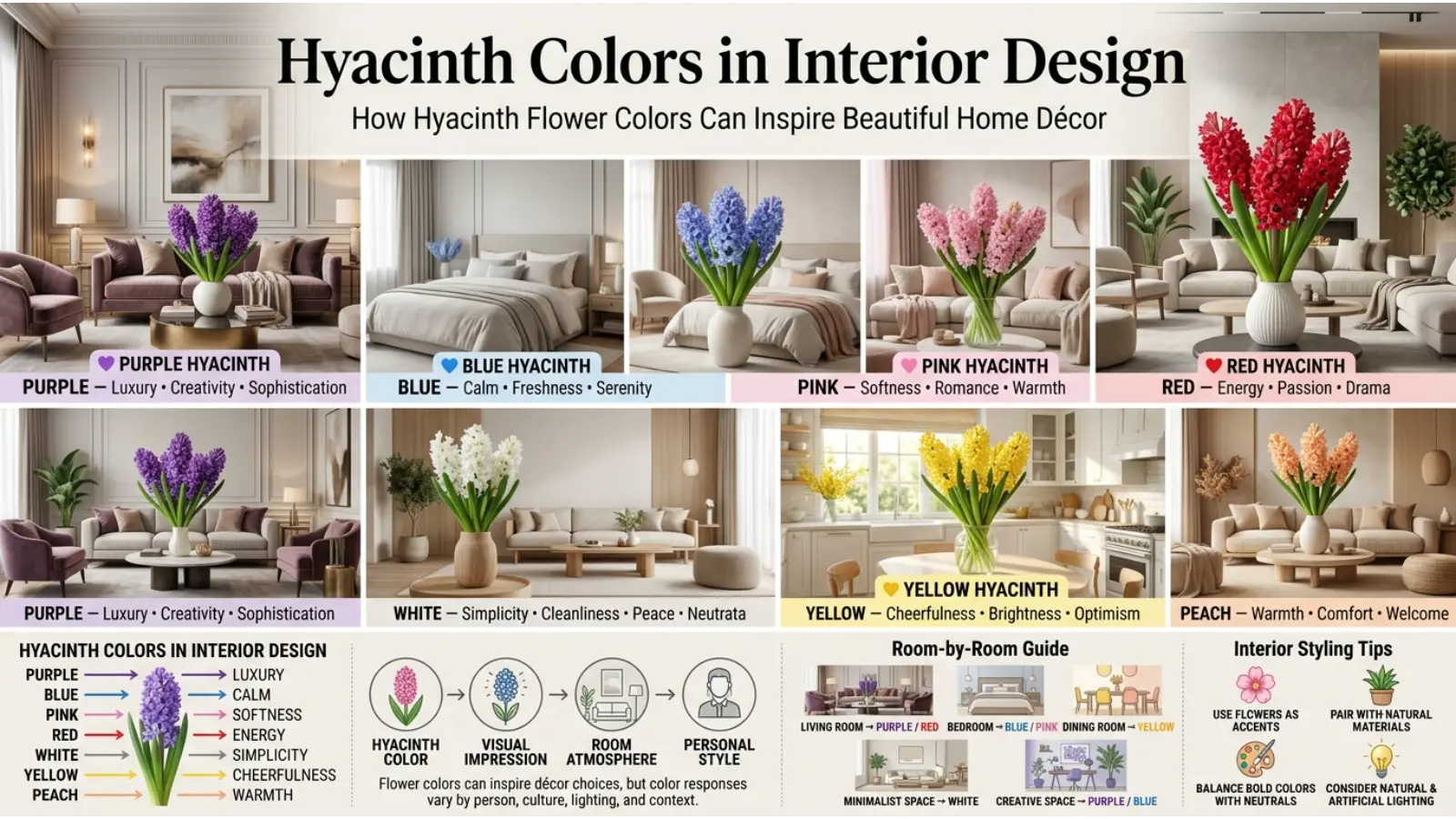
Hyacinth Color Meanings in Interior Design
Hyacinths can add both color and natural texture to an interior.
Purple Hyacinths
Use purple when you want a room to feel sophisticated or artistic.
They pair naturally with:
- Cream
- Beige
- Gray
- Natural wood
- Soft green
Blue Hyacinths
Blue hyacinths work especially well in quiet rooms.
Try them with:
- White
- Light gray
- Pale wood
- Neutral fabrics
White Hyacinths
White flowers can make a space feel fresh and uncluttered.
They work particularly well with minimalist interiors.
Pink Hyacinths
Pink can soften rooms that already contain neutral colors.
A small pink arrangement can provide warmth without dominating the entire space.
Yellow and Orange Hyacinths
Use these colors as accents.
A bright yellow or orange arrangement can become the focal point of a neutral room.
Hyacinth Colors in Fashion
Hyacinth-inspired colors can also influence clothing choices.
Purple
Purple clothing can appear creative, elegant, or distinctive.
Blue
Blue is versatile and works well for casual, professional, and formal clothing.
White
White creates a crisp appearance and can make an outfit look fresh.
Pink
Pink ranges from delicate to bold depending on its shade.
Yellow
Yellow can create an energetic statement.
Red
Red is useful when you want clothing to attract attention or create a confident impression.
Fabric matters too. A glossy fabric makes a color appear more intense, while a matte fabric can make the same shade feel softer.
Best Hyacinth Color Combinations
Hyacinths look especially attractive when different colors are combined thoughtfully.
| Color Combination | Mood | Good For |
|---|---|---|
| 🟣 Purple + ⚪ White | Elegant | Formal arrangements |
| 🔵 Blue + ⚪ White | Peaceful | Bedrooms and spring displays |
| 🩷 Pink + ⚪ White | Gentle | Gifts and celebrations |
| 🟡 Yellow + 🔵 Blue | Cheerful | Gardens |
| 🟣 Purple + 🩷 Pink | Romantic and creative | Decorative arrangements |
| 🔴 Red + ⚪ White | Bold and classic | Romantic settings |
| 🟠 Orange + 🟡 Yellow | Energetic | Outdoor displays |
| 🔵 Blue + 🟣 Purple | Sophisticated | Artistic spaces |
Why Contrast Matters
Colors that strongly contrast with one another can make a display more noticeable.
Related colors create a smoother visual transition.
For example, purple and pink feel connected because they share visual characteristics, while yellow and blue create much stronger contrast.
This principle is useful when designing a garden, bouquet, photograph, or room.
How Lighting Changes Hyacinth Colors
The color you see is not produced by the flower alone.
Lighting can change its appearance significantly.
Warm indoor lighting can make purple flowers appear more reddish.
Cool daylight can make blue petals look clearer.
Dark surroundings can make deep purple flowers appear even darker.
Strong sunlight can make saturated colors look more vivid.
Photography introduces another variable. Camera exposure, white balance, screen settings, and editing can all change how the final flower appears.
So, if you are choosing hyacinths from a photograph, remember that the displayed color may not perfectly match the actual plant.
Choosing a Hyacinth Color for a Gift
The best color depends on the message you want to send.
For an Apology
Purple is the strongest traditional choice.
For Loyalty
Blue fits a message of constancy and trust.
For Peace or a Fresh Start
White creates a gentle impression.
For Affection
Pink is warm and approachable.
For Passion
Red makes a stronger emotional statement.
For Happiness
Yellow or orange can create a cheerful impression.
However, the recipient’s favorite color may matter more than traditional symbolism.
A person who loves yellow may appreciate yellow hyacinths as a joyful gift even if an old flower-language tradition assigns the color another meaning.
Common Misconceptions About Hyacinth Color Meanings
“Every hyacinth color has one official meaning.”
It does not.
Flower symbolism has changed across time and cultures.
“Purple hyacinths always mean an apology.”
Purple hyacinths are strongly associated with regret and forgiveness in flower symbolism, but not everyone knows or follows that tradition.
“Color psychology proves what every person will feel.”
It does not.
Color responses can vary between individuals and situations.
“Ancient mythology gives us the exact modern meaning.”
Mythology influences symbolism, but it does not function as a modern psychological rulebook.
“The brighter the flower, the happier its meaning.”
Not necessarily.
Brightness can change visual energy, but meaning also depends on cultural context and the occasion.
Why Hyacinth Color Meanings Change With Context
A color does not exist in isolation.
Imagine a white hyacinth.
Placed beside wedding decorations, it may suggest purity and new beginnings.
Placed beside a memorial arrangement, it may feel peaceful and respectful.
The Placed in a minimalist living room, it may simply represent clean, natural beauty.
The flower has not changed.
The context has.
This is one of the most important ideas in color symbolism. Meaning comes from the interaction between the color, object, environment, culture, and human experience.
Hyacinths in Everyday Life
Hyacinths are useful beyond flower symbolism.
Their colors can influence:
- Garden planning
- Home decoration
- Gift selection
- Photography
- Artwork
- Seasonal displays
- Wedding arrangements
- Fashion inspiration
- Visual branding
- Creative projects
Their fragrance adds another dimension that many decorative flowers lack.
A hyacinth arrangement can therefore communicate visually while also creating a strong sensory experience.
Frequently Asked Questions
What is the most meaningful hyacinth color?
There is no single most meaningful color. Purple has a particularly strong association with regret and remembrance, while blue is strongly connected with constancy.
What does a purple hyacinth mean in love?
Purple hyacinths can express emotional depth, regret, remembrance, or a desire for forgiveness. They are less straightforwardly romantic than red flowers.
Are blue hyacinths good for friendship?
Yes. Blue’s associations with loyalty, trust, and steadiness make it a natural choice for friendship.
What does a white hyacinth symbolize?
White hyacinths can represent purity, peace, innocence, simplicity, and quiet beauty.
What does pink hyacinth mean?
Pink hyacinths are commonly interpreted as symbols of affection, happiness, tenderness, warmth, and appreciation.
What does a yellow hyacinth symbolize?
Yellow can symbolize happiness and energy in modern color interpretation, while some older flower symbolism connects yellow hyacinths with jealousy.
What does a red hyacinth mean?
Red hyacinths can suggest love, passion, strength, courage, and intense affection, largely through the symbolism associated with red.
Are hyacinth color meanings universal?
No. Floral symbolism varies across cultures, historical periods, and individuals.
Does hyacinth color affect psychology?
Color can influence visual and emotional perception, but there is no universal psychological reaction to a particular hyacinth color.
Which hyacinth color is best for an apology?
Purple is the traditional choice when you want to express regret or ask for forgiveness.
Conclusion
Hyacinths show how much meaning can be packed into a single flower.
Purple can speak of regret and remembrance. Blue suggests constancy and trust. White brings ideas of purity, peace, and quiet beauty. Pink feels affectionate and cheerful, while yellow and orange add energy and warmth. Red creates a stronger impression of passion and emotional intensity.
Still, these meanings should not be treated as universal rules. Flower symbolism develops through history, culture, color associations, personal memories, and the situation in which the flower appears.
That is what makes hyacinths so interesting. Their symbolism is not simply about memorizing a list of colors. It is about understanding how color, nature, emotion, culture, and context interact.
The next time you see a hyacinth in bloom, look beyond its color. Notice its fragrance, season, surroundings, and the feeling it creates. Sometimes the most meaningful symbolism is not the definition written in a flower book—it is the meaning the flower creates for the person looking at it.

Emma Wilson is a dedicated comparison writer and product researcher at ColorMystiic.com. She specializes in creating unbiased product comparisons, detailed reviews, and helpful buying guides. Her goal is to help readers make smarter purchasing decisions with confidence.