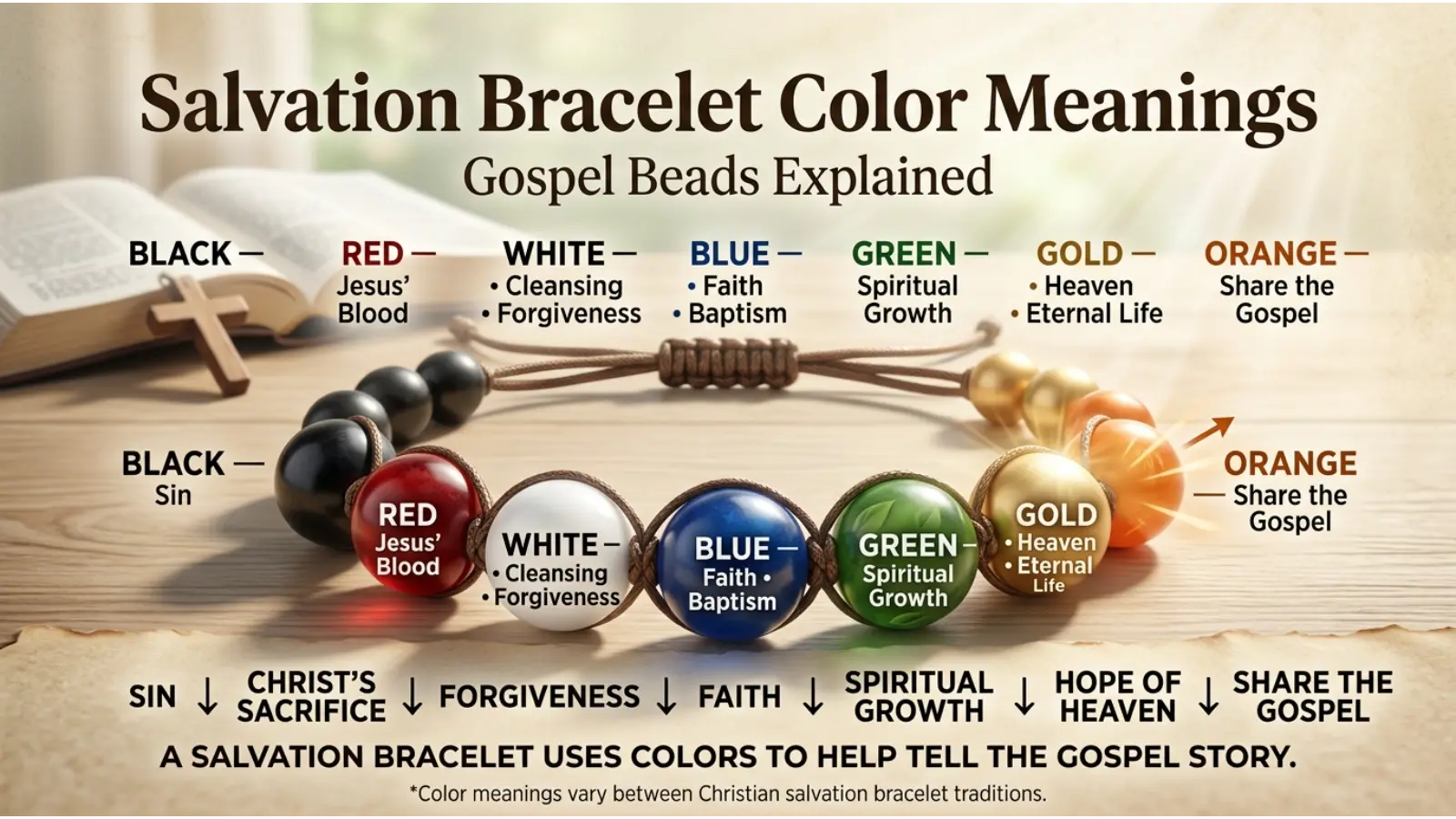
Salvation bracelets use simple colored beads to tell the Christian story of Salvation Bracelet Color Meanings without relying on a long written explanation. Each bead represents a part of the Gospel message, making the bracelet especially useful for evangelism, Sunday school lessons, youth groups, missions, and personal reminders of faith.
The most common five-color version uses yellow, black, red, white, and green. Yellow or gold commonly represents heaven, black or a dark color represents sin, red represents the blood or sacrifice of Jesus Christ, white represents cleansing or forgiveness, and green represents spiritual growth. Some versions also include blue for baptism, while other traditions use clear, purple, or additional beads.
The important point is that these meanings are Christian teaching symbols rather than a universal biblical color code. Different churches, ministries, and evangelism resources may arrange or explain the beads differently.
Quick Answer: What Do the Salvation Bracelet Color Meanings?
The most common salvation bracelet color meanings are:
| Color | Common Meaning | Main Christian Idea |
|---|---|---|
| 🟨 Yellow/Gold | Heaven | Hope of eternal life with God |
| ⬛ Black/Dark | Sin | Humanity’s separation from God because of sin |
| 🟥 Red | Jesus’ blood | Christ’s sacrifice and atonement |
| ⬜ White/Clear | Cleansing | Forgiveness, purity, and righteousness |
| 🟩 Green | Growth | Growing in faith and a relationship with God |
| 🟦 Blue | Baptism | Baptism or a public expression of faith |
The exact order is not universal. A common five-bead bracelet uses yellow, black, red, white, and green, while some six-color versions place blue between white and green to represent baptism.
What Is a Salvation Bracelet?
A salvation bracelet is a small bracelet made with colored beads that communicate a simplified Christian salvation message. It is sometimes called a Gospel bracelet, wordless bracelet, or salvation bead bracelet.
The idea comes from the broader tradition of using colors to communicate the Gospel. Instead of depending on paragraphs of text, the colors act as visual reminders of key Christian teachings.
This makes the bracelet easy to remember. A person can look at the beads and recall a sequence such as:
Heaven → Sin → Jesus’ sacrifice → Cleansing → Growth
The bracelet therefore serves two purposes. It can be a personal reminder of Christian faith, and it can also be used as a conversation starter when someone asks what the colors mean.
The system is particularly popular in children’s ministry because colors are easy to recognize and remember. Child Evangelism Fellowship, for example, describes its Wordless Book as a visual way of sharing the Gospel through colors.
Is There One Official Salvation Bracelet Color Code?
No.
There is no single official color sequence used by every Christian denomination or ministry.
One common version has five colors:
Yellow → Black → Red → White → Green
Another popular version adds blue:
Black → Red → White → Blue → Green → Yellow
Some ministries begin with yellow or gold because they want to introduce the hope of heaven first. Others begin with sin because they follow the traditional sequence of the Wordless Book.
That variation matters because you should not assume that every bracelet uses exactly the same meanings.
Salvation Bracelet Color Meanings Chart
Here is a simple visual guide to the most widely encountered colors:
| 🌈 Bead | ✝️ Meaning | 💡 Symbolic Message |
|---|---|---|
| 🟨 Yellow/Gold | Heaven | God’s kingdom and the hope of eternal life |
| ⬛ Black/Dark | Sin | Sin and humanity’s need for salvation |
| 🟥 Red | Jesus’ blood | Christ’s death and sacrificial love |
| ⬜ White/Clear | Cleansing | Forgiveness, purity, and restored relationship with God |
| 🟩 Green | Spiritual growth | Growing in faith after salvation |
| 🟦 Blue | Baptism | Baptism and identification with Christian faith |
| 🟪 Purple | Worship or royalty in some versions | Christ’s kingship or devotion |
The first five colors are the core of many traditional salvation bracelets. Blue and purple are optional variations, not universal meanings.
🟨 Yellow or Gold: Heaven and Eternal Hope
The yellow or gold bead commonly represents heaven.
Gold is especially meaningful in this teaching because Christian descriptions of the heavenly city in Revelation include imagery of gold. Some Gospel color resources therefore use yellow or gold as a visual reminder of heaven and eternal life.
What Does the Yellow Bead Mean?
The yellow or gold bead can communicate ideas such as:
- Heaven
- God’s kingdom
- Eternal life
- Hope
- God’s glory
- The promise of being with God
The meaning is primarily symbolic, rather than a claim that heaven literally has a particular color.
Why Is Yellow Sometimes Called Gold?
Different bracelets use yellow, gold, or golden-colored beads because actual gold beads can be expensive or difficult to source.
The teaching remains essentially the same: the bright color points toward heaven and Christian hope.
Positive Emotional Associations
Outside theology, yellow is often associated with:
- Light
- Happiness
- Warmth
- Optimism
- Energy
- Hope
Those emotional associations can make yellow visually effective as a reminder of hope. However, color psychology does not prove that a yellow bead creates spiritual hope. Its religious meaning comes from the teaching tradition surrounding the bracelet.
⬛ Black or Dark: Sin and the Need for Salvation
The black or dark bead traditionally represents sin.
The concept is connected with the Christian teaching that human beings are affected by sin and therefore need reconciliation with God. Romans 3:23 is commonly used in Wordless Book presentations to communicate the idea that all have sinned.
What Does the Black Bead Represent?
Depending on the ministry, it may symbolize:
- Sin
- Separation from God
- Spiritual darkness
- Humanity’s need for redemption
- The problem that makes salvation necessary
The bead is not meant to suggest that the color black is morally bad in everyday life.
That distinction is important.
Black Does Not Mean “Bad People”
The symbolic use of black in this teaching system should not be confused with a judgment about people, cultures, clothing, skin color, or personal identity.
Some Christian writers and educators have questioned whether using black specifically for sin can create unwanted racial associations. Other ministries respond by using terms such as dark bead instead of black bead. The Child Evangelism Fellowship version, for example, uses a “dark” color rather than relying on the word black.
This shows why context matters when teaching salvation through color.
🟥 Red: The Blood and Sacrifice of Jesus
The red bead commonly represents the blood of Jesus Christ and His sacrificial death.
This is one of the most recognizable elements of the Gospel color system. Traditional Wordless Book teaching connects red with Christ’s blood and atonement.
What Does Red Represent?
Red may communicate:
- Jesus’ sacrifice
- The crucifixion
- Atonement
- God’s love
- Redemption
- The cost of salvation
The theological point is not simply that red is an emotional color. Rather, the bead points to the Christian belief that Jesus gave His life for humanity.
Why Was Red Chosen?
Red has an obvious visual connection with blood, making it easy to remember the teaching.
In addition, red can communicate powerful ideas in many cultures, including:
- Love
- Sacrifice
- Passion
- Courage
- Life
- Danger
However, those general cultural meanings are separate from the specific Christian symbolism of the salvation bracelet.
⬜ White or Clear: Cleansing, Forgiveness, and Purity
The white bead commonly represents cleansing from sin, forgiveness, purity, or righteousness through Christ.
Traditional Wordless Book teaching used white after red to illustrate the transformation from sin to cleansing.
What Does the White Bead Mean?
Common interpretations include:
- Forgiveness
- Cleansing
- Purity
- A clean heart
- Righteousness
- Reconciliation with God
The white color works naturally as a visual metaphor because clean and white objects are commonly associated with purity.
Still, the color itself does not produce forgiveness. The bracelet is simply a teaching aid used to explain a Christian belief.
Why Do Some Bracelets Use Clear Beads?
Clear beads can serve a similar visual purpose while avoiding a literal white bead.
Some versions therefore use clear or transparent beads for righteousness or cleansing. The exact wording can differ between ministries.
🟩 Green: Spiritual Growth
The green bead generally represents growth in faith.
Once the salvation message has been explained, green moves the teaching toward what happens afterward: continuing to learn, mature, pray, serve, and develop a relationship with God.
Child Evangelism Fellowship’s Wordless Book includes green as a symbol connected with growth.
What Does Green Represent?
Green can symbolize:
- Spiritual growth
- Learning
- Faith development
- New life
- Christian maturity
- Continued relationship with God
Green is a natural choice because plants grow and develop over time.
That creates a simple teaching analogy:
A healthy plant needs care to grow, and Christians are encouraged to grow in their faith as well.
Why Is Green Often the Last Bead?
In many five-color versions, green comes after white because the sequence is designed to communicate a progression:
Sin → Sacrifice → Cleansing → Growth
The green bead therefore emphasizes that the Christian message does not end with conversion. It also includes ongoing spiritual development.
🟦 Blue: Baptism in Some Salvation Bracelets
Blue is an additional color, not part of every salvation bracelet.
Some six-color versions use blue to represent baptism. In those bracelets, blue may appear after white and before green.
What Does the Blue Bead Mean?
It may represent:
- Baptism
- Public identification with Christian faith
- Obedience
- New commitment
- Faith
The exact explanation depends on the church or ministry using the bracelet.
Blue is also widely associated with calmness, water, trust, and peace in general color symbolism. Those associations can make it visually suitable for baptism, but they should not be mistaken for universal biblical rules about blue.
🟪 Purple: An Occasional Extra Color
Purple is not part of the standard five-color salvation bracelet.
Some variations add purple to communicate ideas such as:
- Worship
- Royalty
- Christ’s kingship
- Honor
- Devotion
Purple has a long history of associations with royalty and status because purple dyes were historically difficult and expensive to produce.
When purple appears on a salvation bracelet, always check the accompanying instructions because its meaning is not standardized.
Why Do Salvation Bracelets Use Colors?
The strength of a salvation bracelet is its simplicity.
A person does not need to memorize a long lesson before beginning a conversation. The beads provide visual prompts.
For example:
🟨 Yellow → What is the hope of heaven?
⬛ Dark → Why does humanity need salvation?
🟥 Red → What did Jesus do?
⬜ White → What does forgiveness mean?
🟩 Green → What does spiritual growth look like?
This approach turns abstract theological ideas into a sequence that can be seen and remembered.
It is especially useful for children, visual learners, group activities, and short conversations.
The History Behind Salvation Bracelet Color Meanings
Salvation bracelets are part of a much older Christian teaching tradition commonly associated with the Wordless Book.
The original Wordless Book is traditionally linked to Charles Spurgeon and dates to 1866. The early version used three colors: black, red, and white. These represented sin, Christ’s blood, and cleansing or righteousness.
Later versions added additional colors.
Gold or yellow was added to represent heaven, while green was later used to represent spiritual growth. Some modern versions also added blue for baptism.
The bracelet format transformed the same concept into something portable.
Instead of carrying a small book, a person could wear the Gospel colors on the wrist.
This helped turn the color sequence into a visual reminder that could be worn every day.
Salvation Bracelet Colors and the Bible
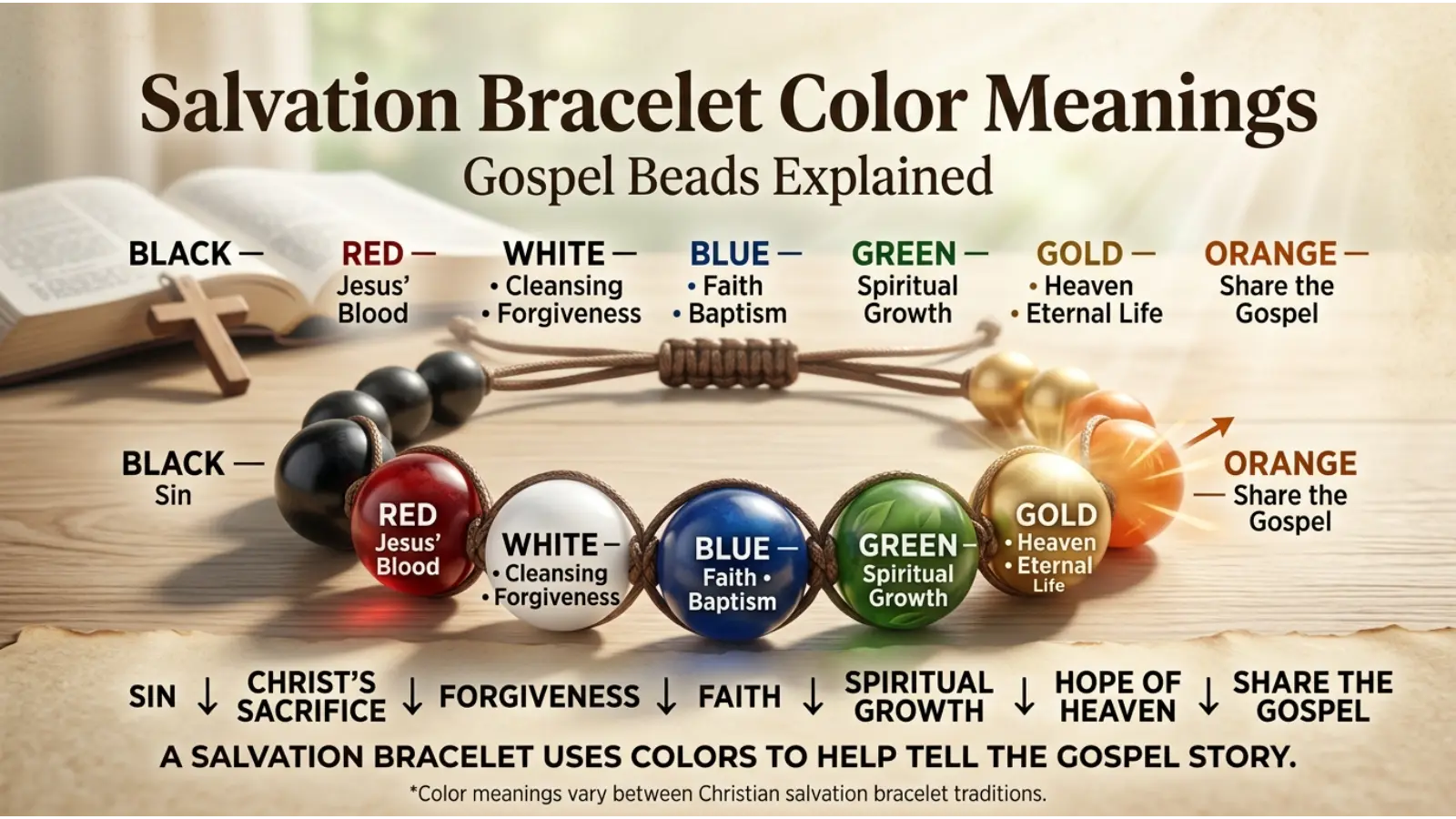
One of the biggest misconceptions is that the Bible gives an official list saying:
Yellow = heaven, black = sin, red = Jesus’ blood, white = forgiveness, green = growth.
It does not.
These are interpretive teaching symbols developed within Christian evangelism traditions.
The Bible contains many references to colors, light, blood, purity, gold, growth, and other imagery. However, the specific bracelet system is a human-created visual teaching method.
That distinction improves the accuracy of the message.
Bible Verses Commonly Used With the Colors
Different ministries use different verses. Examples include:
| Color | Common Biblical Theme | Example Reference |
|---|---|---|
| 🟨 Yellow/Gold | Heaven | Revelation 21 |
| ⬛ Dark | Sin | Romans 3:23 |
| 🟥 Red | Christ’s blood | 1 John 1:7 |
| ⬜ White | Cleansing | Psalm 51:7 |
| 🟩 Green | Spiritual growth | 2 Peter 3:18 |
| 🟦 Blue | Baptism | Acts 2:38 is often discussed in baptism teaching |
These references support the Christian ideas associated with the teaching, but they should not be presented as proof that God assigned a fixed bead color to each doctrine.
Salvation Bracelet Color Meanings in Different Christian Traditions
Christian churches do not all use the same color system.
Some evangelical and Baptist ministries use five or six beads. Children’s ministries may use a five-color Wordless Book sequence. Other groups may change the order, replace black with a dark bead, or add extra colors.
The differences usually reflect teaching preferences rather than completely different Gospel messages.
For example:
Version A: Yellow → Black → Red → White → Green
Version B: Black → Red → White → Green → Yellow
The Version C: Black → Red → White → Blue → Green → Yellow
All three can communicate broadly similar Christian ideas while emphasizing different stages of the story.
Cultural Meaning of Salvation Bracelet Color Meanings
Color symbolism is not universal.
A color that communicates one idea in one society may create a different impression elsewhere.
This is particularly important when salvation bracelets are used in international missions.
For example, research and Christian mission discussions have raised concerns that color symbolism can vary significantly across cultures. One discussion of salvation bracelets notes that color meanings and the cultural understanding of bracelets can differ in parts of Sub-Saharan Africa.
Western Christian Contexts
In many Western Christian settings, these colors are familiar as evangelism symbols:
- Black or dark → sin
- Red → Christ’s blood
- White → cleansing
- Green → growth
- Gold → heaven
Eastern and Asian Contexts
Color meanings can differ substantially.
For example, red has strong associations with luck, celebration, prosperity, and happiness in several Chinese cultural contexts. White can also have funeral associations in some East Asian cultures.
Therefore, a Western Gospel color explanation may not automatically communicate the intended message to every audience.
African and Mission Contexts
In some communities, colors and bracelets can carry meanings unrelated to Western Christian symbolism.
A bracelet may be understood as jewelry, decoration, identity, protection, or even an object with spiritual power.
That means missionaries and teachers should explain the symbolism rather than assuming the audience will understand it automatically.
The Practical Lesson
Color is a language, but it is not a universal language.
When using a salvation bracelet across cultures, explain the meaning of each bead instead of relying on color alone.
Psychology of Salvation Bracelet Color Meanings
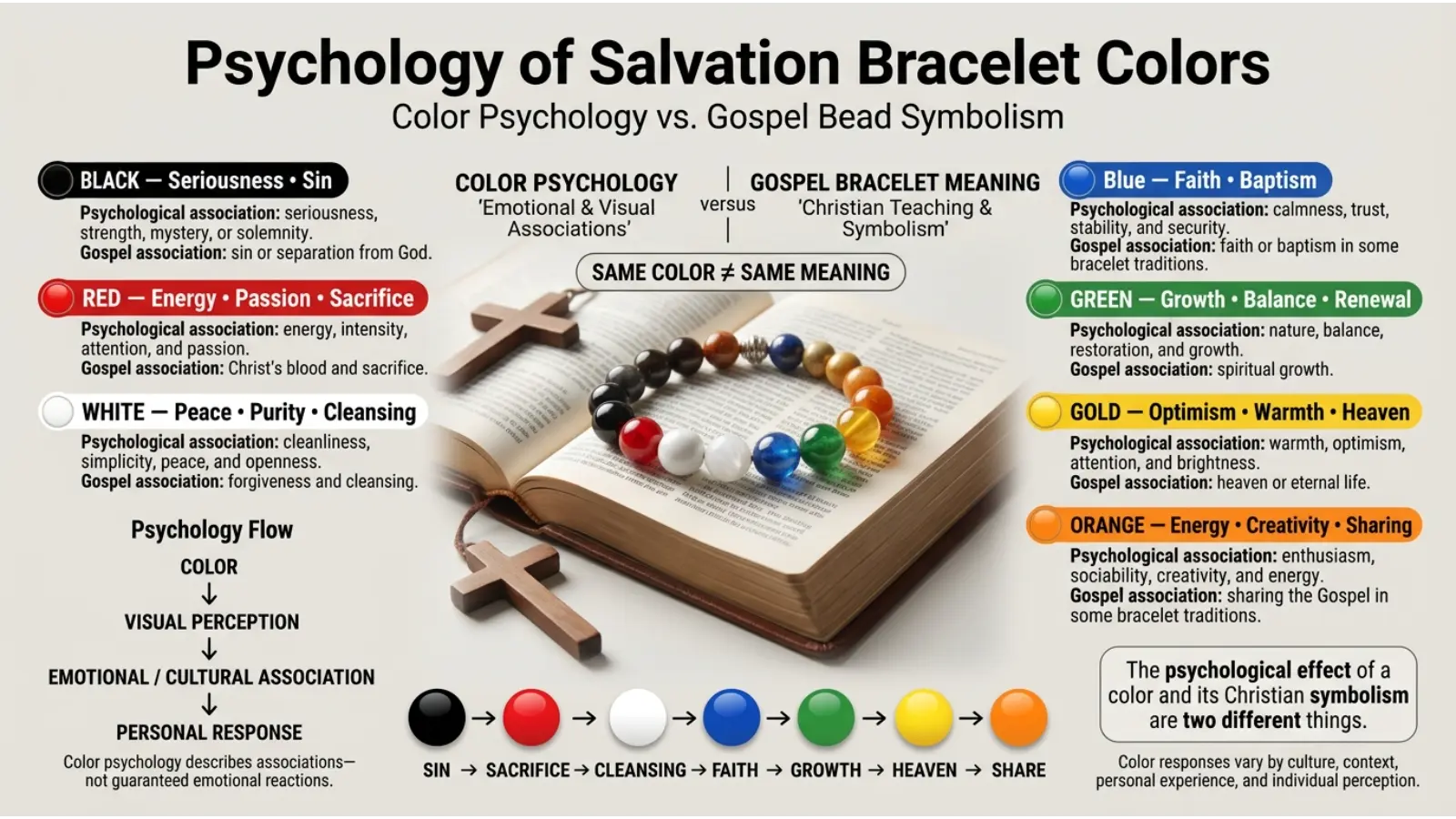
Color psychology can help explain why the bracelet is visually memorable, but it should be separated from Christian theology.
People often respond differently to colors based on context, culture, personal experience, brightness, and surroundings.
There is no reliable scientific rule stating that wearing a particular bead will automatically produce a particular emotion or spiritual state.
Yellow and Attention
Bright yellow tends to stand out visually. It can create associations with sunlight, warmth, optimism, and energy.
That makes it useful as a visually noticeable opening or closing bead.
Black and Contrast
Black creates strong contrast with brighter colors.
Placed next to red or white, a dark bead becomes especially noticeable. This makes the sequence easier to distinguish.
Red and Emotional Intensity
Red is visually strong and is often associated with passion, urgency, love, danger, and blood.
That makes it a memorable symbol for Christ’s sacrifice in the Gospel color system.
White and Visual Simplicity
White often communicates cleanliness and simplicity in many design settings.
That makes it an intuitive visual metaphor for cleansing and purity.
Green and Nature
Green is strongly connected with plants and natural growth.
As a result, it provides an easy visual metaphor for spiritual growth.
Blue and Calmness
Blue is frequently associated with water, calmness, trust, and stability.
When used for baptism, these associations can support the visual message, although the religious meaning comes from the teaching tradition rather than color psychology itself.
Salvation Bracelet Color Meanings and Personality
Some people wear a salvation bracelet because one particular color feels personally meaningful.
For example:
- A person may prefer green because they value growth.
- Someone may like blue because it feels peaceful.
- Another person may choose red because it reminds them of Christ’s sacrifice.
- Yellow may remind someone of hope.
- White may represent a desire for renewal.
However, color preference does not determine personality.
Someone who loves black is not necessarily negative, and someone who prefers yellow is not automatically optimistic.
Personal associations are shaped by experience, culture, religion, fashion, and individual taste.
How Salvation Bracelet Color Meanings Are Used Today
Salvation bracelets have several practical uses.
Children’s Ministry
Teachers can use colored beads during Bible lessons to help children remember a Gospel presentation.
Sunday School
A bracelet can turn a lesson into a simple craft activity while giving students something tangible to take home.
Youth Groups
Teenagers may wear the bracelet as a personal reminder or use it to begin conversations about faith.
Evangelism
The colors can act as visual prompts during a Gospel conversation.
Mission Work
Bracelets can be distributed as simple teaching tools, although cultural research should come first when working with unfamiliar communities.
Personal Faith Reminder
A wearer may use the bracelet as a reminder of salvation, gratitude, growth, or Christian commitment.
How to Read a Five-Color Salvation Bracelet
A common five-color sequence can be remembered like this:
🟨 1. Yellow — Heaven
The story begins with the hope of God’s kingdom and eternal life.
⬛ 2. Black — Sin
Humanity’s sin creates the need for salvation.
🟥 3. Red — Jesus’ Sacrifice
The red bead points to Christ’s blood and sacrificial death.
⬜ 4. White — Cleansing
White represents forgiveness, cleansing, purity, or righteousness through Christ.
🟩 5. Green — Growth
Green reminds Christians to continue growing in faith.
This sequence is common, but it is not the only legitimate arrangement.
Why the Order of the Beads Can Change
The order depends on the teaching method.
Some educators begin with heaven because they want to start with God’s purpose and the believer’s ultimate hope.
Others begin with sin because they want to explain the human problem first.
A six-color version may insert blue between white and green because baptism is taught as a response following salvation.
Therefore, the order should be understood as a teaching sequence, not a theological ranking.
Salvation Bracelet Colors vs. General Christian Color Symbolism
These two ideas should not be confused.
A church may use:
- White for purity
- Red for martyrdom or Christ’s sacrifice
- Purple for royalty
- Green for ordinary time or growth
- Gold for glory
But those meanings can differ from the bead meanings in a salvation bracelet.
The salvation bracelet is specifically designed to tell a Gospel story.
Its colors therefore work together as a sequence rather than existing as isolated symbols.
Common Misconceptions About Salvation Bracelets
1. Every salvation bracelet has the same colors
False.
Five-color and six-color versions are common, and other variations exist.
2. The Bible officially assigns each bead a color
False.
The color system is a Christian teaching tradition, not a universal biblical color chart.
3. Black always means evil in Christianity
Not necessarily.
Color meanings depend on context. In this specific evangelism tool, dark colors commonly symbolize sin.
4. Blue is always part of the bracelet
No.
Blue appears in some versions, usually for baptism.
5. Wearing the bracelet automatically protects someone
No.
A salvation bracelet is a symbolic teaching or reminder tool. It should not be treated as a magical object or source of supernatural protection.
6. The bracelet replaces Christian teaching
No.
The beads are prompts. Their meaning depends on the explanation that accompanies them.
7. Yellow and gold always mean exactly the same thing
Usually, but not universally.
Many versions use either color for heaven, but individual ministries may explain them differently.
Salvation Bracelet Color Combinations
The colors are intentionally designed to create strong visual contrast.
| Combination | Visual Effect | Common Use |
|---|---|---|
| 🟥 Red + ⬜ White | Strong contrast | Gospel teaching and crafts |
| 🟩 Green + 🟨 Gold | Natural + bright | Growth and hope |
| 🟦 Blue + ⬜ White | Calm and clean | Baptism-themed versions |
| ⬛ Dark + 🟥 Red | High contrast | Sin and sacrifice |
| 🟨 Gold + 🟩 Green | Warm and natural | Hope and growth |
| 🟪 Purple + 🟨 Gold | Rich and ceremonial | Royalty or worship variations |
The strong contrast also helps children and visual learners distinguish each stage of the message.
How Lighting Changes Salvation Bracelet Colors
The same bracelet can look different under different lighting.
Under warm indoor lighting:
- Yellow may appear more orange.
- White may look cream.
- Red may look deeper.
- Green may become softer.
Under cool LED lighting:
- White may appear bluish.
- Blue can look more intense.
- Green may appear brighter.
- Yellow can look slightly less warm.
Natural daylight usually gives a more balanced view, although even daylight changes from morning to afternoon.
This matters when photographing salvation bracelets for websites, crafts, or social media. A color that looks white in person may appear gray or yellow in a photograph because of the camera’s white balance.
How to Choose a Salvation Bracelet
If you are buying or making one, start by deciding what teaching system you want to follow.
For a Simple Five-Color Message
Choose:
Yellow/Gold → Black/Dark → Red → White → Green
This is one of the easiest versions to teach.
For a Version Including Baptism
Choose:
Black → Red → White → Blue → Green → Yellow
This adds a specific baptism stage.
For Children
Use large, easy-to-see beads with strong color contrast.
For Group Activities
Use inexpensive craft beads and provide a short explanation of each color.
For International Ministry
Do not assume that the colors have the same cultural meaning everywhere. Explain each symbol clearly and consider local cultural attitudes toward jewelry and color.
Salvation Bracelet Colors in Art and Design
The color sequence can also inspire Christian artwork.
Artists may arrange the beads in:
- Cross shapes
- Heart designs
- Circular patterns
- Prayer bracelets
- Wall decorations
- Children’s craft projects
- Bible study materials
- Christian illustrations
The strongest designs usually keep the color sequence visually clear rather than adding too many decorative colors.
A simple arrangement can actually communicate the concept better than an overly complicated design.
Salvation Bracelets and Fashion
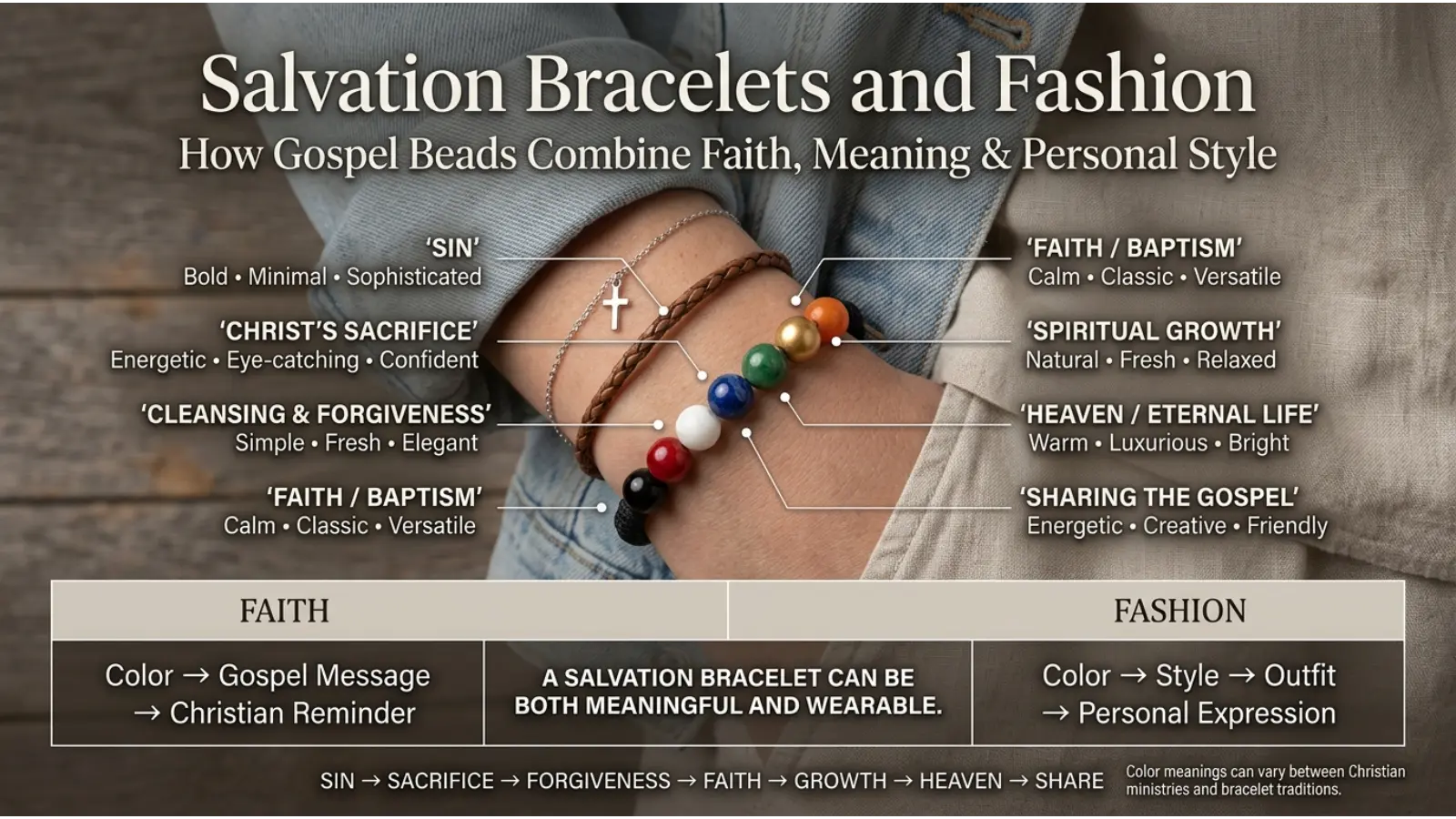
A salvation bracelet can function as both jewelry and a faith symbol.
Some people wear one subtly with casual clothing, while others choose colorful handmade versions that are more noticeable.
The bracelet can be combined with:
- Leather cords
- Beaded bracelets
- Cross pendants
- Simple watches
- Neutral clothing
- Other Christian jewelry
Because the beads are symbolic, the design does not have to be expensive.
The meaning comes from the message attached to the colors, not from the price or material of the bracelet.
Real-World Meaning of the Salvation Bracelet
The greatest value of a salvation bracelet is not the bracelet itself.
It is the conversation and remembrance created by the symbols.
A person may see the colors and remember:
⬛ I need salvation.
🟥 Christ gave Himself.
⬜ Forgiveness is offered.
🟩 Faith should continue to grow.
🟨 Christian hope points toward eternal life.
That makes the bracelet useful as a visual teaching device.
At the same time, it should be treated respectfully. A bracelet does not replace Scripture, prayer, discipleship, or a personal understanding of Christian faith.
Frequently Asked Questions
What do the colors on a salvation bracelet mean?
The most common meanings are yellow or gold for heaven, black or dark for sin, red for Jesus’ blood or sacrifice, white for cleansing or forgiveness, and green for spiritual growth. Some versions add blue for baptism.
What does a black bead mean on a salvation bracelet?
A black or dark bead commonly represents sin and humanity’s need for salvation. Some ministries deliberately call it a “dark bead” to avoid connecting the color black itself with moral badness.
What does the red bead mean?
Red commonly represents the blood of Jesus Christ and His sacrificial death. It is one of the central symbols in the traditional Gospel color system.
What does the white bead mean?
White commonly represents cleansing, forgiveness, purity, or righteousness through Christ.
What does the green bead mean?
Green generally represents spiritual growth. It reminds Christians that faith is understood as something that continues to develop.
What does the yellow bead mean?
Yellow or gold commonly represents heaven, eternal life, God’s kingdom, or Christian hope.
What does blue mean on a salvation bracelet?
Blue is an optional color in some versions and commonly represents baptism. It is not included in every salvation bracelet.
Is a salvation bracelet biblical?
The bracelet itself is not a biblical object. It is a Christian teaching tool based on biblical themes. The specific color meanings are symbolic interpretations rather than an official biblical color code.
Can salvation bracelets be worn by anyone?
Yes. People may wear them as Christian jewelry, teaching aids, conversation starters, or personal reminders. The meaning depends on the Christian tradition and explanation attached to the bracelet.
Do salvation bracelet colors have the same meaning everywhere?
No. Christian ministries use different color systems, and cultural meanings also vary by region. Explaining the colors is especially important when the bracelet is used across cultures.
Final Thoughts on Salvation Bracelet Color Meanings
Salvation bracelet color meanings are best understood as a visual Christian teaching system, not a universal set of biblical color rules.
The most familiar sequence uses five colors: yellow or gold, black or dark, red, white, and green. Together, they create a simple story about heaven, sin, Christ’s sacrifice, cleansing, and spiritual growth. Some versions add blue for baptism, while others use additional colors such as purple.
The history of the system reaches back to the Wordless Book tradition, which used colors to communicate Christian teachings visually. Over time, the concept moved from pages and teaching materials to bracelets that people could carry and wear.
The most useful way to view the bracelet is as a memory tool. The colors give people a simple visual structure for remembering important Christian ideas and starting meaningful conversations about faith.
At the same time, context matters. Colors do not have one universal psychological or cultural meaning, and the Bible does not prescribe a fixed salvation-bracelet color chart. The symbolism comes from Christian teaching traditions that use familiar visual associations to explain the Gospel.
That combination of color, memory, symbolism, and faith is what makes the salvation bracelet such a simple yet memorable Christian teaching tool.

Emma Wilson is a dedicated comparison writer and product researcher at ColorMystiic.com. She specializes in creating unbiased product comparisons, detailed reviews, and helpful buying guides. Her goal is to help readers make smarter purchasing decisions with confidence.