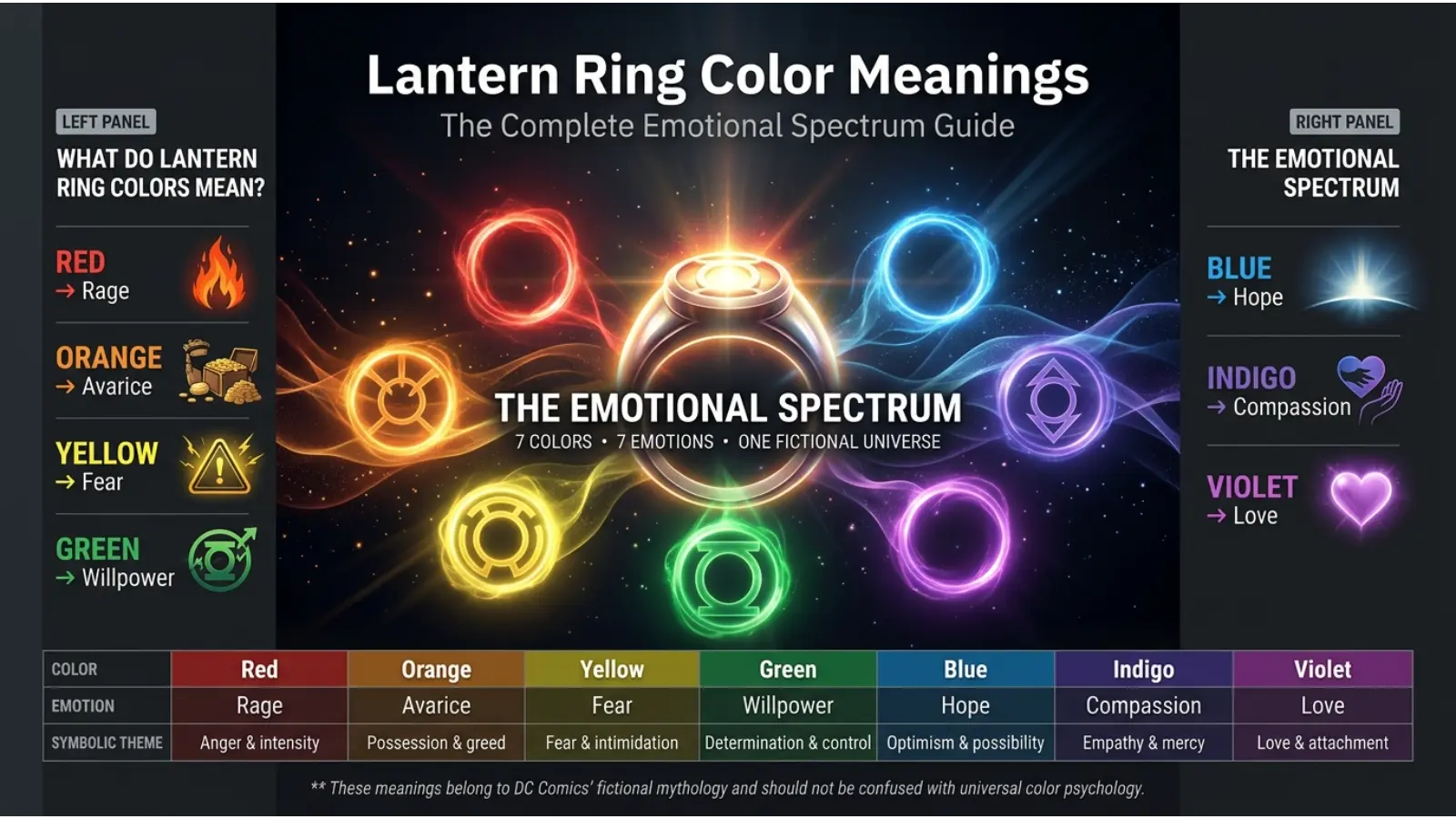
If you are searching for lantern ring color meanings, you are probably curious about what each colored Lantern ring represents and why different characters are connected to different colors. In the DC Comics universe, Lantern rings are more than powerful pieces of technology. Their colors are connected to different emotional forces, giving each ring a distinct purpose and personality.
The familiar green ring represents willpower, while red is linked to rage, yellow to fear, orange to avarice, blue to hope, indigo to compassion, and violet to love. The wider mythology also includes black and white, which are associated with death and life.
These meanings are part of a fictional universe, so they should not be confused with scientific rules of color psychology. However, they offer an excellent example of how color can turn an abstract emotion into something people can immediately recognize.
In this guide, you will learn what every major Lantern ring color means, how the emotional spectrum works, how the colors differ from ordinary color symbolism, and how Lantern colors can be understood in character design, art, fashion, gaming, and visual storytelling.
Quick Answer: What Do Lantern Ring Colors Mean?
| Color | Lantern Meaning | Main Emotional Idea |
|---|---|---|
| 🔴 Red | Rage | Anger, fury, revenge |
| 🟠 Orange | Avarice | Greed, possession, desire |
| 🟡 Yellow | Fear | Intimidation, anxiety, control |
| 🟢 Green | Willpower | Courage, determination, resolve |
| 🔵 Blue | Hope | Faith, optimism, possibility |
| 🟦 Indigo | Compassion | Empathy, mercy, understanding |
| 🟣 Violet | Love | Attachment, devotion, connection |
| ⚫ Black | Death | Mortality, loss, lifelessness |
| ⚪ White | Life | Creation, renewal, vitality |
The easiest way to remember the main spectrum is:
Red = Rage → Orange = Avarice → Yellow = Fear → Green = Willpower → Blue = Hope → Indigo = Compassion → Violet = Love.
What Are Lantern Rings?
Lantern rings are fictional power rings used by different Lantern groups in the DC Universe. The Green Lantern Corps is the most famous example, but the Lantern mythology eventually developed into a much larger collection of colored Corps.
The central idea is that different colors are connected to different emotional forces.
This makes the rings different from ordinary superhero equipment. A Lantern’s color can tell the audience something about the emotional force connected to that character.
For example, green immediately suggests willpower, while red creates an association with rage. Blue suggests hope, and yellow creates a feeling of fear and danger.
As a result, color becomes part of the storytelling rather than simply part of the costume.
The Lantern Emotional Spectrum Explained
The Lantern spectrum is easier to understand when you look at it as an emotional map instead of a simple color chart.
| Lantern Color | Emotional Force | Simple Meaning |
|---|---|---|
| 🔴 Red | Rage | Powerful anger |
| 🟠 Orange | Avarice | Desire to possess |
| 🟡 Yellow | Fear | Power through fear |
| 🟢 Green | Willpower | Strength of determination |
| 🔵 Blue | Hope | Belief in possibility |
| 🟦 Indigo | Compassion | Understanding suffering |
| 🟣 Violet | Love | Deep emotional connection |
| ⚫ Black | Death | End or absence of life |
| ⚪ White | Life | Creation and renewal |
The seven central emotional colors are especially important because they show different ways emotions can influence behavior.
Some are destructive.
Some are constructive.
Others can be either positive or negative depending on how a character uses them.
🔴 Red Lantern Ring Meaning: Rage
The Red Lantern ring represents rage.
Red is one of the easiest colors to understand within the Lantern system because the color already has strong associations with intensity, danger, anger, and heat in everyday visual culture.
However, in the Lantern mythology, red goes far beyond ordinary irritation. Rage becomes a powerful emotional force that can drive a character toward revenge and destruction.
What Does Red Symbolize?
Red Lantern symbolism is connected with:
- Rage
- Fury
- Anger
- Revenge
- Hatred
- Aggression
- Emotional pain
The central idea is anger that has become powerful enough to control behavior.
A red-themed character therefore gives the audience an immediate emotional signal. Before the character speaks, the color itself can suggest conflict.
Red in Real-World Color Psychology
Red is often used in warning signs, emergency indicators, sports uniforms, advertisements, and other situations where designers want strong visual attention.
That does not mean red automatically makes people angry.
Instead, its high visual impact can help explain why it works so effectively as the color of rage in fiction.
🟠 Orange Lantern Ring Meaning: Avarice
Orange represents avarice, which can be understood as an intense desire to possess or acquire.
This makes orange particularly interesting because its everyday associations can be quite different. Outside the Lantern universe, orange is often viewed as energetic, friendly, playful, or warm.
Within the Lantern spectrum, however, it represents a much darker form of desire.
What Does Orange Symbolize?
Orange Lantern symbolism includes:
- Avarice
- Greed
- Possession
- Desire
- Acquisition
- Self-interest
- Material obsession
The emotional question behind orange is:
“What do I want to have?”
This makes orange a useful symbol for characters who value ownership above cooperation.
Why Orange Stands Out
Orange sits visually between red and yellow.
It carries some of the energy of red while retaining some of the brightness of yellow. That makes it visually powerful without having the same emotional identity as either color.
The Lantern mythology gives that energetic color a specific purpose: wanting and possessing.
🟡 Yellow Lantern Ring Meaning: Fear
Yellow represents fear.
The yellow Lantern concept is especially interesting because fear is normally considered a weakness. In the Lantern universe, however, fear becomes a source of power.
A character who can create fear in others can influence their decisions, behavior, and confidence.
What Does Yellow Symbolize?
Yellow Lantern symbolism includes:
- Fear
- Intimidation
- Anxiety
- Threat
- Control
- Uneasiness
- Psychological pressure
The Yellow therefore works especially well for characters who gain influence by making others afraid.
Yellow and Green: Fear Versus Willpower
One of the most interesting relationships in the Lantern spectrum is the contrast between yellow and green.
Yellow represents fear.
Green represents willpower.
This creates a natural storytelling conflict.
A character may feel fear but still choose to move forward.
That is where willpower becomes important.
🟢 Green Lantern Ring Meaning: Willpower
Green represents willpower, making it the defining color of the Green Lantern Corps.
Willpower is the ability to remain focused and continue pursuing a goal despite obstacles, fear, pain, or uncertainty.
That is why green is more than simply a symbol of courage.
What Does Green Symbolize?
Green Lantern symbolism is associated with:
- Willpower
- Determination
- Courage
- Persistence
- Discipline
- Resolve
- Self-control
- Responsibility
The emotional question behind green is:
“Can I overcome what stands in my way?”
Green Does Not Automatically Mean Good
Green Lantern characters are often heroes, but the meaning of green itself is not simply “good.”
Willpower can be used for almost any purpose.
Someone can be determined to help others.
Someone else can be determined to achieve a selfish goal.
Therefore, green represents the strength of will, not a guaranteed moral quality.
🔵 Blue Lantern Ring Meaning: Hope
Blue represents hope.
Hope is different from happiness because a person can experience sadness, fear, or difficulty while still believing that things can improve.
That makes blue one of the most optimistic colors in the Lantern spectrum.
What Does Blue Symbolize?
Blue Lantern symbolism includes:
- Hope
- Faith
- Optimism
- Possibility
- Encouragement
- Belief
- Future potential
The central message of blue is:
“There is still a reason to believe.”
Blue and Green Together
Blue and green have an especially interesting relationship.
Green represents the determination to continue.
Blue represents the belief that continuing is worthwhile.
In simple terms:
Green says, “I can keep going.”
Blue says, “There is still hope ahead.”
That makes these two colors naturally complementary.
🟦 Indigo Lantern Ring Meaning: Compassion
Indigo represents compassion.
While several Lantern colors focus strongly on personal emotions, compassion shifts attention toward other people and their experiences.
Compassion involves recognizing suffering and responding with understanding, concern, or mercy.
What Does Indigo Symbolize?
Indigo Lantern symbolism includes:
- Compassion
- Empathy
- Mercy
- Understanding
- Selflessness
- Emotional awareness
- Concern for others
The central question behind indigo is:
“Can I understand what another person is going through?”
This makes indigo an important contrast to orange.
Orange focuses on possession.
Indigo focuses on understanding.
🟣 Violet Lantern Ring Meaning: Love
Violet represents love and is associated with the Star Sapphire side of the Lantern mythology.
Love is an extremely powerful storytelling emotion because it can motivate protection, sacrifice, loyalty, attachment, and devotion.
At the same time, love can become complicated when it turns into jealousy, obsession, or possessiveness.
What Does Violet Symbolize?
Violet Lantern symbolism includes:
- Love
- Romance
- Attachment
- Devotion
- Connection
- Desire
- Loyalty
- Emotional bonds
The central idea is deep emotional connection.
Why Violet Works as a Love Color
Purple and violet often have rich associations in ordinary visual culture. They can appear mysterious, dramatic, luxurious, or imaginative.
That visual richness makes violet a natural choice for a powerful emotional concept such as love.
⚫ Black Lantern Ring Meaning: Death
Black represents death in the wider Lantern mythology.
Unlike the seven central emotional colors, black moves beyond the idea of an ordinary emotional force and represents the absence or ending of life.
What Does Black Symbolize?
Black Lantern symbolism can suggest:
- Death
- Mortality
- Loss
- Darkness
- Absence
- Decay
- Lifelessness
Black is therefore one of the darkest symbols in the Lantern mythology.
Its meaning becomes even stronger when it is compared with white.
Black represents death.
White represents life.
That opposition creates a powerful visual and thematic contrast.
⚪ White Lantern Ring Meaning: Life
White represents life.
The White Lantern concept expands the emotional spectrum beyond individual emotions and toward the larger idea of life itself.
What Does White Symbolize?
White Lantern symbolism includes:
- Life
- Creation
- Renewal
- Restoration
- Survival
- Vitality
- Continuation
The emotional idea behind white is not simply happiness.
Instead, it represents the presence and continuation of life.
White Versus Black
The contrast is straightforward:
| ⚫ Black | ⚪ White |
|---|---|
| Death | Life |
| Loss | Renewal |
| Absence | Presence |
| Ending | Continuation |
| Darkness | Vitality |
This makes black and white particularly useful for visual storytelling.
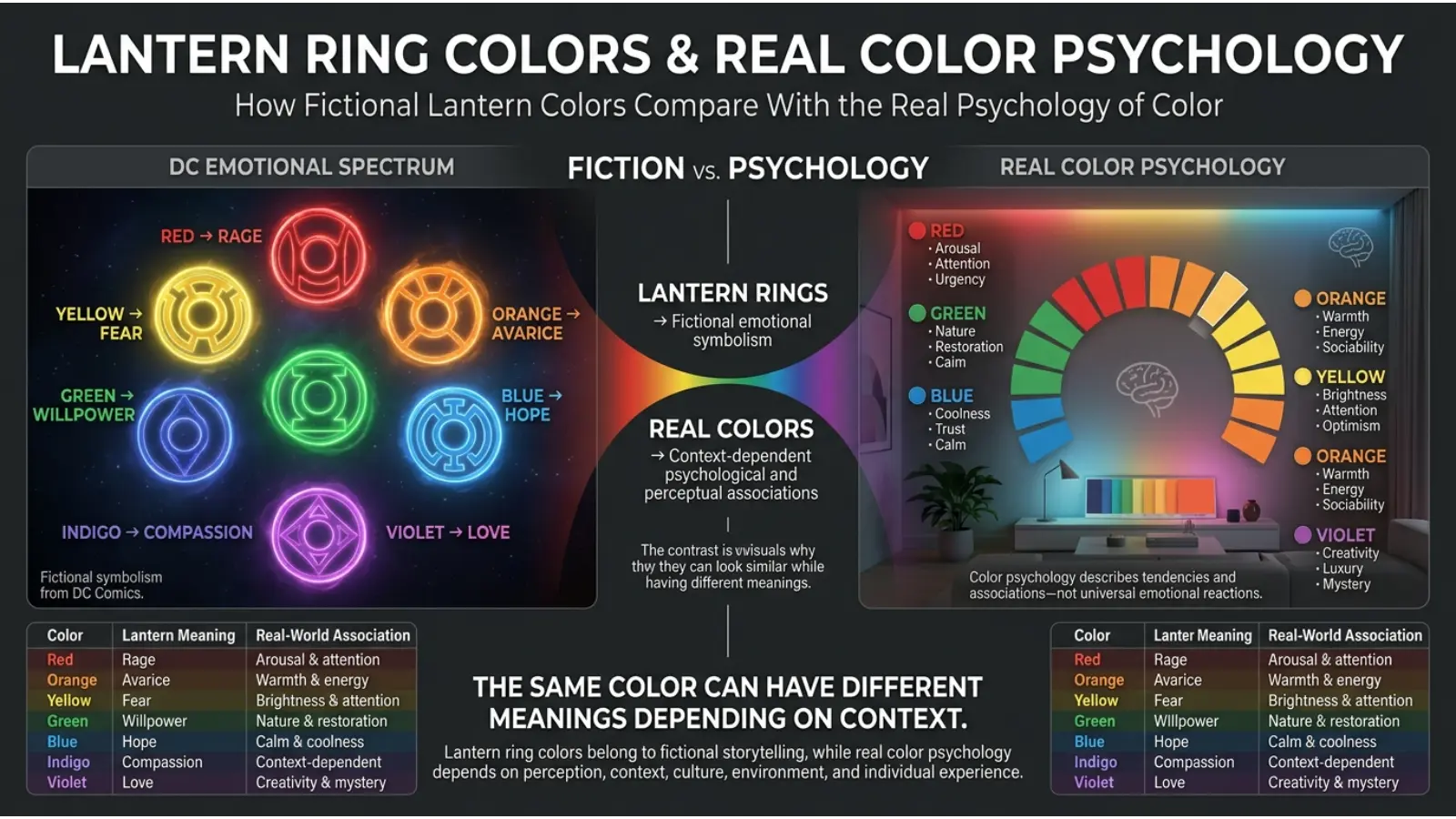
Lantern Ring Color Meanings and Real Color Psychology
Lantern ring meanings are fictional.
That distinction matters.
Real-world color psychology does not say that people who prefer green necessarily have more willpower or that people who like red are naturally angry.
Human responses to color are much more complicated.
Context, culture, lighting, personal experience, age, environment, and even the surrounding colors can affect perception.
For example, red may represent danger in one situation and celebration in another.
Blue may suggest calmness in one design while representing sadness in another.
White can communicate cleanliness in one setting but mourning in another culture.
Therefore, the Lantern system should be treated as fictional symbolism rather than a scientific personality test.
Why Color Is So Important in Lantern Stories
The Lantern system turns invisible emotions into visible objects.
You cannot physically see willpower.
You cannot hold hope in your hand.
Rage does not naturally glow red.
Yet fiction can give all of these ideas a visible form through color.
This creates a fast communication system.
When readers see a red ring, they already understand that rage is important.
When they see blue, they can expect hope to play a role.
They see green, willpower becomes part of the character’s identity.
This is one reason color works so well in comics and other visual storytelling.
Lantern Ring Color Meanings and Character Personality
Fans often enjoy imagining which Lantern ring they would receive.
This is a fun way to explore fictional personality traits, but it should not be treated as a real psychological assessment.
Someone who values persistence may identify with green.
Someone who remains optimistic during difficult times may connect with blue.
The Someone who strongly empathizes with others may choose indigo.
A character driven by revenge may fit red.
A character obsessed with possessions may fit orange.
The character who influences others through fear may fit yellow.
The color provides a storytelling clue, while the character’s actions provide the deeper personality.
A Simple Lantern Personality Chart
| Personality Theme | Possible Lantern Color |
|---|---|
| “I never give up.” | 🟢 Green |
| “There is always hope.” | 🔵 Blue |
| “I care about others.” | 🟦 Indigo |
| “Love drives me.” | 🟣 Violet |
| “I cannot control my anger.” | 🔴 Red |
| “I need to own everything.” | 🟠 Orange |
| “I control others through fear.” | 🟡 Yellow |
| “Life must continue.” | ⚪ White |
| “Death and loss dominate.” | ⚫ Black |
Again, this is a fictional interpretation rather than a scientifically validated personality system.
Lantern Ring Color Meanings in Branding and Marketing
The Lantern spectrum also demonstrates how brands can use colors to create quick emotional impressions.
Green is often useful when a design wants to suggest growth, nature, stability, or energy.
Blue can communicate calmness, reliability, technology, or trust.
Red can attract attention and create a sense of urgency or excitement.
Orange can feel energetic, youthful, and approachable.
Purple can suggest creativity, imagination, luxury, or mystery.
Black often creates a stronger, more sophisticated, or dramatic appearance.
White can provide a clean and simple visual foundation.
However, marketers should never assume that a color has exactly one meaning.
The same color can create completely different impressions depending on the product, audience, culture, and surrounding design.
Lantern Ring Color Meanings in Interior Design
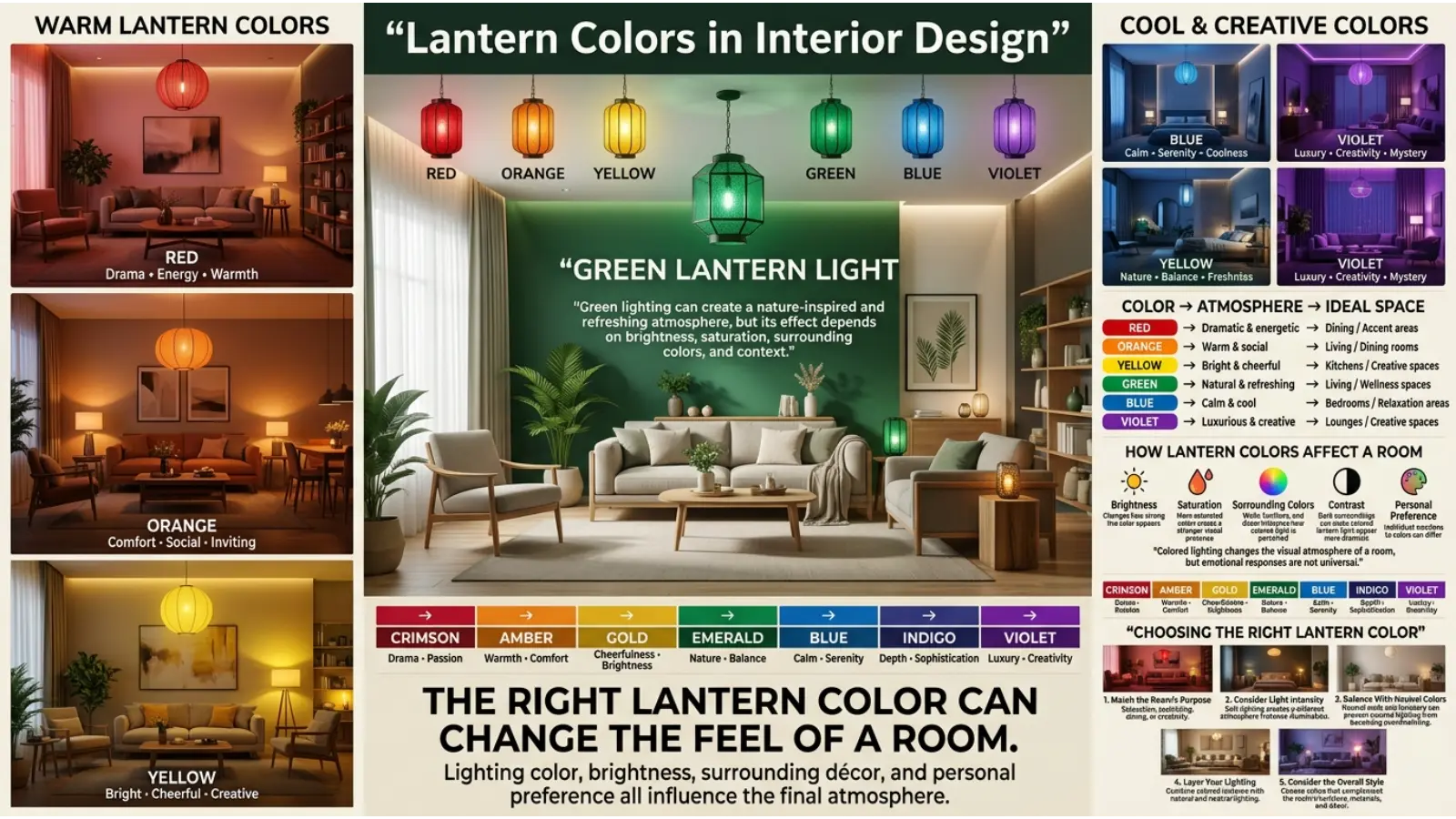
Lantern colors can inspire gaming rooms, bedrooms, offices, entertainment spaces, and themed interiors.
Green
Green lighting can create an energetic and futuristic atmosphere.
It works especially well with black, gray, and other dark neutrals.
Blue
Blue can create a cooler visual environment.
It can work well in technology-inspired rooms, gaming setups, and relaxing spaces.
Red
Red works best as an accent when you want dramatic energy.
A red LED strip or small red furniture element can create impact without overwhelming the entire room.
Purple
Purple can create a fantasy-inspired or cinematic atmosphere.
It works particularly well with dark backgrounds and controlled lighting.
Black and White
Black and white can provide a neutral foundation for Lantern colors.
For example, a dark room with a single green or blue lighting element can make the chosen color stand out much more strongly.
How Lighting Changes Lantern Colors
A color never exists visually by itself.
The light around it changes what the eye sees.
A bright green LED may appear neon in a dark room but much softer outdoors.
A blue object can look colder under white lighting and warmer under certain indoor lighting.
A red surface can appear darker in shadow and much brighter under direct illumination.
Therefore, if you are creating Lantern-inspired artwork, clothing, room lighting, or graphics, always check the color under the lighting conditions where it will actually be used.
Lantern Ring Color Meanings in Fashion
Lantern-inspired fashion does not have to look like a superhero uniform.
You can use the colors as subtle visual references.
A green hoodie with black jeans can create a simple Green Lantern-inspired outfit.
A blue jacket can create a softer interpretation of the Blue Lantern theme.
A red jacket or shoes can become the main focus of an outfit.
Purple accessories can create a Star Sapphire-inspired appearance without using purple everywhere.
Black and white can also provide excellent backgrounds for brighter Lantern colors.
The best approach is often to choose one main Lantern color and use neutral shades to support it.
Lantern Ring Color Meanings in Art and Photography
Artists can use Lantern colors to influence the emotional atmosphere of a scene.
A red glow can increase tension.
A blue glow can create a hopeful or calm feeling.
Green can suggest determination or futuristic energy.
Yellow can create uneasiness.
Violet can suggest romance or emotional intensity.
Black can emphasize loss or darkness.
White can create a feeling of life, light, or renewal.
Still, color should not be expected to tell the entire story.
Composition, facial expressions, shadows, body language, camera angles, and background details all work together to create emotional meaning.
Lantern Ring Color Meanings in Gaming
Lantern colors are particularly effective in games because bright colors allow players to recognize different abilities or factions quickly.
A red energy effect can communicate danger.
A blue effect can suggest a supportive or hopeful ability.
Green can identify a character or power associated with willpower.
Yellow can immediately create a threatening visual signal.
This is an example of color coding.
The Lantern universe takes this familiar design principle and makes color an actual part of its fictional power system.
Lantern Ring Color Meanings in Entertainment
Color symbolism is especially useful in comics, animation, movies, posters, toys, and games because audiences can understand visual differences almost instantly.
A character’s costume can communicate personality.
A glowing weapon can indicate a specific power.
A colored environment can establish mood.
A sudden change in color can signal a change in emotional state.
The Lantern mythology takes this idea even further by making the color itself part of the character’s power.
Why the Lantern Emotional Spectrum Works
The emotional spectrum works because it simplifies complicated human ideas without removing all of their complexity.
Rage can be destructive, but it can also come from pain.
Love can be comforting, but it can also become possessive.
Fear can weaken someone, but it can also motivate action.
Hope can inspire people during difficult circumstances.
Willpower can help someone overcome obstacles.
Compassion can encourage people to understand others.
Avarice can create an endless desire for more.
This gives the Lantern colors more depth than simply calling some colors “good” and others “bad.”
Common Misconceptions About Lantern Ring Colors
Is Green the “Good” Lantern Color?
Not exactly.
Green represents willpower.
Many famous Green Lantern characters are heroes, but the emotional concept itself is not automatically good or evil.
Does Red Simply Mean Anger?
Red specifically represents rage in the Lantern system.
That is stronger than ordinary annoyance or frustration.
Does Blue Mean Sadness?
Not within the Lantern emotional spectrum.
Blue represents hope.
Although blue can have different associations in everyday culture, the Lantern meaning is specifically connected to hope.
Does Orange Mean Happiness?
No.
Orange represents avarice or greed within the Lantern system.
Its fictional meaning is therefore very different from the cheerful associations often given to orange in everyday design.
Does Yellow Mean Cowardice?
Not necessarily.
Yellow represents fear.
Fear can affect anyone, including brave characters. The Lantern mythology turns fear itself into a source of power.
Can Your Favorite Color Determine Your Lantern Ring?
No scientific evidence supports that idea.
Choosing a Lantern color can be a fun fandom activity, but actual personality is much more complicated than a color preference.
Are Black and White Normal Lantern Colors?
They are part of the broader Lantern mythology, but they have a special role.
Black is connected with death, while white is connected with life.
How to Remember All Lantern Ring Colors
Use one strong word for every color:
🔴 Red = Rage
🟠 Orange = Avarice
🟡 Yellow = Fear
🟢 Green = Willpower
🔵 Blue = Hope
🟦 Indigo = Compassion
🟣 Violet = Love
Then remember the two major opposites:
⚫ Black = Death
⚪ White = Life
This simple method makes the entire Lantern spectrum much easier to memorize.
Lantern Ring Color Meanings in One Chart
| Color | Meaning | Positive Side | Dark Side |
|---|---|---|---|
| 🔴 Red | Rage | Passion, emotional force | Fury, revenge |
| 🟠 Orange | Avarice | Strong desire | Greed, possession |
| 🟡 Yellow | Fear | Awareness of danger | Intimidation, control |
| 🟢 Green | Willpower | Courage, persistence | Obsession, stubbornness |
| 🔵 Blue | Hope | Optimism, faith | Unrealistic expectations |
| 🟦 Indigo | Compassion | Empathy, mercy | Emotional burden |
| 🟣 Violet | Love | Loyalty, connection | Obsession, possessiveness |
| ⚫ Black | Death | Acceptance of mortality | Loss, emptiness |
| ⚪ White | Life | Renewal, creation | Overwhelming power |
The positive and darker interpretations in this chart are useful for understanding storytelling possibilities. They should not be mistaken for official psychological definitions.
Frequently Asked Questions
What is the meaning of a Lantern ring?
A Lantern ring’s meaning depends on its color. Each major color is connected to a different emotional force, such as willpower, rage, fear, hope, compassion, love, or avarice.
What color Lantern ring represents willpower?
Green represents willpower. It is the defining emotional force of the Green Lantern Corps.
What color Lantern ring represents rage?
Red represents rage. It is associated with intense anger, fury, revenge, and emotional aggression.
What color Lantern ring represents hope?
Blue represents hope. It is connected with optimism, faith, possibility, and belief in a better future.
What color Lantern ring represents fear?
Yellow represents fear. The yellow Lantern concept uses fear as a source of power and influence.
What color represents compassion in the Lantern spectrum?
Indigo represents compassion. Its themes include empathy, mercy, understanding, and concern for others.
What does the violet Lantern ring mean?
Violet represents love. It is associated with emotional connection, attachment, devotion, and romantic love.
What does an orange Lantern ring represent?
Orange represents avarice, which means an intense desire to possess or acquire.
What does a black Lantern ring symbolize?
Black represents death in the wider Lantern mythology. It is associated with mortality, loss, darkness, and the absence of life.
What does a white Lantern ring symbolize?
White represents life. Its symbolism includes creation, renewal, restoration, and vitality.
Conclusion
The lantern ring color meanings are built around one powerful idea: emotions can be represented visually.
Red represents rage. Orange represents avarice. Yellow represents fear. Green represents willpower. Blue represents hope. Indigo represents compassion. Violet represents love. In the wider Lantern mythology, black represents death and white represents life.
What makes these colors memorable is the way they turn invisible emotions into something readers can see immediately. A glowing ring can tell us what emotional force is driving a character before the story explains it.
At the same time, Lantern meanings should remain separate from real-world color psychology. A person’s favorite color cannot determine their personality, and fictional Lantern symbolism does not function as a scientific psychological test.
Instead, the Lantern spectrum is best appreciated as a creative visual language. It shows how a carefully chosen color can communicate emotion, motivation, conflict, and identity in a single glance.

Emma Wilson is a dedicated comparison writer and product researcher at ColorMystiic.com. She specializes in creating unbiased product comparisons, detailed reviews, and helpful buying guides. Her goal is to help readers make smarter purchasing decisions with confidence.