Pirate flags are among the most recognizable symbols in history and popular culture. A black flag with a skull and crossbones can instantly suggest danger, rebellion, adventure, and the freedom of the sea. However, pirate flag color meanings are more complex than many people realize.
Different pirate crews used different symbols, backgrounds, and colors. While black is strongly connected with the famous Jolly Roger, red flags also carried an especially threatening message. Meanwhile, white symbols often created a sharp visual contrast and made warnings easier to recognize from a distance.
The meaning of a pirate flag also changed depending on the historical period, the crew using it, and later stories in books and movies. Therefore, not every modern interpretation reflects what real pirates originally intended.
This guide explores the symbolism, history, psychology, cultural influence, and modern use of pirate flag colors.
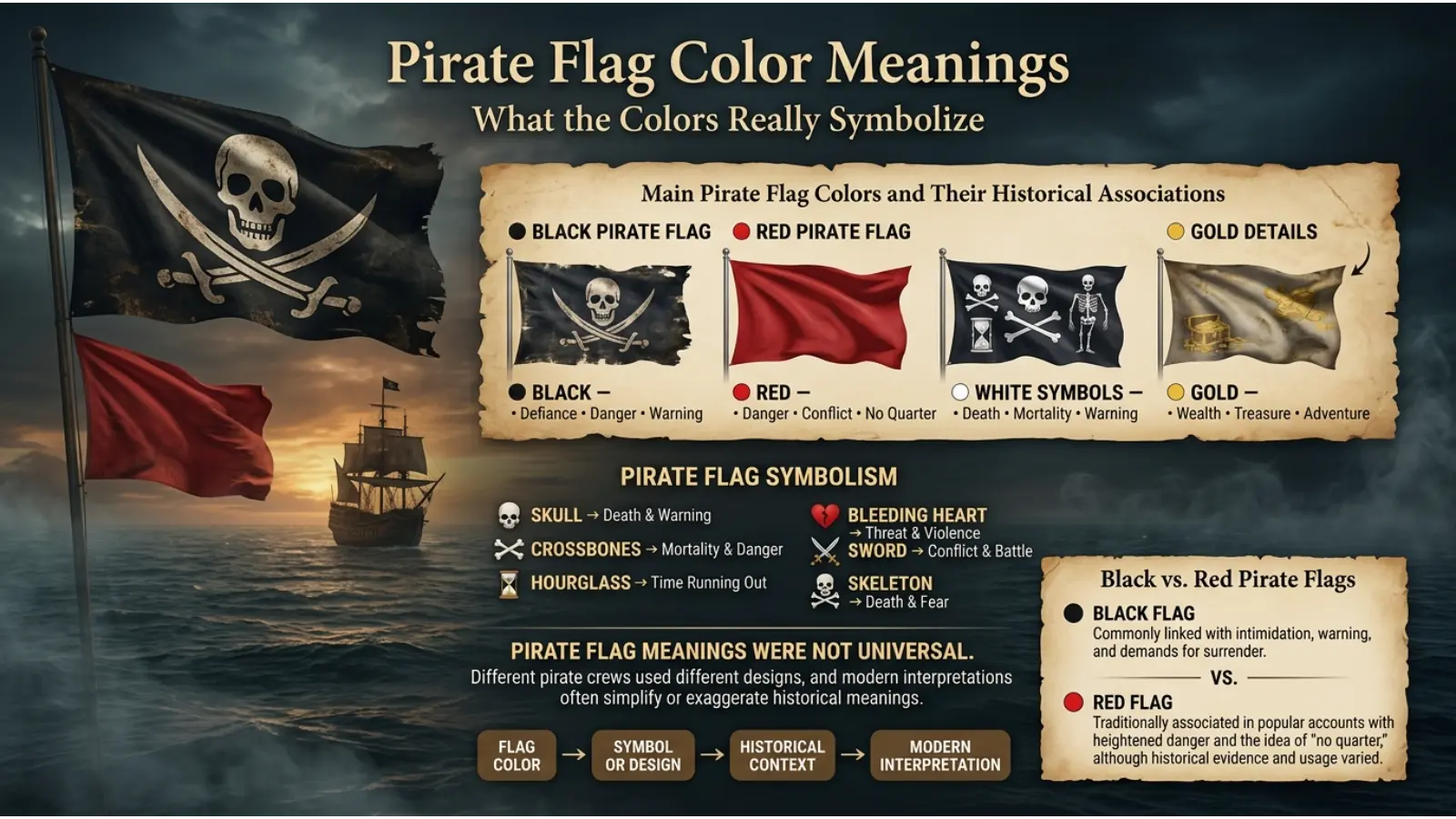
Quick Answer: Pirate flag colors traditionally represented warning and intimidation. Black commonly suggested death and danger, while red was historically associated with a more severe warning and little expectation of mercy. White symbols created strong contrast and represented death-related imagery such as skulls and skeletons.
What Do Pirate Flag Colors Symbolize?
Pirate flags were designed primarily for communication and intimidation. Unlike modern national flags, they did not always follow strict rules about color meanings.
A pirate captain or crew could choose symbols that reflected their reputation, threats, or identity. Consequently, the meaning often came from the combination of the background, colors, and images rather than from one color alone.
The most commonly associated pirate flag colors include:
| Color | Common Association | Historical Context |
|---|---|---|
| ⚫ Black | Death, danger, intimidation | Most strongly linked with the Jolly Roger |
| 🔴 Red | Blood, violence, severe warning | Associated with flags signaling little or no mercy |
| ⚪ White | Death imagery, bones, skeletons | Often used for symbols against dark backgrounds |
| 🟡 Gold | Treasure, wealth, adventure | Mostly a modern and decorative association |
| 🟤 Brown | Ships, wood, the sea and survival | More common in artwork than historic pirate symbolism |
| 🔵 Blue | Ocean, freedom, exploration | Primarily a modern cultural interpretation |
The strongest historically documented associations involve black, red, and white.
⚫ Black Pirate Flag Meaning
Black is the color most closely associated with traditional pirate imagery.
A black pirate flag could create an immediate sense of danger. At sea, approaching ships could recognize the dark banner from a distance, especially when it carried bright white symbols.
Death and Mortality
The black background became strongly connected with images of:
- Skulls
- Crossbones
- Skeletons
- Hourglasses
- Weapons
- Hearts
- Devils
These symbols reminded sailors of death and danger.
However, historians generally caution against assuming that every black pirate flag had exactly the same meaning. Different pirate crews used different designs.
Therefore, black should be understood as part of a broader visual language of intimidation rather than a universal pirate code.
Fear and Intimidation
Black naturally works well as a threatening color because people often associate darkness with uncertainty and danger.
A ship displaying a frightening black flag could create psychological pressure before any fighting began.
This mattered because intimidation could sometimes help pirates capture a ship without a long battle.
Why Black Was Visually Effective
⚫ High emotional impact
⚪ Strong contrast with white symbols
🏴 Easy recognition from a distance
💀 Strong connection with death imagery
The goal was not simply decoration. The flag could become part of a pirate crew’s reputation.
🔴 Red Pirate Flag Meaning
Red has one of the strongest and most dramatic meanings connected with pirate history.
Historical accounts associate certain red flags with a severe warning. In popular explanations, the red flag is often described as signaling that no mercy would be given.
However, the exact meaning and use of red flags could vary across different naval traditions and periods.
Blood and Violence
Red naturally brings blood to mind. Because of this association, it became an effective color for communicating violence and danger.
A red pirate flag could therefore create a stronger sense of immediate threat.
Common Symbolic Associations of Red
🔴 Blood
🔴 Violence
🔴 Anger
🔴 Conflict
🔴 Danger
🔴 Aggression
🔴 Fearlessness
In modern pirate artwork, red often makes a design appear more dramatic and aggressive.
Black vs. Red Pirate Flags
| Feature | Black Flag ⚫ | Red Flag 🔴 |
|---|---|---|
| Main impression | Death and intimidation | Extreme danger and violence |
| Visual feeling | Dark and mysterious | Aggressive and intense |
| Historical association | Strongly linked with the Jolly Roger | Associated with severe warnings |
| Modern use | Classic pirate imagery | Dramatic pirate symbolism |
| Emotional effect | Fear and uncertainty | Urgency and threat |
The difference is not always absolute because historical pirate practices varied. Still, black and red created noticeably different emotional impressions.
⚪ White Symbols on Pirate Flags
White is rarely the main color people associate with pirate flags. Nevertheless, it played an essential visual role.
The famous skull and crossbones design usually uses white against a dark background.
Why White Was Used
White creates strong contrast against black. As a result, symbols become easier to see.
This was particularly useful at sea, where flags needed to communicate visually over long distances.
White Symbols Commonly Included
☠ Skull
🦴 Crossbones
⏳ Hourglass
💀 Skeleton
❤️ Heart
⚔ Weapons
White did not necessarily symbolize purity or peace in pirate flag designs.
Context completely changed its meaning.
A white skull on a black background had a very different emotional effect from a white flag used as a sign of surrender.
💀 The Meaning of the Skull and Crossbones
The skull and crossbones is the image most closely associated with pirate flags.
However, not every historical pirate used the same skull design.
Some pirate flags showed:
- Full skeletons
- Bleeding hearts
- Hourglasses
- Spears
- Swords
- Devils
- Human figures
The skull became powerful because it represented mortality.
A sailor seeing a skull could immediately understand the threat without needing written language.
Therefore, pirate symbols worked almost like visual warnings.
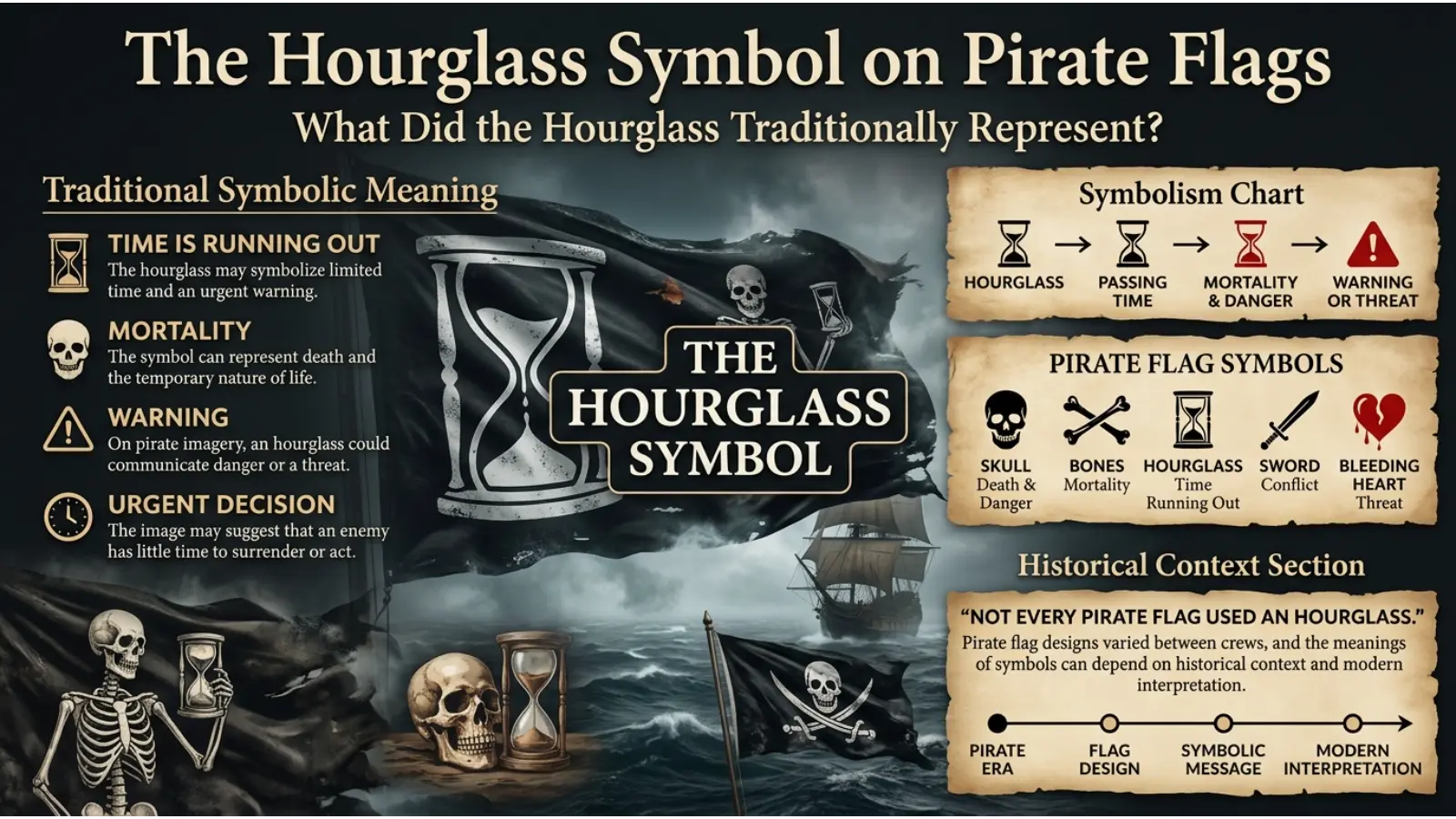
⏳ The Hourglass Symbol on Pirate Flags
The hourglass was another powerful symbol.
It could suggest that time was running out.
For an approaching ship, this message could mean:
Your opportunity to surrender is limited.
The hourglass also represented the passing of time and the certainty of death.
When combined with a skull or skeleton, the image became even more threatening.
❤️ Red Hearts and Pirate Flag Symbolism
Some historical pirate flag designs reportedly included hearts.
At first, a heart may seem unusual on a pirate flag. Yet context changes the meaning.
A heart could represent life itself. When shown being stabbed, bleeding, or threatened, it could symbolize violence or mortality.
Therefore, a heart on a pirate flag was not necessarily romantic.
Instead, its meaning depended on the surrounding imagery.
🟡 Gold and Yellow in Pirate Flag Meanings
Gold and yellow are strongly associated with modern pirate culture.
People often connect these colors with:
- Treasure
- Gold coins
- Wealth
- Adventure
- Discovery
However, gold was not one of the primary colors associated with the classic historical Jolly Roger.
Its connection with pirates developed largely through stories, artwork, games, movies, and treasure imagery.
Modern Meaning of Gold
🟡 Wealth
🟡 Treasure
🟡 Success
🟡 Adventure
🟡 Discovery
In pirate-themed branding and entertainment, gold often balances the darkness of black.
A black-and-gold pirate design can feel mysterious while still suggesting treasure and luxury.
🔵 Blue and the Modern Pirate Image
Blue is not traditionally one of the main historical pirate flag colors. Still, it appears frequently in modern pirate-themed designs.
Blue naturally connects with:
🌊 The ocean
🧭 Exploration
⚓ Sailing
🌎 Freedom
🏝 Adventure
Because pirates operated at sea, modern artists often use deep blue backgrounds around pirate imagery.
Emotional Meaning of Blue
Psychologically, blue is often associated with calmness and stability. However, dark navy blue can also feel serious and mysterious.
Therefore, a dark blue pirate design may feel less threatening than black while still maintaining a maritime atmosphere.
🟤 Brown and Natural Pirate Colors
Brown rarely appears as a major symbolic pirate flag color. Still, it plays an important role in pirate-themed design.
Brown represents:
- Wooden ships
- Old maps
- Leather
- Barrels
- Rope
- Historical adventure
In artwork, brown creates an aged appearance.
For example, an old parchment-colored pirate map can make a design feel historical even if the colors themselves do not represent an official pirate tradition.
🌊 How the Sea Changed the Meaning of Pirate Colors
Pirate flags existed in a maritime environment.
This matters because colors were viewed differently on the ocean than they are on a computer screen today.
Sunlight, fog, storms, distance, and movement could all affect visibility.
Environmental Factors
🌞 Bright sunlight could make colors appear lighter.
🌫 Fog could reduce the visibility of detailed symbols.
🌊 Movement could make small images difficult to recognize.
🌅 Sunrise and sunset could change the appearance of red, black, and other colors.
As a result, strong contrast was especially valuable.
This helps explain why simple designs could be more effective than highly detailed artwork.
The Psychology Behind Pirate Flag Colors
Color psychology can help explain why pirate flag designs remain emotionally powerful.
However, modern psychological research should not be confused with historical pirate intentions.
Pirates did not necessarily choose colors because of formal color psychology theories.
Instead, colors could create immediate visual impressions.
Black and Fear
Black can suggest:
- Mystery
- Power
- Death
- Authority
- Danger
When combined with a skull, the threatening effect becomes stronger.
Red and Urgency
Red attracts attention quickly.
People often associate red with:
- Blood
- Warning
- Danger
- Anger
- Energy
Therefore, red pirate imagery can feel more aggressive than blue or gold designs.
White and Visual Clarity
White provides contrast.
A white skull on a black flag is easy to recognize and visually memorable.
This combination remains popular because the human eye can quickly distinguish the bold shapes.
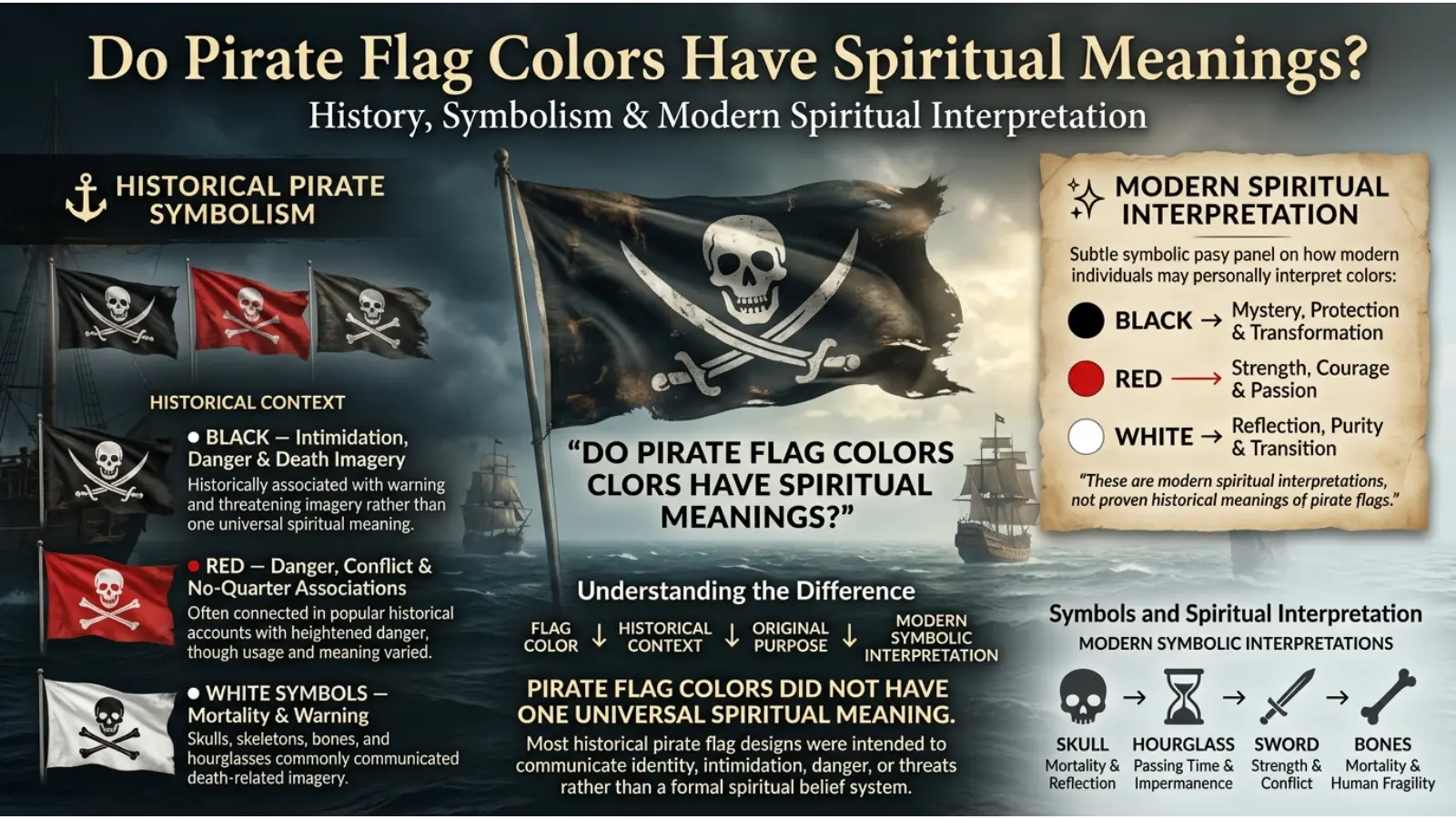
Do Pirate Flag Colors Have Spiritual Meanings?
Pirate flags were primarily connected with maritime history, conflict, reputation, and symbolism rather than one unified spiritual system.
Still, modern audiences sometimes interpret pirate imagery symbolically.
For example:
⚫ Black may represent the unknown or the mystery of death.
💀 Skulls may remind people that life is temporary.
🌊 The sea may symbolize freedom, uncertainty, and transformation.
🔴 Red may represent courage or intense energy.
These interpretations are symbolic and modern rather than universal religious beliefs.
Spiritual meanings vary greatly between traditions and individuals.
Historical Meaning of Pirate Flag Colors
Pirate flags developed during periods when maritime warfare and privateering were common.
The famous term Jolly Roger is strongly associated with pirate flags, especially black flags featuring frightening symbols.
However, historians still debate some details surrounding the origins of the name and the exact development of pirate flag traditions.
Why Pirates Used Distinctive Flags
A pirate crew’s flag could function as part of its identity.
It could communicate:
- Reputation
- Threat
- Intent
- Crew identity
Different captains used different visual designs.
Therefore, there was no single official pirate flag used by every pirate.
That is one reason modern pirate imagery should not be treated as a perfectly standardized historical system.
🎨 Famous Pirate Flag Color Chart
| Pirate Flag Element | Common Color | General Meaning |
|---|---|---|
| Flag background | ⚫ Black | Danger, death, intimidation |
| Flag background | 🔴 Red | Severe threat and violence |
| Skull | ⚪ White | Mortality and death imagery |
| Bones | ⚪ White | Death and danger |
| Blood imagery | 🔴 Red | Violence and mortality |
| Treasure imagery | 🟡 Gold | Wealth and adventure in modern culture |
| Ocean background | 🔵 Blue | Sea, freedom, exploration |
Key Point: Historical meanings were not always fixed. The crew, time period, and design context could change how a flag was understood.
Pirate Flag Colors in Different Cultures
Pirates are often viewed differently around the world.
Modern Western entertainment frequently portrays pirates as rebellious adventurers. Films, novels, and games have helped transform pirate imagery into a symbol of freedom and adventure.
Historically, however, pirates could also be feared criminals who threatened trade and sailors.
Western Popular Culture
In modern Western culture, pirate colors often represent:
🏴 Rebellion
⚓ Freedom
💀 Danger
🗺 Adventure
💰 Treasure
The black flag has become especially recognizable.
Global Entertainment Culture
Pirate imagery has spread through:
- Movies
- Video games
- Anime
- Theme parks
- Sports teams
- Fashion
- Children’s entertainment
As pirate culture became global, the meanings expanded beyond historical reality.
Today, a pirate flag may represent adventure rather than danger.
Pirate Flag Colors in Movies and Fiction
Movies and fictional stories have dramatically shaped how people imagine pirate flags.
The typical modern image often includes:
⚫ Black background
💀 White skull
🦴 Crossbones
🔴 Red accents
This design instantly communicates “pirate” to modern audiences.
However, fictional pirate flags are often designed for visual storytelling rather than historical accuracy.
Why Movies Use Strong Colors
Filmmakers use color to communicate personality quickly.
For example:
- A black flag may represent a dangerous villain.
- A red flag may suggest aggression.
- Gold details may suggest wealth.
- Blue backgrounds may strengthen the ocean setting.
Color becomes part of visual storytelling.
Pirate Flag Colors and Personality Associations
People who enjoy pirate imagery may be attracted to ideas such as adventure, independence, mystery, or rebellion.
However, liking a pirate flag does not determine a person’s personality.
Color preferences can be influenced by:
- Culture
- Age
- Memories
- Fashion trends
- Entertainment
- Personal experiences
Still, certain pirate colors may create different personality impressions.
| Color | Possible Impression |
|---|---|
| ⚫ Black | Bold, mysterious, powerful |
| 🔴 Red | Energetic, fearless, intense |
| 🔵 Blue | Adventurous, calm, freedom-loving |
| 🟡 Gold | Confident, ambitious, playful |
| 🟤 Brown | Traditional, rugged, historical |
These are impressions, not scientific personality diagnoses.
Pirate Flag Colors in Branding and Marketing
Pirate-themed businesses often use color strategically.
Black for Power and Mystery
Black can make a pirate brand appear:
- Strong
- Serious
- Mysterious
- Bold
It works especially well for logos and merchandise.
Red for Energy
Red can add:
- Excitement
- Action
- Urgency
However, too much red may make a design feel aggressive.
Gold for Treasure and Premium Appeal
Gold works well with pirate themes involving:
💰 Treasure
👑 Wealth
🏆 Victory
A black-and-gold combination can create a premium appearance.
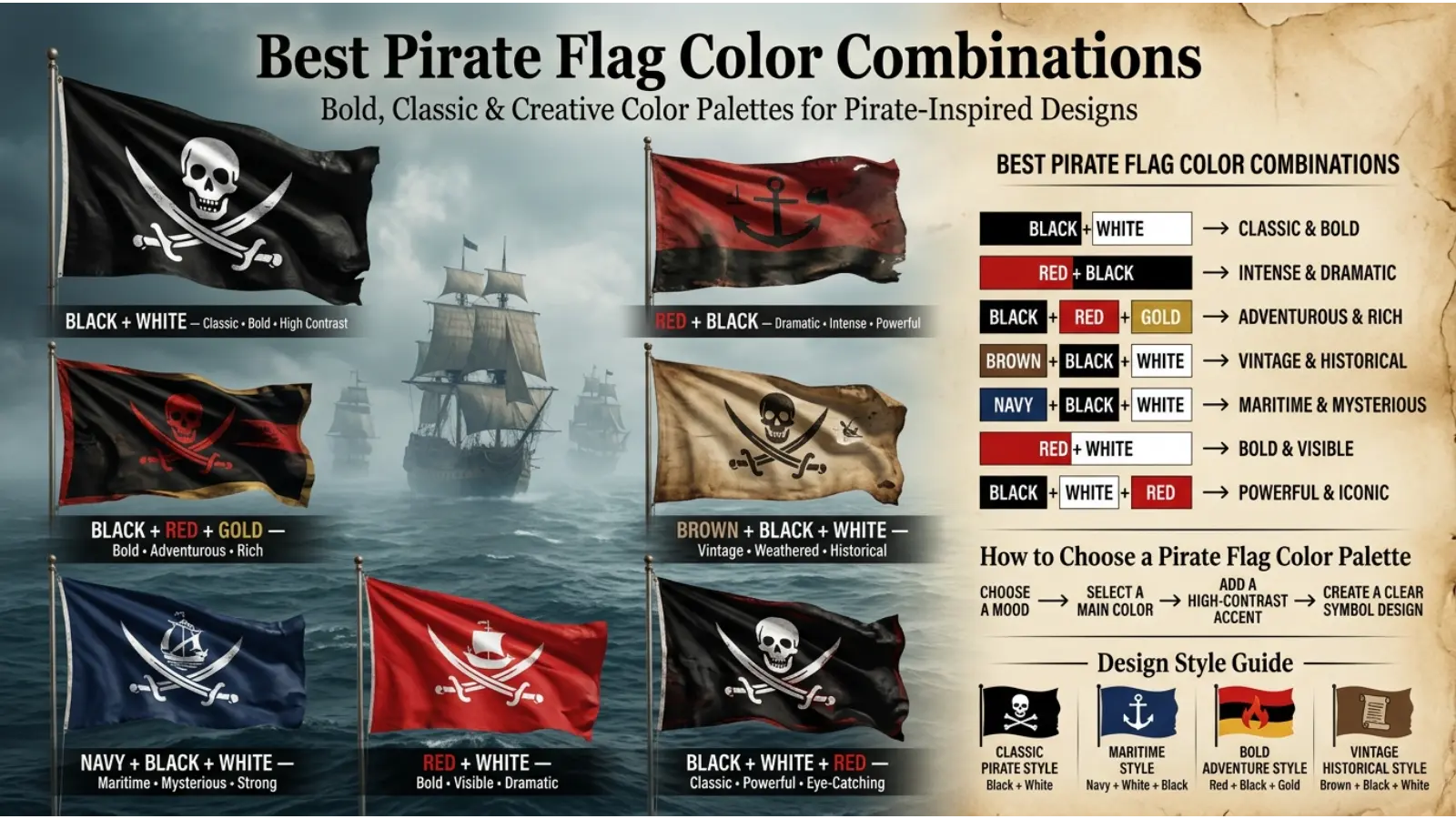
Best Pirate Flag Color Combinations
⚫ Black + ⚪ White
Best for: Classic pirate designs
The strong contrast makes symbols easy to recognize.
Example:
Black flag + white skull and crossbones
This remains the most iconic pirate color combination.
🔴 Red + ⚫ Black
Best for: Aggressive pirate themes
Red brings energy while black adds mystery.
This combination works well for:
- Gaming logos
- Sports designs
- Pirate artwork
⚫ Black + 🟡 Gold
Best for: Treasure and luxury themes
Black creates mystery, while gold represents wealth.
This combination is popular for:
- Pirate-themed events
- Premium merchandise
- Gaming designs
🔵 Navy Blue + ⚪ White
Best for: Nautical pirate themes
Navy blue creates a strong connection with the sea.
White keeps the design clean and visible.
🟤 Brown + 🟡 Gold + ⚫ Black
Best for: Historical adventure designs
This combination can resemble:
🗺 Old maps
⚓ Wooden ships
💰 Hidden treasure
It works particularly well in illustrations and themed interiors.
Pirate Flag Colors in Fashion
Pirate-inspired fashion uses colors differently from historical pirate flags.
Modern pirate clothing often includes:
⚫ Black coats
🤎 Brown leather
⚪ White shirts
🔴 Red scarves
🟡 Gold accessories
Black Clothing
Black can create a dramatic and mysterious appearance.
It is also practical because it pairs easily with other colors.
Red Accessories
A red bandana or scarf can become the focal point of a pirate-inspired outfit.
Because red is visually powerful, a small amount can make a major difference.
Gold Details
Gold jewelry and buttons can suggest:
- Wealth
- Adventure
- Historical luxury
For costume design, gold works best as an accent rather than the dominant color.
Pirate Flag Colors in Interior Design
Pirate colors can also inspire themed rooms.
However, using too much black may make a small room feel darker.
A balanced pirate-inspired color palette can work better.
Pirate-Themed Bedroom
Try combining:
⚫ Black accents
🔵 Deep navy walls
🟤 Wooden furniture
🟡 Gold decorations
This creates a maritime atmosphere without making the entire room feel dark.
Pirate Gaming Room
A stronger design could include:
⚫ Black
🔴 Red
💡 Warm lighting
🏴 Pirate wall art
Lighting is especially important because dark colors absorb more light.
How Lighting Changes Pirate Flag Colors
Lighting can dramatically change how pirate colors appear.
Black
Under bright sunlight, black fabric may reveal texture and appear lighter.
In low light, details may disappear completely.
Red
Warm lighting can make red appear richer.
Cool lighting may make certain red fabrics look darker or less intense.
Gold
Gold surfaces can appear bright and reflective under direct light.
Without enough light, gold may look brown or dull.
Therefore, designers should always test pirate color palettes under different lighting conditions.
Pirate Flag Colors in Art and Photography
Artists often use pirate colors to control emotion.
A dark pirate scene may use:
⚫ Black shadows
🔵 Dark blue ocean
🔴 Red accents
This creates drama and tension.
Meanwhile, a treasure-focused image may include:
🟡 Gold
🏝 Warm sand colors
🔵 Bright ocean blue
The mood changes immediately.
This demonstrates an important principle of color symbolism:
Colors gain meaning from context.
A red flag on a dark ship can feel threatening. The same red color on a festive pirate costume can feel playful.
Common Misconceptions About Pirate Flag Colors
Myth: Every Pirate Used a Skull and Crossbones
Not true.
Different pirates reportedly used different symbols and flag designs.
The skull and crossbones became the most famous symbol, but it was not the only design.
Myth: Black Always Meant the Same Thing
Not necessarily.
Black generally contributed to threatening imagery, but there was no universal color dictionary followed by every pirate crew.
Myth: Red Flags Always Had One Exact Meaning
Historical interpretations vary.
Red flags are strongly associated with severe warnings, but maritime traditions were not always identical across locations and periods.
Myth: Pirate Flags Were Designed Only for Decoration
Pirate flags could communicate identity and intimidation.
A frightening reputation could provide pirates with a strategic advantage.
Myth: Modern Pirate Flags Are Historically Accurate
Many modern designs come from movies, books, games, and artwork.
They may be inspired by history without reproducing an exact historical flag.
Real-World Uses of Pirate Flag Colors Today
Pirate colors continue to influence modern design.
Entertainment
Pirate color palettes appear in:
🎬 Movies
🎮 Video games
📺 Television
📚 Books
🎭 Theater
Black and red often communicate danger, while gold suggests treasure.
Sports
Some sports teams use pirate-inspired symbols to represent:
- Strength
- Fearlessness
- Competition
Business
Pirate themes appear in:
- Restaurants
- Escape rooms
- Events
- Clothing
- Gaming brands
Color helps customers understand the theme immediately.
Art
Artists use pirate colors to create different emotional experiences.
A dark palette may feel dangerous.
A bright blue-and-gold palette may feel adventurous.
Why Context Changes Pirate Flag Color Meanings
The same color can communicate different ideas depending on where and how it appears.
For example:
🔴 Red on a warning flag: danger
🔴 Red on a pirate bandana: adventure
The Red in treasure artwork: excitement
⚫ Black with a skull: death imagery
⚫ Black in a modern logo: power and sophistication
Therefore, color should never be interpreted in isolation.
Symbols, culture, history, lighting, and personal experiences all influence meaning.
How Age and Culture Influence Pirate Color Interpretation
Children may associate pirate flags with:
🏴 Adventure
🗺 Treasure
🏝 Islands
Adults may associate the same imagery with:
⚔ Conflict
💀 Danger
📜 History
Cultural exposure also matters.
Someone who learned about pirates through movies may have a very different understanding from someone studying maritime history.
This is why color meanings are rarely universal.
Pirate Flag Color Meanings at a Glance
⚫ Black
Meaning: Death, danger, mystery, intimidation
🔴 Red
Meaning: Blood, violence, severe warning, aggression
⚪ White
Meaning: Visual contrast, skull and bone imagery, mortality
🟡 Gold
Meaning: Treasure, wealth, success, adventure
🔵 Blue
Meaning: Ocean, freedom, exploration, nautical adventure
🟤 Brown
Meaning: Ships, wood, maps, history, rugged adventure
Frequently Asked Questions
What color was the original pirate flag?
There was no single original pirate flag used by every pirate. Different crews used different designs. Black flags with white symbols later became the most famous pirate image.
What does a black pirate flag mean?
A black pirate flag is commonly associated with death, danger, intimidation, and pirate identity. Its exact meaning could vary depending on the crew and design.
What does a red pirate flag mean?
Red pirate flags are traditionally associated with severe danger, violence, and warnings of little or no mercy. However, historical meanings were not always perfectly standardized.
Why are pirate flags black and white?
Black created a threatening background, while white symbols produced strong contrast. This made skulls, bones, and other images easier to recognize.
Did every pirate use the skull and crossbones?
No. Pirates used a variety of symbols, including skeletons, weapons, hearts, hourglasses, and other threatening images.
What does the skull mean on a pirate flag?
The skull represents mortality and death. It was an effective symbol because people could understand its threatening message quickly.
What does an hourglass mean on a pirate flag?
An hourglass may symbolize that time is running out. In pirate imagery, it could serve as a warning connected with mortality or surrender.
Is the Jolly Roger always black?
The term Jolly Roger is strongly associated with black pirate flags, but pirate flags historically varied in design and color.
Why is red used in modern pirate designs?
Red adds energy, danger, and dramatic contrast. Modern artists and designers often use it to make pirate imagery appear more aggressive.
Do pirate flag colors have spiritual meanings?
There is no single universal spiritual meaning for pirate flag colors. Modern symbolic interpretations may connect black with mystery, red with energy, and the sea with freedom, but these meanings vary.
Final Thoughts
Pirate flag color meanings are rooted in a mixture of history, symbolism, visual communication, and modern storytelling. Black remains the strongest symbol of danger and death-related imagery, while red is connected with severe warnings and aggression. White made threatening symbols easier to see, whereas gold and blue became increasingly important in modern pirate culture.
The most interesting lesson is that pirate colors do not have fixed meanings in every situation. A flag’s message depended on its symbols, the crew using it, historical circumstances, and the people viewing it.
Today, pirate flag colors continue to influence movies, gaming, fashion, branding, art, and interior design. Looking beyond the famous skull and crossbones reveals how powerful color can be as a tool for communication, emotion, identity, and storytelling.

Emma Wilson is a dedicated comparison writer and product researcher at ColorMystiic.com. She specializes in creating unbiased product comparisons, detailed reviews, and helpful buying guides. Her goal is to help readers make smarter purchasing decisions with confidence.