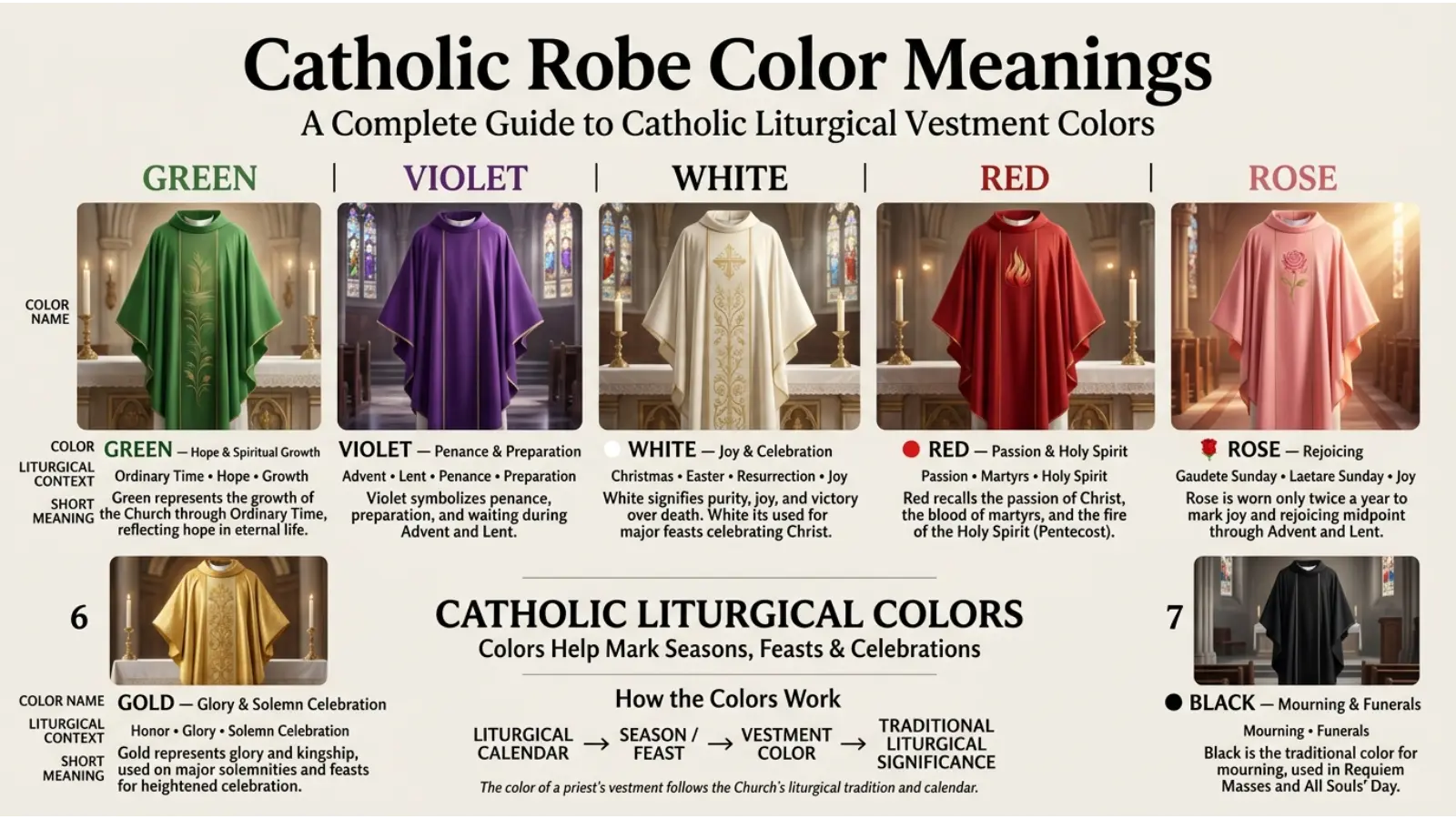
Catholic churches use color in a very deliberate way. The colors seen on a priest’s chasuble, stole, dalmatic, or other liturgical vestments are not simply chosen for decoration. Instead, they help visually express the season, feast, or mystery being celebrated during the Catholic liturgical year. The official Roman Catholic tradition recognizes several principal liturgical colors, including white, red, green, violet, and rose, while black and, in certain circumstances, gold and silver may also be used.People often search for Catholic robe color meanings because the color worn by a priest can change from one Sunday or feast to another.
Understanding these colors can make Mass easier to follow because the vestments provide a visual clue about the character of the celebration.
However, it is useful to make one distinction first: what people commonly call a “Catholic robe” is often a liturgical vestment. For example, the chasuble is the principal vestment worn by a priest celebrating Mass, while the dalmatic is proper to a deacon.
Quick Answer: What Do Catholic Robe Colors Mean?
| Catholic Color | Main Meaning or Liturgical Use | Common Times You See It |
|---|---|---|
| 🟩 Green | Growth, ordinary Christian life, hope | Ordinary Time |
| ⬜ White | Joy, celebration, resurrection, purity | Christmas and Easter seasons; many feasts |
| 🟥 Red | Passion, sacrifice, fire of the Holy Spirit, martyrdom | Palm Sunday, Good Friday, Pentecost, martyrs |
| 🟪 Violet/Purple | Preparation, repentance, penance | Advent and Lent |
| 🌸 Rose | Joy appearing within a penitential season | Gaudete Sunday and Laetare Sunday |
| ⬛ Black | Mourning and remembrance of the dead | Funeral rites and Masses for the Dead where permitted |
| 🟨 Gold | Festivity and special solemnity | Certain more solemn celebrations |
| 🩶 Silver | Festivity and special solemnity | Permitted in certain circumstances, particularly in the United States |
The most important point is that Catholic liturgical colors primarily identify the liturgical season or celebration. Their symbolic meanings can help explain the color, but the Church’s official rules are more important than modern color psychology.
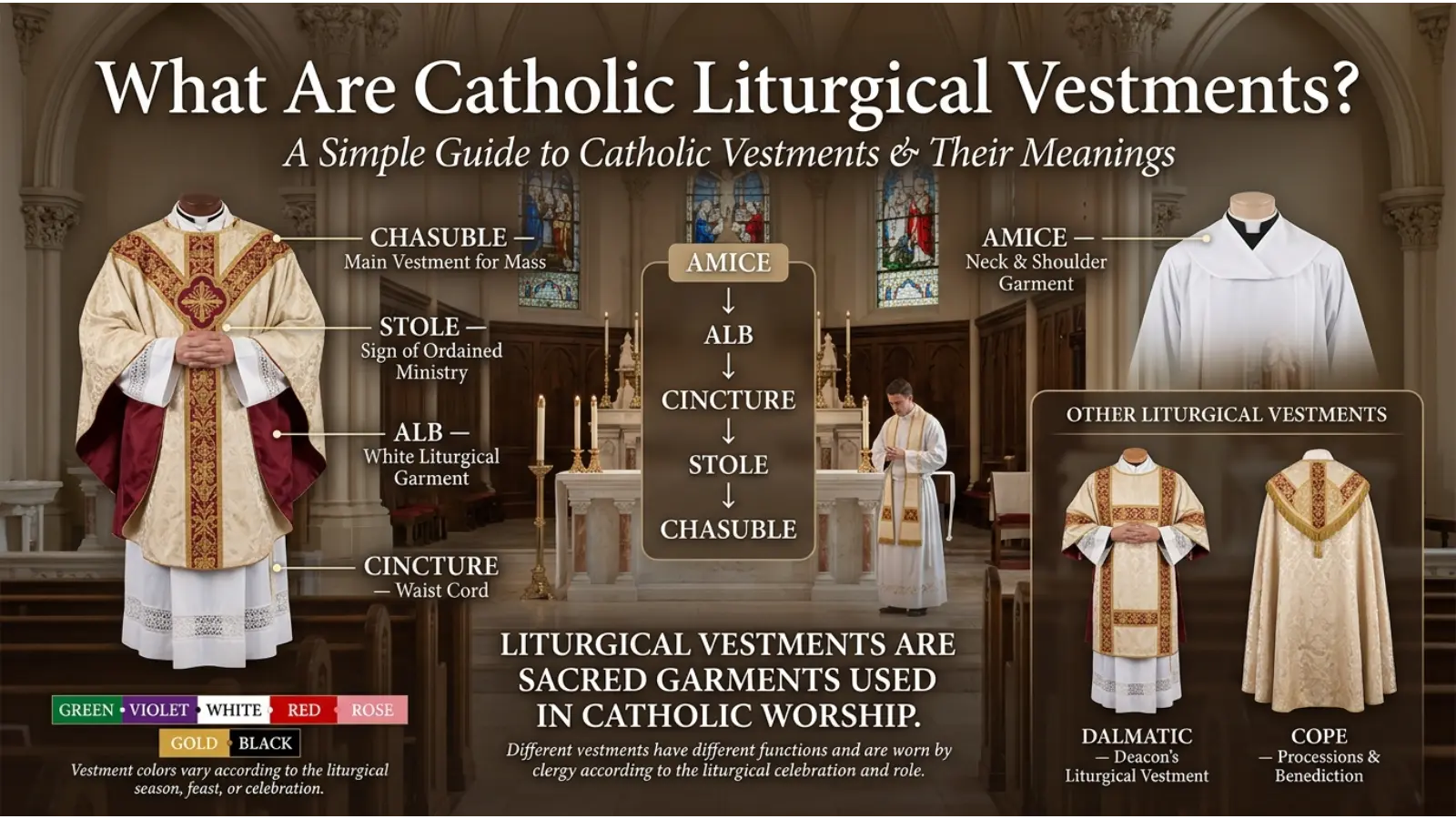
What Are Catholic Liturgical Vestments?
Before looking at individual colors, it helps to understand what is actually being colored.
At Mass, the priest normally wears an alb, stole, and chasuble. The alb is a white garment common to ordained and instituted ministers, while the stole identifies the minister’s ordained office. The chasuble is the vestment proper to the priest celebrant at Mass. Similarly, the deacon normally wears an alb, stole, and dalmatic.
Therefore, when someone asks why a priest is wearing a green, red, white, or purple “robe,” they are usually referring to the color of the outer liturgical vestment, especially the chasuble.
The Church explains that differences in sacred vestments visibly express the variety of ministries in the celebration. Likewise, differences in liturgical colors help express the character of the mysteries celebrated throughout the liturgical year.
🟩 Green Catholic Robe Meaning
Green is the normal color of Ordinary Time.
Unlike the dramatic colors used during Christmas, Easter, Lent, or major feasts, green appears during much of the Catholic calendar. Consequently, it can become one of the most familiar colors seen at Sunday Mass.
What does green symbolize?
Green is commonly associated with:
- Growth
- Life
- Hope
- Continuity
- Perseverance
- The ongoing journey of Christian life
The official liturgical rule, however, is simpler than a long list of symbolic meanings: green is used for the Offices and Masses of Ordinary Time.
Ordinary Time does not mean “unimportant time.” Rather, it is the period of the liturgical year outside the major seasons such as Advent, Christmas, Lent, and Easter.
Why is green connected with growth?
Green naturally brings to mind living plants, new leaves, and continued growth. Because of that familiar visual association, green works well as a symbol for the continuing spiritual journey of Christians.
In practical terms, a green vestment reminds worshippers that Christian life is not limited to major feast days. Everyday discipleship, prayer, service, and spiritual growth also matter.
⬜ White Catholic Robe Meaning
White is associated with joy, celebration, light, and the major mysteries of Christ’s life.
It is used during the Christmas and Easter seasons and for many celebrations of the Lord, the Blessed Virgin Mary, angels, and saints who were not martyrs. It is also used for several important solemnities and feasts specified by the Roman Missal.
What does white symbolize?
White can suggest:
- Joy
- Celebration
- Resurrection
- Light
- Purity
- Glory
- New life
The symbolism is especially easy to understand during Easter. After the penitential season of Lent, the Church enters a period centered on Christ’s Resurrection. Consequently, white creates a strong visual contrast with the purple associated with Lent.
When do Catholic priests wear white?
White is traditionally used during:
- The Christmas season
- The Easter season
- Celebrations of the Lord other than his Passion
- Celebrations of the Blessed Virgin Mary
- Celebrations of the angels
- Celebrations of non-martyr saints
- All Saints
- The Nativity of St. John the Baptist
- Certain other specified feasts
In the United States, white may also be used for Masses for the Dead.
Is white always a symbol of purity?
Not necessarily in every context. Color symbolism changes across history, culture, and religious traditions. In Catholic liturgy, white has a much more specific role because its use is connected to particular celebrations and seasons.
🟥 Red Catholic Robe Meaning
Red is one of the most visually powerful liturgical colors.
It is used for celebrations connected with Christ’s Passion, Pentecost, the Apostles and Evangelists, and martyr saints.
What does red symbolize?
Red can represent:
- Blood
- Sacrifice
- Martyrdom
- The Passion of Christ
- The fire of the Holy Spirit
- Courage
- Witness to faith
When is red worn?
Red is used on:
- Palm Sunday of the Lord’s Passion
- Good Friday
- Pentecost Sunday
- Celebrations of the Lord’s Passion
- Feasts of Apostles and Evangelists
- Celebrations of Martyr Saints
Why does Pentecost use red?
Pentecost celebrates the coming of the Holy Spirit upon the Apostles. Therefore, red creates a strong visual association with the fiery imagery traditionally connected with the Holy Spirit.
🟪 Purple or Violet Catholic Robe Color Meanings
Violet, often called purple, is strongly connected with preparation and penitential seasons.
The Roman Missal specifies violet for Advent and Lent. It may also be used for Offices and Masses for the Dead.
What does purple symbolize?
In Catholic liturgical context, violet is commonly associated with:
- Preparation
- Repentance
- Penance
- Reflection
- Spiritual discipline
- Expectation
During Advent, the Church prepares for Christmas while also looking toward Christ’s return. Meanwhile, Lent is a period of preparation for Easter.
Therefore, the same basic color can accompany two different seasons while still communicating a related idea: spiritual preparation.
Why is purple used during Lent?
Lent is traditionally a penitential season. As a result, violet provides a visual reminder of prayer, repentance, fasting, and preparation for Easter.
Why is purple used during Advent?
Advent also involves preparation, although it is not identical to Lent. It prepares Christians for the celebration of Christ’s birth and directs attention toward the expectation of Christ’s coming.
Thus, the meaning of violet depends partly on context.
🌸 Rose Catholic Robe Color Meanings
Rose is a special color used only on particular days.
The Roman Missal allows rose-colored vestments, where it is the practice, on:
- Gaudete Sunday, the Third Sunday of Advent
- Laetare Sunday, the Fourth Sunday of Lent
What does rose symbolize?
Rose is often understood as expressing joy within a season of preparation or penance.
That makes its appearance unusual and meaningful.
Advent and Lent are normally associated with violet. However, one Sunday in each season allows a lighter visual note.
Why is rose only used occasionally?
Its limited use is part of what makes it noticeable.
Instead of becoming an everyday liturgical color, rose appears as a visual interruption in the normal pattern. Therefore, when worshippers see a rose vestment, they can recognize that the day has a distinctive character.
⬛ Black Catholic Robe Meaning
Black is traditionally associated with mourning and the remembrance of the dead.
The Roman Missal permits black vestments for Masses for the Dead, where this remains customary. In the United States, white or black may also be used for funeral services and other Offices and Masses for the Dead.
What does black symbolize?
Black can communicate:
- Mourning
- Grief
- Seriousness
- Remembrance
- The reality of death
However, Catholic teaching about death and resurrection is more complex than the color alone. A funeral Mass is not simply a ceremony of mourning. It also expresses Christian hope in resurrection and eternal life.
Consequently, black can emphasize mourning without meaning that hope has disappeared.
🟨 Gold and Silver Catholic Vestment Meanings
Gold and silver are somewhat different from the principal seasonal colors.
The Roman Missal permits gold- or silver-colored vestments on more solemn occasions in the dioceses of the United States. More generally, festive and precious vestments may be used on particularly solemn days even when they do not match the ordinary color of the day.
What do gold vestments symbolize?
Gold naturally communicates:
- Celebration
- Honor
- Splendor
- Solemnity
- Preciousness
Because gold is visually rich, it can make a major celebration feel especially festive.
What does silver symbolize?
Silver can suggest:
- Celebration
- Brightness
- Honor
- Solemnity
- Festivity
The Vatican’s Redemptionis Sacramentum also explains that gold or silver may substitute for certain colors on feast days but specifically notes that they are not substitutes for violet or black in the relevant circumstances.
Catholic Robe Color Meanings Chart
Here is a simple visual guide to the main Catholic liturgical colors:
| Color | Main Liturgical Use | Common Symbolic Association |
|---|---|---|
| 🟩 Green | Ordinary Time | Growth, life, hope |
| ⬜ White | Christmas, Easter, many joyful feasts | Joy, resurrection, glory |
| 🟥 Red | Passion, Pentecost, martyrs | Sacrifice, blood, Spirit |
| 🟪 Violet | Advent and Lent | Preparation, repentance, penance |
| 🌸 Rose | Gaudete and Laetare Sundays | Joy during preparation |
| ⬛ Black | Masses for the Dead where customary | Mourning, remembrance |
| 🟨 Gold | Certain solemn celebrations | Festivity, honor |
| 🩶 Silver | Certain solemn celebrations | Festivity, brightness |
Important: the symbolic descriptions above help explain the visual language of Catholic worship, while the official rules determine when each color is actually used.
Why Does the Catholic Church Use Different Robe Colors?
The Church explains that liturgical colors give outward expression to the character of the mysteries being celebrated and to the Christian journey through the liturgical year.
In other words, the colors function almost like a visual calendar.
For example:
Purple → preparation → Christmas or Easter approaches
White → celebration → Christmas or Easter season
Green → ordinary Christian journey → Ordinary Time
Red → Passion, Spirit, apostles, or martyrs
Rose → joy appears within preparation
This visual system helps people understand the rhythm of the Church year without needing to read a calendar every time they enter the church.
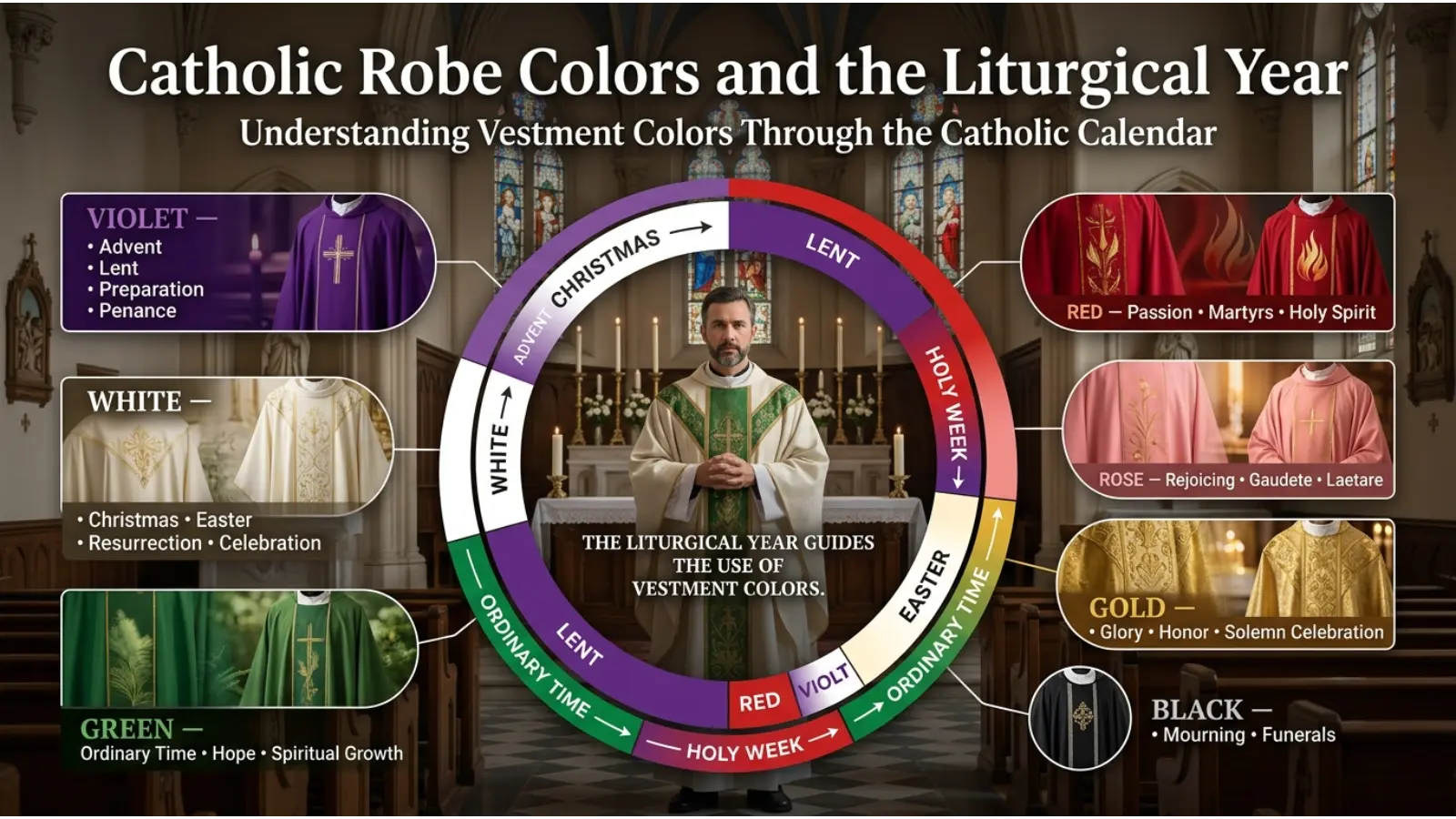
Catholic Robe Colors and the Liturgical Year
The easiest way to understand the system is to connect the colors to the calendar.
Advent — Violet
Advent is a season of preparation before Christmas.
Christmas — White
The Christmas season is celebratory, so white is used.
Ordinary Time — Green
After the major Christmas season, the calendar moves through Ordinary Time. Green becomes the normal liturgical color.
Lent — Violet
Lent is a penitential period leading toward Easter. Violet is used again, but now within a different theological setting.
Easter — White
Easter celebrates the Resurrection of Jesus Christ. White therefore returns as the dominant liturgical color.
Pentecost — Red
Pentecost receives red because of its association with the Holy Spirit and the fire imagery connected with the feast.
This sequence demonstrates an important point: the same color can communicate different shades of meaning depending on the celebration surrounding it.
Do Catholic Robe Color Meanings Have Biblical Meanings?
Some color associations are connected to biblical imagery, but it is important not to claim that every modern liturgical color has one simple biblical definition.
For example, Scripture contains powerful imagery involving white garments, blood, fire, purple clothing, and other colors.
Therefore, statements such as “purple always means repentance in the Bible” can be too simplistic.
A better approach is to distinguish between:
- Biblical imagery
- Catholic liturgical tradition
- Historical symbolism
- Modern color psychology
These areas can overlap, but they are not identical.
Catholic Robe Color Meanings vs. Color Psychology
Color psychology can help explain why certain colors create familiar emotional impressions. Nevertheless, liturgical color meanings should not be reduced to psychology.
For example, people may naturally associate green with plants and life. That can make green feel appropriate for a season focused on ordinary Christian growth.
Likewise, red is visually intense and can suggest energy, danger, blood, or passion in secular settings. In Catholic worship, however, red has a much more specific liturgical role connected with Christ’s Passion, Pentecost, Apostles, Evangelists, and martyrs.
Therefore, context changes color meaning.
The same red shirt, red sports logo, and red chasuble do not necessarily communicate the same message.
Catholic Robe Color Meanings in Different Cultures
Catholic liturgical colors belong to a worldwide Church, yet local traditions can influence how vestments are designed and experienced.
The Roman Missal allows certain adaptations to correspond with the needs and customs of different regions, subject to the Church’s liturgical norms.
As a result, two Catholic churches in different countries may use different artistic styles, fabrics, embroidery, patterns, or vestment designs while following the same basic liturgical color system.
This is especially important when discussing color symbolism across cultures.
Historical Development of Catholic Liturgical Colors
The Catholic liturgical color system developed over centuries rather than appearing as a complete modern chart all at once.
Over time, the Church developed traditions for using different colors during particular seasons and celebrations. The modern Roman Missal preserves a traditional system while also allowing certain regional adaptations.
This history explains why Catholic vestments can look both ancient and varied. The underlying liturgical rules provide continuity, while materials, embroidery, artistic styles, and regional customs can change.
The Church also emphasizes that the beauty of sacred vestments should come from worthy materials and appropriate design rather than excessive decoration.
What Do Catholic Robe Color Meanings Say About a Priest?
A common misunderstanding is that the color of a priest’s vestment represents his personality or personal spiritual condition.
Usually, it does not.
A priest wearing green is not necessarily “more peaceful,” while a priest wearing red is not necessarily “more passionate.” Instead, the color primarily communicates information about the liturgical celebration.
The priest is wearing the color because of the Church’s liturgical calendar and rules, not because he personally selected a color to express his mood.
This distinction is essential for understanding Catholic robe color meanings correctly.
Catholic Vestment Colors and Personality
Color preferences can sometimes be used in fashion or design to create impressions, but they should not be used to diagnose someone’s personality.
For example:
- Someone who loves green is not automatically calm or spiritual.
- Someone who prefers red is not necessarily aggressive.
- Someone who wears white is not automatically pure or peaceful.
- Someone attracted to purple is not necessarily mysterious or creative.
Thus, liturgical color is ceremonial rather than personal.
How Lighting Changes Catholic Robe Colors
Lighting can dramatically affect how a vestment appears.
A deep violet chasuble may look almost blue under cool lighting. Under warm church lighting, the same fabric may appear richer and more reddish.
Likewise:
- White can appear cream-colored under warm lights.
- Gold can look yellow, bronze, or champagne.
- Red can appear darker under low lighting.
- Green can shift toward blue-green or yellow-green.
- Purple can become difficult to distinguish from blue in some photographs.
Photography creates another challenge. Camera exposure, white balance, screen settings, and surrounding colors can all change the appearance of fabric.
Why Do Catholic Vestments Have Gold Designs?
Many Catholic vestments contain embroidered crosses, symbols, saints, vines, wheat, grapes, or other religious imagery.
The Church’s instructions state that ornamentation should consist of figures or symbols that evoke sacred use and should be appropriate to the dignity of the liturgical action.
Gold embroidery can therefore add visual richness without changing the official liturgical color of the vestment.
For example, a green chasuble can contain extensive gold embroidery while remaining a green vestment for liturgical purposes.
This is why the most visually dominant decorative color does not always determine the official liturgical color.
Why Can a Priest Wear a Gold Vestment Instead of the Usual Color?
On more solemn days, the Church permits festive or more precious vestments even when they are not the ordinary color of the day. In the United States, gold or silver-colored vestments are specifically permitted on more solemn occasions.
This creates an important distinction between:
Color of the day: the normal color assigned to the liturgical celebration.
Consequently, seeing a gold chasuble does not necessarily mean that gold has replaced the entire Catholic color system.
Catholic Robe Colors in Funeral Services
Funeral liturgies can involve more than one accepted color tradition.
The choice therefore does not mean that one parish is “more Catholic” than another simply because it uses black, white, or violet.
Instead, legitimate liturgical options and local practice can influence what worshippers see.
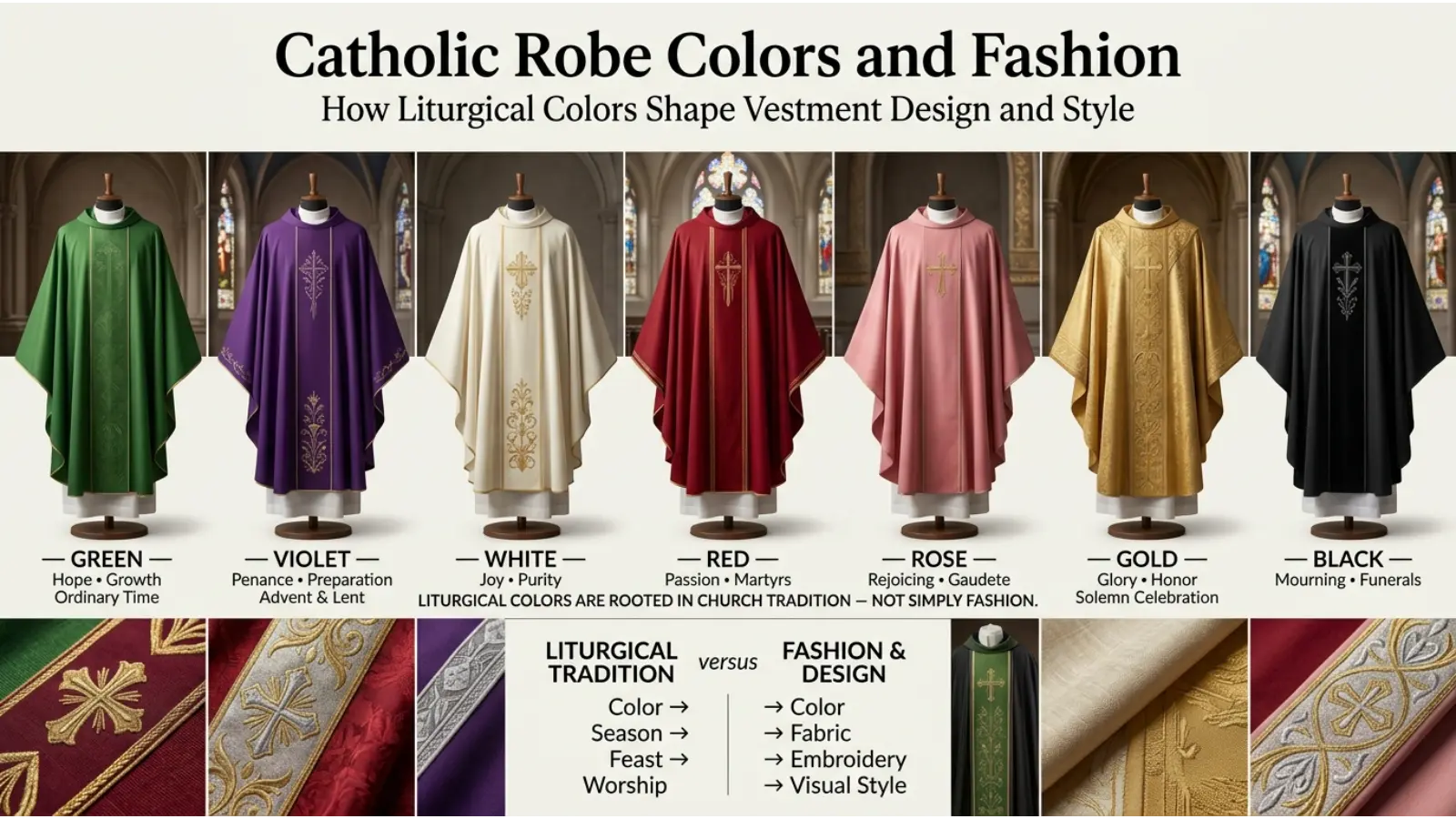
Catholic Robe Colors and Fashion
Although Catholic vestments are primarily liturgical objects, their design also has an artistic dimension.
A vestment can communicate solemnity through:
- Fabric
- Cut
- Embroidery
- Texture
- Symbolic imagery
- Gold or silver detailing
- Contrast between colors
- Shape and proportion
The Church states that vestment design should be worthy of sacred use and that beauty should not depend simply on excessive ornamentation.
Therefore, a simple vestment can be highly meaningful even without elaborate decoration.
Best Color Combinations for Catholic Vestments
Vestment colors are not normally chosen like ordinary fashion outfits. Nevertheless, some combinations are visually common because they support Christian symbols and traditional designs.
| Main Color | Complementary Details | Visual Effect |
|---|---|---|
| 🟩 Green | Gold, white | Natural and celebratory |
| ⬜ White | Gold, red, green | Bright and festive |
| 🟥 Red | Gold, white | Strong and solemn |
| 🟪 Violet | Gold, silver, white | Reflective and dignified |
| 🌸 Rose | Gold, white | Joyful and gentle |
| ⬛ Black | Gold, silver, white | Serious and memorial |
| 🟨 Gold | White, red, green | Rich and festive |
The purpose, however, is not merely visual beauty. The Church connects sacred vestments with the dignity and meaning of worship.
Common Misconceptions About Catholic Robe Colors
“Every Catholic priest chooses his own robe color.”
False. Liturgical colors are generally determined by the celebration and the liturgical calendar.
“Purple and violet are completely different liturgical colors.”
Usually not in this context. The Roman Missal refers to violet or purple for Advent and Lent.
“Red always means anger.”
False. In Catholic liturgy, red can signify the Passion of Christ, martyrdom, or Pentecost.
“Black means Catholics have no hope about death.”
False. Black can express mourning, but Catholic funeral worship also centers on Christian hope in resurrection.
“Gold is always the official color of Christmas.”
Not exactly. White is the traditional liturgical color for Christmas. Gold may be used as a festive or more precious vestment under the relevant rules.
“Green means the priest is celebrating a special feast.”
Usually no. Green is the normal color for Ordinary Time.
“A vestment’s embroidery determines its liturgical color.”
Not necessarily. A green chasuble with extensive gold embroidery remains a green vestment.
Real-World Uses of Catholic Color Symbolism
Catholic liturgical colors can be useful beyond simply identifying what a priest is wearing.
Daily church visits
Knowing the colors can help worshippers recognize the season immediately.
Catholic education
Teachers can use colors to help children remember the major seasons of the liturgical year.
Church decoration
Liturgical colors can guide altar cloths, banners, flowers, and other visual elements when appropriate.
Religious art
Artists can use traditional colors to visually communicate the season or celebration represented in an image.
Photography
Understanding the color system can help photographers document Masses while recognizing that the vestment color carries liturgical information.
Graphic design
Catholic organizations may use traditional colors in calendars, educational materials, parish communications, and religious artwork.
A Simple Way to Remember Catholic Robe Colors
If you want a quick memory system, think of the liturgical year as a visual journey:
🟪 PURPLE → Prepare
Advent and Lent are seasons of preparation.
⬜ WHITE → Celebrate
Christmas and Easter are major celebrations.
🟩 GREEN → Grow
Ordinary Time represents the ongoing journey of Christian life.
🟥 RED → Passion and Spirit
Think of Christ’s Passion, martyrs, and Pentecost.
🌸 ROSE → Rejoice
Joy appears briefly within Advent and Lent.
⬛ BLACK → Remember
Black may be used for the dead where customary.
🟨 GOLD/SILVER → Festive
These can emphasize greater solemnity in permitted circumstances.
Why Context Matters More Than Color Alone
A major mistake in color symbolism is assuming that every color has one permanent meaning.
Color meaning depends on:
- Religious tradition
- Historical period
- Cultural setting
- Liturgical season
- Type of celebration
- Surrounding colors
- Lighting
- Materials
- Artistic design
For example, red in a sports stadium may communicate energy and competition. Red in Catholic worship may point toward Pentecost, the Passion, apostles, evangelists, or martyrdom.
The physical color has not changed. The context has.
That is why Catholic robe color meanings should always be interpreted through the liturgical tradition rather than through general color psychology alone.
Frequently Asked Questions
What is the most common Catholic robe color?
There is no single color that is used for every Mass. Green is used throughout Ordinary Time, while white, violet, red, rose, and other permitted colors appear according to the liturgical season or celebration.
What does a green Catholic robe mean?
Green is the official liturgical color for Ordinary Time. Symbolically, it is often associated with growth, life, hope, and the continuing Christian journey.
What does a white Catholic robe mean?
White is used for Christmas and Easter seasons and many celebrations of Christ, Mary, angels, and non-martyr saints. It commonly conveys joy, celebration, resurrection, and glory.
What does a red Catholic robe mean?
Red is used for celebrations such as Palm Sunday, Good Friday, Pentecost, celebrations of Christ’s Passion, Apostles and Evangelists, and martyrs. It is associated with sacrifice, martyrdom, and the Holy Spirit.
Why do Catholic priests wear purple?
Violet or purple is used during Advent and Lent. It is also permitted for Masses for the Dead. Its traditional associations include preparation, repentance, and penance.
What does a pink Catholic robe mean?
What is commonly called a pink vestment is traditionally described as rose. It may be used on Gaudete Sunday in Advent and Laetare Sunday in Lent, where the practice is observed.
Can Catholic priests wear black robes?
Yes. Black vestments may be used for Masses for the Dead where this is customary. In the United States, black is also among the permitted colors for funeral services and other Offices and Masses for the Dead.
Can a Catholic priest wear gold instead of the normal liturgical color?
Festive or more precious vestments may be used on more solemn days. In the United States, gold or silver-colored vestments are permitted on more solemn occasions.
Are Catholic robe colors the same in every country?
The basic Roman Catholic liturgical system is widely shared, but regional adaptations and local traditions can affect vestment design and some practices. The Church permits certain adaptations according to regional needs and customs.
Does a priest’s robe color represent his personality?
No. The color normally identifies the liturgical season or celebration rather than the priest’s personal character, emotions, or personality.
Final Thoughts on Catholic Robe Color Meanings
Catholic robe colors are best understood as part of a larger visual language of worship. Rather than serving as simple decoration, they help mark the rhythm of the liturgical year and draw attention to the character of each celebration.
Green belongs to Ordinary Time and suggests the continuing journey of faith. White marks joyful and glorious celebrations such as Christmas and Easter. Red points toward the Passion, Pentecost, Apostles, Evangelists, and martyrs. Violet accompanies Advent and Lent, while rose offers a brief visual expression of joy within those seasons. Black can express mourning and remembrance of the dead, while gold and silver can provide a festive character on permitted solemn occasions.
Most importantly, these colors should be read through Catholic liturgical tradition, not through modern color psychology alone. The same color can mean something very different in a church, a fashion collection, a national flag, or a business logo.
Once you learn the basic system, the color of a priest’s vestment becomes a useful visual guide. A glance at the chasuble can often tell you where the Church is in its yearly journey—and, just as importantly, invite you to think about the spiritual character of the celebration taking place.

Emma Wilson is a dedicated comparison writer and product researcher at ColorMystiic.com. She specializes in creating unbiased product comparisons, detailed reviews, and helpful buying guides. Her goal is to help readers make smarter purchasing decisions with confidence.