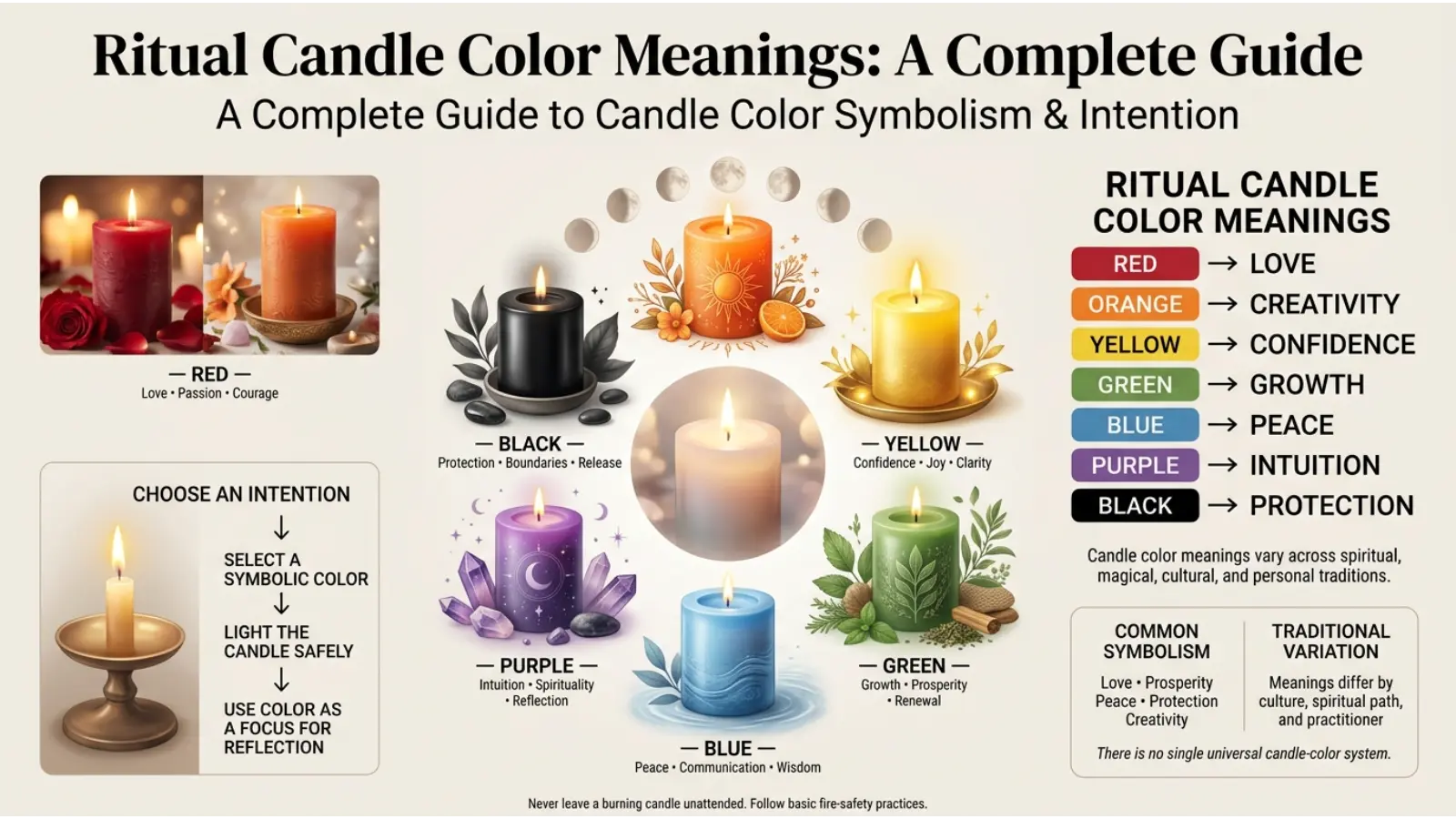
Ritual candles are often chosen for more than their appearance. In many spiritual and symbolic practices, candle color helps represent the intention behind a ritual, meditation, prayer, affirmation, or personal ceremony. Ritual candle color meanings commonly connect colors with ideas such as love, protection, prosperity, healing, peace, courage, cleansing, wisdom, and transformation.
However, there is no single universal color dictionary for ritual candles. Meanings can change between spiritual traditions, cultures, personal practices, and even individual practitioners. A red candle, for example, may represent passion in one practice and courage or vitality in another.
Color psychology adds another layer. Research shows that people make systematic associations between colors and emotions, but those associations are flexible and influenced by context, culture, brightness, saturation, and personal experience. A large systematic review of 132 studies found recurring color-emotion patterns across 64 countries, while also emphasizing that color associations do not automatically mean a color will produce a particular emotional state.
This guide explains the most common ritual candle color meanings while separating traditional symbolism, personal spiritual interpretation, and scientific evidence. You will also learn how to choose a candle for a particular intention, combine colors, use candles in everyday rituals, and avoid common misconceptions.
Quick Answer: What Do Ritual Candle Colors Mean?
Ritual candle colors are commonly used as visual symbols for a specific intention. White often represents cleansing and peace, red passion and courage, pink love and compassion, orange creativity and motivation, yellow happiness and confidence, green prosperity and growth, blue calm and communication, purple spirituality and wisdom, black protection and release, brown grounding, silver intuition, and gold success or abundance.
These meanings are symbolic rather than universal rules. The tradition behind the ritual matters just as much as the color itself.
Ritual Candle Color Meanings Chart
| Candle Color | Common Ritual Meaning | Typical Intention |
|---|---|---|
| ⚪ White | Purity, peace, cleansing, clarity | New beginnings, peace, general intention |
| ⚫ Black | Protection, release, boundaries | Letting go, protection, ending unwanted patterns |
| 🔴 Red | Passion, courage, vitality | Love, motivation, confidence |
| 🩷 Pink | Love, compassion, tenderness | Friendship, self-love, emotional harmony |
| 🟠 Orange | Creativity, enthusiasm, movement | Motivation, opportunity, confidence |
| 🟡 Yellow | Happiness, confidence, mental energy | Learning, communication, optimism |
| 🟢 Green | Growth, prosperity, renewal | Money goals, career, health symbolism |
| 🔵 Blue | Peace, calm, communication | Serenity, reflection, understanding |
| 🟣 Purple | Wisdom, spirituality, intuition | Meditation, reflection, personal growth |
| 🟤 Brown | Grounding, stability, practicality | Home, routine, security |
| 🩶 Silver | Intuition, reflection, mystery | Meditation, dreams, inner exploration |
| 🟨 Gold | Achievement, abundance, confidence | Success, recognition, prosperity |
The chart is a practical symbolic guide, not a scientific or religious rulebook. Different traditions may assign different meanings to the same color.
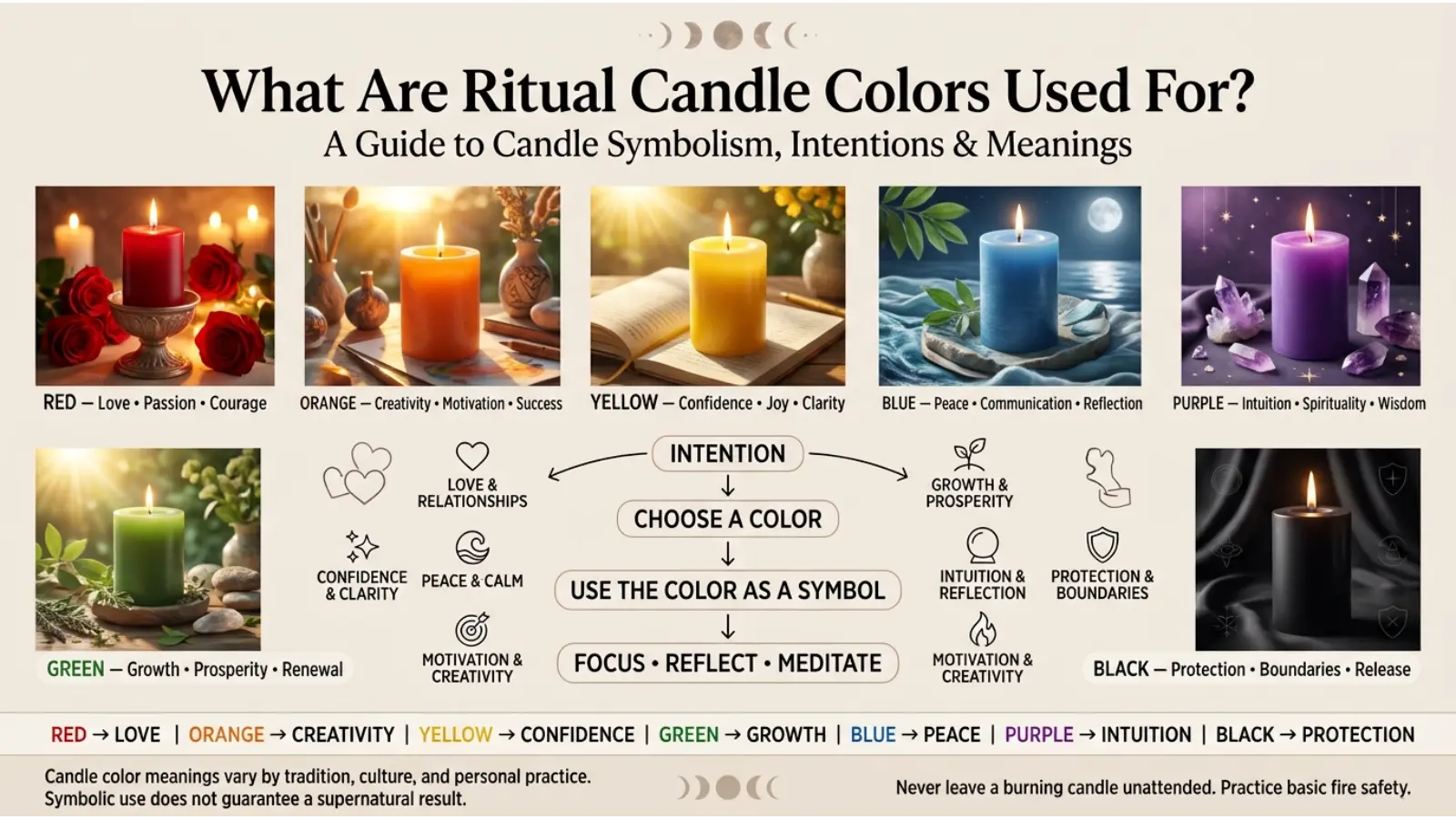
What Are Ritual Candle Colors Used For?
A ritual candle gives a physical form to an abstract intention.
For example, someone focusing on calm may choose blue because blue is commonly associated with peaceful and low-arousal emotions. Someone working on motivation may prefer red or orange because warm colors are often associated with higher-arousal emotions such as excitement, energy, and passion. Scientific research supports some broad color-emotion associations, but it does not establish that lighting a particular candle will cause a specific psychological or spiritual result.
In symbolic practice, the candle can therefore function as a visual reminder.
The process might be simple:
- Choose an intention.
- Select a color that represents that intention.
- Light the candle safely.
- Spend a few quiet minutes focusing on the goal.
- Use prayer, meditation, journaling, or an affirmation if it fits your practice.
- Extinguish the candle safely.
The value of the ritual often comes from attention, repetition, reflection, and personal meaning rather than from the pigment itself.
White Candle Meaning
White ritual candles are commonly associated with peace, purity, cleansing, clarity, protection, and new beginnings.
The White is especially useful when you want a neutral symbolic color. Some modern ritual practices treat white as a general-purpose candle that can represent almost any positive intention.
White Candle Symbolism
White can represent:
- Peace
- Purity
- Clarity
- Cleansing
- Fresh starts
- Hope
- Simplicity
- Spiritual reflection
- Protection
The White also has established religious meanings in some Christian traditions, although these should not be confused with modern candle-magic interpretations. In Catholic liturgical practice, for example, white is associated with celebrations including Christmas and Easter and with particular celebrations of Christ, Mary, angels, and saints who are not martyrs.
When to Use a White Ritual Candle
A white candle can fit intentions involving:
- Starting a new chapter
- Creating a peaceful atmosphere
- Meditation
- Personal reflection
- Symbolic cleansing
- Prayer
- General spiritual practice
Its greatest advantage is flexibility.
If you do not have a specialized color, choosing white can provide a simple symbolic alternative without requiring you to follow a complicated color system.
Black Candle Meaning
Black ritual candles are often associated with protection, boundaries, release, endings, and the removal of unwanted influences.
The Black can sound negative because it is frequently connected with darkness in popular culture. In symbolic practices, however, black does not automatically mean evil or harmful intentions.
It can represent the end of something rather than the beginning of something.
Black Candle Symbolism
Common interpretations include:
- Protection
- Boundaries
- Release
- Ending unwanted habits
- Letting go
- Grounding
- Reflection
- Transformation
- Personal strength
Black can therefore be useful for a ritual focused on leaving something behind.
For example, a person might light a black candle while journaling about a habit they want to stop. The candle becomes a visual symbol for closure.
A Useful Perspective on Black Candles
The meaning depends heavily on context.
A black candle beside a Halloween decoration has a completely different message from a black candle used during quiet meditation. Color does not carry one fixed emotional message in every situation.
Red Candle Meaning
Red ritual candles are commonly connected with passion, courage, strength, vitality, desire, motivation, and action.
The Red is one of the strongest symbolic candle colors because it tends to attract visual attention. Psychological research also finds red associated with both positive and negative high-arousal emotions, including love, excitement, passion, anger, and hostility.
That makes red particularly suitable for intentions involving energy and action.
Red Candle Symbolism
Red may represent:
- Passion
- Romantic love
- Courage
- Physical energy
- Determination
- Confidence
- Desire
- Strength
- Motivation
When to Use Red
A red candle may symbolically fit:
- Romantic intentions
- Confidence-building rituals
- Motivation
- Personal courage
- Goal setting
- Energy and action
- Passion projects
Red is usually more intense than pink. If your intention is gentle affection, pink may communicate it better. If your intention involves strong passion or decisive action, red may feel more appropriate.
Pink Candle Meaning
Pink ritual candles commonly symbolize gentle love, compassion, friendship, emotional warmth, kindness, and self-love.
The Pink provides a softer alternative to red. Rather than emphasizing intensity, it often suggests affection and emotional connection.
Pink Candle Symbolism
Pink can represent:
- Love
- Friendship
- Compassion
- Self-care
- Kindness
- Emotional healing symbolism
- Forgiveness
- Tenderness
- Harmony
The Pink is especially useful for rituals focused on relationships where you want the emphasis to remain gentle rather than forceful.
Research also finds pink strongly associated with positive emotions in many studies, although color-emotion associations remain context-dependent.
Orange Candle Meaning
Orange ritual candles are commonly associated with creativity, enthusiasm, confidence, opportunity, ambition, and movement.
The Orange sits between red and yellow, so it can symbolically combine some of the energy of red with the brightness of yellow.
Orange Candle Symbolism
Orange may represent:
- Creativity
- Motivation
- Enthusiasm
- Confidence
- Opportunity
- Ambition
- Social energy
- Change
- Success through action
Research on color-emotion associations frequently links orange with positive, higher-arousal emotions such as happiness, excitement, pleasure, and fun.
When Orange Works Well
Consider orange for symbolic rituals involving:
- Creative projects
- New opportunities
- Motivation
- Public speaking
- Social confidence
- Career goals
- Overcoming hesitation
Orange is particularly useful when your intention is not simply to feel calm but to move forward.
Yellow Candle Meaning
Yellow ritual candles are often associated with happiness, optimism, learning, communication, confidence, mental energy, and clarity.
The Yellow is visually bright and can create a cheerful symbolic atmosphere.
Yellow Candle Symbolism
Yellow may represent:
- Happiness
- Optimism
- Confidence
- Learning
- Communication
- Creativity
- Mental focus
- Curiosity
- Positive thinking
Scientific research consistently finds yellow associated with positive and relatively high-arousal emotions across many studies.
Yellow for Learning and Communication
A yellow candle may work well as a symbolic reminder before:
- Studying
- Writing
- Brainstorming
- Preparing a presentation
- Practicing communication
- Setting intellectual goals
The candle does not create knowledge by itself. Instead, it can become part of a focused routine that signals, “This is my time to concentrate.”
Green Candle Meaning
Green ritual candles commonly represent growth, prosperity, abundance, renewal, balance, nature, and opportunity.
The Green has a particularly strong connection with natural growth because plants and vegetation make green an everyday environmental cue.
Green Candle Symbolism
Green can represent:
- Growth
- Prosperity
- Abundance
- Renewal
- Balance
- Nature
- Patience
- Stability
- Opportunity
Modern spiritual practices frequently use green for prosperity and money-related intentions. However, this is a symbolic convention rather than a scientifically demonstrated way to create financial outcomes.
Green for Growth
Green works particularly well when the intention is gradual progress.
Examples include:
- Career development
- Learning a new skill
- Building healthy routines
- Saving money
- Starting a project
- Personal development
The symbolism of green is especially powerful when the desired outcome requires patience rather than instant change.
Blue Candle Meaning
Blue ritual candles are commonly associated with peace, calm, communication, wisdom, patience, reflection, and emotional balance.
The Blue is among the colors most often connected with lower-arousal, positive emotional associations in color research. Studies have linked blue with concepts such as comfort, happiness, and relaxation, although blue can also carry associations such as sadness in some contexts.
Blue Candle Symbolism
Blue may represent:
- Peace
- Calm
- Patience
- Wisdom
- Communication
- Reflection
- Trust
- Emotional balance
- Serenity
When to Use Blue
A blue candle can suit a symbolic practice involving:
- Meditation
- Quiet reflection
- Difficult conversations
- Emotional calm
- Study
- Patience
- Peaceful intentions
Blue is also a useful reminder that not every goal requires immediate action. Sometimes the first step is slowing down enough to understand the situation.
Purple Candle Meaning
Purple ritual candles are commonly associated with spirituality, intuition, wisdom, transformation, mystery, and personal growth.
The Purple often occupies a special place in symbolic systems because it combines the visual qualities of red and blue. It can therefore represent a meeting point between energy and calm, action and reflection.
Purple Candle Symbolism
Purple may represent:
- Wisdom
- Intuition
- Spiritual reflection
- Transformation
- Mystery
- Personal growth
- Meditation
- Insight
- Inner exploration
Research also finds purple associated with some empowering emotions, including pride and power, although the associations are not exclusive or universal.
Purple in Religious Contexts
Purple has a specific established meaning in Catholic liturgical practice. It is used during Advent and Lent, seasons associated with preparation, reflection, and penance.
That religious meaning should not automatically be transferred to every spiritual practice. Different traditions use purple in different ways.
Brown Candle Meaning
Brown ritual candles are often associated with grounding, stability, home, practicality, patience, and connection with nature.
The Brown is less dramatic than red or purple, making it suitable for intentions that emphasize steady progress.
Brown Candle Symbolism
Brown may represent:
- Grounding
- Stability
- Home
- Security
- Practicality
- Patience
- Simplicity
- Nature
- Dependability
The Brown can be useful when your goal is to create a feeling of steadiness rather than excitement.
For example, a person establishing a new daily routine might use brown as a symbolic reminder to remain consistent.
Silver Candle Meaning
Silver ritual candles are often associated with intuition, reflection, dreams, mystery, receptivity, and inner awareness.
The Silver has a reflective visual quality, which makes it a natural symbolic choice for themes involving mirrors, moonlight, contemplation, or hidden thoughts.
Silver Candle Symbolism
Silver may represent:
- Intuition
- Reflection
- Mystery
- Dreams
- Inner awareness
- Receptivity
- Imagination
- Emotional reflection
These meanings are primarily symbolic and vary considerably between modern spiritual practices.
Gold Candle Meaning
Gold ritual candles are commonly associated with abundance, achievement, success, confidence, recognition, generosity, and prosperity.
THe Gold has long been visually connected with valuable materials, wealth, ceremony, and prestige. That makes it especially effective when a ritual is designed around achievement or celebration.
Gold Candle Symbolism
Gold may represent:
- Success
- Achievement
- Wealth
- Abundance
- Confidence
- Recognition
- Leadership
- Celebration
- Ambition
The Gold can be particularly appropriate when the focus is not simply obtaining something but recognizing progress that has already been made.
How Color Psychology Ritual Candle Color Meanings
Color psychology can help explain why candle colors feel meaningful even outside formal spiritual traditions.
A major systematic review examined 132 studies involving more than 42,000 participants from 64 countries. Researchers found recurring associations between colors and emotions, but most relationships were many-to-many rather than one-color-equals-one-emotion. Lightness, saturation, hue, context, and cultural experience all matter.
For example:
- Red can suggest passion or anger.
- Blue can suggest calm or sadness.
- Green can suggest comfort or envy.
- White can suggest hope or relief.
- Black can suggest power, fear, or anger.
- Purple can suggest power or pride.
This is why a simple statement such as “blue always means peace” is too absolute.
Symbolic Meaning Is Not the Same as Scientific Effect
There is an important distinction between:
“Blue symbolizes calm in this ritual.”
and
“Blue will make you calm.”
The first is a symbolic statement.
The second is a scientific claim requiring evidence.
Research currently supports reliable color-emotion associations, but it does not justify treating a candle color as a guaranteed method for changing emotions, healing illness, attracting money, or producing supernatural outcomes.
Do Ritual Candle Color Meanings Have Universal Meanings?
No.
There are recurring patterns, but there is no worldwide authority that assigns one mandatory meaning to every candle color.
A color may carry different meanings because of:
- Religion
- Culture
- Historical period
- Spiritual tradition
- Family practice
- Personal experience
- Ritual purpose
- Lighting conditions
- Color shade
Even within the same broad tradition, practitioners may use different systems.
The best approach is to treat a candle color as a symbolic language rather than a universal code.
Ritual Candle Color Meanings in Religious Traditions
Candle symbolism also appears in formal religious settings, but these meanings should be kept separate from modern candle-magic systems.
For example, Catholic liturgical colors are formally connected to particular seasons and celebrations. White is used for several major celebrations, red is associated with celebrations including Pentecost and martyrs, green is used during Ordinary Time, and violet is used during Advent and Lent.
Advent provides another clear example. The traditional Advent wreath contains four candles representing the four weeks of Advent. Three are traditionally purple and one is rose, although white candles may also be used. The purple candles symbolize prayer, penance, preparation, and good works, while the rose candle is connected with rejoicing on Gaudete Sunday.
These meanings come from a particular Christian liturgical tradition. They should not be presented as universal meanings for every ritual candle.
Choosing a Ritual Candle by Intention
Instead of memorizing dozens of color meanings, start with your actual intention.
| Your Intention | Suggested Color | Symbolic Focus |
|---|---|---|
| Peace | 🔵 Blue | Calm and serenity |
| New beginning | ⚪ White | Fresh start and clarity |
| Love | 🩷 Pink | Affection and compassion |
| Passion | 🔴 Red | Energy and desire |
| Prosperity | 🟢 Green | Growth and abundance |
| Creativity | 🟠 Orange | Inspiration and action |
| Learning | 🟡 Yellow | Focus and mental energy |
| Spiritual reflection | 🟣 Purple | Wisdom and intuition |
| Protection | ⚫ Black | Boundaries and release |
| Grounding | 🟤 Brown | Stability and security |
| Achievement | 🟨 Gold | Success and recognition |
| Reflection | 🩶 Silver | Intuition and inner awareness |
The “right” candle is ultimately the one whose symbolism makes sense within your chosen practice.
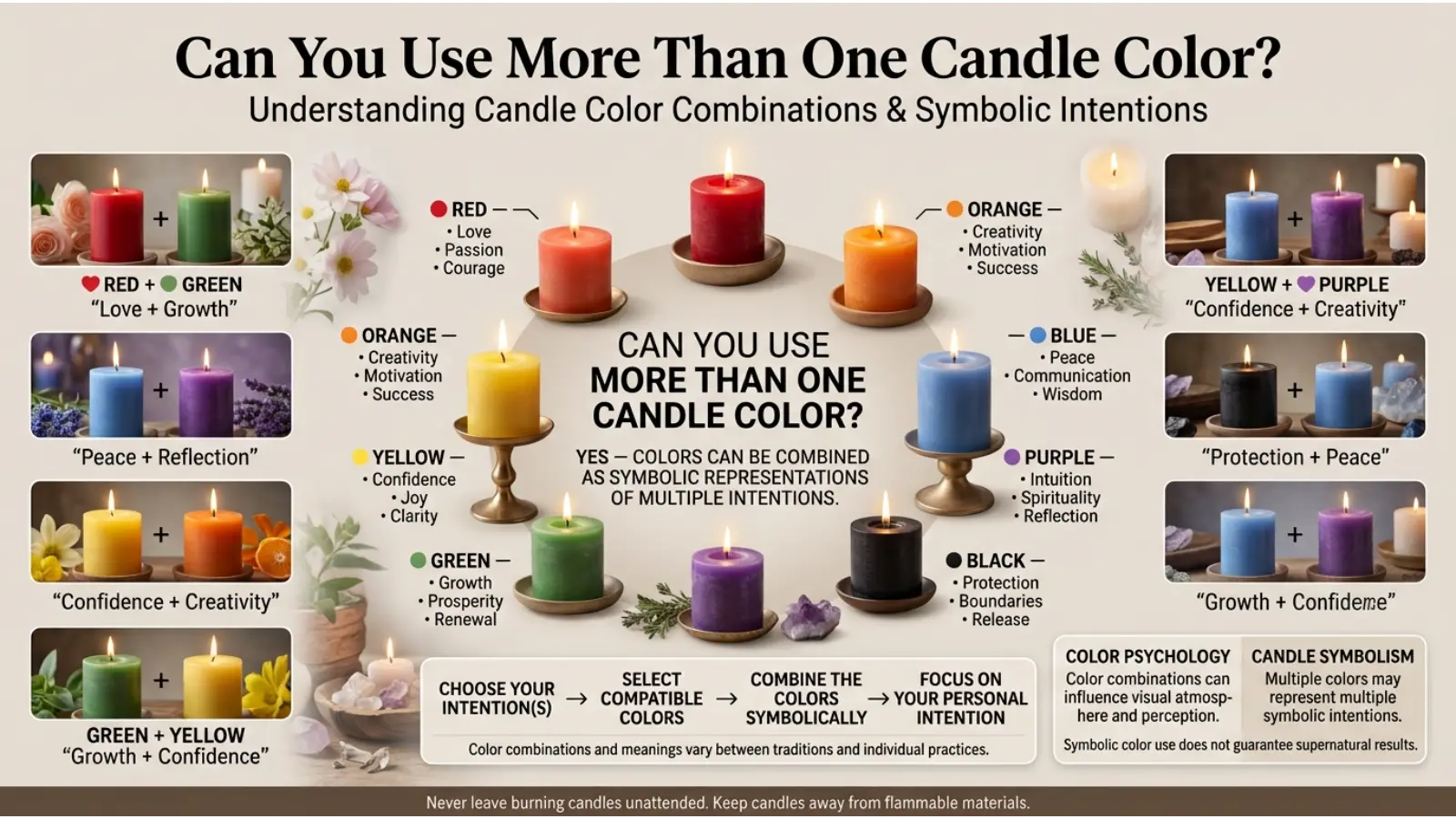
Can You Use More Than One Candle Color?
Yes, if your ritual tradition allows it.
Combining colors can create a layered symbolic message.
For example:
White + Blue
This combination can represent peace plus clarity.
It may fit meditation, reflection, or creating a calm environment.
Red + Pink
This can symbolize passion combined with tenderness.
It may suit a relationship-focused intention where strong affection and emotional warmth are both important.
Green + Gold
This pairing can represent growth plus achievement.
It may be useful as a symbolic combination for career or financial goals.
Purple + White
This can suggest spiritual reflection plus clarity.
It may work well for meditation or personal contemplation.
Black + White
This creates a strong symbolic contrast between release and renewal.
It can represent leaving an old pattern behind while creating space for something new.
These combinations are symbolic interpretations, not universal rules.
How Candle Shade Changes the Meaning
The basic color is only part of the visual message.
Shade, brightness, saturation, and surrounding colors can change perception.
A pale blue candle may feel softer and more delicate than a deep navy candle. A bright red candle can feel more energetic than a dark burgundy candle. A muted green may suggest nature and calm, while a vivid green can appear more energetic or playful.
This fits modern color research, which shows that lightness and saturation can influence emotional associations alongside hue.
Light Colors
Often feel:
- Softer
- Lighter
- Gentler
- More open
Dark Colors
Often feel:
- More serious
- Stronger
- More dramatic
- More mysterious
Highly Saturated Colors
Can appear:
- Energetic
- Bold
- Attention-grabbing
Muted Colors
Can feel:
- Subtle
- Natural
- Calm
- Sophisticated
This is useful when choosing candles for both rituals and interior decoration.
How Lighting Changes Candle Color
A candle does not look the same under every light.
Warm household lighting can make colors appear more yellow, orange, or muted. Daylight may reveal cooler or more accurate color differences. Candlelight itself also changes how nearby colors are perceived.
This matters when buying candles online.
A product photographed under studio lighting may look different in your home. Wax finish, container color, flame brightness, surrounding surfaces, and room lighting can all affect the final appearance.
If the exact shade matters to your ritual or décor, compare the candle under the lighting where you plan to use it.
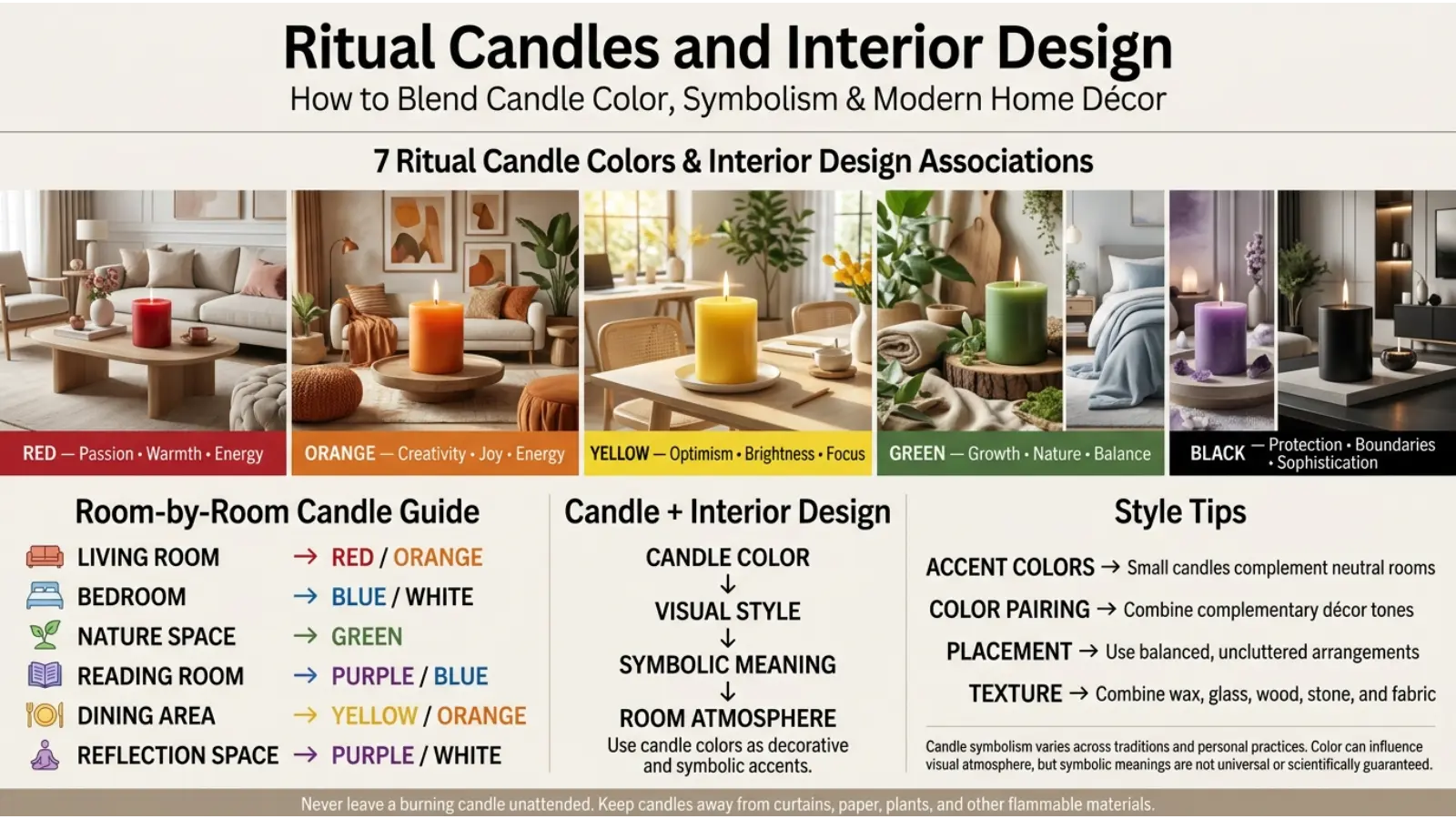
Ritual Candle Color Meanings and Interior Design
Ritual candles can also function as decorative objects.
A candle’s symbolic meaning may influence the atmosphere of a room, while its physical color affects the visual balance.
Living Room
Blue, green, white, brown, and neutral candles can create a relaxed appearance.
Bedroom
Soft pink, white, lavender, or blue can support a gentle visual mood.
Office
Yellow or orange accents can provide visual energy, while blue can create a calmer appearance.
Meditation Space
White, blue, purple, green, and natural earth tones can work well depending on the desired atmosphere.
Dining Area
Red, orange, gold, and warm neutrals can create a more energetic and social appearance.
The goal is not to make every object match. One or two candle colors can create a focal point without overwhelming the room.
Ritual Candle Color Meanings in Fashion and Personal Style
Candle symbolism can even influence personal style.
Someone who wants to communicate calm might choose blue accessories. Someone emphasizing confidence may prefer red. Green can suggest freshness or natural connection, while gold can create a more luxurious impression.
These are impressions, not fixed personality signals.
A person wearing black is not automatically mysterious, just as someone wearing yellow is not automatically cheerful. Clothing color works together with fabric, fit, setting, culture, age, and personal style.
Ritual Candle Color Meanings in Branding and Marketing
Color symbolism also matters outside spiritual practices.
Brands choose colors partly because people already have learned associations with particular visual cues. However, professional branding rarely depends on color alone.
A company may use:
- Blue to suggest reliability or calm
- Green to suggest nature or growth
- Red to attract attention and communicate energy
- Orange to create friendliness and enthusiasm
- Purple to suggest creativity or premium positioning
- Black to communicate sophistication or strength
- White to create simplicity and clarity
These associations are not universal psychological laws. They work through a combination of cultural expectations, design conventions, context, and consumer experience.
That same principle explains why a ritual candle can feel different depending on its surroundings.
Common Misconceptions About Ritual Candle Colors
Myth 1: Every Color Has One Exact Meaning
Not true.
Color symbolism varies across traditions and cultures. A color can carry several meanings at once.
Myth 2: A Candle Color Guarantees an Outcome
There is no good scientific basis for claiming that a specific candle color guarantees money, romance, healing, or another external result.
A ritual may help someone focus, reflect, organize intentions, or create a meaningful routine. That is different from proving a supernatural effect.
Myth 3: Black Candles Are Always Negative
Black can symbolize protection, boundaries, endings, or release. Its meaning depends on the ritual context.
Myth 4: White Always Means Purity
White has many associations, including peace, clarity, celebration, mourning, simplicity, and spirituality. Its meaning changes across cultures and situations.
Myth 5: Color Psychology Works the Same for Everyone
Research finds recurring patterns, but people do not respond identically to every color. Context and personal experience matter.
How to Create a Simple Ritual With a Candle
A ritual does not need to be complicated.
1. Define One Intention
Instead of choosing a vague goal, make it specific.
For example:
“I want to become more consistent with my studies.”
is easier to focus on than:
“I want everything to improve.”
2. Choose a Symbolic Color
For the example above, yellow might represent learning and mental energy, while blue could represent calm concentration.
3. Prepare the Space
Place the candle on a stable, heat-resistant surface away from curtains, books, bedding, paper, and other flammable objects.
4. Light the Candle
Spend a few minutes focusing on your intention.
You might meditate, pray, breathe slowly, or write in a journal.
5. Connect the Color to the Intention
Rather than simply staring at the candle, explain to yourself why you selected its color.
This turns the color into a personal symbol.
6. End the Ritual
Write down one practical action you can take.
For example:
Intention: Improve my studies.
Candle: Yellow.
Action: Study mathematics for 30 minutes today.
The final step turns symbolic reflection into real-world behavior.
Candle Safety Comes Before Ritual
A candle can be meaningful and beautiful, but it is still an open flame.
Never leave a burning candle unattended. Keep it away from anything that could catch fire, place it on a stable heat-resistant surface, and keep it away from children and pets. The National Candle Association also recommends trimming the wick to about ¼ inch before use and avoiding drafts such as open windows, fans, and air vents.
Do not move a candle while its wax is liquid. When extinguishing it, avoid using water because hot wax can splatter. Allow the candle and melted wax to cool before touching or moving it.
A meaningful ritual is never worth creating a fire risk.
How Culture Changes Ritual Candle Meanings
Color is not interpreted in isolation.
A person’s culture can influence what a color reminds them of. Religious ceremonies, national traditions, holidays, clothing, funerals, weddings, festivals, advertising, and family customs can all shape color associations.
Even the same color may communicate opposite ideas in different settings.
That is why a responsible guide should avoid phrases such as “green always means money” or “white always means purity.”
A better approach is:
“Green is commonly used symbolically for growth, prosperity, and renewal in some modern spiritual practices.”
That wording recognizes the tradition without pretending it is universal.
Personality Associations With Ritual Candle Colors
People sometimes choose candle colors based on the qualities they want to emphasize.
For example:
- Red may appeal to someone seeking boldness.
- Blue may appeal to someone seeking calm.
- Green may represent growth.
- Purple may represent introspection.
- Yellow may symbolize optimism.
- Black may represent boundaries.
- White may symbolize a fresh start.
However, color preference does not determine personality.
Someone who loves black is not automatically serious. The Someone who prefers pink is not automatically gentle. Someone who likes red is not necessarily aggressive.
Color can express identity, mood, memory, or aesthetic taste without defining the person.
Ritual Candle Color Meanings for Everyday Life
You do not need to follow a formal spiritual system to use color symbolically.
You can use candles as visual anchors for everyday habits.
For Studying
Choose yellow or blue and associate it with focused study time.
For Relaxation
Choose blue, white, or a soft green.
For Creativity
Choose orange or yellow.
For Personal Growth
Choose green.
For Confidence
Choose red or orange.
For Reflection
Choose purple, blue, or silver.
For a Fresh Start
Choose white.
The important part is consistency. If the same color repeatedly marks a particular activity, it can become a familiar visual cue for that routine.
Ritual Candle Color Combinations Chart
| Combination | Symbolic Theme | Useful For |
|---|---|---|
| ⚪ + 🔵 White & Blue | Peace + clarity | Meditation and reflection |
| 🔴 + 🩷 Red & Pink | Passion + affection | Relationship symbolism |
| 🟢 + 🟨 Gold | Growth + achievement | Career and prosperity themes |
| 🟣 + ⚪ Purple & White | Wisdom + clarity | Spiritual reflection |
| ⚫ + ⚪ Black & White | Release + renewal | Personal transitions |
| 🟡 + 🟠 Yellow & Orange | Focus + creativity | Study and creative work |
| 🟢 + 🔵 Green & Blue | Growth + peace | Balance and renewal |
| 🔴 + 🟠 Red & Orange | Energy + motivation | Action-oriented goals |
Again, these combinations are practical symbolic interpretations rather than fixed rules.
What Makes a Ritual Candle Feel Meaningful?
The strongest ritual symbolism often comes from consistency and intention.
A candle becomes more meaningful when you repeatedly connect it with a particular purpose.
For example, if every Sunday evening you light a blue candle while reviewing your week, blue may eventually become personally associated with reflection and calm. Another person might have a completely different association with the same color.
This illustrates an important principle of symbolism:
Meaning is partly inherited and partly created.
Culture gives colors shared associations. Personal experience adds another layer.
Frequently Asked Questions About Ritual Candle Color Meanings
What is the best candle color for rituals?
There is no single best color. Choose the color that best represents your intention within your tradition or personal symbolic system. White is often a practical choice when you want a neutral or general-purpose symbol.
What candle color is used for love?
Red and pink are commonly associated with love. Red tends to emphasize passion, desire, and intensity, while pink more often represents tenderness, affection, compassion, and gentle emotional connection.
What color candle represents protection?
Black and white are both commonly used symbolically for protection, although the exact interpretation depends on the spiritual tradition. Black may emphasize boundaries and release, while white may emphasize peace, clarity, or cleansing.
What color candle represents money or prosperity?
Green is one of the most common modern symbolic choices for prosperity, abundance, growth, and financial goals. Gold is also frequently associated with wealth, achievement, and success.
What color candle is best for healing?
Blue, green, white, and purple may be used symbolically for healing-related intentions in different modern practices. However, a candle should not be presented as a medical treatment or substitute for professional healthcare.
What does a black candle mean spiritually?
Black candles can symbolize protection, boundaries, release, endings, grounding, or transformation. They do not automatically represent evil or negative intentions.
What does a white candle mean spiritually?
White candles commonly symbolize peace, clarity, purity, cleansing, protection, and new beginnings. Specific religious traditions may give white additional meanings.
What does a purple candle mean in rituals?
Purple is often associated with spirituality, wisdom, intuition, meditation, transformation, and personal growth. In Christianity, purple also has specific liturgical meanings, including its use during Advent and Lent.
Can I use a white candle instead of another color?
In some modern ritual practices, white is treated as a flexible substitute for other colors. However, this is a practice-specific convention rather than a universal spiritual rule.
Do candle colors really work?
That depends on what “work” means. Color research supports recurring associations between colors and emotions, but there is not scientific evidence that a ritual candle color guarantees supernatural outcomes. A candle can still serve as a useful symbol, mindfulness cue, or personal ritual object.
Final Thoughts on Ritual Candle Color Meanings
Ritual candle color meanings are best understood as a symbolic language, not a universal set of supernatural instructions.
White can suggest peace and renewal. Red can express passion and courage. Pink can represent affection. Orange can encourage a sense of creative movement. Yellow can symbolize optimism and learning. Green can point toward growth and prosperity. Blue can create a visual language of calm. Purple can represent wisdom and spiritual reflection. Black can symbolize protection and release, while brown, silver, and gold offer additional meanings for grounding, intuition, and achievement.
The deeper lesson is that color works through context.
A candle’s meaning can come from a spiritual tradition, a religious ceremony, cultural history, psychological association, design choice, or your own personal experience. Scientific research shows that people share many broad color-emotion associations, but those associations are not rigid and do not guarantee a particular emotional or physical outcome.
So when choosing a ritual candle, begin with the intention rather than the color chart. Ask yourself what you want the candle to represent. Then select the color that communicates that idea most naturally to you and your tradition.
Used thoughtfully and safely, a simple candle can become a powerful visual reminder: not because the color controls the future, but because symbols can help people pause, focus, reflect, and give meaning to the actions they choose to take.

Emma Wilson is a dedicated comparison writer and product researcher at ColorMystiic.com. She specializes in creating unbiased product comparisons, detailed reviews, and helpful buying guides. Her goal is to help readers make smarter purchasing decisions with confidence.