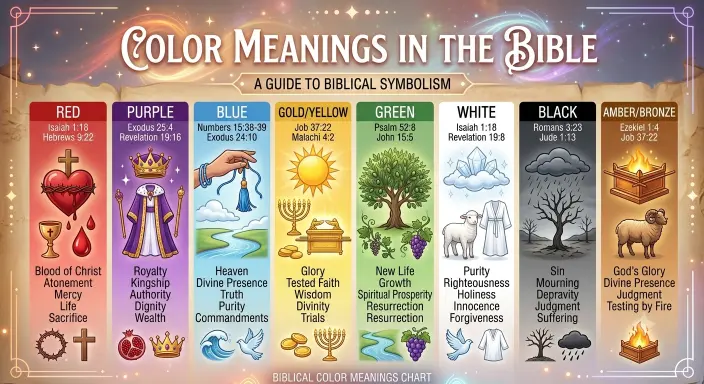
Colors appear throughout the Bible, yet they are rarely included by accident. From the blue threads on the garments of Israel’s priests to the brilliant white robes described in Revelation, biblical colors often carry symbolic meaning that helps readers understand God’s message more deeply. However, these meanings are usually based on the context of a passage rather than a fixed dictionary of color symbolism.Many people search for color meanings in the Bible to understand dreams, Bible studies, church decorations, Christian art, or personal spiritual reflection.
While some interpretations come directly from Scripture, others developed later through Christian tradition. Therefore, it is helpful to distinguish between what the Bible clearly teaches and what believers have symbolically associated with colors over time.
In this guide, you’ll discover the biblical symbolism of major colors, how they were used in worship and prophecy, their historical significance, and why these colors continue to inspire faith today.
Quick Answer
In the Bible, colors often represent spiritual truths rather than fixed meanings. White commonly symbolizes purity and holiness, red points to sacrifice and redemption, blue reflects heaven and God’s commandments, purple represents royalty and kingship, gold signifies God’s glory, while black and scarlet may symbolize judgment, sin, or mourning depending on the biblical context. The meaning always depends on the surrounding passage rather than the color alone.
What Do Color Meanings in the Bible Represent?
Biblical colors serve as visual symbols that help communicate God’s character, covenant, worship, judgment, redemption, and hope. Unlike modern color psychology, Scripture does not assign one universal meaning to every color.
Instead, colors gain significance through:
- The historical setting
- The purpose of the passage
- Temple worship
- Priestly garments
- Prophetic visions
- Cultural customs of ancient Israel
As a result, the same color may represent different ideas in different books of the Bible.
For example, red may symbolize both the blood that brings salvation and the violence associated with war. Likewise, white can represent righteousness, while pale white in another context may simply describe appearance.
Understanding these differences helps readers avoid oversimplifying biblical symbolism.
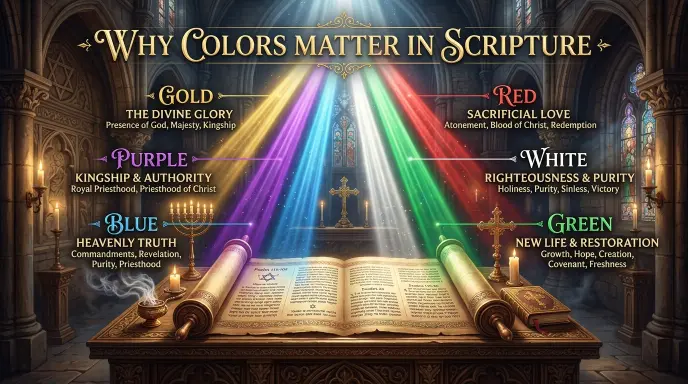
Why Colors Matter Throughout Scripture
The Bible frequently uses colors to communicate spiritual realities without lengthy explanations.
Colors appear in:
- The Tabernacle
- The Temple
- Priestly clothing
- Sacred curtains
- Precious stones
- Prophetic visions
- Heavenly worship
- The Book of Revelation
- Symbolic dreams
These visual details remind readers that God often teaches through images as well as words.
White in the Bible: Purity, Holiness, and Victory
White is one of the most recognizable biblical colors.
It commonly symbolizes:
- Purity
- Holiness
- Forgiveness
- Righteousness
- Eternal life
- Spiritual victory
Throughout Revelation, believers wear white robes to represent cleansing through Christ.
Jesus’ clothing became dazzling white during the Transfiguration, reflecting divine glory.
Angels are also frequently described as wearing white garments, reinforcing ideas of holiness and heavenly presence.
Positive Associations
- Innocence
- New beginnings
- Cleansing
- Faithfulness
- Resurrection
- Hope
Important Context
Although white generally carries positive symbolism, every passage should still be interpreted within its biblical setting.
Red in the Bible: Sacrifice, Blood, and Redemption
Red appears throughout Scripture with several important meanings.
Most commonly it represents:
- Blood
- Sacrifice
- Atonement
- Redemption
- Life
- Covenant
The Passover lamb’s blood protected Israel.
Later, Christ’s sacrifice fulfilled this picture through His death on the cross.
However, red can also symbolize:
- War
- Judgment
- Violence
- Sin
Isaiah famously declares:
“Though your sins are like scarlet, they shall be as white as snow.”
This contrast emphasizes God’s power to forgive.
Blue in the Bible: Heaven and God’s Commands
Blue holds special significance in biblical worship.
God instructed Israel to include blue thread in priestly garments and sacred curtains.
Blue often points toward:
- Heaven
- God’s presence
- Obedience
- Divine truth
- Faithfulness
The Israelites also wore blue tassels as reminders to obey God’s commandments.
Rather than representing emotion, blue often reminds believers to keep their focus on God.
Purple in the Bible: Royalty and Kingship
Purple dye was extremely expensive in the ancient world.
Consequently, purple became associated with:
- Kings
- Wealth
- Authority
- Honor
- Royal dignity
The Tabernacle included purple fabrics.
Jesus also wore a purple robe during His trial—not as an honor, but as mockery by Roman soldiers. Ironically, this act highlighted His true identity as King.
Gold in the Bible: God’s Glory and Divine Majesty
Gold symbolizes:
- God’s glory
- Purity
- Majesty
- Holiness
- Eternal value
The Ark of the Covenant contained gold.
Temple furnishings also featured gold extensively.
In Revelation, the heavenly city shines with pure gold, symbolizing God’s eternal kingdom.
Gold consistently points readers toward something precious and enduring.
Silver in the Bible: Redemption and Refinement
Silver often represents:
- Redemption
- Refinement
- Purification
- Value
The Silver was commonly used in temple offerings.
The refining process also became a metaphor for God’s work in shaping His people through trials.
However, silver also reminds readers of Judas’ betrayal, showing that symbols may carry different meanings depending on context.
Green in the Bible: Life, Growth, and Restoration
Although green appears less often than some other colors, it usually reflects:
- New life
- Fruitfulness
- Prosperity
- Renewal
- God’s provision
Green pastures in Psalm 23 illustrate God’s loving care for His people.
Throughout Scripture, flourishing vegetation often symbolizes spiritual blessing.
Black in the Bible: Mourning, Judgment, and Suffering
Black generally appears during difficult circumstances.
It may symbolize:
- Mourning
- Famine
- Judgment
- Sorrow
- Affliction
Prophetic books frequently use darkness and black imagery when describing national disaster.
Still, black is not presented as inherently evil. Instead, it often reflects the seriousness of a situation.
Scarlet in the Bible: Sin and Salvation
Scarlet has a unique place in biblical symbolism.
It can represent:
- Sin
- Sacrifice
- Cleansing
- Covenant
- Redemption
Scarlet thread appeared in purification ceremonies.
Rahab’s scarlet cord also became a sign of protection and deliverance.
Thus, scarlet demonstrates how one symbol can communicate both human sinfulness and God’s saving grace.
Biblical Color Symbolism in the Tabernacle
One of the clearest examples of biblical color symbolism appears in the Tabernacle.
Its fabrics included:
- Blue
- Purple
- Scarlet
- Fine white linen
- Gold
Together, these colors reflected:
- God’s holiness
- Heavenly authority
- Royal majesty
- Sacrifice
- Purity
Rather than being decorative choices alone, these colors reinforced spiritual truths during worship.
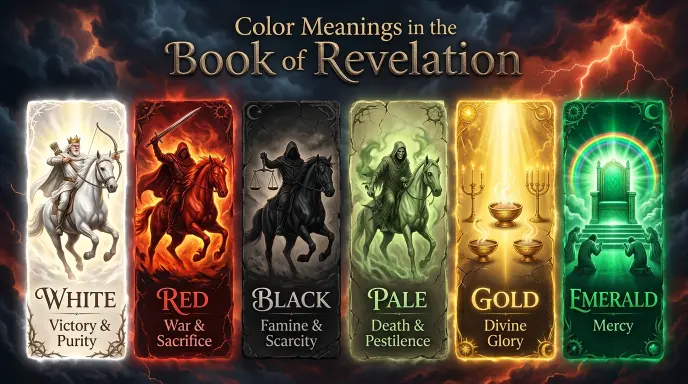
Color Meanings in the Bible Revelation
Revelation contains some of the Bible’s richest color imagery.
Examples include:
- White horses
- White robes
- Golden lampstands
- Emerald rainbow
- Fiery red dragon
- Black horse
- Pale horse
These colors contribute to symbolic visions that communicate judgment, victory, hope, and God’s ultimate reign.
Since Revelation uses apocalyptic language, colors should be interpreted carefully within the broader message of the book.
Historical Background of Biblical Colors
Producing colorful fabric in biblical times required expensive natural dyes.
For example:
- Purple came from sea snails.
- Blue dyes required rare materials.
- Scarlet often came from insects.
- Gold and silver were precious metals.
Because of their cost, many colors naturally became symbols of wealth, honor, and sacred worship.
Understanding this history explains why Scripture frequently connects these colors with royalty and holiness.
Do Biblical Colors Have Fixed Meanings?
Not always.
One of the biggest misconceptions is believing every biblical color has exactly one spiritual definition.
Instead:
- Context matters.
- Literary style matters.
- Historical setting matters.
- Audience matters.
- Purpose matters.
Responsible Bible study avoids assigning universal meanings without considering the surrounding passage.
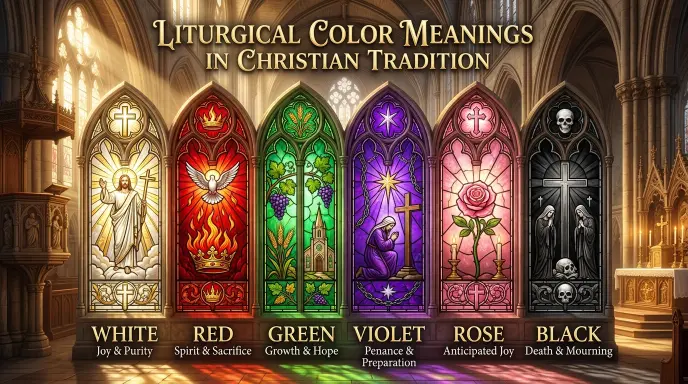
Color Meanings in Christian Tradition
Beyond Scripture, Christians throughout history have associated colors with seasons of worship.
For example:
- White often represents Easter and Christmas.
- Purple is used during Advent and Lent.
- Red symbolizes Pentecost and martyrdom.
- Green reflects ordinary time and spiritual growth.
These traditions help teach biblical themes but should not be confused with direct biblical commands.
Everyday Lessons from Biblical Color Symbolism
Biblical colors continue to influence modern life.
They appear in:
- Church architecture
- Christian art
- Bible illustrations
- Worship banners
- Religious holidays
- Personal devotion
- Inspirational design
Many believers also appreciate these colors as reminders of biblical truths rather than mystical formulas.
Common Misconceptions About Color Meanings in the Bible
Every color has one fixed meaning.
False. Most colors carry multiple meanings depending on context.
Every symbolic interpretation comes directly from Scripture.
Not necessarily. Many modern interpretations come from later Christian tradition.
Colors predict spiritual messages.
The Bible does not teach that colors alone reveal God’s will. Scripture emphasizes wisdom, context, and discernment.
Biblical symbolism replaces careful Bible study.
No. Symbols enrich understanding but should never override the plain meaning of Scripture.
Frequently Asked Questions
What do colors symbolize in the Bible?
They often communicate spiritual truths such as holiness, redemption, kingship, judgment, hope, and God’s presence. Their meaning depends on the biblical context.
What is the most important color in the Bible?
There is no single most important color. White, blue, purple, red, gold, and scarlet all play significant roles in different parts of Scripture.
Does every biblical color have a spiritual meaning?
No. Some colors clearly carry symbolic significance, while others simply describe objects or appearances.
What does white represent in the Bible?
White generally symbolizes purity, righteousness, forgiveness, holiness, and victory.
Why is purple important in Scripture?
Purple was associated with royalty, wealth, honor, and kingship because it was extremely valuable in the ancient world.
What does blue symbolize in the Bible?
Blue often represents heaven, God’s presence, faithfulness, and obedience to His commandments.
Does red always represent sin?
No. Red may symbolize sacrifice, blood, redemption, covenant, war, or judgment depending on the passage.
What does gold symbolize?
Gold consistently points toward God’s glory, holiness, eternal value, and divine majesty.
Are biblical color meanings accepted by all Christians?
Most Christians agree on many major symbols found directly in Scripture. However, interpretations of some colors vary among denominations and traditions.
Can biblical colors help with Bible study?
Yes. Understanding historical and literary symbolism can deepen appreciation of Scripture, provided colors are interpreted within their proper context.
Final Thoughts
The color meanings in the Bible reveal how visual details can enrich our understanding of Scripture. Rather than offering a rigid code for interpreting every passage, biblical colors invite readers to pay closer attention to context, history, and God’s unfolding message. White reminds us of holiness, red points to sacrifice and redemption, blue draws our thoughts toward heaven and obedience, while purple and gold reflect divine kingship and glory.
By studying these symbols carefully, we gain a deeper appreciation for the richness of the biblical narrative. At the same time, it is wise to distinguish between meanings clearly supported by Scripture and interpretations that developed later in Christian tradition. When read in context, biblical colors become more than artistic details—they become meaningful signposts that illuminate faith, worship, and the story of God’s relationship with humanity.

Emma Wilson is a dedicated comparison writer and product researcher at ColorMystiic.com. She specializes in creating unbiased product comparisons, detailed reviews, and helpful buying guides. Her goal is to help readers make smarter purchasing decisions with confidence.