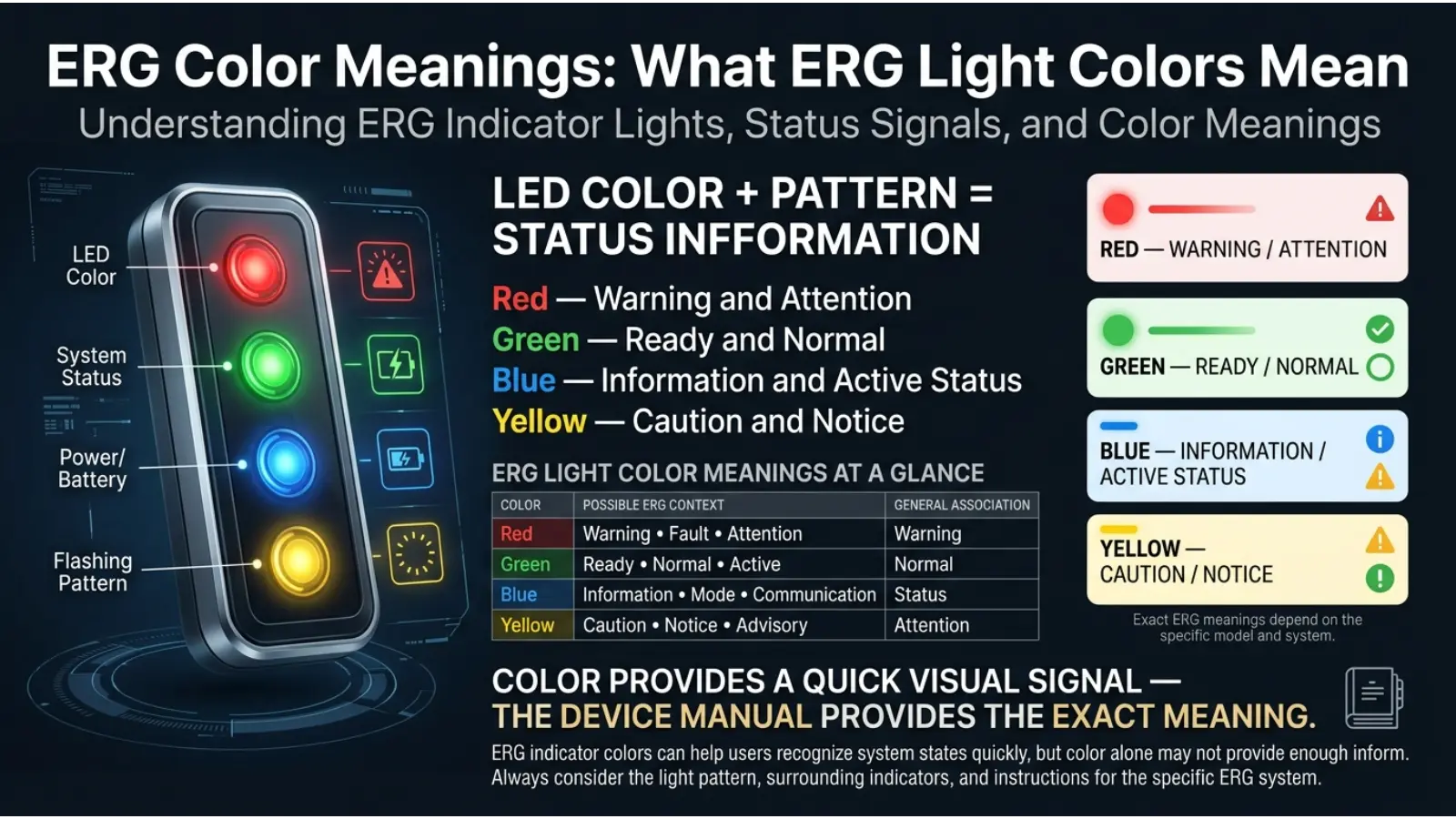
ERG color meanings usually refer to the colors used on an ERG light, indicator, display, or electronic system to communicate information quickly. However, the exact meaning of an ERG color can change depending on the device, manufacturer, software, or system where it appears.
Unlike traditional colors such as red, blue, or green, ERG colors do not have one universal meaning. Instead, these colors often work as visual signals. They can show that a device is operating normally, waiting for input, connecting to another system, charging, experiencing an error, or requiring attention.
People search for ERG color meanings because colored lights can be confusing. A green light may mean everything is working correctly on one device, while a flashing green light could mean activity or connection on another. Similarly, red often signals a warning, but its exact level of urgency depends on the system.
Understanding the context behind the light is therefore more useful than relying only on general color symbolism.
Quick Answer
ERG color meanings depend on the specific device or system. Generally, green may indicate normal operation, red may signal an error or warning, yellow or orange may show caution, and blue or white may represent connection, standby, or system activity. Always check the device’s official instructions because ERG color meanings are not universally standardized.
What Does ERG Mean in Color Indicators?
When ERG is associated with lights or electronic indicators, the letters alone do not automatically define a specific color system. Different industries and manufacturers may use the term differently.
For this reason, an ERG indicator color should always be interpreted according to its environment.
For example, an ERG light on:
- Electronic equipment may show system status.
- A medical device may communicate operating conditions.
- Industrial equipment may signal machine activity.
- A computer system may display connection or performance information.
- A charging device may show battery status.
- A smart device may use colors for notifications.
Therefore, the same color can communicate different information in different situations.
Why Are Colors Used for ERG Indicators?
Colors allow people to understand information quickly.
Imagine looking at a machine with only written messages. You would need to read each message before understanding whether the machine was operating correctly. Colored indicators can make the situation easier to recognize at a glance.
For example:
| ERG Indicator Color | Common General Meaning | What It May Suggest |
|---|---|---|
| 🟢 Green | Normal or ready | System operating correctly |
| 🔴 Red | Error or danger | Immediate attention may be needed |
| 🟡 Yellow | Warning or caution | Check the system soon |
| 🟠 Orange | Alert or transition | A condition requires awareness |
| 🔵 Blue | Connection or activity | Bluetooth, network, or active mode |
| ⚪ White | Power or standby | Device is powered or waiting |
| 🟣 Purple | Special mode | Depends heavily on the device |
These meanings are common patterns rather than universal rules.
Green ERG Light Meaning
Green is one of the most commonly used colors in electronic and industrial indicator systems.
Common Green Meanings
A green ERG light may indicate:
- Normal operation
- Successful connection
- Ready status
- Completed process
- Safe condition
- Fully charged battery
- Permission to continue
Green works well because many people already associate it with safety and movement.
Traffic signals provide a familiar example. Green tells drivers that movement is permitted. Because of this long-established association, designers often use green to communicate success or readiness.
However, a flashing green ERG light may have a different meaning from a solid green light.
For example:
Solid green: Normal operation.
Flashing green: Activity, connection, processing, or another changing condition.
The pattern of the light can therefore be just as important as the color.
Red ERG Light Meaning
Red is usually the strongest warning color.
In many ERG systems, a red indicator may suggest:
- System error
- Critical warning
- Fault detection
- Overheating
- Low battery
- Failed connection
- Emergency condition
Red attracts attention quickly because it has strong visual contrast in many environments.
However, not every red light means immediate danger.
On some devices, red simply means:
- Battery is charging.
- Recording is active.
- A notification is waiting.
- Power is turned on.
Therefore, context always matters.
Why Red Feels Urgent
Red has strong symbolic associations with:
- Danger
- Stop signals
- Emergency situations
- Blood
- Fire
- Warning signs
Because of these associations, people often react to red more quickly than neutral colors.
Designers use this psychological connection carefully. A red ERG indicator can immediately tell users that something deserves attention.
Yellow ERG Light Meaning
Yellow commonly represents caution.
A yellow ERG light may indicate:
- Warning
- Reduced performance
- Temporary issue
- Maintenance requirement
- Battery becoming low
- System waiting
- Attention recommended
Yellow is visually positioned between green and red in many warning systems.
This creates a simple mental pattern:
Green = Continue
Yellow = Be Careful
Red = Stop or Check Immediately
This pattern is easy for many users to understand because it appears in transportation, machinery, safety systems, and technology.
Orange ERG Light Meaning
Orange is often used when a system needs attention but the situation is not necessarily critical.
Possible orange meanings include:
- Charging
- Alert
- Maintenance
- Updating
- Temporary system condition
- Reduced battery
- Special operating mode
Orange sits visually between yellow and red. As a result, it can communicate stronger attention than yellow without always suggesting a serious failure.
For example, a device may use orange to indicate that:
The system is working, but something is changing.
This makes orange useful for transitional conditions.
Blue ERG Light Meaning
Blue indicators are commonly associated with technology.
Depending on the device, a blue ERG light may represent:
- Bluetooth connection
- Wireless activity
- Network connection
- Active system mode
- Data transfer
- Cooling
- Information status
Blue generally feels less urgent than red or orange.
In technology and branding, blue is often associated with:
- Reliability
- Stability
- Trust
- Communication
- Intelligence
However, these psychological associations do not automatically determine the technical meaning of a blue indicator.
The manufacturer decides what the blue light represents.
White ERG Light Meaning
White lights often communicate a neutral system state.
A white ERG indicator may mean:
- Device is powered on
- Standby mode
- Normal illumination
- Connection status
- Default operating mode
- General notification
White is often used because it appears clean and neutral.
However, white lights can become difficult to see in bright environments. Therefore, some devices use white primarily for indoor equipment or displays.
Purple ERG Light Meaning
Purple is less common in traditional warning systems.
When purple appears in an ERG indicator system, it may represent:
- Special mode
- Custom setting
- Advanced feature
- Mixed system status
- Unique manufacturer function
Purple does not have a widely shared technical meaning like red or green.
Therefore, purple indicators should always be checked against the device’s instructions.
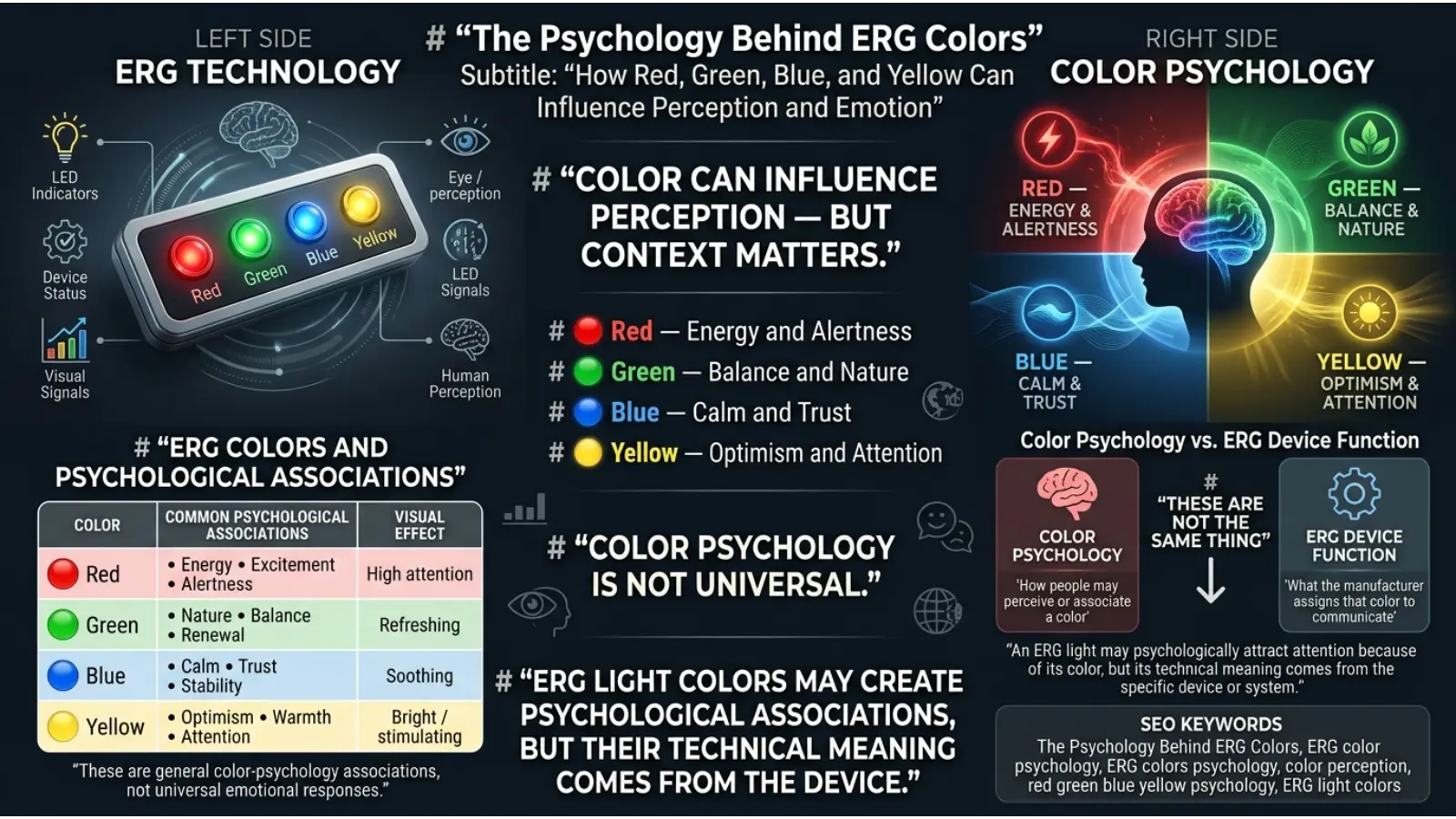
The Psychology Behind ERG Colors
ERG indicator colors work partly because humans learn to associate colors with certain actions.
However, color psychology should not be confused with technical standards.
For example:
- Red may attract attention.
- Green may feel safer or more positive.
- Yellow may encourage caution.
- Blue may feel calm or technological.
These associations can influence how quickly people understand an indicator.
Still, human reactions to color are affected by:
- Culture
- Personal experience
- Age
- Environment
- Lighting
- Previous exposure to technology
Therefore, color alone cannot communicate everything.
The best indicator systems often combine:
Color + Symbol + Text + Flashing Pattern
This reduces confusion and improves accessibility.
Why Flashing Patterns Change ERG Color Meanings
A light’s behavior can change its meaning.
For example, a solid green light and flashing green light may communicate completely different messages.
Solid Light
A solid light often represents a stable condition.
Examples include:
- Connected
- Ready
- Operating normally
- Power active
Slow Flashing Light
Slow flashing may indicate:
- Waiting
- Searching
- Connecting
- Standby activity
Fast Flashing Light
Rapid flashing may represent:
- Active processing
- Data transfer
- Warning
- Urgent notification
Alternating Colors
Some ERG systems may switch between colors.
For example:
Red and blue alternating: A special alert or connection mode.
Green and orange alternating: A transition or processing state.
Again, these are general possibilities. The actual meaning depends on the product.
ERG Color Meanings and Safety
Colors are frequently used in safety communication because they can be recognized quickly.
However, relying only on color can create problems.
Some people have difficulty distinguishing certain colors. For example, red-green color vision differences may make it harder to interpret traditional indicator systems.
For this reason, good ERG indicator design should also include:
- Symbols
- Labels
- Audible alerts
- Different flashing patterns
- Screen messages
A well-designed system should not depend entirely on color.
Cultural Differences in ERG Color Meanings
Technical indicator systems often use internationally familiar patterns, but cultural associations can still influence how people interpret colors.
Green
In many cultures, green is associated with:
- Growth
- Nature
- Permission
- Safety
- Renewal
This makes it useful for positive system messages.
Red
Red can represent:
- Danger
- Warning
- Energy
- Celebration
- Good fortune
For example, red has positive cultural meanings in several Asian traditions. Therefore, symbolic meaning and technical meaning may not always match.
White
White can symbolize:
- Cleanliness
- Simplicity
- Peace
However, its cultural symbolism varies across different regions.
Blue
Blue is often associated with:
- Calmness
- Trust
- Stability
- Communication
Modern technology has strengthened the connection between blue and digital communication.
The Important Difference
Cultural symbolism influences emotional interpretation.
Technical instructions determine functional meaning.
Therefore, an ERG indicator should always be interpreted according to the device rather than cultural symbolism alone.
Historical Development of Colored Indicators
Colored signaling systems developed because people needed faster ways to communicate information.
Over time, transportation systems, factories, electrical equipment, computers, and consumer electronics adopted color-coded signals.
The familiar red-yellow-green pattern became especially influential in systems involving:
- Traffic control
- Industrial machinery
- Safety equipment
- Operational status
As technology developed, additional colors such as blue, white, and purple became more common.
Modern LED technology made it easier for manufacturers to create:
- Multiple colors
- Changing colors
- Flashing patterns
- Custom notification systems
As a result, today’s ERG color meanings may be more complex than traditional warning lights.
ERG Colors in Technology and Electronic Devices
Electronic devices often use colors to reduce the need for written messages.
A single indicator can communicate different stages of operation.
For example:
| Device Condition | Possible Color Signal |
|---|---|
| Normal operation | 🟢 Green |
| Charging | 🟠 Orange or 🔴 Red |
| Fully charged | 🟢 Green |
| Low battery | 🟡 Yellow or 🔴 Red |
| Wireless connection | 🔵 Blue |
| Standby | ⚪ White |
| Error | 🔴 Red |
The exact system can vary significantly.
Therefore, never assume that a color has the same meaning across every product.
ERG Indicator Colors in Industrial Settings
Industrial environments often require fast and clear communication.
Colored indicators may help workers understand:
- Machine status
- Production activity
- System errors
- Maintenance requirements
- Safety conditions
For example:
Green: Machine operating normally.
Yellow: Maintenance or attention needed.
Red: Fault or emergency condition.
However, industrial systems may follow specific safety standards and workplace procedures. Workers should follow official training rather than relying on general color meanings.
ERG Colors in Medical and Technical Equipment
Medical and technical equipment may use color-coded indicators to communicate important information.
However, meanings can differ between manufacturers.
A color may indicate:
- Equipment status
- Connection
- Measurement activity
- Battery condition
- Alarm level
Medical equipment should never be interpreted using general color psychology alone.
If an unfamiliar red, orange, or flashing ERG light appears on a medical device, users should follow the device instructions or contact a qualified professional.
How Lighting Changes ERG Color Appearance
Lighting can dramatically change how indicator colors look.
A green light may appear weaker under bright sunlight. A yellow light may appear closer to orange under warm lighting.
Several factors affect color appearance:
Brightness
A brighter LED can appear more intense.
Ambient Light
Sunlight and strong room lighting can reduce visibility.
Viewing Angle
Some displays look different when viewed from the side.
Screen Settings
Digital interfaces may change colors depending on display calibration.
Color Temperature
Warm lighting can make colors appear more yellow or orange.
Therefore, the appearance of an ERG indicator may not always match its intended color perfectly.
How Age Can Affect ERG Color Interpretation
Color perception can change with age.
Older adults may experience reduced sensitivity to certain visual differences. Small indicator lights may also become harder to see.
Designers can improve usability by using:
- Larger indicators
- Strong contrast
- Clear labels
- Symbols
- Audible notifications
This approach makes ERG systems easier to understand for a wider range of users.
Personality Associations With ERG Colors
The colors used by ERG indicators are designed primarily for communication, not personality testing.
Still, people often associate certain colors with personality characteristics.
For example:
- Green may be linked with balance and calmness.
- Red may be linked with energy and confidence.
- Blue may be linked with trust and stability.
- Yellow may be linked with optimism.
- Purple may be linked with creativity.
However, preferring a particular indicator color does not determine a person’s personality.
Color preferences can change depending on mood, culture, trends, and personal experience.
ERG Colors in Branding and Marketing
Color-coded systems influence branding because users quickly develop emotional associations with colors.
Technology companies often use:
- Blue for trust and communication.
- Green for growth and success.
- Red for attention and urgency.
- Orange for energy and action.
- Purple for creativity and uniqueness.
However, brands do not use colors only because of psychology.
They also consider:
- Industry expectations
- Competition
- Accessibility
- Cultural audiences
- Product personality
The same color can produce different results depending on how it is combined with typography, images, and design.
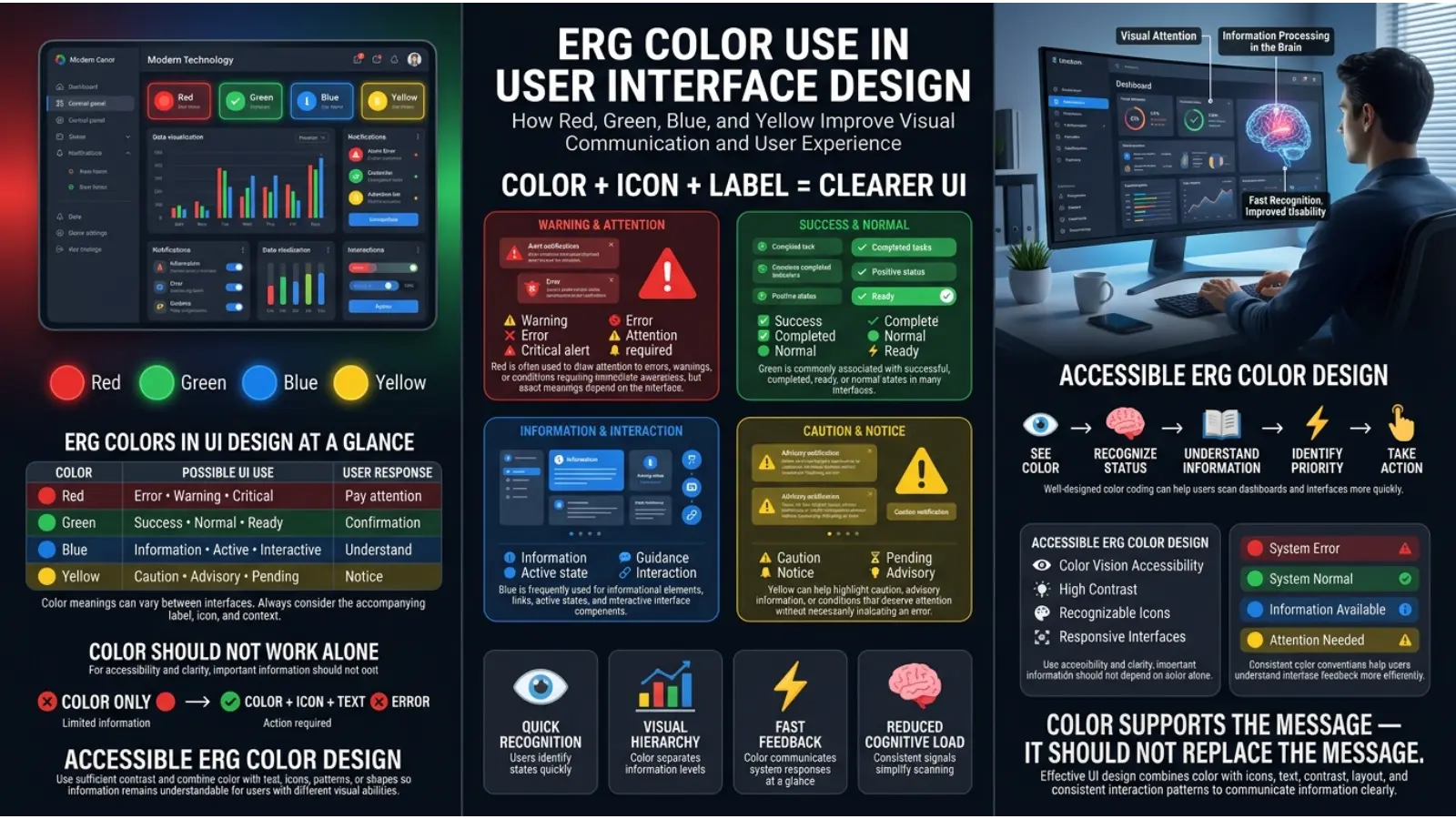
ERG Color Use in User Interface Design
Digital designers often use colors to guide user behavior.
For example:
Green button: Confirm or continue.
Red button: Delete or stop.
Yellow message: Warning.
Blue button: Information or navigation.
However, good interface design should not depend on these conventions alone.
A delete button should include a clear label rather than relying only on red.
This is especially helpful for users with color vision differences.
Practical Color Combinations for ERG Indicators
The best indicator combinations provide strong contrast.
Green and Red
Useful for showing:
Normal vs. Error
However, designers should add symbols because some users cannot easily distinguish these colors.
Green and Yellow
Useful for:
Ready vs. Caution
This combination works well when paired with labels.
Blue and White
Often used for:
Technology and Connection
The combination can feel clean and modern.
Orange and Blue
This combination creates strong visual contrast.
It can help users quickly distinguish between different system modes.
Common Misconceptions About ERG Color Meanings
Misconception: Every ERG Color Has One Universal Meaning
This is false.
Different manufacturers can assign different meanings to the same color.
Misconception: Red Always Means Danger
Not necessarily.
Red may also represent charging, recording, or an active notification.
Misconception: Green Always Means Everything Is Perfect
A green light may simply mean that one specific function is active.
Other problems could still exist.
Misconception: Color Psychology Explains Technical Indicator Colors
Color psychology may influence design choices, but technical meanings are determined by the system designer.
Misconception: Flashing and Solid Lights Mean the Same Thing
Often, they do not.
The flashing pattern may contain additional information.
Real-World Applications of ERG Color Meanings
Daily Technology
Phones, computers, routers, chargers, and smart devices use colors to communicate status.
Business Equipment
Printers, servers, security systems, and office machines often use color indicators.
Manufacturing
Machines use colored signals to show operating conditions.
Transportation
Color signals help communicate movement, caution, and stopping conditions.
Entertainment
Gaming devices and LED systems use colors to show modes, player status, and notifications.
Home Electronics
Smart lights and appliances use changing colors to communicate connection and operating status.
Sports Technology
Electronic scoreboards, wearable devices, and training equipment may use color to display performance information.
How to Correctly Understand an ERG Light Color
If you see an unfamiliar ERG indicator, follow these steps.
1. Identify the Device
First, determine exactly which product or system displays the light.
2. Check the Light Pattern
Is the light:
- Solid?
- Flashing slowly?
- Flashing quickly?
- Changing colors?
3. Look for Symbols
Many devices include symbols near the indicator.
4. Check the Device Display
An error message may explain the color.
5. Consider Recent Activity
Did you recently:
- Charge the device?
- Connect Bluetooth?
- Update software?
- Change a setting?
- Start recording?
The recent activity may explain the indicator.
6. Follow Official Instructions
This is the most reliable method.
General ERG color meanings can provide clues, but the device documentation provides the correct interpretation.
Why Context Changes ERG Color Meaning
Context is the most important part of understanding colored indicators.
Consider the color red.
On a charger, it may mean:
Charging
On a camera, it may mean:
Recording
On a machine, it may mean:
Fault
On a warning system, it may mean:
Emergency
The color stays the same, but the message changes.
This demonstrates an important principle of color communication:
Colors do not communicate meaning independently. People interpret them through context.
Frequently Asked Questions About ERG Color Meanings
What do ERG colors mean?
ERG colors usually represent different device, system, or indicator statuses. Their exact meanings depend on the specific equipment or manufacturer.
Does a green ERG light mean everything is working?
Often, green indicates normal operation or readiness. However, its exact meaning depends on the device.
Why is my ERG light red?
A red ERG light may indicate an error, warning, charging status, recording activity, or another function. Check the device instructions for the correct meaning.
What does a flashing ERG light mean?
A flashing light may indicate activity, connection, waiting, processing, or a warning. The flashing speed can also change the meaning.
What does an orange ERG indicator mean?
Orange commonly represents an alert, charging process, maintenance condition, or temporary status. However, the meaning varies by device.
Is blue an ERG warning color?
Blue is usually associated with connection, wireless activity, information, or a special operating mode rather than a serious warning. Still, the device manufacturer determines the meaning.
Are ERG color meanings universal?
No. Some general color conventions exist, but ERG color meanings are not universal across all devices and systems.
Why do ERG lights use different colors?
Different colors help users recognize system conditions quickly. Colors can communicate normal operation, warnings, errors, connections, and activity.
Does lighting affect how ERG colors look?
Yes. Sunlight, room lighting, screen brightness, viewing angle, and color temperature can all affect how an indicator appears.
Should I rely only on the color of an ERG indicator?
No. Check symbols, flashing patterns, messages, and official device instructions for the most accurate interpretation.
Final Thoughts on ERG Color Meanings
ERG color meanings are best understood as a visual communication system rather than a fixed collection of universal color definitions. Green may suggest normal operation, red may draw attention to an error or active function, yellow and orange may signal caution, while blue and white often communicate connection, information, or standby status.
Still, the most important factor is context. A color’s meaning can change based on the device, industry, lighting, flashing pattern, and manufacturer.
Understanding general color symbolism can help you make an educated first guess. However, technical indicator colors should always be confirmed using the specific system’s instructions. Once you begin paying attention to both color and context, ERG lights become easier to read and far more useful in everyday technology and equipment.

Emma Wilson is a dedicated comparison writer and product researcher at ColorMystiic.com. She specializes in creating unbiased product comparisons, detailed reviews, and helpful buying guides. Her goal is to help readers make smarter purchasing decisions with confidence.