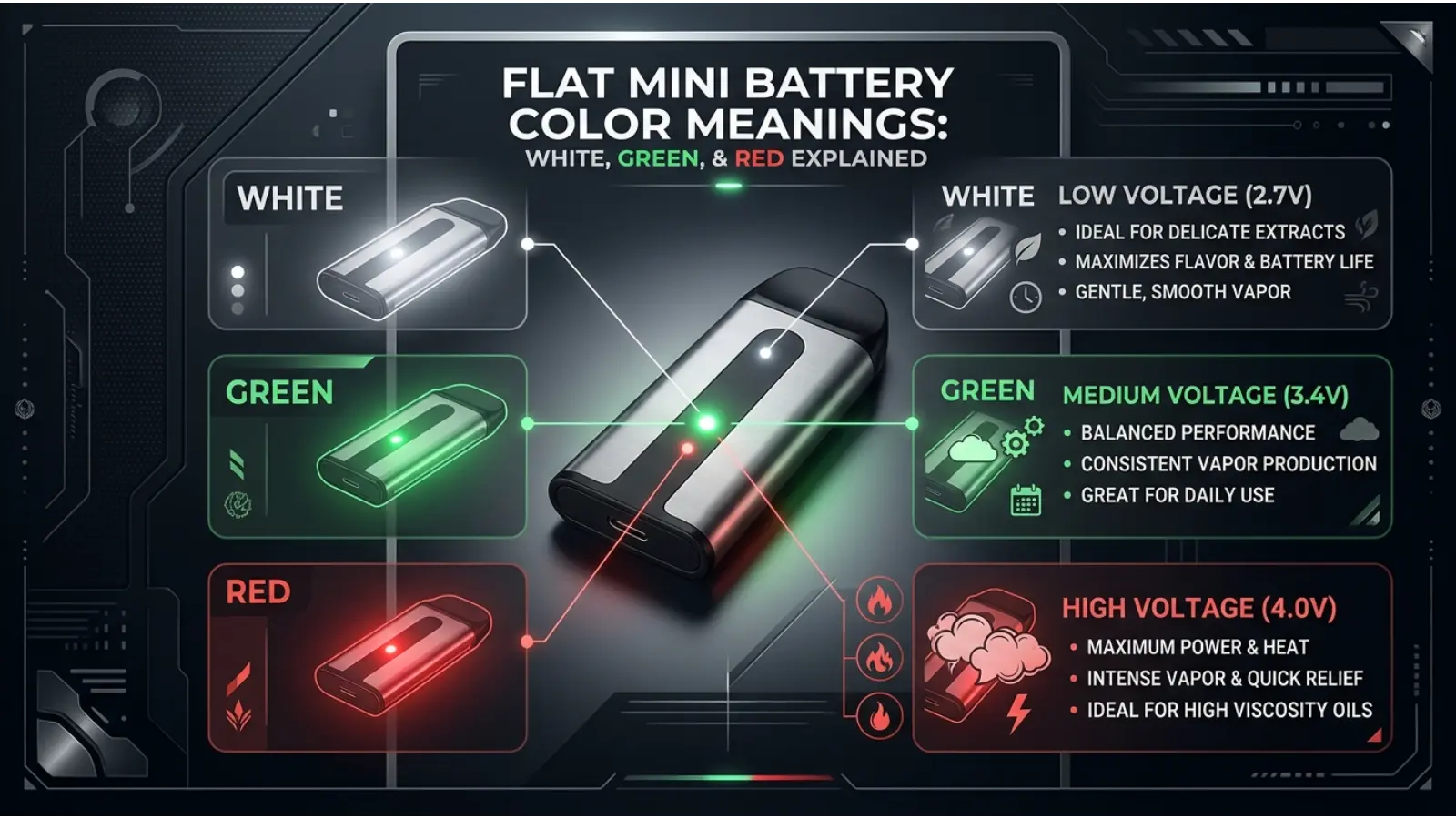
If you are looking for flat mini battery color meanings, you are probably trying to figure out what the different lights on your battery are telling you. The answer is simpler than it may first appear. On the Yocan FLAT Series, the indicator colors are used as a visual way to identify different voltage settings.
The three main indicator colors are white, green, and red. They correspond to 2.6V, 3.2V, and 3.8V, respectively. So, rather than treating these colors as ordinary symbols of emotions or personality, it is better to understand them as part of the device’s control system.
That distinction matters because color has no single universal meaning. Red might represent danger in one situation, celebration in another, and a high setting on an electronic device. Context gives color its meaning.
This guide explains the flat mini battery color meanings, what each indicator represents, how the colors differ from traditional color psychology, and how to avoid common misunderstandings.
Quick Answer
Flat Mini battery colors generally indicate voltage settings:
| Indicator Color | Setting | Voltage |
|---|---|---|
| ⚪ White | Low | 2.6V |
| 🟢 Green | Medium | 3.2V |
| 🔴 Red | High | 3.8V |
Always check the instructions supplied with your exact device because LED behavior can vary between models.
Flat Mini Battery Color Meanings at a Glance
The easiest way to remember the system is:
White → Green → Red
2.6V → 3.2V → 3.8V
Low → Medium → High
This creates a simple visual progression.
White identifies the lowest preset. Green marks the middle setting. Red identifies the highest preset.
The important point is that these meanings come from the device’s indicator system. They are not universal meanings that apply to every battery or electronic product.
For example, another manufacturer could use blue for low power or yellow for a medium setting. Therefore, you should never assume that an LED color means the same thing on every device.
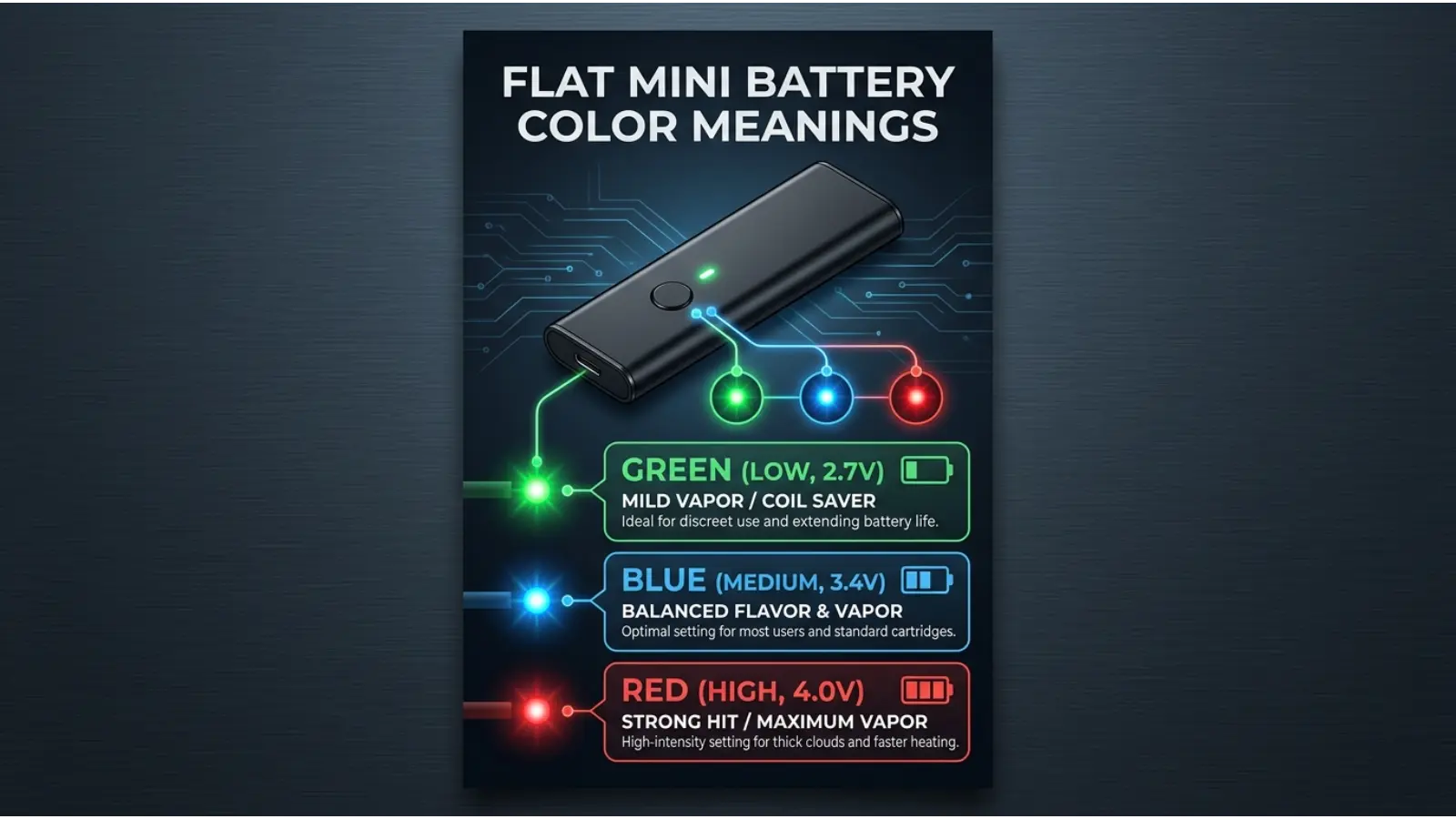
What Does White Mean on a Flat Mini Battery?
The white indicator represents the 2.6V low setting in the documented FLAT Series color system.
White is interesting because it carries many traditional associations outside technology. People often connect white with cleanliness, simplicity, peace, or minimalism. None of those symbolic meanings explain what the white LED means on this battery.
Here, white is simply a visual identifier for the lowest voltage option.
Why White Works as an Indicator
White is highly visible against a darker device body. Because it looks distinct from green and red, it gives users an easy way to recognize the low setting.
This is a good example of contextual color meaning. The same color can communicate completely different information depending on where it appears.
In a room, white might make a space feel clean and open. On a battery indicator, it can simply mean 2.6V.
What Does Green Mean on a Flat Mini Battery?
A green indicator represents the 3.2V medium setting.
Green has many positive associations in everyday life. It can suggest nature, growth, freshness, or balance. Traffic systems also commonly use green as a signal to proceed.
However, none of these traditional associations should be used to interpret the Flat Mini.
The green light has a specific technical job: it tells you that the device is at its middle voltage setting.
Why Green Is Easy to Remember
Green sits naturally between white and red in the Flat Mini’s three-color sequence.
That makes the system relatively easy to memorize:
White = low
Green = medium
Red = high
Once you learn this sequence, you do not need to remember the voltage number every time you look at the indicator.
What Does Red Mean on a Flat Mini Battery?
A red indicator represents the 3.8V high setting.
Red is one of the most visually noticeable colors, which makes it useful for drawing attention. In many other situations, red can communicate warnings, heat, urgency, or danger.
But on the Flat Mini, red does not automatically mean something is wrong.
If the indicator is showing red as part of the normal voltage-selection system, it means the device is at the 3.8V setting.
This is an important distinction because assuming that every red light means “warning” can lead to confusion.
Flat Mini Battery Color Meanings Chart
Here is the simplest reference chart for the three documented voltage colors:
| Color | Meaning on Flat Mini | Voltage | Level |
|---|---|---|---|
| ⚪ White | Low voltage | 2.6V | Low |
| 🟢 Green | Medium voltage | 3.2V | Medium |
| 🔴 Red | High voltage | 3.8V | High |
Think of this chart as a device-specific color code, not a general color psychology chart.
Why the Colors Should Not Be Confused With Color Psychology
Color psychology deals with how people perceive and associate colors. However, it does not mean every use of a color carries the same emotional message.
For instance:
- Red can suggest excitement or warning.
- Green can suggest nature or freshness.
- White can suggest simplicity or cleanliness.
Yet those meanings change when the colors are placed into a technical interface.
On a Flat Mini:
- White identifies 2.6V.
- Green identifies 3.2V.
- Red identifies 3.8V.
The device therefore gives the colors a functional meaning.
This is why understanding context is essential when researching color meanings.
Flat Mini Battery Body Colors Are Different
Another common source of confusion is the difference between the battery’s physical color and the indicator light.
A device may have a colorful exterior, but that does not necessarily tell you anything about its voltage setting.
For example, a battery with a purple, blue, black, silver, or pink exterior does not automatically have a special color meaning.
The body color is mainly related to appearance and personal preference.
The indicator light, meanwhile, serves a functional purpose.
Body Color vs. Indicator Color
| Feature | Purpose |
|---|---|
| Battery body color | Appearance and style |
| LED indicator color | Operating information |
| Voltage | Technical setting |
| Color psychology | Symbolic interpretation |
Keeping these categories separate makes the product much easier to understand.
Do Flat Mini Colors Indicate Battery Charge?
This is one of the most important misconceptions to avoid.
A color used for a voltage setting should not automatically be interpreted as a battery-charge percentage.
For example, seeing green does not necessarily mean the battery is fully charged simply because many electronic products use green to indicate a good charge level.
Likewise, seeing red does not automatically mean the battery is almost empty.
The documented Flat Series color system uses the three colors to identify voltage levels.
If your device displays a separate flashing pattern or charging light, consult the instructions for that particular model instead of applying assumptions from another device.
How Context Changes the Meaning of Color
The Flat Mini provides a useful lesson in how humans interpret color.
Imagine three different situations involving red.
The red traffic light can mean stop.
A red rose may symbolize love or romance.
A red LED on a device might represent a high setting.
The color has not changed. The surrounding system has changed.
That is why serious color analysis should never treat symbolism as a universal dictionary.
The meaning depends on:
- purpose,
- culture,
- environment,
- design conventions,
- personal experience,
- and the information surrounding the color.
Real-World Example: Checking Your Flat Mini Setting
Imagine you are looking at your Flat Mini and the indicator appears green.
Instead of asking what green traditionally symbolizes, look at the device’s indicator system.
In the FLAT Series color code, green corresponds to the medium 3.2V setting.
Now imagine the indicator changes to white. The relevant information changes to 2.6V.
If it changes to red, the corresponding documented setting is 3.8V.
This example shows why identifying the purpose of a color is often more useful than relying on general symbolism.
Why Manufacturers Use Color-Coded Indicators
Small electronic devices have limited space for screens and labels. A color-coded LED provides a compact way to communicate information.
Instead of displaying:
Voltage: 3.2V
a manufacturer can use a colored light as a quick visual signal.
That can make a small product easier to operate.
However, color indicators work best when the manufacturer provides clear documentation. Without a reference guide, users may interpret the same color differently.
For that reason, product manuals remain more reliable than general assumptions about LED colors.
Does Lighting Change How the Flat Mini Colors Look?
Yes. The surrounding environment can affect how an LED appears to your eyes or camera.
A white LED may look slightly bluish under some conditions. Green can appear darker in bright surroundings. Red can appear especially intense in a dark room.
Phone cameras can introduce another problem. Automatic white balance and exposure may change the appearance of LED colors in photographs.
Therefore, a picture of a Flat Mini should not be treated as a perfect color reference.
When accuracy matters, compare the behavior with the manufacturer’s instructions.
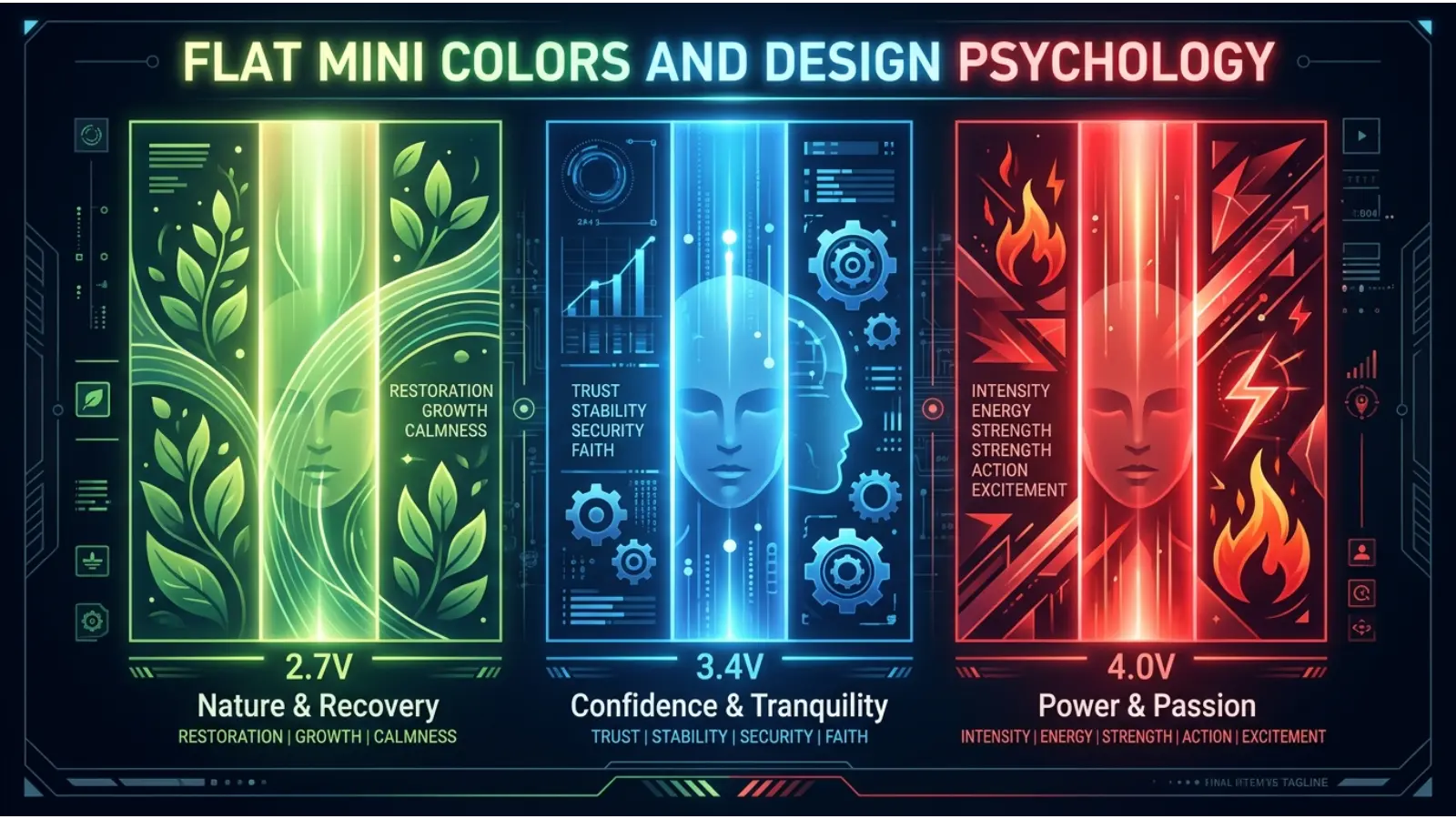
Flat Mini Colors and Design Psychology
Although the LED colors have technical meanings, their visual choices can still be examined from a design perspective.
White provides a clean visual distinction.
Green is easy to separate from both white and red.
Red is highly noticeable and therefore makes an effective marker for the highest setting.
This does not mean that users will automatically experience specific emotions because of these colors. Rather, it shows how designers can use differences in color to make information easier to recognize.
Good interface design often depends on visual contrast and consistency, not just symbolism.
Common Misconceptions About Flat Mini Battery Colors
Does Red Mean the Battery Is Empty?
No. Red is used for the 3.8V high setting in the documented voltage system.
Does Green Mean the Battery Is Fully Charged?
Not necessarily. Green identifies the 3.2V medium setting, rather than automatically indicating a charge percentage.
Does White Mean the Battery Is Off?
No. White is associated with the 2.6V low setting in the documented system.
Does the Body Color Change the Voltage?
The exterior color should not be assumed to determine the voltage. The indicator system communicates the selected setting.
Does Every Mini Battery Use These Colors?
No. Different manufacturers and models can use different LED systems.
Does Red Always Mean Danger?
No. Color meaning depends on context. On this device, red can indicate the high voltage setting.
Flat Mini Battery Colors vs. Traditional Color Meanings
The comparison below shows why context matters:
| Color | Common Symbolic Association | Flat Mini Meaning |
|---|---|---|
| White | Peace, simplicity | 2.6V low |
| Green | Nature, growth | 3.2V medium |
| Red | Energy, warning | 3.8V high |
This table should not be read as saying that the traditional associations are universal. Color symbolism varies significantly across cultures and situations.
The Flat Mini simply provides a clear technical example of how a product can assign its own meanings to familiar colors.
How to Remember the Flat Mini Color System
A simple memory trick is to think of the colors as moving upward:
⚪ White → 🟢 Green → 🔴 Red
Then connect them to:
2.6V → 3.2V → 3.8V
And finally:
Low → Medium → High
The three-step sequence is more useful than trying to attach emotional symbolism to each color.
Frequently Asked Questions
What are the Flat Mini battery color meanings?
The documented voltage indicator colors are white for 2.6V, green for 3.2V, and red for 3.8V.
What does a white Flat Mini light mean?
White identifies the 2.6V low-voltage setting in the FLAT Series indicator system.
What does a green Flat Mini light mean?
Green identifies the 3.2V medium setting.
What does a red Flat Mini light mean?
Red identifies the 3.8V high setting.
Is a red Flat Mini light a warning?
Not necessarily. In the standard voltage indicator system, red represents the high setting.
Does green mean the battery is charged?
You should not assume that. Green is used to identify the medium voltage setting.
Do the exterior colors of the Flat Mini have special meanings?
The exterior colors are primarily aesthetic choices. They should not be confused with the functional LED colors.
Why does my Flat Mini look like a different color in a photo?
Camera exposure, white balance, surrounding lighting, and screen settings can all change how an LED appears.
Are Flat Mini colors part of color psychology?
Not in the traditional sense. The colors are primarily being used as a technical interface to communicate voltage settings.
Should I use another battery’s color chart for my Flat Mini?
No. LED conventions can differ between products. The instructions for the specific model are the better reference.
Final Thoughts on Flat Mini Battery Color Meanings
The easiest way to understand flat mini battery color meanings is to forget traditional color symbolism for a moment and look at the device’s own visual language.
For the documented FLAT Series system, white corresponds to 2.6V, green to 3.2V, and red to 3.8V. These colors function as quick visual labels for different voltage settings.
The larger lesson is useful beyond this particular product. A color does not carry one permanent meaning everywhere. Context gives it purpose. Red can represent love, danger, celebration, or a technical setting. Green can suggest nature or simply identify a middle option. White can symbolize peace or indicate a low setting.
So when you see a colored light on an electronic device, the best question is not “What does this color usually mean?” Instead, ask “What does this manufacturer use this color to communicate?”
That small change in thinking can make color-based technology much easier to understand.

Emma Wilson is a dedicated comparison writer and product researcher at ColorMystiic.com. She specializes in creating unbiased product comparisons, detailed reviews, and helpful buying guides. Her goal is to help readers make smarter purchasing decisions with confidence.