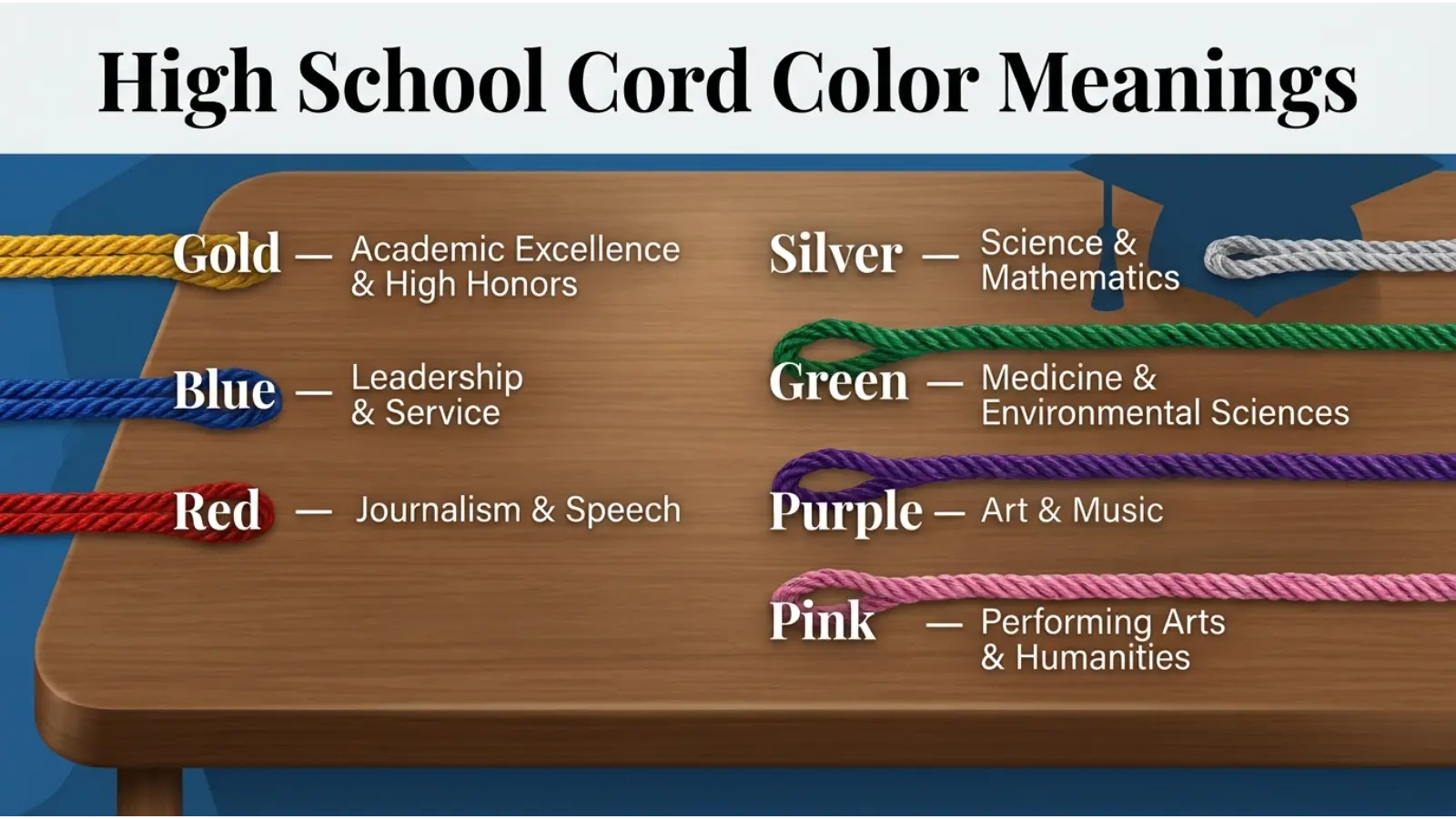
Graduation cords are among the most visible symbols worn during a high school commencement ceremony. A student may walk across the stage wearing one cord, several cords, or cords combined with medals and honor stoles. But what do the different colors actually mean?The answer is more complicated than a simple color chart. High school cord color meanings are not universal.
Schools, districts, honor societies, academic programs, and states can assign different meanings to the same color. For example, a gold cord may represent academic achievement at one school while another school may use it for membership in a particular organization.
Therefore, the best way to understand a graduation cord is to consider color, organization, achievement, school policy, and ceremony tradition together. This guide explains the most common high school graduation cord meanings, the symbolism behind popular colors, and how students can correctly identify what their cords represent.
Quick Answer: What Do High School Cord Color Meanings?
High school graduation cords usually identify academic honors, extracurricular achievements, leadership, community service, membership, or special programs. Common meanings include:
| Cord Color | Common Meaning | Important Note |
|---|---|---|
| Gold / Yellow | Academic honors, achievement, excellence | Often associated with high achievement, but school rules vary |
| White | Academic, service, arts, or special recognition | Meaning depends heavily on the school |
| Red | Leadership, achievement, or membership | May represent a specific organization |
| Blue | Academic achievement, leadership, or service | Common but not standardized |
| Green | Health sciences, environmental programs, service, or achievement | Institution-specific |
| Purple | Academic distinction, leadership, arts, or special programs | Not universally defined |
| Silver / Gray | Achievement, technology, special recognition | Less standardized |
| Orange | Career programs, technical achievement, or school-specific honors | Varies considerably |
| Black | Academic or organizational recognition | Often used differently by individual schools |
The most important rule is simple: your school’s graduation handbook or ceremony program is the final authority.
Why High School Cord Color Meanings Are Not Universal
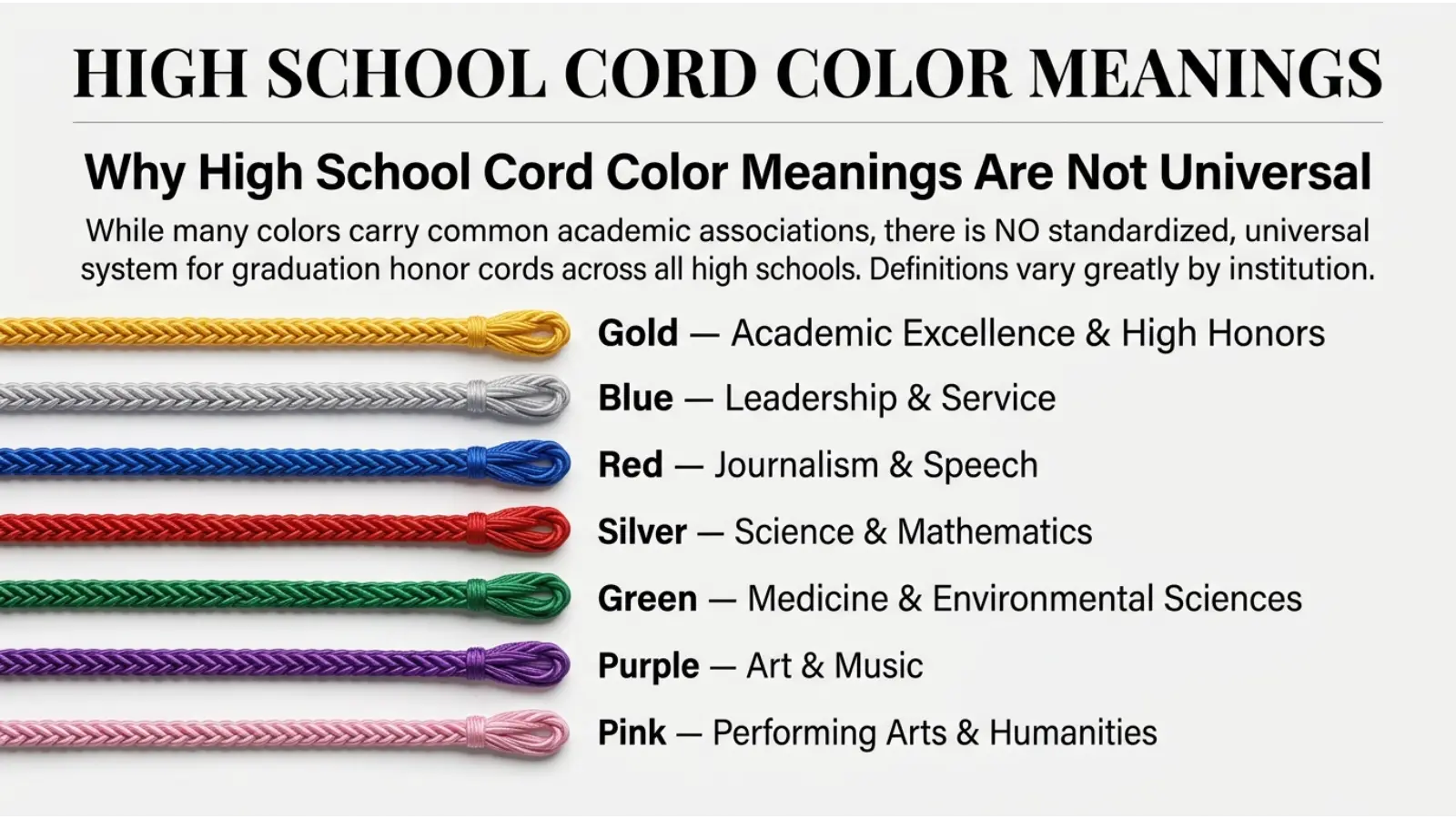
Unlike traffic signs or national flags, graduation cords do not have one worldwide color dictionary.
Instead, schools and organizations develop their own recognition systems. Consequently, two students in different schools can wear identical-looking cords while receiving them for completely different accomplishments.
For instance, one school might award a blue cord for National Honor Society membership, while another might use blue for a particular academic department. Similarly, gold might represent honor graduates in one district and a career-and-technical program in another.
This is why online graduation cord charts should be treated as general references rather than official rules.
The color provides a clue, but the organization awarding the cord provides the real meaning.
Gold and Yellow Graduation Cord Meaning
Gold and yellow cords are among the most recognizable graduation colors.
They commonly suggest academic excellence, achievement, honors, or distinction. Gold also has a long symbolic connection with value, accomplishment, and success, which makes it a natural choice for graduation recognition.
However, gold does not automatically mean a student has the highest GPA.
Some schools use gold cords for honor graduates, while others connect them with a specific academic society, program, or achievement.
What Gold Graduation Cords Can Represent
Depending on the school, gold or yellow may recognize:
- Academic honors
- High GPA
- Honor graduates
- Academic societies
- Leadership
- Special achievement
- School-specific awards
- Career or technical accomplishments
Therefore, students should check their school’s requirements before assuming what a gold cord means.
White Graduation Cord Meaning
White cords often communicate ideas such as achievement, service, purity, dedication, or academic recognition.
Nevertheless, white is especially difficult to interpret because schools use it for many different purposes.
A white cord might represent a service organization, academic department, arts program, or special school award.
Symbolically, white is often associated with clarity and simplicity. In graduation ceremonies, this can create a clean and formal appearance that works well with traditional caps and gowns.
Red Graduation Cord Meaning
Red cords are frequently associated with leadership, achievement, dedication, or membership in a particular organization.
The color itself has strong visual energy. Red can attract attention quickly, so it is useful when a school wants a particular honor to stand out during a large ceremony.
However, red does not automatically indicate leadership.
At one school, a red cord may represent an honor society. At another, it may identify a specific academic or extracurricular program.
Blue Graduation Cord Meaning
The Blue cords can represent academic achievement, leadership, service, or organizational membership.
Blue is also widely associated with qualities such as stability, trust, calmness, and responsibility. Those associations can make it an appealing choice for recognition programs.
Still, color symbolism should not be confused with official graduation policy.
If a school awards blue cords to members of a particular organization, the membership requirement—not the psychological meaning of blue—is what determines the cord’s actual significance.
Green Graduation Cord Meaning
Green cords are sometimes used for health-related programs, environmental activities, service, academic programs, or organizational recognition.
The connection between green and growth makes the color especially appropriate for educational achievement. Green can also suggest renewal, nature, and progress.
Yet these symbolic associations do not create a universal graduation standard.
A green cord in one school may represent an environmental club, while another school may use it for a health science pathway.
Purple Graduation Cord Meaning
The Purple cords can symbolize academic distinction, leadership, creativity, arts programs, or special achievement.
Purple has historically been associated with prestige and status in many cultural settings. Because of that, it can create a strong visual impression when used for formal recognition.
At the high school level, however, purple is often assigned according to local tradition.
So, if you see a purple cord at graduation, you should not assume that it represents a particular GPA or organization without checking the school’s official information.
Silver and Gray Graduation Cord Meaning
Silver and gray cords are less standardized than gold, white, red, or blue cords.
They may be used for:
- Special academic achievement
- Technology programs
- Career pathways
- Leadership
- School-specific honors
- Membership organizations
- Special graduation distinctions
Silver also carries a symbolic association with value and achievement, while gray tends to create a more neutral and formal appearance.
Because these colors have fewer widely recognized graduation conventions, the school’s own explanation is particularly important.
Orange Graduation Cord Meaning
The Orange cords may be connected with career and technical education, special academic programs, leadership, achievement, or school organizations.
Orange is visually energetic and can represent creativity, enthusiasm, confidence, and activity. Those qualities make it useful for programs that want their recognition to be easy to identify.
However, there is no universal rule stating that every orange graduation cord has the same meaning.
Black Graduation Cord Meaning
The Black graduation cords can represent academic honors, organizational membership, leadership, or special recognition.
Black is also commonly used in graduation clothing because it has a formal and traditional appearance. As a result, its symbolic meaning can be less obvious than a brighter color.
A black cord should therefore be interpreted according to the awarding organization rather than color symbolism alone.
What Do Double and Multiple Graduation Cords Mean?
A student may receive more than one cord because they have earned several types of recognition.
For example, a graduating student might receive:
- One cord for academic honors
- Another for community service
- A third for membership in an organization
In that situation, wearing multiple cords communicates a broader record of achievement.
Some schools also use double-colored or intertwined cords. These may identify a specific organization, program, or combined achievement.
Importantly, the number of cords does not necessarily indicate that one student is academically stronger than another. Different schools recognize different types of accomplishments.
High School Cord Color Meanings Chart
The following chart provides a practical starting point, but it should not replace official school information.
| Color | Common Symbolic Association | Possible Graduation Recognition |
|---|---|---|
| Gold | Excellence, achievement, success | Academic honors or distinction |
| Yellow | Achievement, optimism, energy | Academic or program recognition |
| White | Service, achievement, formality | Academic, service, arts, or special honors |
| Red | Energy, leadership, achievement | Leadership or organization |
| Blue | Stability, responsibility, trust | Academic, leadership, or service recognition |
| Green | Growth, renewal, nature | Environmental, health, service, or program honors |
| Purple | Prestige, creativity, distinction | Academic, leadership, arts, or special recognition |
| Silver | Value, accomplishment | Special achievement or program |
| Orange | Energy, creativity, enthusiasm | Career, technical, or program recognition |
| Black | Formality, strength, tradition | Academic or organizational recognition |
Remember: “Common” does not mean “official.” Your school determines the actual meaning.
How Schools Decide Graduation Cord Colors
Schools usually need a system that allows graduates to display achievements without making the ceremony difficult to organize.
Therefore, administrators and organizations may assign specific colors to specific accomplishments.
For example, a school could establish:
- Gold for academic honors.
- Blue for service.
- Red for leadership.
- Green for a special program.
- Purple for an honor society.
Another school could use completely different assignments.
This local flexibility explains why graduation cord meanings sometimes appear contradictory online.
High School Graduation Cord Meaning vs. Stole Meaning
Graduation cords and stoles are related, but they are not the same thing.
A cord is usually a narrow rope-like accessory worn around the neck and hanging down the front of the graduation gown.
A stole is a wider fabric strip that rests over the shoulders.
Both can recognize accomplishments. However, schools may use them differently.
For example, a stole might represent membership in a major organization, cultural group, academic program, or school leadership position, while cords may identify individual honors or achievements.
The distinction depends on the institution’s graduation policy.
High School Cord Colors and Academic Achievement
Academic achievement is one of the most common reasons students receive graduation cords.
Schools may use grades, GPA thresholds, academic programs, or membership requirements to determine eligibility.
However, a cord should not automatically be interpreted as proof of a particular GPA.
For example, one school might require a specific cumulative GPA for a gold cord, while another might award gold cords to students completing an honors program.
Thus, the eligibility requirement matters more than the color itself.
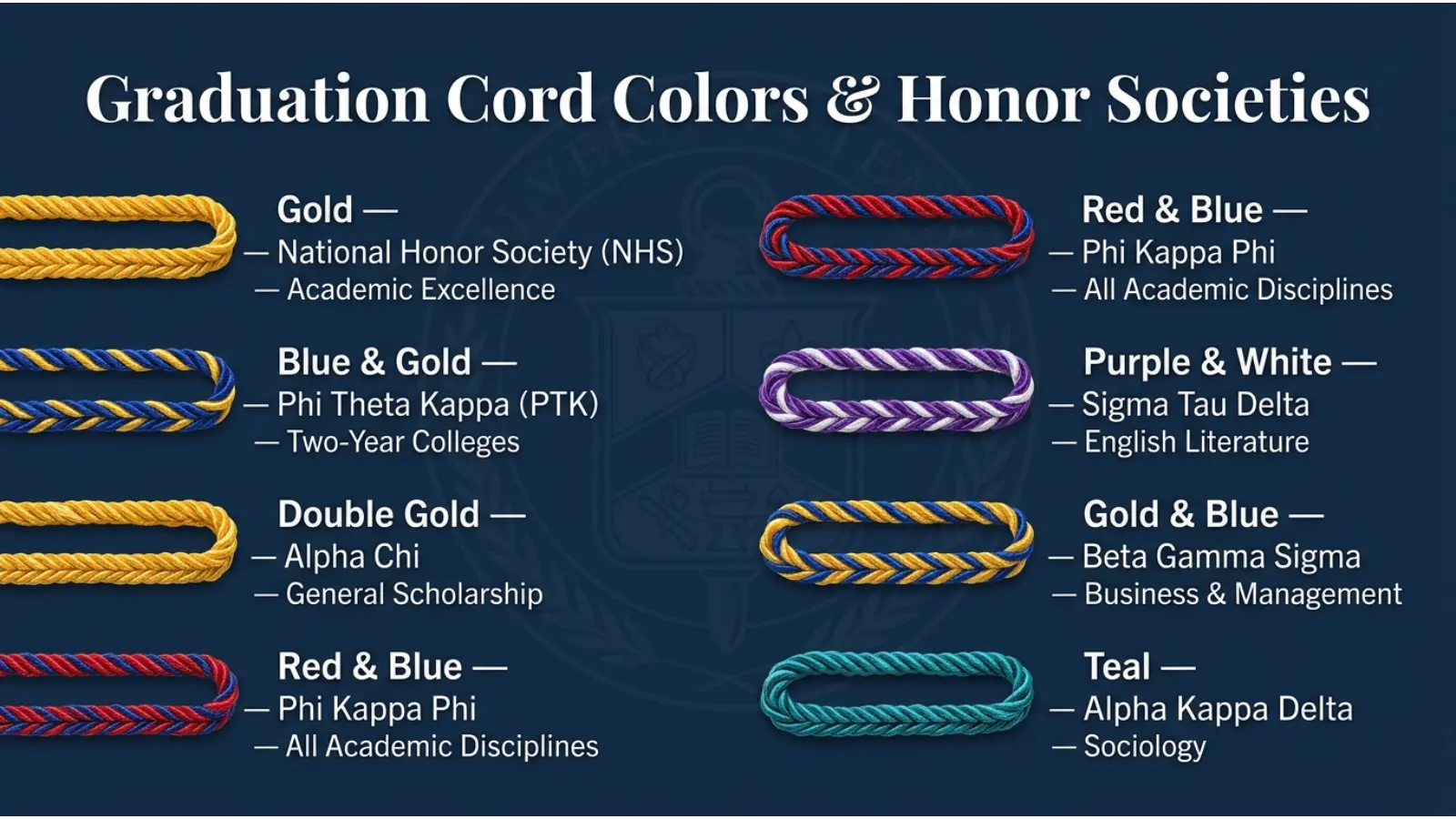
Graduation Cord Colors and Honor Societies
Honor societies often use cords, stoles, pins, or other regalia to identify members.
In these cases, the cord’s meaning comes from the organization.
Membership may involve requirements such as:
- Academic performance
- Leadership
- Service
- Character
- Participation
- Completion of a program
The color can help identify the organization, but it is the organization’s rules that establish what the recognition means.
Graduation Cords for Community Service
Some schools recognize students who contribute significant time to community service.
A cord can make this achievement visible during commencement.
This type of recognition is particularly meaningful because it shows that graduation honors do not have to be based only on grades. Service awards can highlight responsibility, participation, and contributions to the wider community.
Schools may use blue, white, green, red, or another designated color for this purpose.
Graduation Cords for Leadership
Leadership cords may recognize students who served in positions such as:
- Student government
- Club leadership
- Team leadership
- Peer mentoring
- School committees
- Community organizations
Leadership recognition does not necessarily mean being class president. A student who consistently organizes activities, supports classmates, or takes responsibility within a program may also qualify.
The exact requirements vary by school.
Graduation Cords for Career and Technical Programs
Career and technical education programs may use cords to recognize students who complete specialized pathways.
These programs can include areas such as:
- Information technology
- Engineering
- Automotive studies
- Health sciences
- Business
- Agriculture
- Skilled trades
- Digital media
Because these programs differ widely, their cord colors are especially likely to be institution-specific.
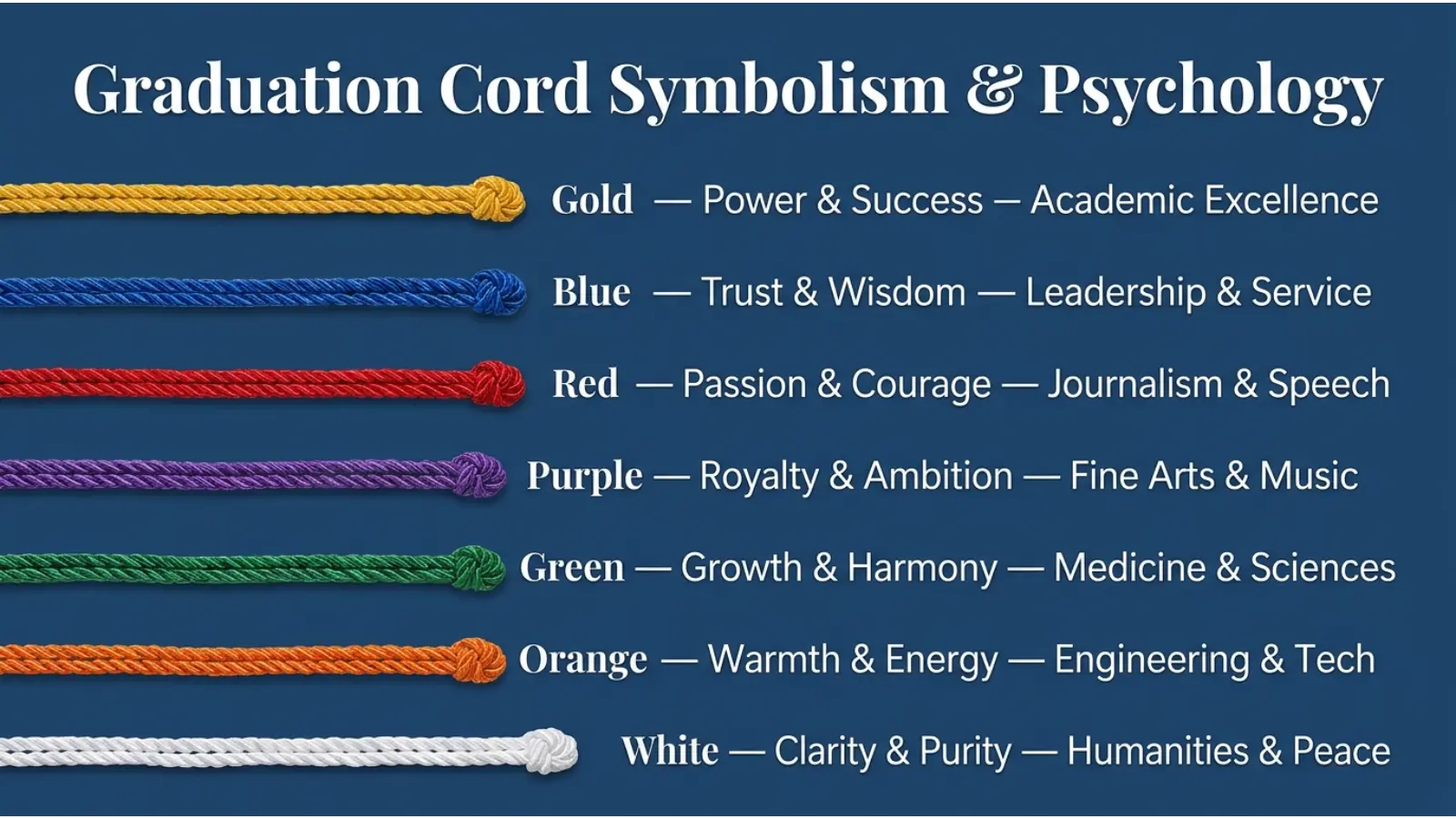
Graduation Cord Symbolism and Psychology
Color psychology can help explain why particular colors feel appropriate for certain achievements. However, psychology does not provide a scientific rule saying that a specific graduation cord color causes a specific emotion.
For example, bright colors may attract visual attention, while darker colors can appear more formal. Cultural learning also affects how people interpret colors.
Consequently, graduation cord design works through a combination of:
- Visual contrast
- Cultural symbolism
- School tradition
- Personal experience
- Ceremony context
- Organizational identity
The same red that feels energetic in one setting may represent an organization in another.
Do Graduation Cord Colors Affect How People Perceive Students?
They can influence first impressions, but the effect should not be overstated.
A bright cord may stand out against a dark gown. A metallic cord may appear prestigious because metallic materials are often associated with awards. Meanwhile, a soft color can create a quieter visual impression.
However, observers usually do not know the exact meaning unless the school provides a guide.
Therefore, the cord is best understood as a visual communication tool, not a complete description of a student’s personality or ability.
Cultural Differences in Graduation Cord Colors
Color meanings change across cultures.
White, for example, can have different symbolic associations in different societies. Red can represent celebration, strength, luck, danger, love, or other ideas depending on the cultural setting.
Graduation ceremonies themselves also vary internationally.
For that reason, it would be misleading to claim that a color has one permanent global meaning.
Modern graduation regalia is also shaped by school traditions, academic institutions, and organizational systems. As a result, local context often matters more than broad cultural symbolism.
Historical Background of Academic Regalia
Academic gowns, hoods, caps, and other forms of academic dress have roots in European university traditions.
Over time, academic institutions developed systems for visually distinguishing fields of study and academic status.
Modern high school graduation ceremonies borrow many visual elements from this broader academic tradition. However, high school cord systems are not identical to university academic regalia.
In particular, many high schools have created their own cord traditions to recognize extracurricular activities, service, leadership, and local programs.
Thus, today’s graduation cords are a mixture of academic tradition and modern school recognition.
Personality Associations With High School Cord Color Meanings
People often associate colors with personality traits, but color preference does not determine personality.
For example:
- Gold may feel confident and achievement-focused.
- Blue may feel calm, dependable, or professional.
- Red may feel energetic and bold.
- Green may feel natural and growth-oriented.
- Purple may feel creative or distinctive.
- White may feel clean and simple.
- Black may feel formal and powerful.
These are symbolic impressions, not personality tests.
A student wearing a red cord is not necessarily more confident than someone wearing a blue cord. The cord represents an achievement or affiliation, not a psychological diagnosis.
Graduation Cord Colors in Branding and School Marketing
Schools sometimes use consistent colors across graduation materials, logos, banners, certificates, and event programs.
This creates visual identity.
For example, if a school uses blue as its main institutional color, blue graduation accessories can make the ceremony feel connected to the school’s wider brand.
Likewise, an honor program may use gold to visually communicate achievement.
However, the goal is usually not to manipulate emotions. Instead, consistent color helps people recognize programs and understand information quickly.
Graduation Cord Colors in Photography
Graduation photography provides an interesting example of how color changes perception.
A cord can look different depending on:
- Outdoor sunlight
- Indoor lighting
- Camera exposure
- Background color
- Gown color
- Metallic thread
- Image editing
- White balance
For example, a gold cord may look yellow under one light and more metallic under another.
Therefore, students comparing cord colors from photographs should avoid relying only on pictures.
Real-Time Example: A 2026 High School Graduation
Imagine a student graduating from a U.S. high school in May or June 2026.
The student wears a black gown with a gold cord and a blue cord. Someone watching the ceremony might assume gold means academic honors and blue means leadership.
That assumption could be correct—but it could also be wrong.
Suppose the school’s official graduation program states that:
- Gold = honor graduate
- Blue = community service
- Red = student leadership
- Green = health sciences
In that school, the student’s two cords communicate academic achievement and service.
Now imagine another high school using the exact same colors but assigning blue to an academic society. The visual appearance is almost identical, yet the meaning changes.
This is why the school-issued graduation guide is more reliable than a general internet color chart.
How Lighting Changes Graduation Cord Colors
Lighting can dramatically change the appearance of graduation regalia.
Under warm indoor lighting, white cords can appear cream-colored. Gold can become more orange. Blue may look darker than expected.
Under bright daylight, colors may appear clearer and more saturated.
Photography can create another difference. Cameras automatically adjust exposure and white balance, which can alter how a cord appears on a screen.
Consequently, students ordering cords should compare the manufacturer’s color sample and the school’s official description rather than relying entirely on photographs.
Age and Color Interpretation
Age can also influence how people interpret color.
Children may focus more on whether a color is bright, attractive, or familiar. Adults may pay more attention to institutional symbolism and formal presentation.
Graduation is also a highly structured event. Because attendees know that cords represent achievement, they are more likely to interpret the color as an official symbol rather than simply a fashion choice.
This context changes the meaning of the same color.
How to Find the Meaning of Your Graduation Cord
If you already have a graduation cord and do not know what it represents, use this order:
1. Check Your School’s Graduation Guide
Look for the official commencement program, senior handbook, or graduation instructions.
2. Ask Your School Counselor
Counselors usually know the recognition requirements or can direct you to the appropriate organization.
3. Identify the Organization
If the cord came from an honor society, club, or program, ask that organization what the color represents.
4. Check Your Eligibility
Look at the requirements you completed. This can help identify the reason you received the cord.
5. Do Not Assume From Color Alone
A color chart found online can provide a useful clue, but it cannot override your school’s official policy.
How to Choose Graduation Cord Colors for a School Program
Schools creating a new recognition system should make each color easy to understand.
A strong system should:
- Use colors that are visually distinct.
- Publish the meaning before graduation.
- Explain eligibility requirements.
- Keep the same meaning from year to year.
- Provide accessible alternatives for students with color-vision differences.
- Avoid assigning too many similar shades.
- Coordinate cords with stoles and medals.
- Give organizations written guidelines.
Most importantly, the school should publish a color key so families do not have to guess.
Graduation Cord Colors and Color-Blind Accessibility
Color should not be the only way to communicate an achievement.
Some students and families have color-vision differences, making certain colors difficult to distinguish.
Therefore, schools can improve accessibility by pairing each color with:
- Organization names
- Printed labels
- Symbols
- Written descriptions
- Program names
This makes graduation recognition clearer for everyone.
Common Misconceptions About High School Cord Color Meanings
Myth 1: Every Gold Cord Means the Same Thing
Not true. Gold is commonly associated with academic achievement, but schools can assign it to different honors.
Myth 2: A Cord Always Represents GPA
Not necessarily. Cords can recognize service, leadership, membership, programs, or other accomplishments.
Myth 3: There Is One Official National Cord Color Chart
There is no single universal chart that determines every high school’s cord meanings.
Myth 4: More Cords Always Mean a Higher GPA
Not necessarily. Multiple cords can represent different categories of achievement.
Myth 5: Color Psychology Determines Cord Meaning
Color symbolism can influence the visual impression of a cord, but the school or organization establishes its official meaning.
Myth 6: A Graduation Cord Is Only Decorative
Usually, cords are worn as recognition symbols. Their specific meaning depends on the institution.
Practical Uses of High School Cord Color Meanings
Understanding graduation cord symbolism is useful beyond the ceremony itself.
For Students
It helps students understand which accomplishments they may qualify for before graduation.
For Parents
It makes graduation photographs and ceremony programs easier to interpret.
For Schools
A clear cord system makes recognition more organized and understandable.
For Designers
Color selection can make different achievement categories visually distinct.
For Photographers
Knowing the meaning and appearance of cords helps photographers capture important details.
For Families
A graduation cord can become a meaningful keepsake because it represents a specific achievement from a major educational milestone.
High School Cord Color Meanings FAQ
What is the most common graduation cord color?
Gold or yellow is among the most recognizable graduation cord colors and is often connected with academic achievement or honors. However, schools can use it differently.
What does a gold cord mean in high school graduation?
A gold cord commonly represents academic achievement, honors, or distinction. The exact requirement depends on the school.
What does a blue graduation cord mean?
A blue cord may represent academic achievement, leadership, service, or membership in a particular organization. There is no universal definition.
What does a red graduation cord mean?
Red may represent leadership, achievement, or membership in an organization. Students should check their school’s official cord guide.
What does a green graduation cord mean?
Green cords may be used for environmental programs, health-related programs, service, or special academic achievements.
What does a purple graduation cord mean?
Purple may symbolize academic distinction, leadership, creativity, arts programs, or organization membership. Its official meaning varies.
Do graduation cords mean you graduated with honors?
Sometimes. Many schools use cords to identify honor graduates, but cords can also recognize activities, service, leadership, or organizations.
Can a student wear multiple graduation cords?
Yes, if the school or organizations allow it. Multiple cords can represent multiple achievements.
How can I find out what my graduation cord means?
Check your school’s commencement instructions first. You can also ask a counselor, teacher, or the organization that awarded the cord.
Are high school graduation cord colors standardized?
No. Graduation cord colors are generally not standardized across all high schools. Local school and organization policies determine their meanings.
Final Thoughts on High School Cord Color Meanings
High school graduation cords are more than colorful accessories. They turn achievements that might otherwise remain invisible into symbols that can be seen during one of the most important ceremonies of a student’s school life.
Still, color alone does not tell the whole story. Gold can suggest achievement, blue can suggest responsibility, red can appear energetic, and green can suggest growth, but the official meaning comes from the school or organization awarding the cord.
Therefore, when researching high school cord color meanings, use general color symbolism as a starting point and official school information as the final answer.
Ultimately, the most meaningful part of a graduation cord is not its color. It is the work behind it—hours of study, service, leadership, creativity, teamwork, or commitment that helped a student reach graduation day.

Emma Wilson is a dedicated comparison writer and product researcher at ColorMystiic.com. She specializes in creating unbiased product comparisons, detailed reviews, and helpful buying guides. Her goal is to help readers make smarter purchasing decisions with confidence.