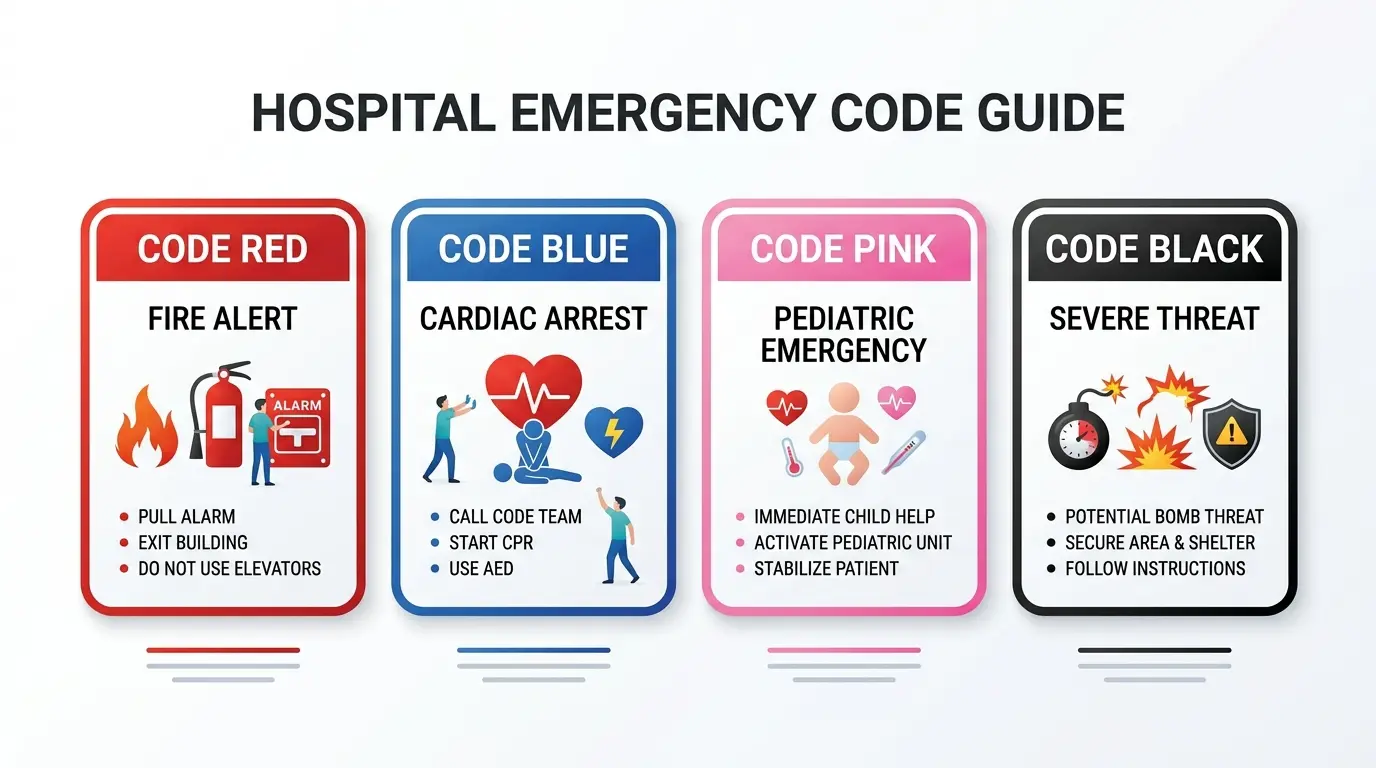
Hospitals use short emergency codes to communicate serious situations quickly without creating unnecessary confusion for patients and visitors. When someone hears “Code Blue,” “Code Red,” or “Code Silver,” the color can signal a very different type of emergency depending on the hospital.That difference matters because hospital code color meanings are not universal. The American Hospital Association has noted significant variation among hospitals and has supported the move toward plain-language emergency alerts in some settings.
So, what does each hospital code color mean? In many U.S. hospitals, Code Blue refers to a cardiac or respiratory emergency, Code Red to a fire, Code Orange to a hazardous-material incident, and Code Pink to an infant or child abduction. However, individual hospitals can assign additional colors differently. Johns Hopkins Medicine, for example, uses several codes that illustrate how detailed and facility-specific these systems can be.
This guide explains the most common hospital emergency code meanings, why hospitals use colors, how the system developed, what different colors can represent, and why you should always follow the instructions given by the hospital itself.
Quick Answer: What Do Hospital Code Colors Mean?
Hospital code colors are emergency communication signals used by hospitals to alert staff to specific situations. Common examples include:
| Hospital Code | Common Meaning | Important Note |
|---|---|---|
| Code Blue | Cardiac or respiratory emergency | Common across many U.S. hospitals |
| Code Red | Fire or smoke | Widely used |
| Code Orange | Hazardous material spill/release | Common but not universal |
| Code Pink | Infant or child abduction | Often used in pediatric settings |
| Code Silver | Armed person/active shooter | Frequently used for security emergencies |
| Code Gray/Grey | Security or combative-person emergency | Meaning varies considerably |
| Code Yellow | Disaster or emergency activation | Often used for broader emergencies |
| Code Green | Security/combative-person response | Meaning differs by facility |
| Code Purple | Security response or other emergency | Highly facility-specific |
| Code Gold | Bomb threat | Used by some hospitals |
The safest rule is simple: a color code only has the meaning assigned to it by that particular hospital.
Why Do Hospitals Use Color Codes?
Hospitals are busy environments where seconds can matter. A short emergency code allows trained staff to recognize a situation quickly and begin the correct response.
For example, saying “Code Blue” over a hospital communication system can alert a specialized medical response team without announcing detailed patient information throughout a public area.
However, color codes can also create problems when different hospitals use the same color for different emergencies. The American Hospital Association has documented variation in emergency codes and has highlighted plain-language communication as a way to reduce confusion and improve safety.
Therefore, color codes are best understood as local communication systems, not a universal international language.
Hospital Code Blue Meaning
Code Blue commonly means a cardiac or respiratory emergency.
It may be activated when a patient has stopped breathing, has no effective pulse, or requires immediate resuscitation.
A Code Blue response can involve physicians, nurses, respiratory therapists, emergency response teams, and other trained professionals. The exact team and procedure depend on the hospital.
Johns Hopkins Hospital, for example, defines Code Blue as cardiac/respiratory arrest.
Why Is Blue Used?
Blue has become strongly associated with medical emergencies in many hospital systems. The color is therefore useful as a rapid visual and verbal identifier.
Still, the color itself does not cause the emergency or describe the patient’s condition in detail. It is simply a communication label.
What Should Visitors Do During Code Blue?
Visitors generally should:
- Stay calm.
- Follow staff instructions.
- Avoid blocking hallways.
- Give emergency personnel room to work.
- Do not attempt to enter the treatment area unless instructed.
A Code Blue is usually directed toward trained hospital personnel rather than visitors.
Hospital Code Red Meaning
Code Red commonly means fire or smoke inside the hospital.
A Code Red can involve an actual fire, visible smoke, or another fire-related threat.
For example, both Johns Hopkins and Children’s Hospital Los Angeles use Code Red for fire.
Why Is Red Used for Fire?
Red already has a strong association with danger, heat, warning, and fire in many cultures. Because of this familiar visual connection, it is easy for people to remember.
During a Code Red, hospital staff may follow procedures involving:
- Protecting people in immediate danger.
- Activating the fire alarm.
- Closing doors to limit smoke and fire spread.
- Moving patients when necessary.
- Contacting emergency services.
- Following the hospital’s evacuation or fire-response plan.
The exact procedure depends on the building and hospital emergency plan.
Hospital Code Orange Meaning
Code Orange commonly refers to a hazardous-material incident or spill.
This may involve a chemical, biological, or other potentially dangerous substance requiring special handling.
Johns Hopkins Hospital uses Code Orange for a hazardous material spill or release. Children’s Hospital Los Angeles also identifies Code Orange with hazardous-material spills.
Why Does Code Orange Make Sense?
Orange is frequently used in safety systems to attract attention to hazards. In hospitals, the color can serve as a memorable warning that specialized precautions may be necessary.
If you hear Code Orange as a visitor, do not investigate the source yourself. Instead, follow staff directions and stay away from restricted areas.
Hospital Code Pink Meaning
Code Pink is commonly associated with an infant or child abduction.
This code is especially important in hospitals that provide maternity, neonatal, or pediatric services.
Johns Hopkins lists Code Pink for infant/child abduction, while Children’s Hospital Los Angeles uses Code Pink for infant abduction.
Why Is a Separate Code Used?
Hospitals may have controlled entrances, security procedures, identification systems, and locked-unit protocols designed to protect children.
A rapid alert can allow security and clinical staff to respond immediately while limiting unnecessary information in public areas.
Hospital Code Silver Meaning
Code Silver commonly refers to an armed person, active shooter, or hostage situation.
Johns Hopkins uses Code Silver for an armed assailant, while Children’s Hospital Los Angeles identifies it with an armed individual, active shooting, or hostage situation.
What Should Visitors Do?
If a hospital announces Code Silver, visitors should take the announcement seriously and follow the facility’s instructions.
Depending on the circumstances, hospital security may direct people to:
- Move away from the threat.
- Shelter in a secure location.
- Remain quiet.
- Follow security or police instructions.
- Avoid entering affected areas.
Because these situations are highly dangerous, the hospital’s current instructions should always take priority over general information found online.
Hospital Code Gray or Grey Meaning
Code Gray/Grey has no single universal meaning.
It may refer to a combative person, security incident, or another behavioral emergency.
For example, Children’s Hospital Los Angeles uses Code Gray for a combative person, while Johns Hopkins Hospital uses Code Gray for elopement in its listed code system.
This is an excellent example of why memorizing a universal hospital color chart can be misleading.
Code Gray vs. Code Silver
These codes can both involve security, but they are not necessarily interchangeable.
In one hospital, Code Gray may involve an aggressive or combative person, while Code Silver may indicate an armed threat. Another hospital may use different terminology.
Always check the hospital’s own emergency policy.
Hospital Code Yellow Meaning
Code Yellow often indicates a disaster, emergency, or disaster-plan activation.
Johns Hopkins Hospital lists Code Yellow as an emergency or disaster, while its Bayview materials describe Code Yellow as disaster-plan activation.
A disaster code can relate to situations such as:
- Severe weather
- Major infrastructure failure
- Mass-casualty events
- External disasters
- Other events requiring hospital-wide coordination
The precise definition depends on the facility.
Hospital Code Green Meaning
Code Green can refer to a security or behavioral emergency in some hospitals.
For example, Johns Hopkins Hospital uses Code Green for a combative person.
However, Code Green is not universal. A different hospital may assign the color to another type of emergency.
This is one reason healthcare organizations increasingly consider plain-language alerts such as “Security Alert” instead of relying entirely on color-based codes.
Hospital Code Purple Meaning
Code Purple is highly facility-specific.
Johns Hopkins Hospital uses Code Purple for a security request, while other hospitals may assign purple to completely different situations.
The color purple has no inherent medical meaning. Its significance comes from the hospital’s emergency-management policy.
Therefore, if you hear Code Purple, look for instructions from hospital staff rather than assuming it has one universal definition.
Hospital Code Gold Meaning
Code Gold may indicate a bomb threat or similar security emergency.
Johns Hopkins Hospital lists Code Gold for a bomb threat.
Because security codes can vary between institutions, however, Code Gold should not automatically be interpreted this way everywhere.
Hospital Code White Meaning
Code White can have several meanings depending on the hospital.
For example, one Johns Hopkins system document lists Code White for severe weather, while other institutions may use white for behavioral or pediatric emergencies.
This demonstrates an important point: a hospital color code is a local policy, not a universal color dictionary.
Hospital Emergency Code Color Chart
The following chart summarizes commonly encountered U.S. hospital code meanings:
| Color Code | Common Meaning | How Universal Is It? |
|---|---|---|
| 🔵 Blue | Cardiac/respiratory emergency | Relatively common |
| 🔴 Red | Fire | Very common |
| 🟠 Orange | Hazardous material incident | Common |
| 🩷 Pink | Infant/child abduction | Common in many pediatric/maternity hospitals |
| 🟡 Yellow | Disaster/emergency | Common but variable |
| ⚫ Silver | Armed person/active threat | Common in many systems |
| ⚪ White | Severe weather or other emergency | Highly variable |
| 🟢 Green | Combative/security response | Variable |
| 🩶 Gray/Grey | Security/behavioral emergency | Highly variable |
| 🟣 Purple | Security or facility-specific emergency | Highly variable |
| 🟡 Gold | Bomb threat in some systems | Facility-specific |
Important: This is a guide to common usage, not a universal hospital standard. Official hospital policies should always take priority.
Why Hospital Code Colors Are Not Universal
One of the biggest misconceptions about hospital code color meanings is that every hospital follows exactly the same system.
They do not.
The American Hospital Association has pointed to substantial differences between hospitals, including different codes for evacuation and other emergencies.
There are several reasons for this variation.
Different State and Regional Practices
Hospitals may follow state-level recommendations or regional systems.
Johns Hopkins, for example, identifies its emergency codes as Maryland-compliant codes.
Different Hospital Needs
A children’s hospital may need detailed pediatric security codes that are less relevant in another facility.
Different Emergency Plans
Hospitals design emergency-management systems around their buildings, patients, staff, equipment, and local risks.
The Joint Commission emphasizes that hospitals need comprehensive emergency-management programs capable of addressing a wide range of disasters and maintaining continuity of care.
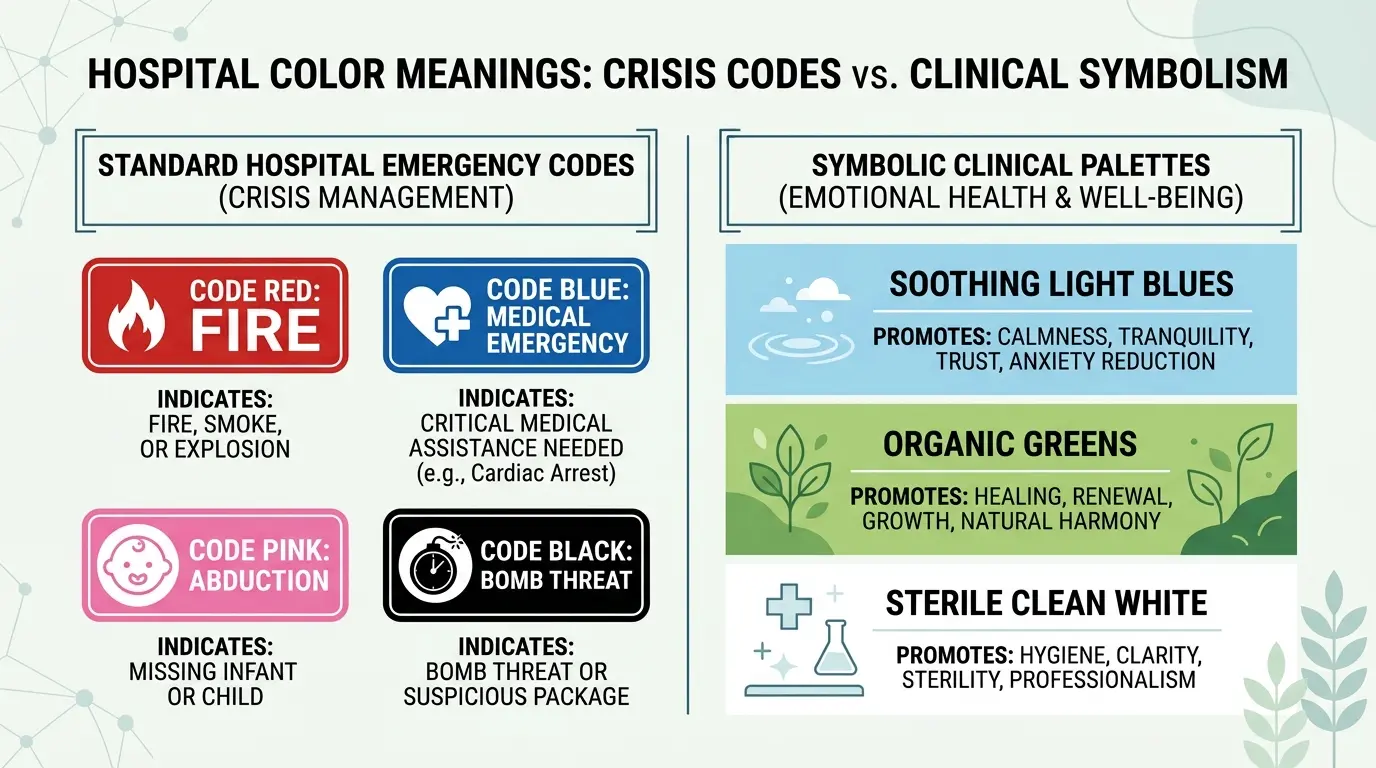
The Difference Between Hospital Code Colors and Medical Color Symbolism
Hospital code colors should not be confused with general color psychology.
For example, people may associate:
- Red with danger
- Blue with calmness
- Green with safety
- Yellow with warning
- Orange with caution
These associations can help explain why certain colors are memorable in safety systems. However, they do not prove that a hospital selected a particular color because of psychological research.
In many cases, the meaning is simply an established institutional convention.
That distinction is important for accurate health information.
Psychology Behind Hospital Emergency Colors
Color can influence attention and recognition, but color psychology should not be overstated.
Highly visible colors can help information stand out against a surrounding environment. Red, for example, is commonly used for warnings and fire-related equipment. Blue is also widely recognizable in medical settings.
However, human responses to color depend on context, culture, lighting, personal experience, and the surrounding visual environment.
A hospital code therefore works best as part of a larger communication system that includes:
- Spoken announcements
- Staff training
- Signs
- Alarms
- Digital communication
- Emergency procedures
- Plain-language instructions
The color alone is not the emergency response.
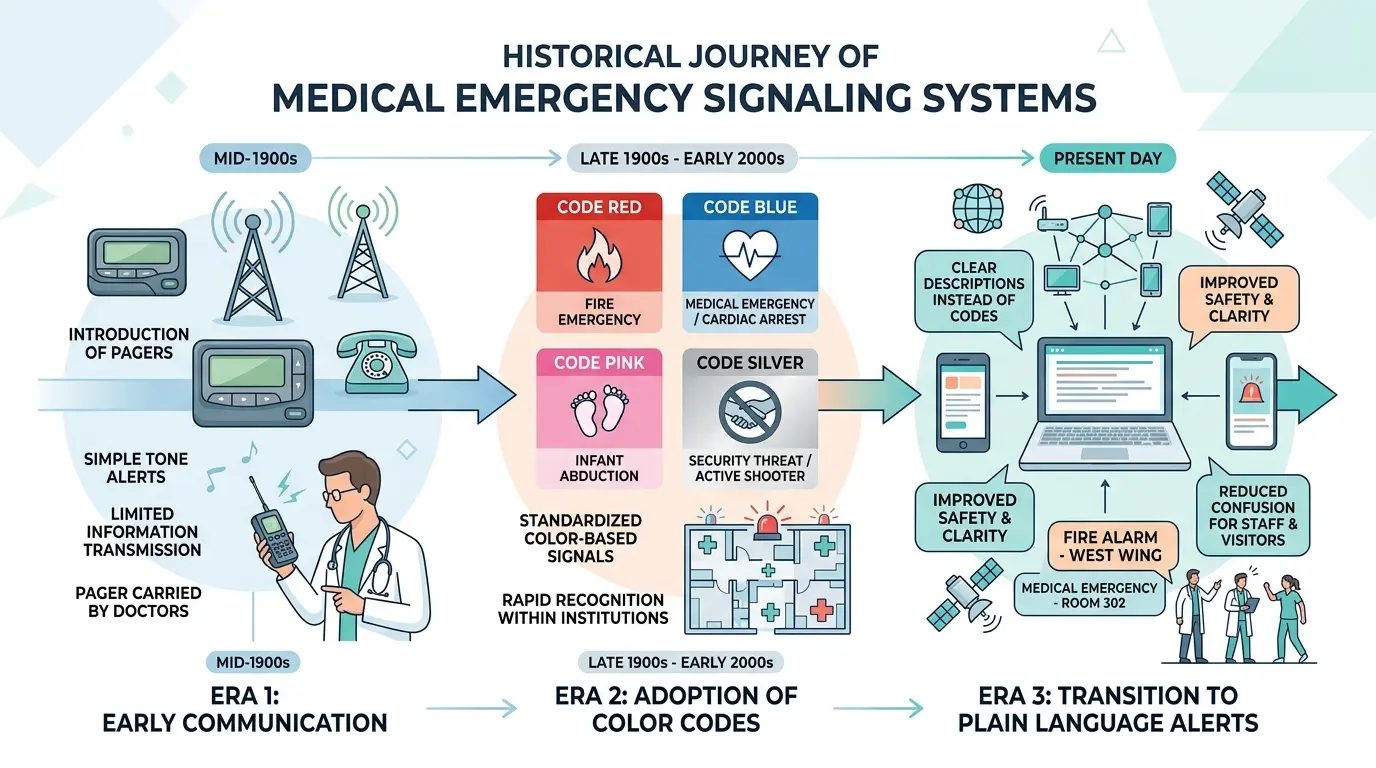
Historical Development of Hospital Code Colors
Emergency color codes developed as hospitals looked for fast ways to communicate sensitive or urgent information.
Over time, individual hospitals and regions created their own systems. As healthcare workers began working across multiple facilities, however, differences between code systems became a safety concern.
The American Hospital Association documented examples of confusion caused by differing color systems, including concerns involving patient wristband colors.
This history helps explain the modern debate over whether emergency communication should rely on colors or use plain language.
Hospital Code Colors and Patient Safety
The purpose of an emergency code is not decoration or branding. It is rapid communication.
A good emergency communication system should help the right people understand:
- What has happened.
- Where it has happened.
- Who should respond.
- What action is expected.
- What information should remain private.
Color codes can support this process, but they can also introduce ambiguity when different institutions use the same color differently.
That is why staff training and clear hospital policies are essential.
A Real-World Example of Hospital Code Colors
Consider a patient in a hospital when an overhead announcement says:
“Code Red.”
At Johns Hopkins Hospital, this means a fire.
Staff members would respond according to the hospital’s fire-emergency procedures. A visitor, meanwhile, should remain calm and follow staff directions rather than trying to find the source of the alarm.
Now imagine the same visitor later hears “Code Gray” at a different hospital. The meaning may be different because Code Gray is not standardized nationally.
This simple example shows why knowing the hospital’s own emergency code system is more reliable than memorizing a single internet chart.
How Context Changes Hospital Code Color Meanings
Context is one of the most important parts of understanding hospital colors.
A color might mean one thing when announced overhead and something else when printed on a hospital badge, wristband, sign, or internal emergency document.
Even within healthcare, color can be used for different purposes.
For example, the American Hospital Association has discussed standardized patient wristband colors separately from emergency communication codes.
Therefore, never assume that a colored wristband, staff uniform, emergency code, or medical device uses the same color system.
Lighting Can Change How Hospital Code Color Meanings Look
Lighting also affects how colors appear.
A red sign under bright white lighting may look different from one viewed under dim emergency lighting. Blue, purple, and gray can become particularly difficult to distinguish under some lighting conditions.
For this reason, hospitals should not depend on color alone for critical information.
Text, symbols, alarms, spoken instructions, and clear procedures provide additional layers of communication.
This is also important for people with color-vision differences.
Hospital Code Colors in Branding and Design
Hospitals use color beyond emergency communication.
Healthcare branding often uses colors such as blue, green, white, and teal because they can create visual associations with cleanliness, calmness, technology, nature, and professionalism.
However, a hospital’s branding palette should not be confused with its emergency code system.
A hospital might use blue extensively in its logo and website while separately using Code Blue for a medical emergency.
The same color can therefore carry different meanings in different contexts.
Hospital Colors in Interior Design
Hospital interior design uses color strategically to make large and stressful environments easier to navigate.
Blue
Blue can create a calm visual atmosphere and is frequently seen in healthcare environments.
Green
Green can provide a connection with nature and may be used in patient rooms, waiting areas, or staff spaces.
White
White can create a clean, bright appearance but may feel overly clinical when used without warmer materials.
Warm Colors
Soft warm colors can make waiting rooms and family areas feel more welcoming.
The goal is usually balance rather than simply choosing a “medical color.”
Hospital Code Colors in Everyday Life
You may encounter hospital color systems through:
- Overhead announcements
- Staff emergency badges
- Hospital orientation materials
- Security notices
- Emergency preparedness training
- Pediatric safety programs
- Fire-safety procedures
- Hospital employee manuals
Visitors usually do not need to memorize every code.
Instead, they should understand the basic principle: listen carefully and follow the hospital’s instructions.
Common Misconceptions About Hospital Code Color Meanings
Myth 1: Every hospital uses the same colors
False. Hospitals can use different meanings for the same color.
Myth 2: Code Blue always means someone is dying
Not necessarily. It generally indicates a medical emergency requiring an urgent response, often cardiac or respiratory arrest.
Myth 3: Code Red always means a patient emergency
Usually, Code Red refers to fire, not a medical condition.
Myth 4: Code Silver always means the same thing worldwide
No. Code Silver is commonly associated with an armed threat in many U.S. hospitals, but emergency codes are facility-specific.
Myth 5: Color codes are the only emergency communication method
No. Hospitals use broader emergency-management systems involving staff responsibilities, procedures, alarms, communications, and disaster planning.
Hospital Code Colors and Plain-Language Alerts
Some healthcare organizations are moving toward plain-language emergency communication.
Instead of requiring employees to remember that a particular color means a specific emergency, an organization might announce:
- “Fire emergency”
- “Security alert”
- “Active threat”
- “Hazardous-material spill”
- “Severe weather”
The American Hospital Association has highlighted standardized plain-language emergency codes as a way to improve clarity and reduce errors.
Plain language can be particularly useful for visitors, patients, new employees, contractors, and staff who work across multiple healthcare facilities.
Frequently Asked Questions About Hospital Code Color Meanings
What is the most common hospital code?
Code Blue is one of the most widely recognized hospital emergency codes and commonly refers to a cardiac or respiratory emergency.
What does Code Red mean in a hospital?
Code Red commonly means a fire or smoke emergency. However, always follow the specific hospital’s emergency instructions.
What does Code Blue mean in a hospital?
Code Blue generally indicates a cardiac or respiratory emergency requiring an immediate medical response.
What does Code Pink mean in a hospital?
Code Pink commonly refers to an infant or child abduction, especially in hospitals with maternity or pediatric services.
What does Code Silver mean in a hospital?
Code Silver commonly indicates an armed person, active shooter, or similar security threat. The exact definition depends on the hospital.
What does Code Orange mean in a hospital?
Code Orange commonly refers to a hazardous-material spill, release, or related emergency.
Does every hospital use the same emergency codes?
No. Hospital emergency codes can vary significantly between institutions and regions.
Why are hospitals switching to plain-language emergency codes?
Plain-language alerts can reduce confusion because staff and visitors do not have to remember different color systems. The American Hospital Association has promoted standardized plain-language approaches for this reason.
Should patients memorize hospital code colors?
Usually, no. Patients and visitors should follow the instructions provided by hospital staff. If you work in a healthcare facility, learn the emergency codes and procedures used by your specific organization.
Final Thoughts on Hospital Code Color Meanings
Hospital code color meanings are best understood as communication tools, not universal color symbolism. Blue commonly signals a medical emergency, red often indicates fire, orange frequently identifies hazardous materials, and pink is widely associated with infant or child abduction. Yet several other colors can have very different meanings from one hospital to another.
The most useful lesson is therefore not to memorize one “official” hospital color chart. Instead, understand that context determines meaning.
A color used in a hospital logo may communicate trust. A colored wall may help navigation. A wristband may communicate a patient-safety condition. An overhead code may activate an emergency response team. The same color can serve completely different purposes.
As hospitals continue to improve emergency preparedness, the larger goal remains the same: fast, clear, reliable communication that protects patients, staff, and visitors. The Joint Commission likewise treats emergency readiness as an essential part of hospital safety and resilience.

Emma Wilson is a dedicated comparison writer and product researcher at ColorMystiic.com. She specializes in creating unbiased product comparisons, detailed reviews, and helpful buying guides. Her goal is to help readers make smarter purchasing decisions with confidence.