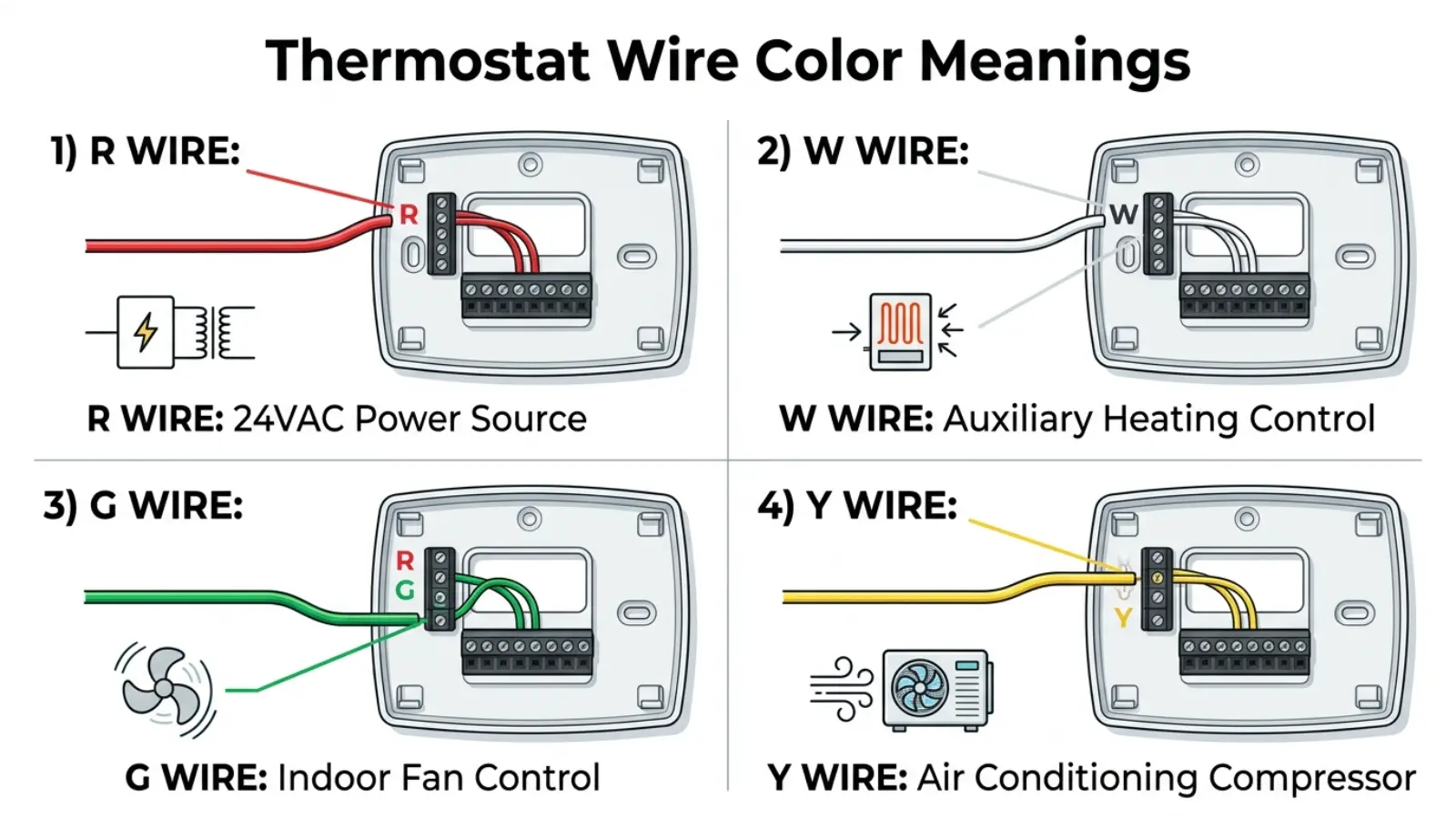
Thermostat wire color meanings help homeowners, DIY enthusiasts, and HVAC technicians identify the purpose of each wire connecting a thermostat to a heating and cooling system. Although wire colors follow common industry conventions, they are not universal standards. Therefore, understanding what each color usually represents—and confirming connections by terminal labels—is essential for safe installation and troubleshooting.
Many people search for thermostat wire color meanings because they are replacing an old thermostat, installing a smart thermostat, or trying to solve heating or cooling problems. However, they quickly discover that wire colors do not always match from one home to another.
This guide explains the most common thermostat wire colors, how they work, when they differ, and how to identify wires correctly without making dangerous assumptions.
Quick Answer:
Thermostat wire color meanings are based on common HVAC conventions. Red usually supplies 24V power, white controls heat, yellow controls cooling, green operates the fan, blue or black often serves as the common (C) wire, and orange or dark blue is commonly used for the heat pump reversing valve. Always verify wires by their terminal labels instead of color alone.
Thermostat Wire Color Meanings Chart
| Wire Color | Typical Terminal | Common Function | Used In |
|---|---|---|---|
| Red | R / Rc / Rh | 24V power | All HVAC systems |
| White | W / W1 | Heating | Furnace & heat systems |
| Yellow | Y / Y1 | Air conditioner compressor | Cooling systems |
| Green | G | Indoor blower fan | Most systems |
| Blue | C | Common wire | Smart thermostats |
| Black | C or AUX | Common or auxiliary | Some installations |
| Orange | O | Heat pump reversing valve | Heat pumps |
| Dark Blue | B | Reversing valve | Some heat pumps |
| Brown | AUX / E | Auxiliary or emergency heat | Heat pumps |
| Pink | Spare | Unused or custom | Some homes |
Understanding Thermostat Wiring Colors
Unlike household electrical wiring, thermostat wires carry low-voltage (24V AC) signals rather than high-voltage electricity. Their purpose is to tell the HVAC equipment when to heat, cool, or circulate air.
Although installers generally follow accepted color conventions, local practices, repairs, and older installations may use different colors. As a result, the terminal letters printed on the control board and thermostat are always more reliable than the insulation color.
Why Thermostat Wire Colors Matter
Correct wire identification helps you:
- Install a new thermostat safely.
- Upgrade to a smart thermostat.
- Troubleshoot heating or cooling issues.
- Avoid wiring mistakes.
- Protect HVAC equipment from damage.
Even a single misplaced wire can prevent your furnace or air conditioner from operating correctly.
Red Thermostat Wire Meaning
The red wire is usually the system’s power wire.
Typical Terminal
- R
- Rc
- Rh
Function
The red wire supplies 24-volt power from the HVAC transformer to the thermostat.
Some thermostats use:
- Rc for cooling
- Rh for heating
Many modern systems connect Rc and Rh with an internal jumper.
Common Problems
If the red wire becomes disconnected:
- Thermostat loses power.
- Heating and cooling stop working.
- Smart thermostat may not turn on.
White Thermostat Wire Meaning
The white wire usually controls heating.
Terminal
W or W1
Function
When the thermostat calls for heat, it connects R to W, telling the furnace or boiler to start heating.
Common systems:
- Gas furnace
- Oil furnace
- Electric furnace
- Boiler
Yellow Thermostat Wire Meaning
The yellow wire controls the outdoor air conditioning compressor.
Terminal
Y or Y1
Function
When cooling begins:
- Compressor starts.
- Outdoor condenser turns on.
- Refrigerant begins circulating.
Without the yellow wire connected properly, the AC may not cool even though the indoor fan operates.
Green Thermostat Wire Meaning
Green almost always controls the indoor blower fan.
Terminal
G
Function
This wire starts the indoor fan independently from heating or cooling.
Many homeowners use the “Fan On” setting during mild weather to improve air circulation.
Blue Thermostat Wire Meaning
Blue commonly serves as the Common Wire (C-wire).
Terminal
C
Function
The C-wire provides a continuous return path for electrical power.
It is especially important for:
- Smart thermostats
- Wi-Fi thermostats
- Touchscreen thermostats
- Programmable thermostats
Without a C-wire, some smart thermostats rely on battery power or power stealing technology.
Black Thermostat Wire Meaning
Black wires have no single universal purpose.
They often serve as:
- Common wire
- Auxiliary heat
- Spare conductor
Always confirm the terminal connection before assuming its purpose.
Orange Thermostat Wire Meaning
Orange is mainly found in heat pump systems.
Terminal
O
Function
The orange wire controls the reversing valve that changes the system between:
- Heating mode
- Cooling mode
Not every HVAC system includes this wire.
Dark Blue (B) Wire Meaning
Some manufacturers use a dark blue wire connected to terminal B.
Instead of energizing during cooling, the reversing valve energizes during heating.
This depends on equipment manufacturer design.
Brown Thermostat Wire Meaning
Brown wires frequently control:
- Auxiliary heat
- Emergency heat
They are common on heat pump systems operating in cold climates.
Pink Thermostat Wire Meaning
Pink wires usually have no standard meaning.
They may be:
- Spare wires
- Future expansion wires
- Installer-selected colors
Why Wire Colors Can Be Different
Many homeowners expect every thermostat to use identical colors.
However, several factors create differences.
Previous Repairs
Technicians may replace damaged wire sections using whatever color is available.
Older Homes
Older HVAC installations often predate today’s common color conventions.
Different Manufacturers
Equipment manufacturers sometimes recommend different wiring methods.
Installer Preference
Some installers prioritize available cable colors over traditional conventions.
Common Thermostat Wiring Example
Standard Heating and Cooling System
| Terminal | Typical Color | Function |
|---|---|---|
| R | Red | Power |
| W | White | Heat |
| Y | Yellow | Cooling |
| G | Green | Fan |
| C | Blue | Common |
Heat Pump Wiring Example
| Terminal | Typical Color | Function |
|---|---|---|
| R | Red | Power |
| Y | Yellow | Compressor |
| G | Green | Fan |
| O | Orange | Reversing valve |
| AUX | Brown | Auxiliary heat |
| C | Blue | Common |
Real-Time Example
Imagine you replace an old manual thermostat with a Wi-Fi smart thermostat. After installation, the screen remains blank. You notice the old thermostat did not use the blue wire, but a blue conductor is tucked inside the wall.
After checking the HVAC control board, you confirm that the blue wire is connected to the C terminal. Connecting that same wire to the thermostat’s C terminal provides continuous power, allowing the smart thermostat to start normally.
This example shows why terminal labels matter more than wire color alone.
Common Wiring Mistakes
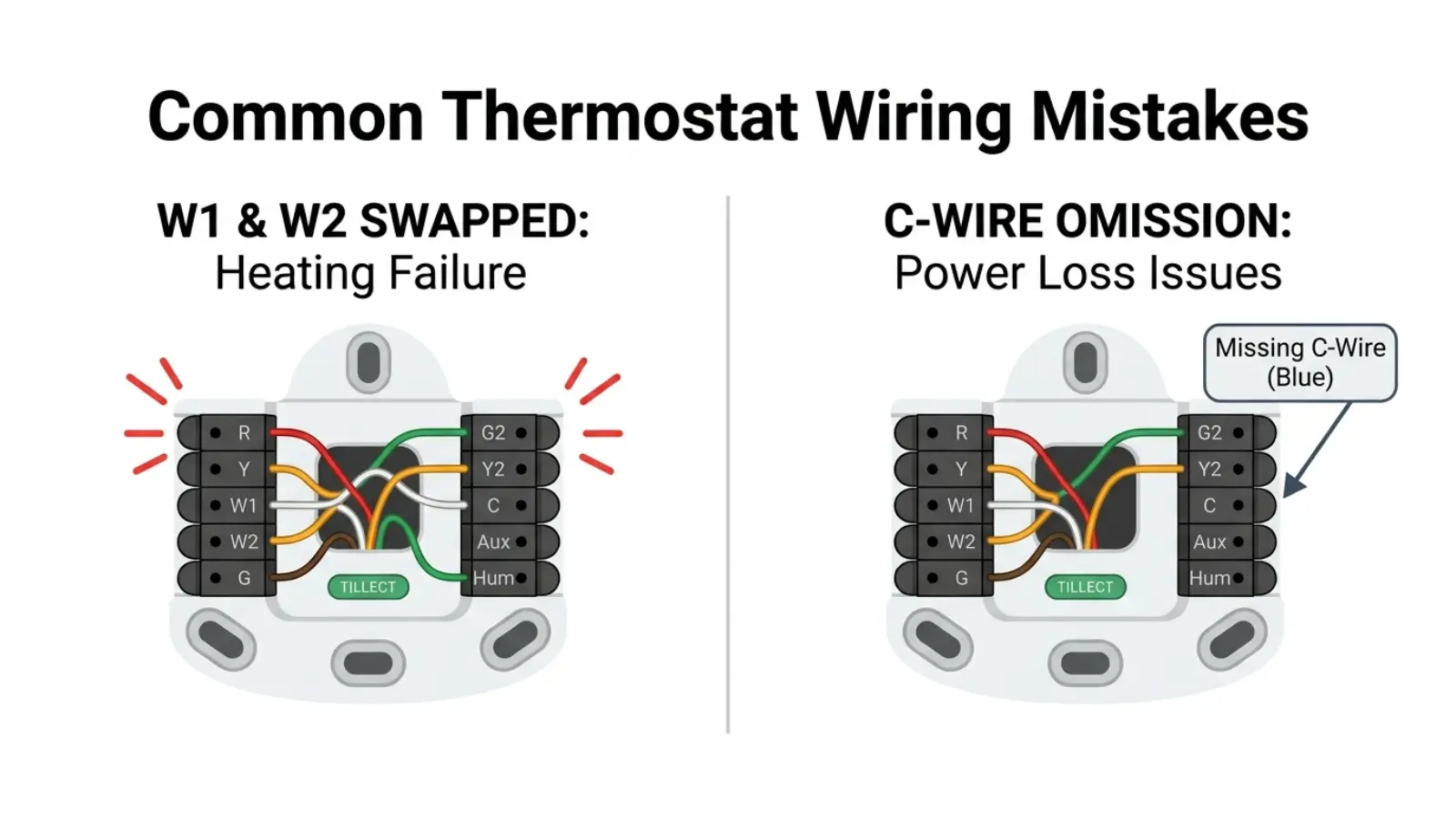
Avoid these common errors:
- Assuming every blue wire is a C-wire.
- Connecting wires by color instead of terminal letters.
- Forgetting to turn off HVAC power before wiring.
- Ignoring manufacturer wiring diagrams.
- Mixing Rc and Rh incorrectly.
- Leaving loose wire connections.
Safety Tips
Always remember:
- Turn off power at the HVAC breaker.
- Photograph existing wiring before removal.
- Label every wire.
- Use the equipment wiring diagram.
- Contact an HVAC professional if unsure.
Low-voltage thermostat wiring is generally safer than household electrical wiring, but mistakes can still damage equipment.
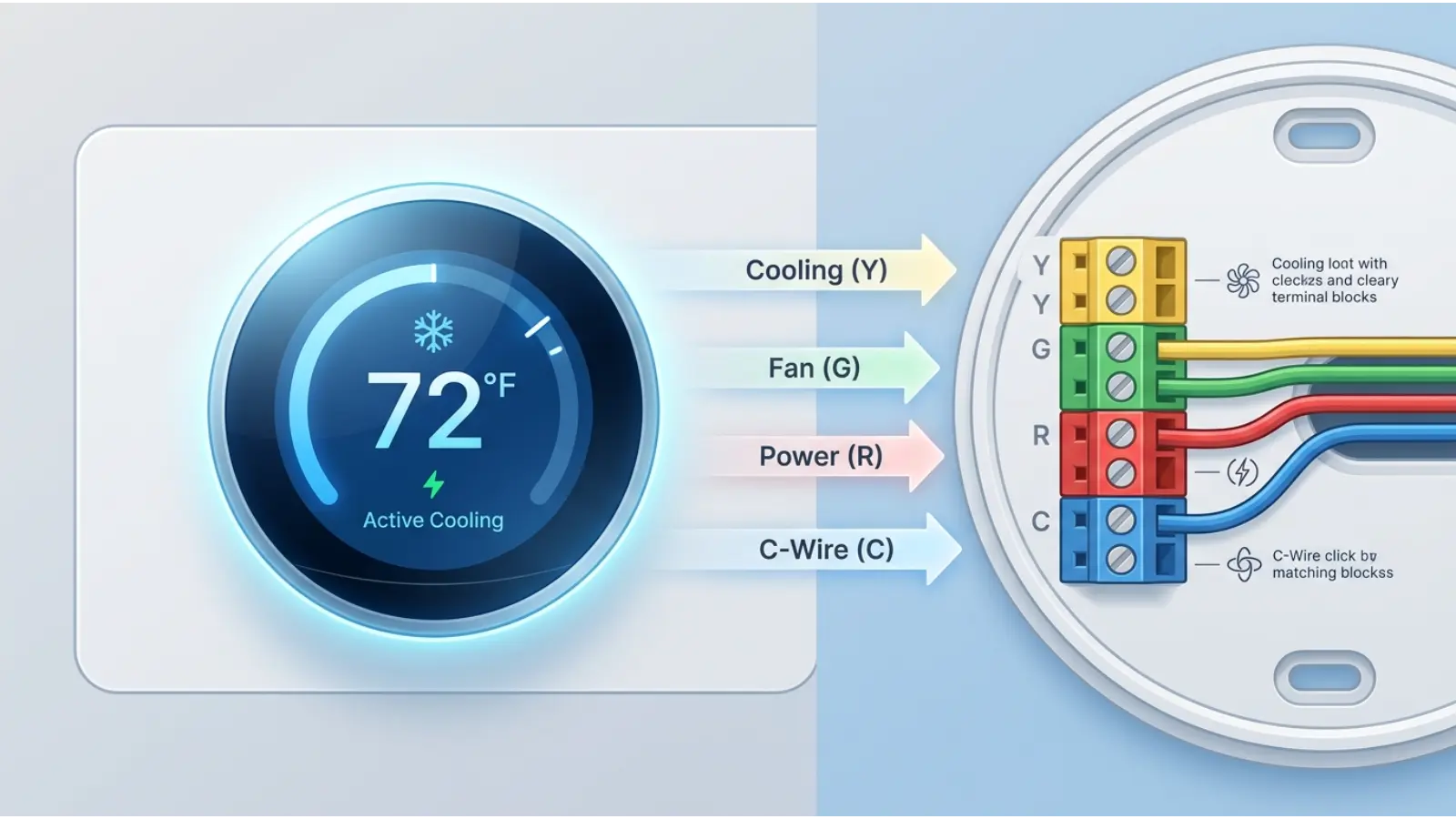
How Smart Thermostats Use Wire Colors
Modern smart thermostats often require:
- R
- C
- W
- Y
- G
Some advanced models also support:
- Humidifiers
- Dehumidifiers
- Ventilation systems
- Multi-stage heating
- Multi-stage cooling
The additional terminals may use different wire colors depending on the installation.
Common Misconceptions
Every Red Wire Means the Same Thing
Usually true, but always verify the terminal.
Blue Always Means Common
Not always. Blue may serve another function in older systems.
Color Alone Identifies Every Wire
Incorrect. Terminal letters provide the real identification.
Smart Thermostats Always Need New Wiring
Many existing systems already contain an unused C-wire hidden behind the wall.
Practical Applications
Thermostat wire color knowledge is useful when:
- Replacing a thermostat
- Installing a smart thermostat
- Troubleshooting HVAC issues
- Understanding service reports
- Communicating with HVAC technicians
- Inspecting a newly purchased home
Frequently Asked Questions
What do thermostat wire colors mean?
They identify the likely function of each wire, such as power, heating, cooling, fan, or common connection. However, colors are conventions rather than strict standards.
Is blue always the C-wire?
No. Blue is commonly used as the common wire, but installers may choose another color.
Which wire controls heating?
The white wire connected to the W terminal usually controls heating.
Which wire starts the air conditioner?
The yellow wire connected to the Y terminal typically starts the compressor.
What does the green thermostat wire do?
It controls the indoor blower fan.
Why doesn’t my thermostat wire color match the guide?
Older homes, repairs, and installer preferences often result in different colors.
Can I connect wires by matching colors?
No. Always match wires according to terminal labels.
Do all smart thermostats need a C-wire?
Many do, although some models can operate without one depending on the HVAC system.
What happens if wires are connected incorrectly?
The HVAC system may fail to operate correctly or, in some cases, components could be damaged.
Should I hire an HVAC technician?
If the wiring does not match standard terminal labels or you are uncertain about the connections, professional assistance is the safest option.
Conclusion
Understanding thermostat wire color meanings makes thermostat replacement, HVAC troubleshooting, and smart thermostat installation much easier. While common color conventions—such as red for power, white for heat, yellow for cooling, green for the fan, and blue for the common wire—provide a helpful starting point, they are not guaranteed. The most reliable way to identify a thermostat wire is by checking the terminal it connects to on both the thermostat and the HVAC control board.
By learning how thermostat wiring works and verifying every connection carefully, homeowners can reduce installation errors, improve system reliability, and communicate more effectively with HVAC professionals. Color is a useful guide, but correct terminal identification is what keeps your heating and cooling system operating safely and efficiently.

Emma Wilson is a dedicated comparison writer and product researcher at ColorMystiic.com. She specializes in creating unbiased product comparisons, detailed reviews, and helpful buying guides. Her goal is to help readers make smarter purchasing decisions with confidence.