Construction sites can look like a sea of colorful helmets. White, yellow, blue, green, orange, red, and black helmets often appear to have different meanings. But there is an important detail many people miss: construction helmet color meanings are not universal. A blue helmet may identify a visitor on one site and a skilled worker on another.
The color is usually part of a site’s communication system. It can help workers quickly recognize roles, responsibilities, experience levels, or special duties. At the same time, helmet color can affect visibility and perception, especially when workers operate around vehicles, machinery, scaffolding, and changing light.
So, what does each construction helmet color mean? The answer depends on the country, company, project, and safety policy. In the United States, OSHA’s construction head-protection rules focus on protecting workers from head-injury hazards and on compliant protective equipment; they do not establish a universal color code for worker roles. (OSHA)
This guide explains the most common construction helmet colors, what they may represent, how color affects perception, and why you should always check the specific site’s rules before assuming someone’s job from their helmet.
Quick Answer: Construction helmet colors usually identify workers by role, responsibility, or site status, but there is no single worldwide color code. White often represents management or competent workers, black may identify supervisors, orange may identify signalers, and blue may be used for visitors on some UK sites. Yellow is widely associated with general construction work, but its meaning varies by employer and country.
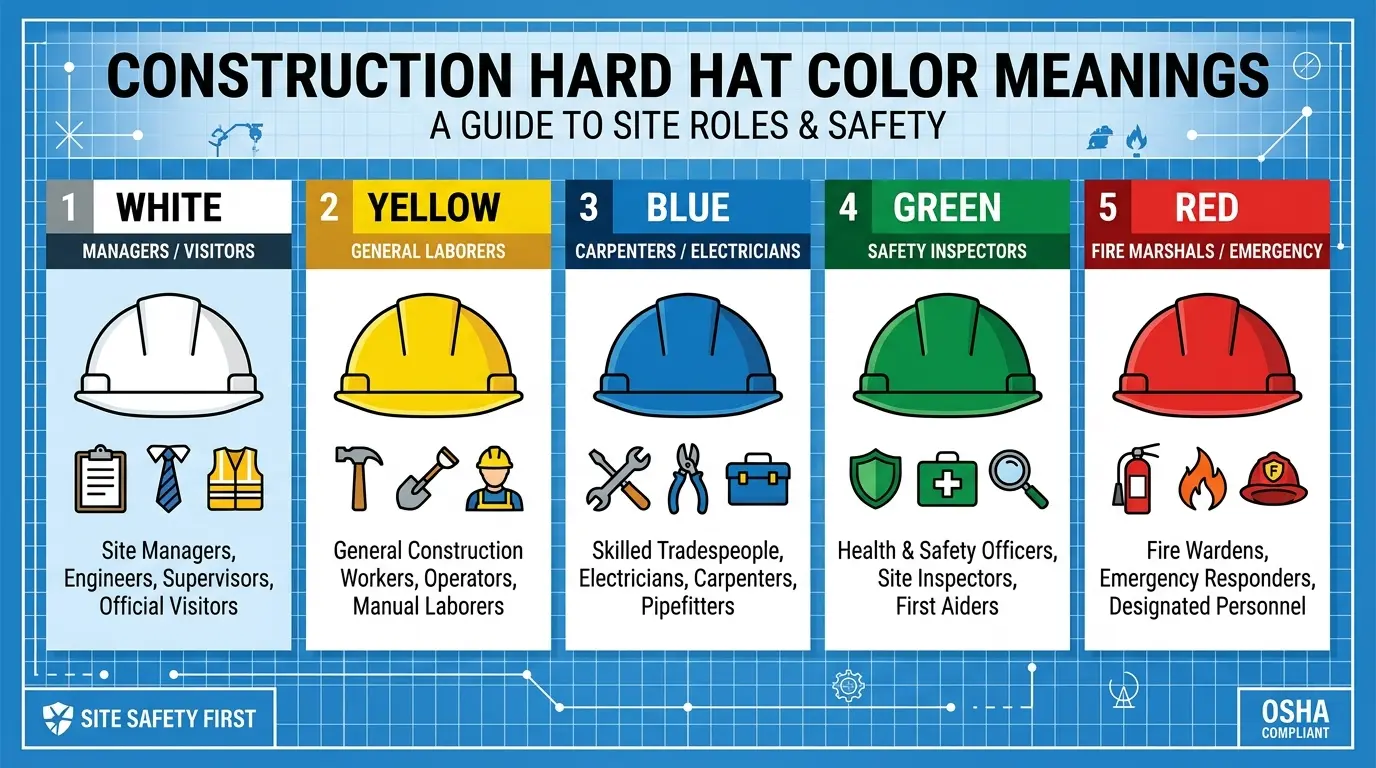
Construction Helmet Color Meanings Chart
The following chart shows common examples, not a universal rulebook. The same color can have a completely different meaning on another construction project.
| Helmet Color | Common Meaning on Some Sites | Typical Impression | Important Note |
|---|---|---|---|
| White | Managers, supervisors, competent workers | Leadership, experience, authority | Often used for senior or general site personnel |
| Yellow | General workers, laborers, operators | Visibility, caution, construction work | Very common, but not universally assigned |
| Blue | Visitors, technical workers, electricians, or other roles | Technical or visitor status | Meaning changes greatly between sites |
| Green | Safety personnel, first aiders, new workers | Safety, health, fresh status | Site-specific |
| Orange | Signalers, road crews, traffic-related workers | High visibility, attention | Often useful where worker visibility matters |
| Red | Emergency, fire, rescue, or special responsibility | Urgency, authority, danger | Not a universal construction role |
| Black | Supervisors or site leadership | Authority, control | Used in some established site systems |
| Brown | High-heat or welding work on some older systems | Heat-related work | Not a universal modern code |
| Grey | Visitors or miscellaneous roles on some older systems | Neutral status | Rarely reliable without site guidance |
One well-documented example comes from Build UK. Its 2017 helmet-color scheme used white for site managers, competent operatives, and vehicle marshals; black for site supervisors; orange for slingers and signallers; and blue for site visitors. Earlier systems used different meanings, showing exactly why a color should never be interpreted without context. (NBS)
Why Do Construction Helmets Have Different Colors?
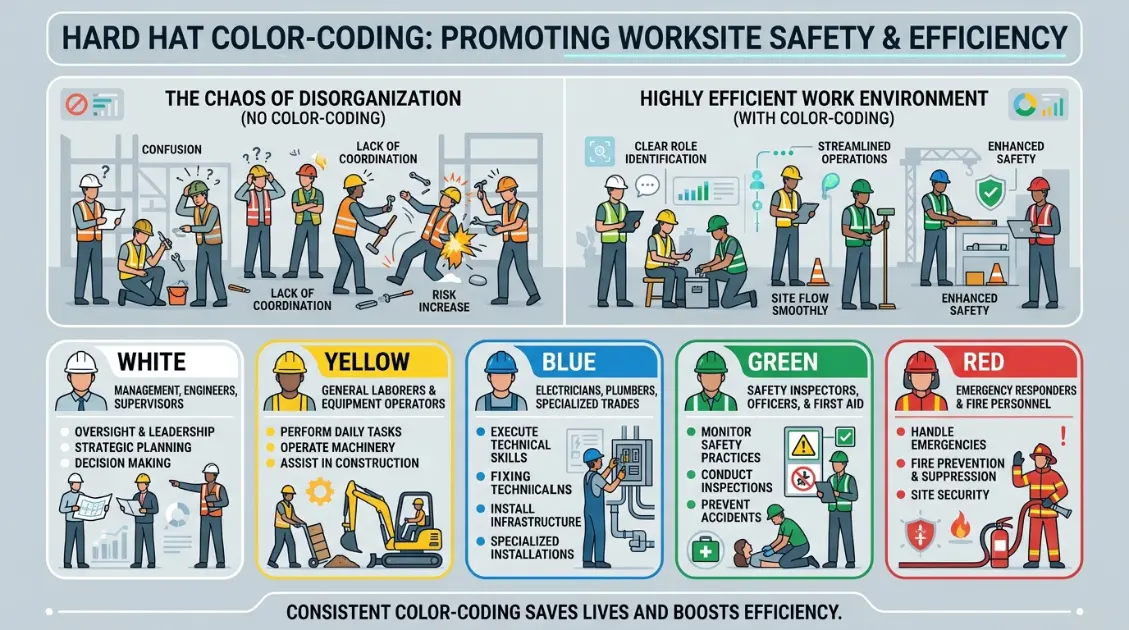
Construction helmet colors serve two practical purposes: identification and visibility.
First, color can make it easier to recognize who is who. On a large project, a supervisor may need to find a signaler, visitor, safety worker, or manager quickly. A simple color system can reduce the need to read badges or walk closer to identify someone.
Second, bright helmet colors can help workers stand out against the construction environment. Buildings, concrete, steel, machinery, soil, and shadows create complicated backgrounds. Research into construction-site color schemes has suggested that carefully selected colors and combinations can improve visibility and workers’ perception of potential hazards. (PubMed)
However, helmet color is not a substitute for proper PPE standards, training, signage, or communication.
A helmet that looks bright and professional may still be unsuitable if it does not provide the protection required for the hazard. OSHA requires protective helmets where workers face possible head injury from impact, falling or flying objects, or certain electrical hazards. (OSHA)
What Does a White Construction Helmet Mean?
White construction helmets are commonly associated with management, supervisors, engineers, competent workers, or other senior personnel, depending on the site’s system.
White has a clean, highly visible appearance and is easy to distinguish from many darker construction backgrounds. Because of these qualities, it can work well for people who need to be easily recognized across a busy site.
In the Build UK system, white helmets were assigned to site managers, competent operatives, and vehicle marshals. (NBS)
White Helmet Symbolism
Outside formal safety rules, white often creates impressions of:
- Authority
- Cleanliness
- Organization
- Professionalism
- Experience
- Responsibility
These are visual associations, not proof of someone’s job title or qualifications.
A worker wearing a white helmet is not automatically a project manager. The site’s own PPE policy has the final word.
What Does a Yellow Construction Helmet Mean?
Yellow is perhaps the color most people associate with construction helmets.
On many sites, yellow helmets are used for general workers, laborers, or workers performing common construction duties. However, this is a convention rather than a universal international standard.
Yellow also has a strong practical advantage: it is visually noticeable.
OSHA’s safety-color rules use yellow for caution and physical hazards such as striking, stumbling, falling, tripping, and caught-in-between hazards. However, these rules concern hazard marking, not a universal yellow-hard-hat job classification. (OSHA)
Why Yellow Works on Construction Sites
Yellow sits between attention and visibility. Against darker materials such as steel, asphalt, machinery, and unfinished walls, a bright yellow helmet can create strong visual contrast.
Its meaning can therefore work on two levels:
Practical meaning: visibility and identification.
Symbolic meaning: caution, energy, attention, and activity.
That does not mean yellow helmets are scientifically “safer” in every situation. Background, weather, lighting, helmet design, reflective markings, and viewing distance all influence visibility.
What Does a Blue Construction Helmet Mean?
Blue is one of the most variable construction helmet colors.
Depending on the site, a blue helmet may identify:
- Visitors
- Electricians
- Carpenters
- Technical workers
- Skilled workers
- Temporary workers
- Specialized personnel
For example, the Build UK color system uses blue for site visitors. Older construction color systems documented by NBS used blue for carpenters, electricians, and other technical operators. (NBS)
This is a perfect example of why construction helmet color meanings cannot be treated as universal facts.
Blue can also create a visual impression of calmness, reliability, and technical professionalism. Those psychological associations may influence how people perceive the wearer, but they do not determine the person’s actual competence.
What Does a Green Construction Helmet Mean?
Green helmets may be used for safety personnel, first aiders, new workers, or workers with particular responsibilities, depending on the company.
Older construction color systems have used green for safety inspectors and new or probationary workers. (NBS)
Green has an intuitive connection with:
- Safety
- Health
- Renewal
- Permission
- Nature
- Recovery
That makes it an understandable choice for safety-related roles. Still, green should never automatically be interpreted as “safety officer.”
A green helmet could mean something completely different on another project.
What Does an Orange Construction Helmet Mean?
Orange helmets are often associated with high-visibility work, particularly signalers, traffic-related work, road crews, or people working around moving equipment.
Build UK’s helmet system uses orange for slingers and signallers. (NBS)
Orange attracts attention because it is visually strong against many natural and industrial backgrounds. It also has an established connection with warning and temporary hazards.
This makes orange especially useful when a worker needs to be noticed by:
- Crane operators
- Vehicle drivers
- Equipment operators
- Road users
- Other workers
High-visibility safety systems also use colors such as fluorescent yellow-green and fluorescent orange-red because conspicuity is important around traffic and other hazards. (Connect NCDOT)
What Does a Red Construction Helmet Mean?
Red helmets often create an immediate impression of emergency, danger, authority, or urgent responsibility.
Some organizations may use red for:
- Fire marshals
- Emergency teams
- Rescue personnel
- Special safety responsibilities
- Supervisory roles
But red is particularly site-dependent. There is no general rule that says every red construction helmet belongs to a firefighter or safety officer.
The strong psychological effect of red can make it useful for rapid recognition. OSHA also uses red as a safety color for danger and emergency-stop applications, although that does not establish red as a construction-worker helmet code. (OSHA)
What Does a Black Construction Helmet Mean?
Black helmets may represent site supervisors or leadership in certain construction systems.
Build UK’s scheme, for example, uses black for site supervisors. (NBS)
Black has strong associations with:
- Authority
- Seriousness
- Control
- Professionalism
- Formality
These associations can make black visually useful for leadership identification. Yet darker colors can also provide less contrast in some environments, especially against dark structures or during low-light conditions.
Therefore, a black helmet may look professional while still requiring suitable visibility measures around vehicles and machinery.
What Do Brown and Grey Construction Helmet Color Meanings?
Brown and grey are less reliable as modern construction color codes.
Older systems have used brown for people involved in high-heat applications, including welders, while grey has sometimes been used for visitors. (NBS)
Today, however, these meanings should be treated as historical or site-specific examples, not universal definitions.
If you see a brown or grey helmet, the safest approach is simple: check the project’s PPE chart.
Are Construction Helmet Colors Universal?
No.
This is the most important fact in understanding construction helmet color meanings.
Different countries, contractors, industries, and individual projects may use different color systems. Even within the same country, two companies can assign different responsibilities to the same color.
For example, a blue helmet may mean visitor on one site but electrician on another.
This lack of universal color coding has been recognized as a practical problem. NBS reported that different approaches and conflicting contractor systems could create confusion, which was one reason for the Build UK color system. (NBS)
Therefore:
Never assume a worker’s role from helmet color alone.
Look for site signage, badges, high-visibility vest markings, identification cards, or the project’s official PPE policy.
Construction Helmet Color Meanings in the United States
In the United States, OSHA’s construction rules establish requirements for protective helmets based on hazards, but they do not create a universal color scheme assigning workers to specific roles by helmet color. (OSHA)
That distinction matters.
A company in Texas could use white for supervisors and yellow for general workers. Another company could use white for everyone. A third could use different colors for visitors and specialty roles.
Therefore, an American construction helmet color chart found online should be treated as a possible workplace convention, not an OSHA universal standard.
Construction Helmet Color Meanings in the UK
The UK provides a useful example of a more structured role-based system.
Build UK’s 2017 system specified:
- White: site managers, competent operatives, and vehicle marshals
- Black: site supervisors
- Orange: slingers and signallers
- Blue: site visitors
The system was introduced to create greater consistency across participating sites. (NBS)
Even so, special organizations and projects can have their own requirements. NBS noted, for example, that Network Rail’s PPE standard used only white and blue helmets on its sites. (NBS)
The lesson is simple: national examples are useful, but project rules still matter.
Construction Helmet Color Meanings Psychology
Color can influence attention and perception, but color psychology should not be confused with hard science about personality.
A yellow helmet may feel energetic or attention-grabbing. A white helmet may appear clean and professional. Blue can feel calm and technical. Red can communicate urgency.
These impressions are shaped by:
- Personal experience
- Culture
- Workplace expectations
- Previous exposure to safety systems
- Environmental contrast
- Lighting
- Age
- Context
Research in construction safety supports the idea that color and contrast can influence visual perception and recognition of hazards. However, that does not mean every person experiences a particular color in exactly the same way. (PubMed)
Color Does Not Determine Personality
It would be misleading to say that a person wearing a blue helmet is naturally calm or that someone wearing a red helmet is aggressive.
The helmet color is usually assigned by the employer.
So, the better interpretation is:
Color can communicate a role or create an impression, but it does not reveal a person’s personality.
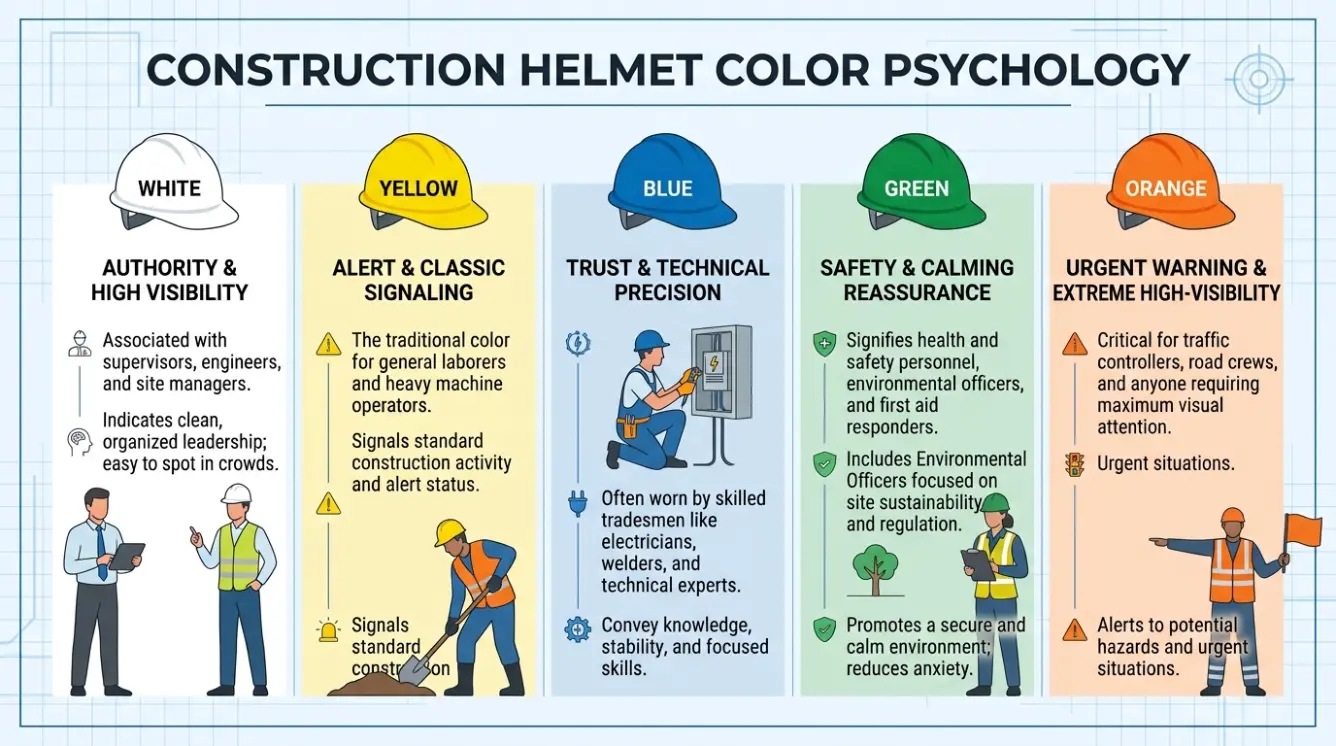
How Lighting Changes Construction Helmet Colors
The same helmet can look very different under different lighting.
Bright sunlight can make yellow, orange, and white helmets appear highly visible. Under artificial lighting, shadows, dust, fog, or cloudy skies, the visual contrast can change.
A white helmet may blend into a bright sky or pale concrete wall. A dark helmet can disappear against steel or shaded areas.
This is why visibility should be considered as a complete system rather than a single color choice.
Reflective materials can become especially important at night. Research on road-worker visibility found that nighttime noticeability was strongly influenced by the brightness of retroreflective material, while color contrast played a smaller role under nighttime illumination. (TRID)
Real-Time Example: A Busy Construction Site
Imagine a large building project on August 7, 2026.
A visitor enters the site and sees:
- White helmets near the site office
- Black helmets around supervisory staff
- Orange helmets near crane operations
- Blue helmets among visitors
- Yellow helmets throughout the active work areas
The visitor might assume these meanings are universal.
They are not.
The site’s induction board explains that the company has assigned each color to a specific role. The orange helmets are used to make signalers easier for crane operators to identify. Blue identifies visitors so supervisors can quickly recognize people who may not know the site’s hazards. White identifies competent site personnel.
Now imagine another contractor arrives with a completely different color system.
The colors may look identical, but their meanings change.
This is why the written site policy is more reliable than any internet helmet-color chart.
How Construction Helmet Colors Help Safety
A well-designed color system can make communication faster.
Consider a crane operation. The operator may not have time to read every person’s name or job title. A distinct helmet color can provide a quick visual cue about who has a specific role.
Color can also help supervisors identify visitors or inexperienced personnel.
However, a color system works best when:
- Everyone knows what the colors mean.
- The meanings are documented.
- The system is used consistently.
- Other identification methods are available.
- Workers receive site-specific training.
- Colors remain visible in actual working conditions.
A color system that changes every week can create more confusion than it solves.
Construction Helmet Colors and Branding
Construction companies sometimes choose helmet colors that match corporate branding, but safety and identification should come first.
A company may want a distinctive blue, orange, green, or white helmet because it fits its brand identity. That can make the workforce look consistent in photographs and marketing materials.
However, branding should not override safety requirements.
A construction helmet is primarily protective equipment. OSHA requires protective helmets where workers face specified head hazards, and compliant helmets must meet applicable performance criteria. (OSHA)
For businesses, a better strategy is to use branding through:
- Company logos
- Approved decals
- Uniforms
- High-visibility clothing
- Signage
- Vehicle graphics
while keeping the helmet-color system clear and consistent.
Construction Helmet Color Meanings in Photography and Media
Photographers often use helmet colors to make a construction scene easier to understand.
A white helmet can visually suggest management. Yellow can immediately communicate “construction worker” to a general audience. Orange can emphasize a worker involved in traffic or signaling.
This is useful in:
- Company websites
- Safety campaigns
- Training materials
- News photography
- Recruitment advertisements
- Construction presentations
But photographs can also create false impressions.
A stock photo showing a blue helmet does not prove that blue means electrician, visitor, or supervisor. The photographer may have chosen the color simply because it looked good on camera.
Construction Helmet Colors in Interior and Industrial Design
Helmet colors are not normally an interior-design issue, but workplace designers can use color strategically.
For example, a large industrial facility might use strong visual color coding for:
- Safety equipment
- Emergency areas
- Restricted zones
- Worker identification
- Traffic pathways
- Machinery warnings
The goal is not decoration. It is fast recognition.
OSHA’s safety-color rules already demonstrate how color can support hazard communication: red is associated with danger and emergency functions, while yellow is used for caution and certain physical hazards. (OSHA)
Construction Helmet Colors and Fashion
Safety helmets are protective equipment rather than fashion accessories. Still, appearance can affect whether people accept and consistently wear PPE.
Workers may prefer certain colors because they look cleaner, brighter, or more professional. Employers may also choose colors that make their teams easy to identify.
For practical work, however, comfort, fit, compatibility with other PPE, certification, condition, and suitability for the hazard matter far more than appearance.
HSE guidance, for example, emphasizes that head protection should be in good condition, fit correctly, be worn properly, and come from a reputable supplier. (HSE)
Why Yellow and Orange Are So Common
Yellow and orange have strong associations with construction because they are used extensively in safety environments.
Their value is not simply that they “look dangerous.” Their real advantage is that bright colors can create useful contrast against many worksite backgrounds.
Construction environments contain:
- Grey concrete
- Black asphalt
- Silver steel
- Brown soil
- Green landscaping
- Dark machinery
- Shadows
- Dust
Bright helmet colors can stand out among these competing visual elements.
Still, visibility depends on the whole environment. A color that stands out against dark machinery may not stand out against a bright sky.
Do Helmet Colors Indicate Skill Level?
Sometimes, but not always.
Some employers use helmet colors to distinguish supervisors, competent workers, trainees, visitors, or specialized personnel.
Others use color only for general identification.
A helmet color therefore cannot reliably tell you whether someone is highly skilled, inexperienced, licensed, or qualified.
If competence matters for a task, use the formal qualification, authorization, badge, or site record—not helmet color.
Do Helmet Colors Indicate Safety Responsibility?
They can.
A construction company may designate a particular color for safety staff, first aiders, fire marshals, or emergency personnel.
The advantage is speed. During an incident, workers can recognize the relevant person without searching through a crowd.
The limitation is that emergency roles must be clearly communicated. A color alone should not be expected to carry the entire safety system.
Common Misconceptions About Construction Helmet Colors
Myth 1: Every yellow helmet means a laborer
Not necessarily. Yellow is common for general construction workers, but companies can assign it differently.
Myth 2: OSHA requires white helmets for managers
No. OSHA establishes head-protection requirements, but it does not create a universal manager-white-helmet rule. (OSHA)
Myth 3: Blue always means electrician
No. Blue can identify technical workers on some systems and visitors on others. (NBS)
Myth 4: Red always means emergency worker
No. Red may be used for emergency responsibilities, but its meaning is determined by the employer or project.
Myth 5: A brighter helmet is automatically safer
Not necessarily. Helmet protection depends on the helmet’s design, certification, fit, condition, and suitability for the hazard. Visibility is only one part of safety.
Myth 6: Helmet color tells you how experienced someone is
Not reliably. Some systems use color for role identification, but experience should be confirmed through formal qualifications and site records.
How to Choose the Right Construction Helmet Color
If you are responsible for creating a site color system, start with the job rather than the color.
Ask:
- Which roles must be recognized quickly?
- Which people need to be visible around vehicles?
- Which colors are already used for hazards?
- Could visitors misunderstand the system?
- Will the colors remain visible in poor weather?
- Are reflective markings needed?
- Can workers distinguish the selected colors?
- Is the system documented during site induction?
Most importantly, do not copy an internet chart without checking local requirements and company policy.
A color system should be simple enough for a new worker to understand within minutes.
Construction Helmet Color Combinations
A helmet does not work alone. Its color interacts with clothing, background, lighting, and reflective materials.
White and High-Visibility Orange
This combination can create a strong professional appearance while adding visibility through the clothing.
Yellow and Dark Workwear
Yellow can create strong contrast against dark clothing, machinery, and construction materials.
Orange and Reflective Materials
Orange is useful for roles that need to attract attention, particularly around traffic or moving equipment. High-visibility standards address color, retroreflection, and material performance for conspicuity. (ANSI Webstore)
Blue and White
Blue and white can provide a clean identification system when the site assigns them to different groups.
Black and Bright Reflective Markings
Black can clearly distinguish supervisors, while reflective elements can improve visibility in low-light environments.
The best combination depends on the surroundings rather than fashion.
Construction Helmet Color Meanings for Visitors
Visitors deserve special attention because they may not know the hazards or site layout.
Some construction systems use blue helmets for visitors. Build UK’s system is one documented example. (NBS)
A visitor-color system can help employees immediately recognize people who may require assistance or supervision.
However, visitor identification should also include:
- Site induction
- Visitor badges
- Escort rules where required
- High-visibility clothing where appropriate
- Restricted-area controls
- Clear signage
Color makes identification easier; it does not replace site safety procedures.
Why Context Changes Construction Helmet Color Meaning
Color is a language, but languages depend on rules.
A red helmet in one workplace might mean “emergency response.” In another, it might simply be a company color.
The meaning changes because the social context changes.
This happens with many colors outside construction as well. Red can mean danger, love, celebration, or authority depending on the situation. Blue can suggest trust, technology, calmness, or a particular team.
Construction helmet colors work in exactly the same way.
The helmet’s color has a visual meaning, while the site’s policy gives it an operational meaning.
Age and Cultural Differences in Helmet Color Perception
People do not all interpret colors identically.
Workers who have spent years on construction sites may immediately recognize a color code that is unfamiliar to a new visitor.
Culture also matters. A worker who has worked under a British role-based system may interpret a blue helmet differently from someone accustomed to another country’s conventions.
Age, training, eyesight, lighting conditions, and previous workplace experience can also influence recognition.
That is why good safety systems combine color with words, symbols, badges, training, and clear procedures.
What Matters More Than Helmet Color?
If you are deciding whether a construction helmet is appropriate, focus on the protective requirements first.
Important considerations include:
- Correct helmet type
- Applicable safety standard
- Impact protection
- Electrical protection when required
- Proper fit
- Retention system
- Condition of the shell
- Condition of the suspension
- Compatibility with other PPE
- Manufacturer instructions
- Site-specific requirements
ANSI/ISEA Z89.1 covers industrial protective helmets and addresses types, classes, testing, and performance requirements. (ANSI Webstore)
The color is useful for identification, but the protective performance is what protects the worker.
Frequently Asked Questions
What do different construction helmet colors mean?
They usually identify job roles, site status, responsibilities, or worker groups. However, there is no single universal color system. Always follow the specific construction site’s rules.
What does a white hard hat mean?
White often identifies managers, supervisors, competent workers, engineers, or other senior personnel. In some systems, however, white is simply a general helmet color.
What does a yellow construction helmet mean?
Yellow is commonly associated with general construction workers or laborers. Nevertheless, its exact meaning depends on the employer and site.
What does a blue hard hat mean?
Blue can represent visitors, electricians, carpenters, technical workers, or other specialized groups. Its meaning varies significantly between systems.
What does an orange construction helmet mean?
Orange is often used for workers who need strong visual identification, including signalers and road-related personnel. Build UK’s system uses orange for slingers and signallers. (NBS)
What does a black hard hat mean?
Some construction sites use black helmets for supervisors. This is a role-based convention rather than a universal safety requirement.
Does OSHA have construction hard hat color codes?
No universal OSHA color code assigns helmet colors to construction job roles. OSHA’s rules focus on when head protection is required and on applicable protective-helmet criteria. (OSHA)
Are construction helmet colors the same in every country?
No. Countries, industries, companies, and individual construction projects can use different systems. The UK provides one structured example, while U.S. OSHA regulations do not establish a universal role-based helmet-color scheme. (NBS)
Is a white or yellow helmet safer than a black helmet?
Color alone does not determine protective performance. Visibility can be affected by color and contrast, but the helmet must also be suitable for the hazard and meet the required protective criteria. (OSHA)
Can helmet color identify a worker’s qualifications?
Not reliably. Some sites use color to indicate roles or competence categories, but qualifications should be confirmed through official credentials and site records.
Final Thoughts on Construction Helmet Color Meanings
Construction helmet colors are more than decoration. When a site uses them consistently, they can become a simple visual communication system that helps workers recognize supervisors, visitors, signalers, technical staff, and other groups.
Yet the biggest lesson is also the simplest: there is no universal construction helmet color dictionary.
White may suggest leadership. Yellow may suggest general construction work. Blue may identify visitors or technical workers. Orange may highlight signalers. Black may indicate supervisors. Green or red may carry special safety meanings. But these interpretations are conventions, not guarantees.
Color psychology adds another layer. Bright colors can attract attention, while contrast can improve visual recognition. Research supports the value of thoughtful color and visibility choices in construction environments, but perception depends on lighting, surroundings, culture, and context. (PubMed)
So, the next time you see a row of colorful construction helmets, do not judge the wearer by color alone. Instead, think of the helmets as part of a larger safety language—one that works best when everyone understands the rules behind it.
Most importantly, when working on a real construction site, follow the site’s official helmet-color policy and PPE requirements rather than relying on a general online chart.

Emma Wilson is a dedicated comparison writer and product researcher at ColorMystiic.com. She specializes in creating unbiased product comparisons, detailed reviews, and helpful buying guides. Her goal is to help readers make smarter purchasing decisions with confidence.