A Hawaiian lei is much more than a colorful necklace. It can express affection, respect, welcome, congratulations, remembrance, beauty, connection, and a relationship with the land. The meaning of a lei often comes from the flowers, leaves, shells, seeds, feathers, or other materials used to make it—not simply from its color.That is why lei color meanings can be more complicated than a simple chart such as “red means love” or “yellow means happiness.
” In Hawaiian culture, the plant itself, its scent, where it grows, the occasion, the person receiving it, and the way the lei is made can all influence its significance. The University of Hawaiʻi describes lei making as a continuing cultural practice involving many materials and techniques.
This guide explains the most useful ways to understand lei colors without turning Hawaiian culture into a rigid color-code system. You will learn what common lei colors can suggest, how flower symbolism changes the interpretation, and how to choose colors thoughtfully for weddings, graduations, celebrations, ceremonies, fashion, and everyday gifting.
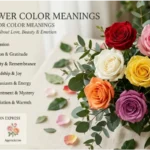
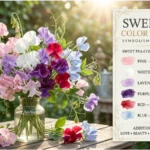
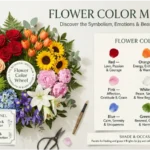
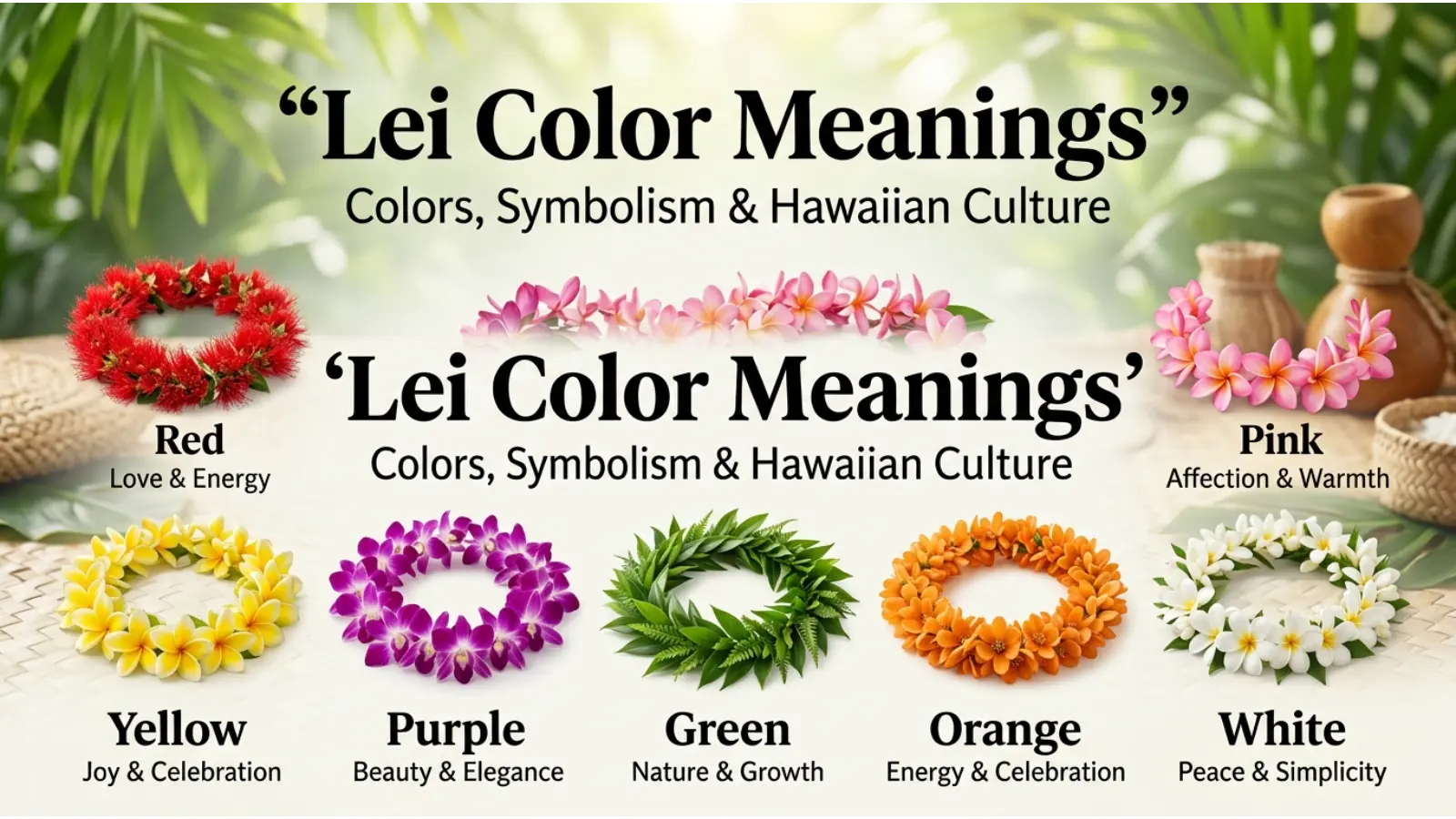
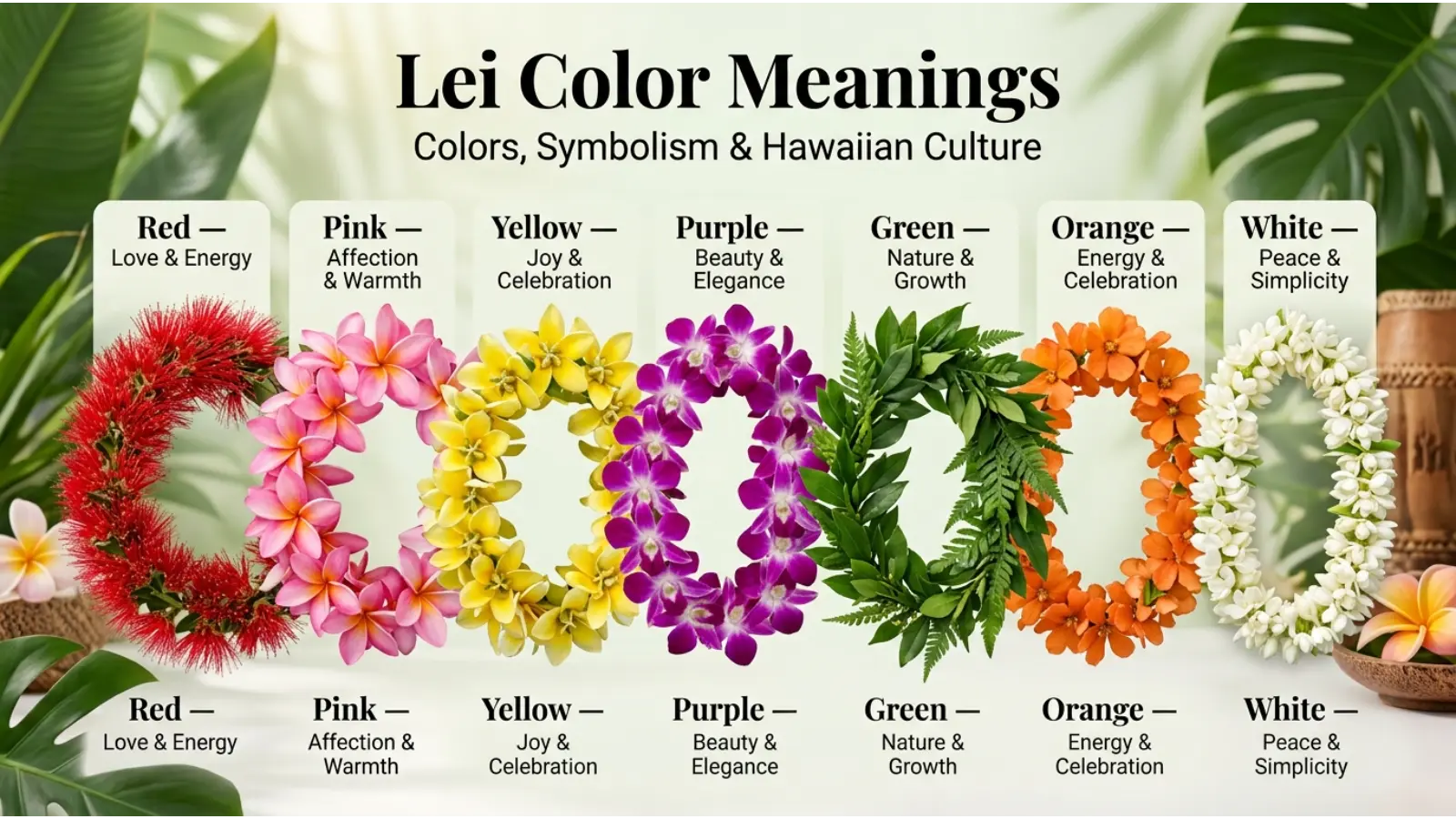
Quick Answer: Lei color meanings are influenced by the flower or plant, cultural context, occasion, and personal intention. Red may suggest passion or strength, yellow can feel joyful and celebratory, pink often conveys affection, purple can create a sense of beauty or distinction, green connects strongly with nature, white can suggest simplicity or remembrance, orange feels energetic, and gray can appear more subdued. However, these are general associations rather than universal Hawaiian rules.
Lei Color Meanings at a Glance
| Lei Color | Common Visual Association | What It Can Suggest | Best Used For |
|---|---|---|---|
| ❤️ Red | Strong, warm, vivid | Love, passion, energy, celebration | Romantic occasions, celebrations |
| 💗 Pink | Soft, gentle, warm | Affection, friendship, tenderness | Birthdays, weddings, welcoming |
| 💛 Yellow/Gold | Bright, sunny | Joy, celebration, warmth, optimism | Graduations, festivals, honors |
| 💜 Purple | Rich, elegant | Beauty, distinction, creativity | Formal events, ceremonies |
| 💚 Green | Natural, fresh | Nature, growth, connection to land | Cultural events, everyday wear |
| 🧡 Orange | Energetic, warm | Enthusiasm, vitality, excitement | Parties, festivals, celebrations |
| 🤍 White | Clean, light | Peace, simplicity, remembrance | Formal occasions, memorial settings |
| 🩶 Gray/Silver | Quiet, neutral | Reflection, restraint, dignity | Symbolic or understated designs |
| 🌈 Mixed Colors | Varied and lively | Celebration, abundance, creativity | Festivals and major celebrations |
This chart is a practical visual guide, not a traditional Hawaiian dictionary of fixed color meanings. Hawaiian lei traditions are much richer than a one-color-one-message system.
What Does a Lei Symbolize?
At its heart, a lei is a way of giving and wearing something meaningful. Hawaiian-language dictionaries define lei as a garland or wreath made from materials such as flowers, leaves, shells, ivory, feathers, or paper, and also connect the word with affection and beloved people.
Consequently, the meaning of a lei often depends on the relationship between the giver and receiver.
A lei may communicate:
- Affection
- Respect
- Welcome
- Congratulations
- Honor
- Friendship
- Love
- Farewell
- Appreciation
- Connection to place
The University of Hawaiʻi notes that lei have become internationally recognized as expressions of greeting, farewell, honor, congratulations, and love. At the same time, traditional Hawaiian meanings can be much deeper because particular plants and materials have their own histories and cultural associations.
Hawaiian Lei Color Meanings and Flower Symbolism
Color can influence how a lei looks and feels, but the flower or plant may carry the stronger cultural meaning.
For example, a green maile lei is not simply “a green lei.”
This distinction matters because two leis can have the same color while communicating very different ideas.
A purple orchid lei and a green maile lei may both be beautiful, yet their cultural histories are not interchangeable.
Red Lei Color Meaning
Red is visually powerful. In general color symbolism, it is often associated with love, passion, courage, energy, and strong emotion.
However, a red lei does not automatically mean romantic love. It may simply be part of a festive arrangement, a cultural design, or a combination chosen for visual impact.
Red can work particularly well when the occasion is energetic or celebratory.
Pink Lei Color Meaning
Pink usually creates a softer impression than red. It can suggest affection, warmth, friendship, tenderness, and appreciation.
That makes pink lei attractive for birthdays, welcoming ceremonies, weddings, and personal gifts.
Still, the specific flower matters. A pink lei made from one plant should not automatically be assigned the same cultural meaning as every other pink lei.
Yellow and Gold Lei Color Meaning
Yellow is bright and immediately noticeable. It often creates associations with sunshine, happiness, warmth, optimism, and celebration.
Gold and yellow can also feel prestigious because bright yellow-gold tones are visually connected with precious materials and ceremonial decoration.
Interestingly, Hawaiʻi has an official system of island colors established in state law. Golden yellow is associated with Oʻahu, while other islands have different official colors. These island colors are distinct from a universal system of personal lei color meanings.
Purple Lei Color Meaning
Purple often appears sophisticated, artistic, mysterious, and elegant.
Modern lei arrangements frequently use purple flowers because the color creates strong contrast against green leaves. Purple can therefore communicate beauty and ceremony without necessarily carrying one fixed traditional message.
A key cultural caution is useful here: purple flowers are popular in contemporary Hawaiʻi, but popularity does not mean that purple itself has one universal traditional meaning.
Green Lei Color Meaning
Green has an especially natural visual connection in lei because leaves and vines are fundamental lei materials.
It can suggest:
- Nature
- Growth
- Freshness
- Renewal
- Life
- Connection to the land
Therefore, green can sometimes be more than a decorative color. When the green material is a culturally significant native plant, the plant itself becomes central to the meaning.
White Lei Color Meaning
White creates a calm, clean, understated appearance.
In modern symbolic language, people may associate white with peace, simplicity, purity, remembrance, or dignity.
White leis can be especially effective when you want an elegant appearance that does not compete with formal clothing.
Orange Lei Color Meaning
Orange combines the warmth of red with the brightness of yellow. It often feels energetic, playful, confident, and festive.
For modern events, orange lei arrangements can create a lively atmosphere, particularly when combined with yellow, red, or green.
Gray and Silver Lei Color Meaning
Gray is less common as the dominant color of a flower lei, but it can appear through foliage, dried materials, shells, or other natural elements.
Its quiet appearance may suggest dignity, age, reflection, or restraint. In Hawaiian island symbolism, gray is officially associated with Kahoʻolawe.
That is an example of why context matters: an official island color is not necessarily a general emotional meaning for every lei.
Why Lei Color Meanings Are Not Universal
A common mistake is assuming that every Hawaiian lei follows a fixed color dictionary.
Traditional lei culture is more complex.
The University of Hawaiʻi Press describes traditional lei knowledge involving dozens of flowers and plants, including many color variations, with meanings connected to botanical characteristics, legends, chants, and cultural uses.
Therefore, interpretation can depend on:
- The plant or flower
- The color
- The occasion
- The person receiving the lei
- The relationship between giver and receiver
- The place associated with the material
- The construction method
- The historical period
- Personal intention
This approach is more accurate than treating lei colors like traffic lights with one universal meaning for each shade.
Psychology of Lei Colors
Color psychology can help explain why different lei colors create different visual impressions. However, scientific evidence does not support the idea that a color automatically produces the same emotion in every person.
A person’s response can change with culture, memories, age, surroundings, lighting, and personal experience.
For example, a bright yellow lei may look cheerful in sunlight but appear much softer under warm indoor lighting. Similarly, deep purple may look formal when paired with black but playful when surrounded by tropical flowers.
Color and Emotion
People often perceive bright, warm colors as more energetic than muted colors. Strong reds and oranges can attract attention, while softer pinks and pale whites may create a gentler appearance.
However, this is perception rather than a guaranteed emotional reaction.
That distinction matters when using color psychology professionally. Designers can influence visual impressions, but they cannot control exactly what every viewer feels.
Color and Memory
A lei can also become emotionally powerful because of the event connected with it.
Someone may remember a yellow lei because they received it at graduation. Another person may associate white flowers with a wedding. Someone else may remember purple orchids from a family celebration.
In these cases, the personal memory can become stronger than any general color symbolism.
Spiritual Meaning of Lei Colors
Lei can have spiritual and cultural significance, but interpretations should be handled respectfully.
Traditional Hawaiian relationships with plants were not simply decorative. University of Hawaiʻi educational material explains that lei materials could have profound personal and spiritual significance and that Native Hawaiians developed deeply meaningful relationships with the natural world.
Maile is one example. Hawaiian-language and botanical resources document its cultural connections with hula and Laka, including its historical use in ritual contexts.
Because of this, it is better to discuss spiritual significance through specific plants, traditions, and contexts rather than claiming that “purple always means spiritual power” or “green always means healing.”
Those statements may sound attractive online, but they oversimplify Hawaiian traditions.
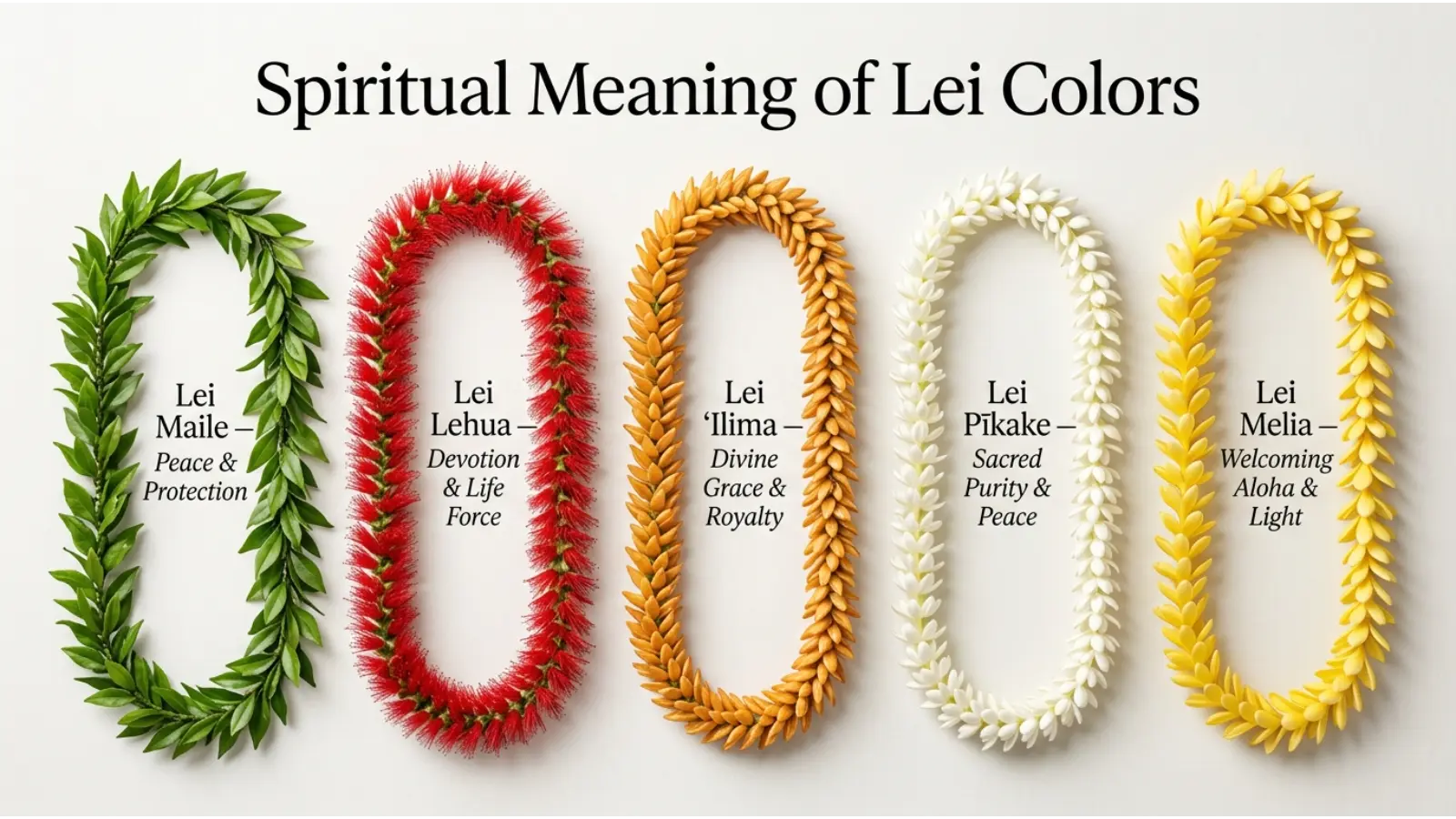
Cultural Meaning of Lei in Hawaiʻi
Lei are deeply connected with Hawaiian cultural life.
They are worn, given, created, and displayed in many settings. Contemporary lei traditions include flowers, foliage, shells, feathers, seeds, and other materials. The method of construction can also vary according to the material being used.
Lei Day, celebrated in Hawaiʻi, provides a modern example of how lei remain part of community life. In 2026, the University of Hawaiʻi at Mānoa held lei-making workshops and a lei-focused cultural panel emphasizing that lei should be understood as more than decoration.
This modern perspective is important. A lei can be visually beautiful while also representing relationships between people, plants, place, and culture.
Hawaiian Island Colors and Lei Symbolism
Hawaiʻi has legally recognized official colors for its islands.
| Island | Official Color |
|---|---|
| Hawaiʻi | Red |
| Maui | Pink |
| Oʻahu | Golden Yellow |
| Kauaʻi | Purple |
| Molokaʻi | Green |
| Lānaʻi | Orange |
| Niʻihau | White |
| Kahoʻolawe | Gray |
These colors are established in Hawaiʻi law as official island colors.
This is one of the most useful facts for understanding lei color meanings because island colors can sometimes appear in floral decorations, celebrations, parades, and cultural events.
However, these official island colors should not be confused with a universal code saying that every red lei means Hawaiʻi or every purple lei means Kauaʻi. The context determines how the color is being used.
Historical Meaning of Hawaiian Lei
Lei traditions existed long before modern tourism made the flower necklace an international symbol of Hawaiʻi.
Historically, lei could be made from many different natural materials, and their significance was connected to the plants, people, ceremonies, and environments surrounding them. University of Hawaiʻi sources emphasize that traditional lei knowledge includes botanical, cultural, oral, and historical information.
The history also shows why a modern tourist interpretation can sometimes miss the deeper meaning of a lei.
A lei is not simply an accessory. Depending on its material and context, it can represent a relationship with people, place, memory, ceremony, and the natural world.
Personality Associations With Lei Colors
People often ask what their preferred lei color says about their personality.
Color preference can offer a fun way to describe style, but it cannot accurately diagnose someone’s personality.
- Red: bold, expressive, energetic
- Pink: warm, affectionate, gentle
- Yellow: optimistic, cheerful, outgoing
- Purple: creative, artistic, distinctive
- Green: natural, balanced, relaxed
- Orange: enthusiastic, playful, adventurous
- White: simple, calm, refined
- Gray: understated, thoughtful, modern
These are cultural and design associations—not scientific personality tests.
Someone who loves purple may be highly practical. Someone who prefers green may be very energetic. Personal taste has many causes beyond color symbolism.
Lei Color Meanings in Branding and Marketing
Lei colors can also inspire branding, particularly for businesses connected with Hawaiʻi, travel, hospitality, weddings, events, beauty, and tropical products.
A brand might use:
- Green to emphasize nature and environmental connection
- Yellow to create a bright tropical feeling
- Pink for warmth and softness
- Purple for a more premium or artistic identity
- Orange for energy and fun
- White for a clean, refined appearance
The most effective branding does not simply pick a color because an online chart says it has a certain meaning.
Instead, designers consider the entire visual system.
For example, green combined with natural textures can communicate an earthy identity, while the same green beside metallic gold can feel more luxurious.
Context changes color meaning.
Using Lei Colors in Interior Design
Lei-inspired colors can bring a tropical atmosphere into a home without making every room look like a souvenir shop.
Living Room
Try green foliage tones with warm white, natural wood, and small amounts of yellow or orange.
This creates a fresh environment while keeping stronger colors under control.
Bedroom
Soft pink, muted purple, cream, and natural green can create a relaxed visual palette.
Avoid using highly saturated red across every wall because intense colors can dominate a small sleeping space.
Home Office
Green can provide a natural visual base, while yellow or orange can be introduced through small decorative details.
A colorful lei arrangement can become a focal point without overwhelming the workspace.
Kitchen
Yellow, white, green, and natural wood work particularly well in kitchens because they create a fresh, bright appearance.
Use stronger colors in accessories rather than making every surface highly saturated.
Lei Color Meanings in Fashion
Lei colors can change the impression of an outfit.
A bright red or orange lei can become the central statement piece. A white or pale pink lei can create a softer formal look. Purple can add contrast to neutral clothing, while green works naturally with earthy colors.
For formal clothing, keep the relationship between the lei and outfit balanced.
If the clothing is already highly patterned, a simpler lei may look more polished. On the other hand, a plain dress or shirt can provide a strong background for a colorful lei.
Best Color Pairings
Green + White: Fresh, natural, clean
Purple + Green: Strong floral contrast with a tropical feel
Yellow + Green: Bright, sunny, botanical
Pink + White: Soft, elegant, romantic
Red + Green: High contrast and festive
Orange + Yellow: Warm and energetic
Purple + Gold: Rich and formal
White + Natural Green: Simple and understated
The goal is not to follow a strict color rule. Instead, think about contrast, brightness, saturation, and the overall mood you want.
How Lighting Changes Lei Color Meaning
Lighting can dramatically change the appearance of a lei.
Natural daylight usually reveals more detail in flowers and foliage. Warm indoor bulbs can make yellow, orange, and red appear richer. Cool lighting can make whites and some greens appear different from their outdoor appearance.
Photography creates another challenge.
A lei that looks soft pink in person may appear almost white in an overexposed photograph. A dark purple flower may look nearly black in poor lighting.
Therefore, when selecting lei colors for an event, always view the flowers under lighting similar to the final setting.
Real-Time Example: Choosing a Lei for an Event Today
Imagine you are attending a graduation celebration in Hawaiʻi today and want to give a lei to a family member.
You could choose a bright yellow lei because the color feels cheerful and celebratory. Alternatively, you might choose a mixed lei containing flowers and greenery that reflects the person’s personality.
If the graduate loves native plants and Hawaiian cultural traditions, a meaningful lei material may be more appropriate than simply choosing the brightest color.
This is the key lesson: the thought behind the lei can matter more than the color alone.
The best choice considers the person, occasion, material, and cultural context together.
Lei Colors in Weddings and Romantic Celebrations
Weddings often use soft and elegant lei palettes.
Pink, white, cream, purple, and green can work beautifully with formal clothing and floral decorations.
Red may create a stronger romantic statement, while white can create a quieter appearance.
For a wedding, however, it is worth asking the lei maker about the specific flowers and materials rather than selecting only by color. A knowledgeable maker can explain what is available seasonally and what materials are appropriate for the occasion.
Lei Colors for Graduation
Graduation is one of the settings where colorful lei can create a strong visual celebration.
Yellow and gold can complement the idea of achievement. School colors can also be incorporated into a lei arrangement.
A mixed-color lei may be especially appropriate when several colors are already important to the graduate’s school, team, family, or community.
The important point is that these are contemporary uses and visual associations, not universal traditional Hawaiian rules.
Lei Colors for Birthdays and Welcoming Gifts
For birthdays, choose colors according to the personality and preferences of the recipient.
Pink can feel warm and friendly. Yellow can feel cheerful. Purple can feel artistic. Green can create a natural appearance.
For welcoming someone, a colorful arrangement can communicate warmth without needing one particular color to carry the entire message.
The gesture of giving the lei is part of its meaning.
Common Misconceptions About Lei Color Meanings
Myth 1: Every Lei Color Has One Fixed Meaning
This is probably the biggest misunderstanding.
A color can suggest something, but the flower, plant, occasion, and cultural context may matter more.
Myth 2: Red Always Means Romantic Love
Red is commonly connected with passion and love in many cultures, but a red lei does not automatically carry a romantic message.
It can simply be festive or visually striking.
Myth 3: Purple Always Has a Spiritual Meaning
Purple can have spiritual or ceremonial associations in some cultural systems, but that does not mean every purple Hawaiian lei has a spiritual message.
The specific plant and cultural context should be considered.
Myth 4: Lei Are Only Decorative
Traditional and contemporary Hawaiian sources make clear that lei have deeper cultural significance than decoration alone.
Myth 5: All Hawaiian Lei Are Made From Flowers
Not at all.
Myth 6: More Expensive Means More Meaningful
Price does not determine emotional value.
A carefully chosen lei made with appropriate materials can carry deep personal meaning regardless of cost.
Real-World Applications of Lei Color Symbolism
Lei color ideas appear across many areas of everyday life.
Daily Life
People use lei to celebrate relationships, achievements, arrivals, departures, and special moments.
Business
Hotels, event companies, tourism businesses, and wedding planners may use lei colors to create a recognizable Hawaiian atmosphere.
Marketing
Color can help a tropical brand establish a visual identity, especially when combined with natural textures and culturally appropriate imagery.
Art
Artists can use lei colors to explore relationships between people, nature, memory, place, and identity.
Photography
Bright flowers against green foliage create strong contrast, making lei effective subjects for portraits and event photography.
Home Decoration
Lei-inspired palettes can bring natural tropical colors into rooms through flowers, fabrics, artwork, and accessories.
Fashion
Lei can transform a simple outfit into a ceremonial or celebratory look while adding color and texture.
Sports
Team colors can be incorporated into lei for celebrations, championships, school events, and community gatherings.
Entertainment
Films, photography, festivals, and stage performances often use lei to communicate Hawaiʻi visually. Responsible representation, however, should recognize that lei are cultural objects rather than generic tropical props.
How to Choose the Right Lei Color
If you are buying or giving a lei, start with the person rather than the color chart.
Ask yourself:
What is the occasion?
A graduation, wedding, birthday, farewell, ceremony, or casual welcome may call for different styles.
What colors does the person like?
Personal preference can make the gift more meaningful.
What materials are being used?
The flower or plant can be more culturally significant than its color.
Where will the lei be worn?
Consider clothing, lighting, photographs, and the event setting.
Is the lei culturally appropriate for the occasion?
When the event has specific Hawaiian cultural meaning, asking a knowledgeable local lei maker is the respectful choice.
Frequently Asked Questions About Lei Color Meanings
What do different lei colors mean?
Different lei colors can create different visual and emotional associations, but there is no universal Hawaiian color code. The flower, plant, occasion, and cultural context are also important.
What does a red lei mean?
Red can suggest love, passion, strength, energy, or celebration. However, a red lei does not automatically represent romantic love.
What does a yellow lei symbolize?
Yellow often creates associations with happiness, warmth, brightness, and celebration. Yellow also has a specific place in Hawaiʻi’s official island-color system because golden yellow represents Oʻahu.
What does a purple lei mean?
Purple often looks elegant, creative, and distinctive. Its meaning depends on the flower and occasion rather than a single universal Hawaiian definition.
What does a green lei symbolize?
Green commonly suggests nature, growth, freshness, and connection with plants. When a lei uses a culturally significant green material such as maile, the plant’s own history becomes especially important.
What does a white lei mean?
White often creates a clean, calm, elegant impression. It can work well for formal events, but white does not have one universal traditional meaning for every Hawaiian lei.
Are lei colors connected to Hawaiian islands?
Yes. Hawaiʻi law recognizes official colors for the islands, including red for Hawaiʻi, pink for Maui, golden yellow for Oʻahu, purple for Kauaʻi, green for Molokaʻi, orange for Lānaʻi, white for Niʻihau, and gray for Kahoʻolawe.
Is a lei only made from flowers?
No. Lei may be made from flowers, leaves, vines, shells, seeds, feathers, and other materials. Different materials also have their own cultural histories.
Does the color of a lei determine its spiritual meaning?
No. Spiritual interpretation should not be assigned solely from color. Specific plants, cultural traditions, ceremonies, and historical uses provide much more reliable context.
What is the best lei color for a gift?
There is no single best color. Choose according to the occasion, recipient, available materials, personal preference, and cultural context. A meaningful material can be more important than simply selecting a favorite color.
Final Thoughts on Lei Color Meanings
Understanding lei color meanings starts with looking beyond the color itself.
Red, pink, yellow, purple, green, orange, white, and other colors can create recognizable emotional impressions. Yet Hawaiian lei traditions cannot be reduced to a simple chart. The plant, material, construction, occasion, relationship, history, and connection to place all contribute to meaning.
That is what makes lei symbolism so interesting.
A green lei may be beautiful because of its color, but a maile lei carries the history of a culturally important native plant. A yellow lei may look joyful, while yellow also has a specific connection to Oʻahu’s official island color. A purple lei may appear elegant, but its exact significance depends on what it is made from and why it is being given.
Ultimately, the most meaningful lei is not necessarily the brightest or most expensive one. It is the one chosen with thought, respect, and an understanding of the person, place, and occasion behind the gift.
Emma Wilson is a dedicated comparison writer and product researcher at ColorMystiic.com. She specializes in creating unbiased product comparisons, detailed reviews, and helpful buying guides. Her goal is to help readers make smarter purchasing decisions with confidence.