Bracelets can be simple accessories, but their colors often carry a message. A red bracelet may suggest passion or courage, while blue can create an impression of calm and trust. Green is commonly connected with nature, growth, and renewal, while black may suggest strength, mystery, or elegance.That is why people search for bracelet color meanings when choosing friendship bracelets, spiritual bracelets, beaded jewelry, awareness bracelets, gemstone bracelets, or fashion accessories.
However, a color does not have one universal meaning. Its interpretation can change with culture, religion, personal experience, fashion trends, materials, and even the other colors around it.
This guide explains the most common bracelet color meanings and separates widely recognized symbolism from personal or spiritual interpretation. You will also learn how bracelet colors affect perception, how different cultures may understand them, and how to choose colors for gifts, outfits, businesses, and everyday wear.
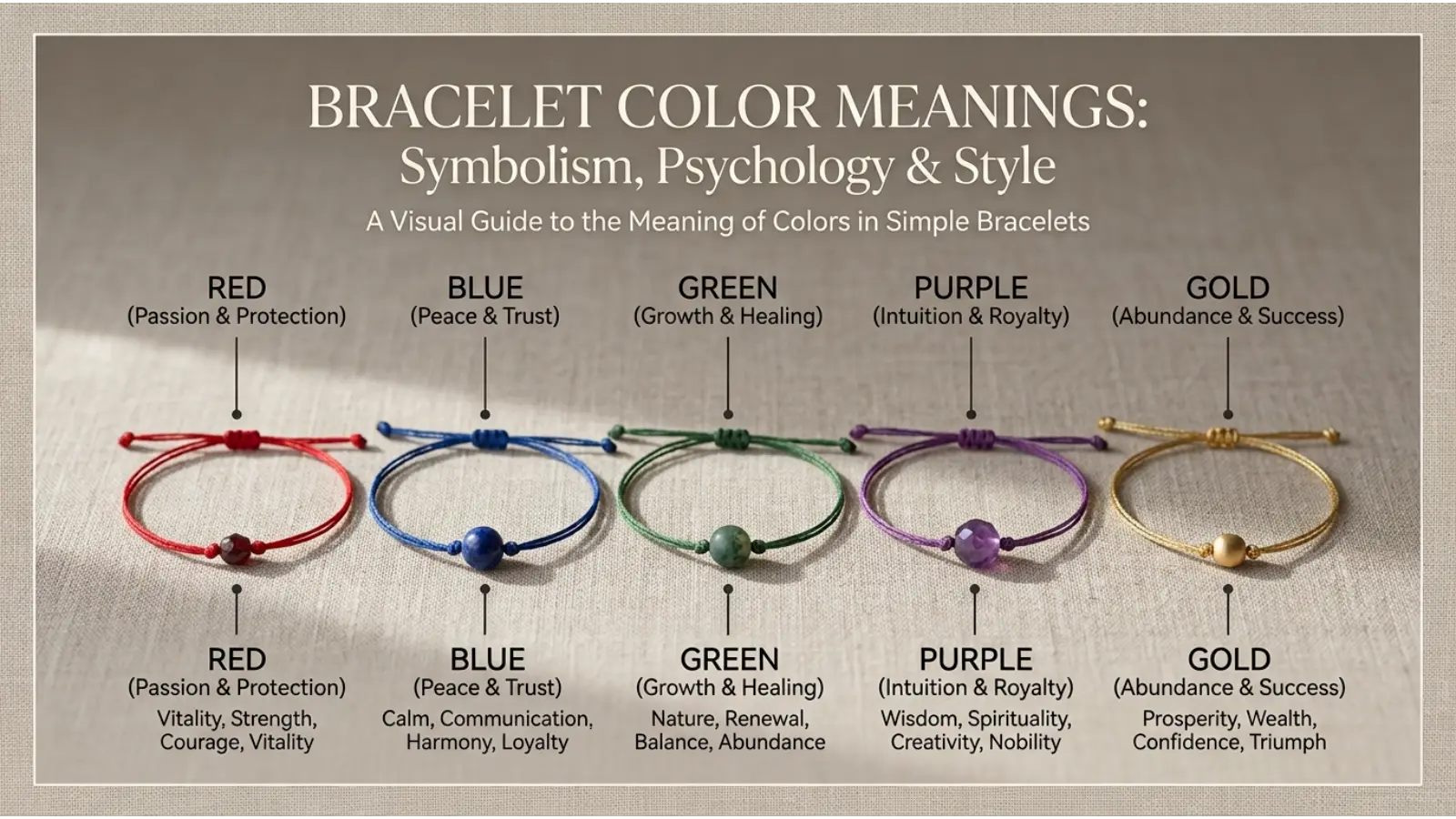
Quick Answer: Bracelet colors can symbolize emotions, values, relationships, beliefs, or personal style. Red is often associated with passion and energy, blue with calm and trust, green with growth and nature, yellow with happiness, purple with spirituality and creativity, pink with affection, white with peace, black with strength or mystery, orange with enthusiasm, and gold with success or luxury. The exact meaning depends on context and culture.
Bracelet Color Meanings Chart
The following chart provides a practical starting point. These meanings are common associations, not fixed rules.
| Bracelet Color | Common Meaning | Emotional Association | Popular Use |
|---|---|---|---|
| 🔴 Red | Love, passion, courage | Energy, excitement | Romance, confidence |
| 🔵 Blue | Peace, trust, calm | Relaxation, security | Everyday wear, friendship |
| 🟢 Green | Growth, nature, renewal | Balance, freshness | Wellness, nature themes |
| 🟡 Yellow | Happiness, optimism | Joy, energy | Friendship, summer fashion |
| 🟣 Purple | Creativity, spirituality | Imagination, mystery | Artistic and spiritual styles |
| 🩷 Pink | Love, kindness, affection | Warmth, tenderness | Gifts, friendship |
| ⚪ White | Peace, purity, simplicity | Calm, clarity | Weddings, minimal fashion |
| ⚫ Black | Strength, mystery, elegance | Power, seriousness | Fashion, protection symbolism |
| 🟠 Orange | Energy, enthusiasm | Warmth, excitement | Sport and casual styles |
| 🩵 Light Blue | Serenity, openness | Calm, friendliness | Casual and wellness styles |
| 🟤 Brown | Stability, earth, reliability | Comfort, grounding | Natural designs |
| 🩶 Gray | Balance, neutrality | Sophistication, restraint | Modern fashion |
| 🟡 Gold | Success, wealth, achievement | Prestige, confidence | Luxury jewelry |
| 🩶 Silver | Modernity, elegance, reflection | Coolness, refinement | Formal and contemporary styles |
What Do Bracelet Colors Symbolize?
A bracelet color works like a visual signal. Before someone knows anything about the wearer, color can influence the impression created by the accessory.
For example, a bright red bracelet can attract attention because red is visually strong and frequently connected with high-energy emotions. By contrast, a soft blue bracelet usually feels quieter and more relaxed.
Still, color symbolism is not a secret code. The same bracelet can mean different things to different people.
A blue friendship bracelet might represent loyalty to one person and spiritual peace to another. Likewise, a black bracelet could be a fashion choice, a memorial symbol, a personal reminder, or part of a specific cultural tradition.
The material also matters. A green glass bracelet does not necessarily communicate the same message as a green jade bracelet. The color, material, shape, pattern, and setting work together.
Why Bracelet Color Meaning Changes With Context
Context is one of the most overlooked parts of color symbolism.
Consider a gold bracelet. At a formal event, it may communicate luxury and status. In a handmade friendship bracelet, the same color might simply represent warmth or celebration.
Lighting can change this impression too. A deep purple bracelet may look almost black under low indoor lighting, while natural sunlight can reveal its brighter violet tones.
Age and personal experience also affect interpretation. Someone may associate yellow with childhood happiness, while another person may connect it with a particular sports team, national symbol, or personal memory.
Red Bracelet Meaning: Love, Passion, and Courage
Red is one of the strongest bracelet colors visually. It commonly represents love, passion, excitement, courage, strength, and energy.
Because red attracts attention, a red bracelet can make an outfit feel more energetic. It can also work as a small accent when someone wants to add intensity without wearing an entirely red outfit.
In romantic settings, red is frequently associated with love and desire. In other situations, it can suggest confidence and determination.
However, red has a less positive side. It can also represent anger, danger, warning, or aggression. The surrounding design determines which interpretation feels more natural.
Best combinations: Red and black create a bold look, while red and white feel cleaner and brighter. Red with gold often creates a luxurious appearance.
Blue Bracelet Meaning: Peace, Trust, and Calm
Blue is commonly associated with calmness, trust, stability, openness, and reliability.
That makes blue bracelets popular for everyday wear. The color tends to feel less intense than red or orange, so it can work well with casual and professional clothing.
Light blue usually creates a softer impression than navy blue. Dark blue can appear more serious and formal, while turquoise or aqua may feel energetic and refreshing.
Blue also has strong cultural and symbolic uses in many parts of the world, although its meaning is not identical everywhere.
Best combinations: Blue and white create a clean appearance. Navy and silver look polished, while turquoise and gold can create a more decorative style.
Green Bracelet Meaning: Growth, Nature, and Renewal
Green is strongly connected with plants, forests, spring, and natural environments. As a result, green bracelets often suggest growth, renewal, balance, health, or connection with nature.
A bright green bracelet can feel youthful and energetic. Dark green tends to appear richer and more traditional.
Green is also widely used in environmental branding because people naturally connect the color with vegetation and the natural world. However, wearing green does not automatically communicate environmental values.
In some cultures and traditions, green also has religious or historical importance. Those meanings should be understood within their specific cultural context rather than treated as universal.
Best combinations: Green works naturally with brown, cream, white, gold, and other earth-inspired colors.
Yellow Bracelet Meaning: Happiness and Optimism
Yellow is often associated with sunshine, happiness, optimism, warmth, and playfulness.
A yellow bracelet can brighten a simple outfit and make the accessory stand out. Because bright yellow has high visual energy, even a small bracelet can become a noticeable focal point.
There is another side to yellow. Depending on its shade and context, it can sometimes suggest caution, jealousy, or anxiety. Cultural symbolism also varies.
Soft pastel yellow tends to feel gentler than vivid neon yellow. Therefore, choosing the shade is just as important as choosing the basic color.
Best combinations: Yellow looks cheerful with white and light blue. Mustard yellow works particularly well with brown, cream, olive, and dark blue.
Purple Bracelet Meaning: Creativity, Mystery, and Spirituality
Purple has a long association with royalty, luxury, imagination, creativity, and mystery. It can also have spiritual associations in particular traditions.
Because purple sits between red and blue visually, it can feel both energetic and calm depending on the shade.
Deep purple often appears dramatic and luxurious. Lavender feels softer, lighter, and more delicate. Violet can appear creative and expressive.
Purple is particularly useful for people who want jewelry to look distinctive without relying on extremely bright colors.
Best combinations: Purple pairs well with silver, white, lavender, black, and selected shades of green.
Pink Bracelet Meaning: Love, Kindness, and Affection
Pink commonly communicates tenderness, affection, friendship, care, and romantic love.
Its meaning has also changed through history and culture. Modern Western fashion often connects pink with femininity, but that association is cultural rather than a biological rule.
Different shades produce different impressions. Pale pink can feel gentle and understated, while hot pink appears energetic and confident.
Pink bracelets are therefore useful for friendship gifts, romantic gifts, awareness campaigns, and playful fashion.
Best combinations: Pink and white create a soft appearance, while pink and black create stronger contrast. Pink and gold can feel elegant.
White Bracelet Meaning: Peace, Purity, and Simplicity
White commonly represents peace, cleanliness, simplicity, innocence, and clarity in many modern contexts.
A white bracelet can look minimal and fresh. Because white reflects a large amount of visible light, it can also make small jewelry details easier to notice.
However, white does not have the same meaning everywhere. In some cultures, white is strongly connected with mourning and funerary traditions. Therefore, assuming that white always means happiness or purity would be misleading.
For minimalist fashion, white works especially well because it can blend with almost any clothing palette.
Best combinations: White pairs with virtually every color, particularly gold, silver, blue, black, beige, and pastel shades.
Black Bracelet Meaning: Strength, Mystery, and Elegance
Black is one of the most versatile bracelet colors. It can communicate sophistication, authority, mystery, seriousness, independence, or strength.
Black bracelets are especially popular because they work with almost every wardrobe. A simple black band can look casual, while a black bracelet with metal details can look formal.
Black also has symbolic associations with mourning and grief in many Western contexts. In other situations, it may represent rebellion, alternative fashion, or individuality.
The material changes the impression significantly. Matte black rubber feels sporty, while polished black stone can appear luxurious.
Best combinations: Black works with red for dramatic contrast, silver for modern style, and gold for a luxury appearance.
Orange Bracelet Meaning: Energy and Enthusiasm
Orange combines the warmth of red and yellow, so it often feels energetic, friendly, adventurous, and enthusiastic.
An orange bracelet can be particularly effective in casual or sporty outfits. Bright orange grabs attention, while burnt orange creates a warmer and more mature appearance.
Because orange is visually active, it may be less suitable when the goal is an extremely quiet or formal look.
Best combinations: Orange works with navy, cream, brown, white, and muted green.
Gold Bracelet Meaning: Success, Luxury, and Achievement
Gold has a strong visual connection with wealth, precious materials, achievement, celebration, and prestige.
Unlike ordinary yellow, metallic gold reflects light and produces a different sensory effect. That reflective quality can make gold jewelry appear more valuable and noticeable.
Gold bracelets are common in formal jewelry because they can communicate elegance without requiring bright colors.
However, gold does not always mean wealth. It may also represent celebration, tradition, family heritage, or sentimental value.
Best combinations: Gold pairs naturally with black, white, cream, emerald green, navy, burgundy, and deep purple.
Silver Bracelet Meaning: Elegance and Modernity
Silver often creates an impression of sophistication, modern design, clarity, and refinement.
Its cooler appearance makes it particularly useful for contemporary jewelry. Silver can also feel less visually heavy than gold, making it popular for everyday accessories.
Silver bracelets work across many styles, from minimalist designs to detailed traditional jewelry.
The meaning can change when silver is combined with other colors. Silver and blue often feel cool and calm, while silver and black appear sleek and dramatic.
Brown Bracelet Meaning: Stability and Connection With Nature
The Brown is an earthy color associated with wood, soil, leather, warmth, stability, and reliability.
Brown bracelets often have a natural or handmade appearance, particularly when they use leather, wood, natural beads, or earthy stones.
The color can feel comforting rather than attention-seeking. That makes it useful for people who prefer understated accessories.
Best combinations: Brown works especially well with beige, cream, green, orange, gold, and denim blue.
Gray Bracelet Meaning: Balance and Sophistication
Gray sits between black and white, which gives it a naturally neutral character.
A gray bracelet can suggest balance, restraint, maturity, and modern simplicity. It does not demand attention as strongly as red or yellow.
Gray is especially useful in minimalist fashion because it can support stronger colors without competing with them.
Metallic gray can also create a futuristic appearance when combined with black or blue.
Spiritual Bracelet Color Meanings
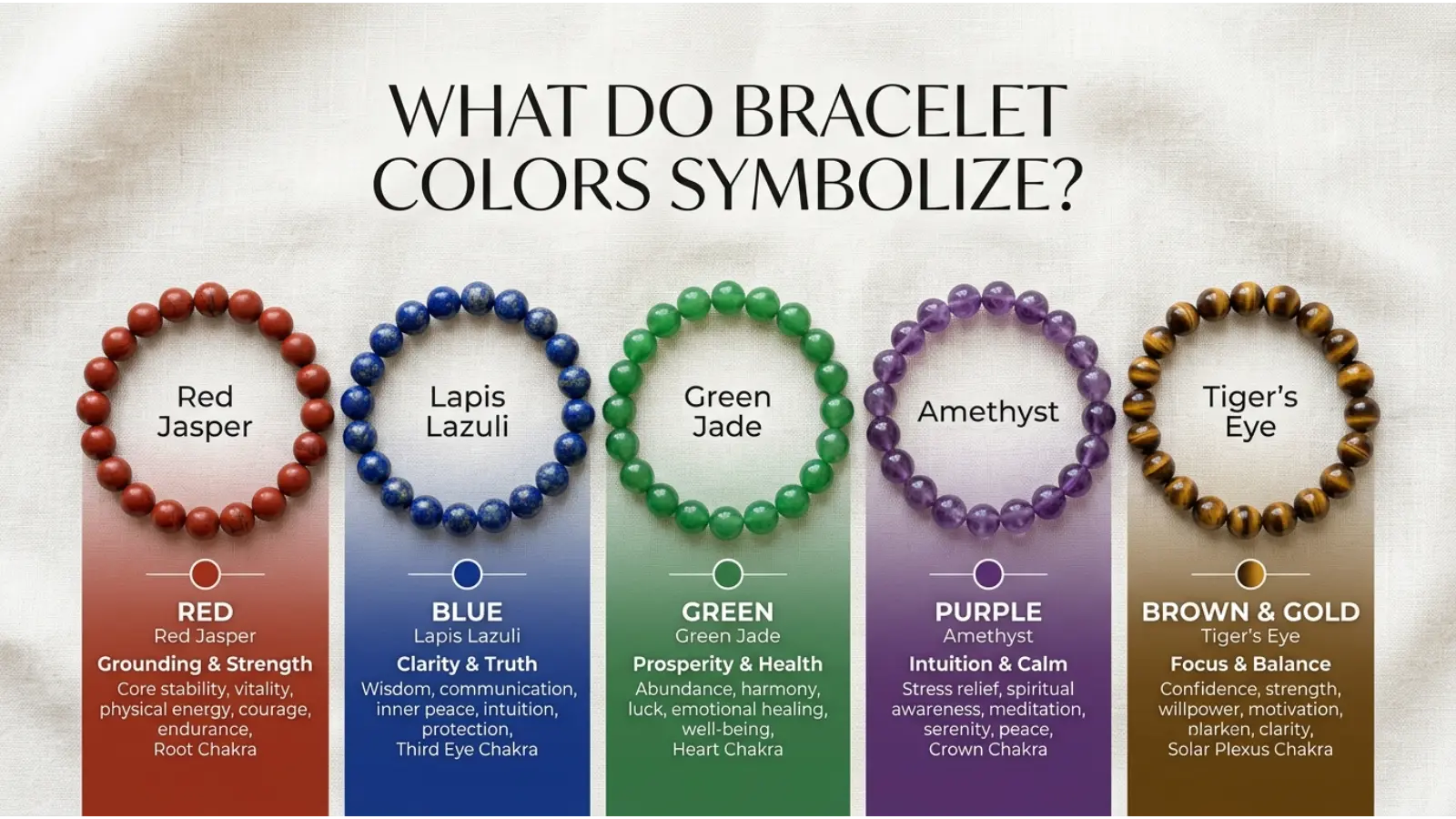
Color symbolism appears in many spiritual practices, but there is no single universal spiritual color dictionary.
Some traditions connect specific colors with particular ideas, energies, rituals, or sacred objects. Those associations should be understood within the tradition that uses them.
For example, red may be interpreted as vitality or protection in some practices, while green may represent growth or renewal. Blue may be associated with peace or spiritual reflection, and purple may be connected with wisdom or contemplation.
These are symbolic interpretations rather than scientifically established effects of wearing a particular color.
A bracelet can still have genuine personal meaning. If someone chooses a color as a reminder of hope, healing, faith, gratitude, or personal growth, that emotional connection can be meaningful even when the color itself has no proven supernatural power.
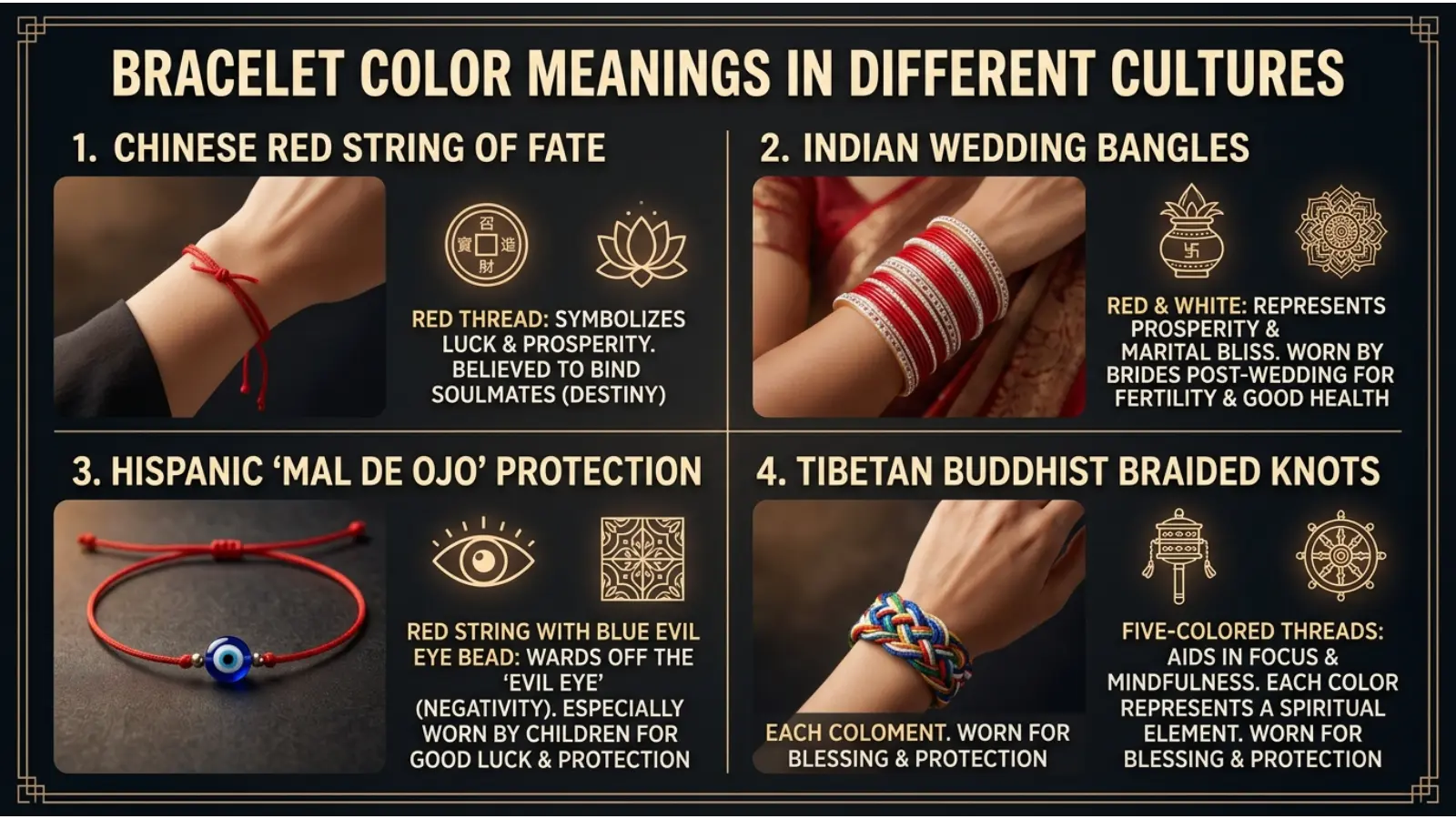
Bracelet Color Meanings in Different Cultures
Color symbolism is deeply cultural.
Western Culture
In many Western societies, red is commonly associated with love and danger, white with weddings and purity, black with elegance and mourning, and gold with wealth or celebration.
These associations are common but not universal.
East Asian Cultures
Several East Asian cultures give important symbolic roles to colors, particularly in festivals, ceremonies, clothing, and traditional art.
Red, for example, can have strong associations with celebration, prosperity, luck, or happiness in some Chinese cultural contexts.
However, meanings differ between countries and situations, so it is better to discuss specific traditions rather than treating “Asian color meanings” as one system.
Middle Eastern Contexts
Color symbolism in Middle Eastern societies can be influenced by religion, history, local traditions, national identity, and modern fashion.
Green, for example, can have important religious and cultural associations in some Islamic contexts. However, individual countries and communities may use colors differently.
African Cultures
Africa contains hundreds of cultural traditions, so there is no single African system of bracelet color meanings.
Colors can appear in clothing, beadwork, ceremonies, art, national identity, and community traditions. Their meanings depend heavily on the specific people and region.
Latin American Cultures
Color symbolism across Latin America can reflect Indigenous traditions, Catholic traditions, Spanish colonial history, local festivals, and modern popular culture.
Colors used in celebrations may have meanings that are very different from those found in North American fashion.
Historical Development of Bracelet Color Meanings and Symbolism
Bracelets have been used for thousands of years as decoration, status markers, religious objects, protective symbols, gifts, and personal ornaments.
Historically, the meaning of a color was often connected to the materials available to a society. Natural pigments, stones, metals, shells, plants, and dyes were not equally easy to obtain.
Rare colors could therefore become associated with wealth or status.
Purple provides a well-known historical example. Certain purple dyes in the ancient Mediterranean world were expensive to produce, which helped connect purple with elite status and power.
Modern bracelets are different because industrial dyes and synthetic materials make almost every color widely accessible. As a result, a color’s meaning today is influenced more by media, fashion, branding, personal identity, and cultural trends.
Bracelet Color Psychology: What Does Science Actually Tell Us?
Color can influence perception, but claims about color psychology are often exaggerated online.
Research in color science and psychology suggests that color can affect emotional responses, attention, visual judgments, and expectations. However, these effects are strongly influenced by context, culture, brightness, saturation, personal experience, and the task being performed.
That means a red bracelet may attract attention without automatically making the wearer aggressive. A blue bracelet may appear calm without physically making someone calmer.
The safest approach is to think of color as a cue, not a command.
Color can contribute to an impression, but it does not control a person’s emotions or personality.
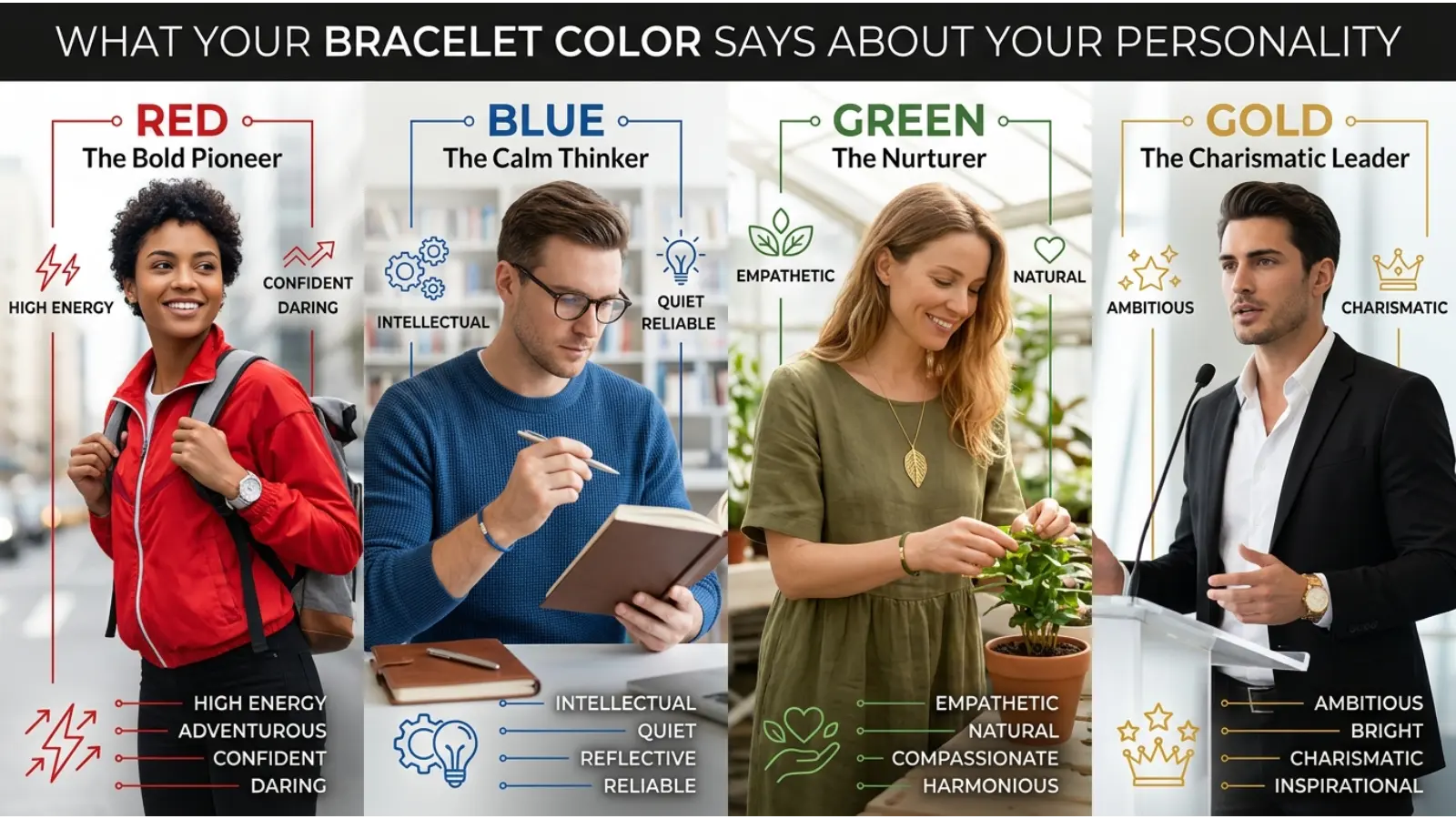
What Bracelet Color Says About Personality
People sometimes use color preference to describe personality. For example, someone who loves black may be described as independent, while someone who prefers yellow may be described as optimistic.
These descriptions can be fun and sometimes feel personally accurate. However, color preference alone cannot reliably determine personality.
A person’s choice may reflect clothing availability, culture, current trends, memories, mood, profession, or simply what looks good with their skin tone.
Instead of saying “people who wear blue are calm,” a more accurate statement is that blue is commonly perceived as calm or trustworthy in many contexts.
That distinction keeps symbolism useful without turning it into an unsupported personality test.
Bracelet Colors in Branding and Marketing
Bracelet colors can become part of a brand’s visual identity.
A company selling outdoor products might choose green and brown to reinforce associations with nature. A technology brand may use blue to create a visual impression of reliability or modernity. A luxury jewelry company may use black, white, gold, or deep jewel tones to support a premium image.
Color does not work alone. Typography, photography, packaging, material, price, product quality, and brand reputation all influence how customers interpret it.
For a bracelet business, the color palette should match the product’s intended audience.
A children’s friendship bracelet collection might use bright, playful colors. A premium handmade jewelry brand may benefit from muted earth tones or metallic accents.
Bracelet Colors in Fashion
Fashion gives color a different role because the bracelet becomes part of a complete outfit.
A black bracelet can act as a neutral accessory. A red bracelet can become an accent. A gold bracelet can repeat metallic details in a watch or belt buckle.
For professional clothing, navy, silver, black, brown, and muted colors are generally easy to coordinate.
For casual outfits, brighter shades such as orange, yellow, pink, turquoise, and green can add personality.
The best color is not always the one with the “best meaning.” It is the one that supports the message, outfit, occasion, and personal taste.
How to Choose a Bracelet Color for a Gift
Choosing a bracelet color becomes easier when you think about the relationship and the occasion.
For a romantic gift, red or pink may communicate affection.
If a friendship gift, blue, yellow, green, or multicolor designs can suggest loyalty, happiness, and shared memories.
For a graduation or achievement, gold can represent celebration and accomplishment.
For someone who prefers minimalist fashion, black, white, silver, brown, or neutral shades may be safer choices.
The most meaningful gift, however, often includes a personal reason for the color. A bracelet becomes more memorable when the recipient understands why you selected it.
Bracelet Color Combinations and Their Meanings
Combining colors creates a new visual message.
Red and Black
This combination feels bold, dramatic, confident, and powerful. It works particularly well for statement bracelets.
Blue and White
Blue and white create a clean, calm, and refreshing appearance. They are useful for minimalist and summer-inspired designs.
Green and Brown
These colors reinforce natural and earthy associations. They work well with wooden beads, leather, and outdoor-inspired jewelry.
Purple and Gold
Purple and gold create a rich, decorative appearance. Historically, both colors have been associated with status in different contexts.
Pink and White
This pairing feels gentle, affectionate, and light. It works well for friendship, romantic, and soft fashion designs.
Black and Gold
Black provides strong contrast while gold adds warmth and visual richness. Together, they often create a luxury-inspired appearance.
Orange and Blue
Orange and blue are contrasting colors, so they can create a lively and energetic bracelet design. The balance is easier when one color dominates and the other acts as an accent.
How Lighting Changes Bracelet Color
Lighting can dramatically change how a bracelet looks.
Warm indoor bulbs can make yellow, orange, red, and brown appear richer. Cool lighting can make blue and gray appear stronger.
Natural daylight usually gives a more balanced view of color, although the exact appearance still changes according to the time of day and surroundings.
This matters when buying bracelets online. A bracelet shown in studio lighting may look different in your home.
If accurate color matching matters, check the product under natural daylight when possible rather than relying on a phone screen alone.
Real-Time Example: Choosing a Bracelet for a Job Interview
Imagine someone is attending a job interview and wants to wear a bracelet.
They have three choices: bright red, navy blue, or gold.
The red bracelet may attract attention and create a stronger visual accent. The gold bracelet may appear stylish but could feel more decorative depending on the workplace.
The navy bracelet offers a quieter appearance and can coordinate easily with professional clothing.
If the interview is for a creative design position, a small red or colorful bracelet might show personality without becoming distracting. For a conservative office, navy, silver, or a simple black bracelet may fit more naturally.
The lesson is simple: color meaning depends on the situation, not just the color itself.
Bracelet Colors in Everyday Life
Bracelets can communicate messages without words.
At a sports event, team colors can show support and group identity.
At a charity event, a colored bracelet may represent awareness of a particular cause.
Among friends, matching bracelets can symbolize connection or shared memories.
In fashion, the bracelet may have no symbolic meaning at all. The wearer may simply like the color.
This is why you should avoid assuming that every colored bracelet has a hidden message.
Common Misconceptions About Bracelet Color Meanings
Every Color Has One Universal Meaning
It does not. Cultural background, context, personal experience, and design all influence interpretation.
Wearing a Color Changes Your Personality
There is no strong basis for saying that wearing a particular bracelet color permanently changes personality.
Spiritual Bracelet Colors Have Scientifically Proven Powers
Symbolic and spiritual beliefs can be meaningful to individuals, but they should not be presented as established scientific facts.
Black Always Means Negativity
Black can symbolize mourning in some contexts, but it can also represent elegance, strength, sophistication, simplicity, and independence.
White Always Means Purity
White has positive associations in many settings, but some cultures strongly associate white with mourning or death.
Red Always Means Romance
Red can represent love, but it can also signal danger, urgency, power, anger, celebration, or energy.
Frequently Asked Questions About Bracelet Color Meanings
What is the most popular bracelet color meaning?
There is no single universal meaning. Blue is commonly associated with calm and trust, red with love and energy, and black with strength and elegance.
What color bracelet represents love?
Red and pink are commonly associated with love and affection. Red tends to feel more passionate, while pink often communicates tenderness and care.
What color bracelet represents friendship?
Blue, yellow, green, and multicolor bracelets can represent friendship. The best choice depends on the personal meaning shared between the friends.
What bracelet color means protection?
Some spiritual and cultural traditions associate colors such as red, black, blue, or specific combinations with protection. However, these meanings vary by tradition and should not be treated as universal facts.
What color bracelet represents peace?
White and blue are commonly associated with peace and calm in many modern contexts.
What does a black bracelet mean?
A black bracelet can represent elegance, strength, mystery, independence, mourning, or personal style. Its meaning depends strongly on context.
What does a red bracelet mean spiritually?
In some spiritual traditions, red can symbolize vitality, energy, courage, passion, or protection. The exact interpretation depends on the specific tradition.
What does a green bracelet symbolize?
Green commonly represents nature, growth, renewal, balance, and freshness. It can also carry cultural or religious meanings in particular communities.
Can bracelet colors reveal someone’s personality?
Not reliably. Color preferences may offer clues about someone’s style or current preferences, but they cannot accurately determine personality by themselves.
Why do people wear different colored friendship bracelets?
Friendship bracelets can use colors to express shared memories, emotions, personal interests, group identity, or simply visual preference. The meaning is often created by the people wearing them.
Final Thoughts on Bracelet Color Meanings
Bracelet colors are powerful because they combine personal expression with visual symbolism. Red can add passion, blue can create a calm impression, green can suggest nature and renewal, yellow can bring energy, purple can feel creative, and black can provide strength and elegance.
Yet no bracelet color has a meaning that applies to every person and every culture. A color becomes meaningful through context, history, materials, tradition, fashion, and personal experience.
The most useful way to understand bracelet color meanings is to treat them as flexible visual language. When choosing a bracelet, think beyond the dictionary definition of a color. Consider who will wear it, where it will be worn, what the other colors are doing, and what personal message you want the bracelet to carry.
Sometimes the most meaningful color is not the one with the most famous symbolism. It is simply the color that reminds you of something that matters.

Emma Wilson is a dedicated comparison writer and product researcher at ColorMystiic.com. She specializes in creating unbiased product comparisons, detailed reviews, and helpful buying guides. Her goal is to help readers make smarter purchasing decisions with confidence.