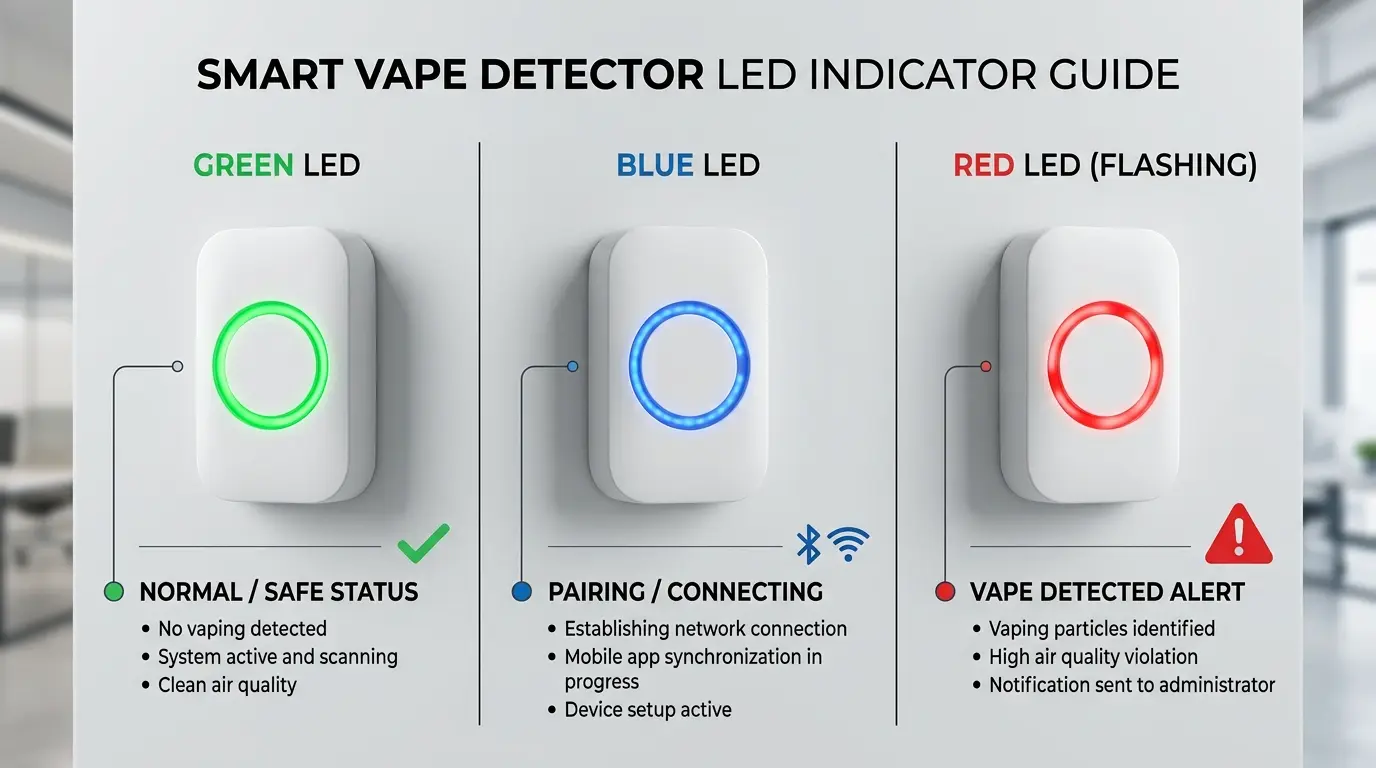
If you have seen a vape detector with a blue, green, yellow, orange, or red light, you may wonder what each color means. Unlike traffic lights or common warning systems, however, vape detector color meanings are not universal. The meaning depends on the manufacturer, model, installation settings, and the way a school, workplace, or building has configured its alert system.
A vape detector is designed to detect signs associated with vaping, often by monitoring airborne particles and other environmental conditions. Some models use colored lights to show normal operation, warnings, faults, or detected activity. Others send an alert to a dashboard or administrator rather than displaying a simple color.
This guide explains the most common vape detector color meanings, how to interpret indicator lights safely, why colors vary between devices, and what the colors can—and cannot—tell you.
Quick Answer: What Do Vape Detector Colors Mean?
There is no single universal vape detector color chart. In many systems, green or blue may indicate normal operation, while yellow or amber can represent a warning, and red may indicate an alert, fault, or detected event. However, the exact meaning depends on the detector.
| Common Color | Possible Meaning | Important Note |
|---|---|---|
| 🟢 Green | Normal operation, ready, or connected | Model-specific |
| 🔵 Blue | Power, connectivity, or system status | Not necessarily vaping |
| 🟡 Yellow/Amber | Warning, attention, or maintenance | Check the device guide |
| 🟠 Orange | Alert, configuration, or intermediate status | Meaning varies widely |
| 🔴 Red | Alarm, detected event, or fault | Do not assume it always means vaping |
| ⚪ White | Startup, setup, or general status | Manufacturer dependent |
| 🟣 Purple | Special status or configuration | Less common |
| No light | Powered off, sleep mode, or fault | Check power and connectivity |
The safest interpretation is simple: the color is a status signal, not proof by itself that someone is vaping.
Vape Detector Color Meanings Explained
Understanding the colors starts with an important distinction. A detector can communicate several different types of information:
- Device status
- Network connection
- Environmental warning
- Maintenance condition
- Security alert
- Possible vaping-related detection
- System fault
Therefore, seeing a red light does not automatically mean that a person has been caught vaping.
The detector may be reporting a technical condition, an environmental change, or an event that requires review.
Green Vape Detector Light Meaning
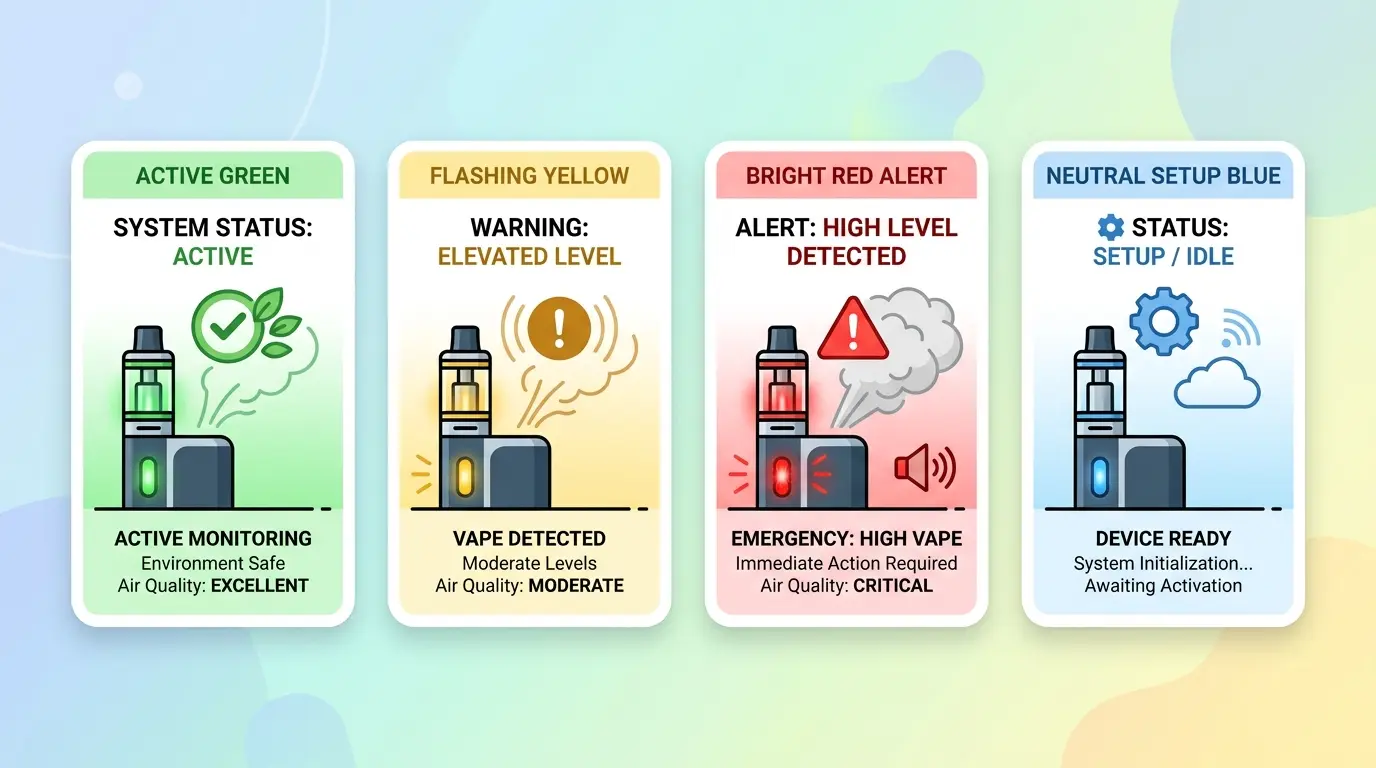
A green light commonly suggests that a device is operating normally, powered on, connected, or ready to function.
For example, a school may install a detector in a restroom. If its status indicator is green during normal conditions, the light may simply mean that the detector is functioning correctly.
However, green does not universally mean “no vaping.”
Some systems use different light patterns, such as:
- Solid green
- Flashing green
- Green and another color
- Green during startup only
Consequently, the installation manual is more reliable than the color alone.
What Green Usually Communicates
Green is widely associated with:
- Normal operation
- Ready status
- Successful connection
- System health
- Low-risk conditions
Because green has a strong cultural association with “go” and “safe,” designers often choose it for normal operating conditions.
Blue Vape Detector Light Meaning
A blue light may indicate power, connectivity, communication, or another normal system state.
Blue is especially useful in technology because people often associate it with:
- Digital systems
- Communication
- Stability
- Technology
- Connectivity
Nevertheless, blue should not automatically be interpreted as “vaping detected.”
A detector could use blue to show that it is connected to a network, communicating with a monitoring platform, or completing a startup process.
Why Blue Can Be Confusing
Many electronic products use blue LEDs for completely different reasons. Therefore, the same blue light can have different meanings on two detector models.
The color plus flashing pattern plus accompanying alert is often more informative than color alone.
Yellow or Amber Vape Detector Light Meaning
Yellow or amber commonly communicates caution, attention, or a condition that needs checking.
Depending on the system, this could relate to:
- Environmental conditions
- Maintenance
- Connectivity
- Sensor status
- A preliminary warning
- System configuration
Yellow is useful because it sits visually between green and red. It can therefore communicate “pay attention” without necessarily meaning “emergency.”
Does Yellow Mean Someone Is Vaping?
Not necessarily.
A yellow light may represent a warning rather than a confirmed vaping event. Some systems can detect environmental changes that require additional evaluation.
For this reason, a yellow indicator should be interpreted according to the specific detector’s documentation.
Orange Vape Detector Light Meaning
The Orange or amber-orange indicators can be used for warnings, setup modes, communication problems, or special system states.
Orange has an interesting visual effect. It is noticeable and energetic, but it generally feels less severe than red.
A designer might therefore use orange when a device wants attention without presenting the strongest possible alarm signal.
Still, orange has no universal vape-detector definition.
If you see an orange light, look for:
- Whether it is flashing or solid.
- Whether another indicator is illuminated.
- Whether an audible alarm is active.
- Whether a monitoring system has generated an alert.
- What the detector’s model documentation says.
Red Vape Detector Light Meaning
A red light is commonly used for an alert, warning, fault, or event requiring attention.
Because red has strong associations with danger and urgency, it is a logical choice for high-priority notifications.
Depending on the detector, red could potentially indicate:
- A detected event
- Alarm status
- Sensor fault
- System problem
- Security alert
- Communication failure
Therefore, red does not automatically prove that vaping occurred.
This distinction matters in schools, offices, hotels, and public buildings. A colored indicator should be treated as information from a monitoring system rather than as independent evidence of a person’s behavior.
Flashing Red vs. Solid Red
Light patterns can change the meaning.
A solid red indicator might represent one state, while a rapidly flashing red indicator could represent another.
For example, manufacturers may use combinations such as:
Solid light → system condition
Slow flashing → communication or status
Rapid flashing → urgent notification
These are examples of how systems can be designed, not universal rules.
White Vape Detector Light Meaning
The White LEDs may appear during startup, installation, configuration, or general status conditions.
White is commonly associated with:
- Initialization
- Neutral status
- Setup
- General illumination
- System activity
Because white has fewer warning associations than red or yellow, it is often suitable for information that does not require immediate attention.
However, some detectors may not use white indicators at all.
Purple Vape Detector Light Meaning
Purple is less common in ordinary status systems. When it appears, it may represent a special mode, configuration state, pairing process, or another manufacturer-specific function.
Purple is strongly associated with creativity, mystery, luxury, and individuality in broader color symbolism. Yet those associations should not be confused with the technical meaning of an LED.
In a vape detector, purple is a technical signal—not a universal psychological or spiritual symbol.
Vape Detector Color Meanings Chart
The following chart is useful as a general reference, but it should never replace the manufacturer’s instructions.
| Color | Common Visual Association | Possible Detector Status | Confidence |
|---|---|---|---|
| Green | Safe/normal | Operating normally or ready | General |
| Blue | Technology/connection | Power, communication, or network status | General |
| Yellow | Caution | Warning or attention needed | General |
| Amber | Attention | Warning, configuration, or maintenance | General |
| Orange | Alert | Special warning or intermediate condition | General |
| Red | Danger/urgency | Alarm, event, or fault | General |
| White | Neutral | Startup or general status | General |
| Purple | Special state | Configuration or uncommon status | Low/general |
| No light | Inactive | Power issue, sleep state, or no indicator | Model-specific |
Key point: this chart describes common color conventions, not a universal vape-detector standard.
Why Vape Detector Colors Are Different
One reason people search for vape detector color meanings is that different devices behave differently.
A detector is not simply a colored light. It is part of a larger monitoring system.
The manufacturer may decide:
- Which colors to use
- Which events trigger them
- Whether the light flashes
- How long the light remains active
- Whether an alarm sounds
- Whether an alert is sent remotely
Installation teams may also configure systems differently.
As a result, a red light in one building may not mean exactly the same thing as a red light in another.
Color Alone Cannot Identify Vaping
This is one of the most important facts to understand.
A detector’s indicator color is generally not a chemical test that identifies a particular person or substance.
Environmental sensors can respond to changes in the surrounding air. Depending on the technology, systems may monitor airborne particles and other environmental signals.
Therefore, a detector alert should be interpreted within its intended monitoring system.
This is particularly important when distinguishing between:
- Actual vaping
- Aerosols from other sources
- Environmental changes
- Sensor errors
- Maintenance conditions
- System alerts
The Psychology Behind Vape Detector Colors
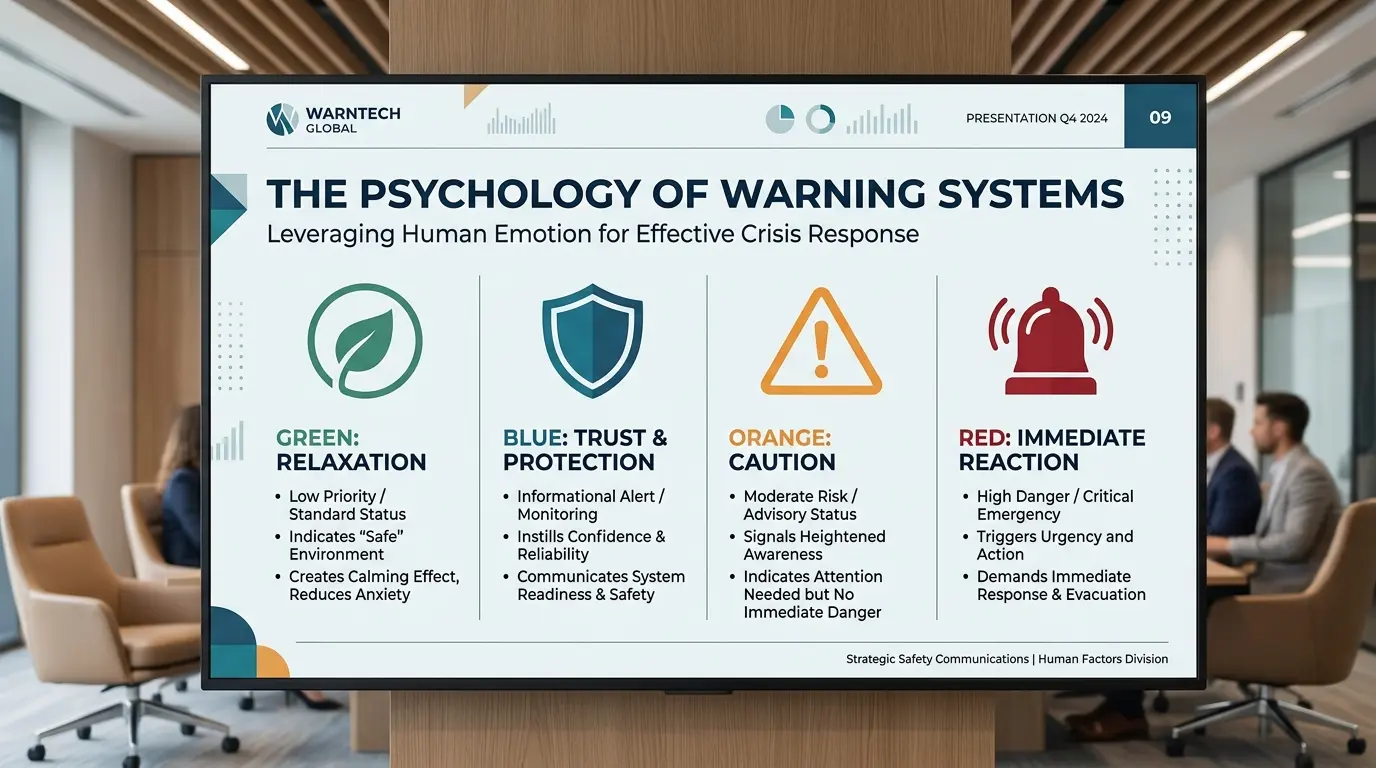
Color psychology can help explain why manufacturers choose particular colors, although it does not determine the technical meaning of a detector light.
Red Creates Urgency
Red attracts attention quickly and is widely associated with:
- Danger
- Stop
- Warning
- Urgency
- Emergency
That makes red useful for high-priority notifications.
Yellow Signals Caution
Yellow tends to communicate attention without the same level of danger associated with red.
It works well for:
- Warnings
- Maintenance
- Caution
- Conditions requiring review
Green Suggests Normality
Green commonly communicates:
- Normal
- Ready
- Good
- Approved
- Active
This makes it a natural choice for normal device operation.
Blue Feels Technological
Blue is frequently used in technology interfaces because it can suggest:
- Reliability
- Communication
- Technology
- Calmness
- Connectivity
The emotional impression of a color, however, should not be confused with the detector’s actual technical function.
What Does a Vape Detector Actually Detect?
The answer depends on the technology used by the particular product.
Some modern environmental monitoring systems are designed to identify changes associated with vaping aerosols while also monitoring other environmental conditions.
A detector may use sensors to monitor airborne conditions rather than “seeing” a vape device in the way a camera sees an object.
This distinction helps explain why a detector may respond to an environmental event without providing a simple statement such as:
“This person is vaping.”
Instead, the system may generate an alert that administrators can evaluate.
Real-Time Example: Reading a Vape Detector Light
Imagine a school restroom where a vape detector normally displays a green status light.
At 2:15 p.m., a staff member notices that the device changes to a flashing red indicator.
What should they conclude?
Not simply:
“Someone definitely vaped.”
A better interpretation is:
“The monitoring system has entered an alert state and the event should be checked according to the school’s procedures.”
The staff member can then check the monitoring dashboard, timestamp, device information, and other available evidence.
This example shows why understanding vape detector color meanings requires more than memorizing a color chart.
Do Vape Detectors Have Universal Colors?
No.
There is no universal color code that requires every vape detector manufacturer to assign exactly the same meaning to every color.
This is similar to many electronic devices. A blue LED on one product may mean Bluetooth connectivity, while blue on another product may indicate power.
The same principle applies to vape detectors.
What Should You Check?
If you need the exact meaning of a particular detector:
- Find the manufacturer’s model number.
- Check the official user manual.
- Look for an LED-status table.
- Check whether the light is solid or flashing.
- Review the monitoring dashboard if available.
- Ask the facility administrator when appropriate.
This approach is much more accurate than relying on a general internet color chart.
How Flashing Patterns Change Color Meanings
Color is only one part of an indicator system.
A manufacturer can create several meanings from one color by changing:
- Flash speed
- Flash duration
- Number of flashes
- Color combinations
- Sound alerts
- Screen notifications
For example, a device might use a solid indicator for status and a flashing indicator for an active notification.
Therefore, when identifying a light, record the complete pattern rather than only saying “it was red.”
Vape Detector Colors in Schools
Schools are among the most visible environments where vape detectors are used.
The goal is generally to help staff identify potential vaping-related events in locations where vaping may be prohibited.
Restrooms and other enclosed areas can be challenging to supervise continuously. A monitoring device can provide an additional layer of awareness.
However, color indicators should be handled carefully.
A detector alert should not automatically be treated as proof of individual responsibility. Schools typically need to follow their own policies and procedures when responding to an alert.
Vape Detector Colors in Workplaces
Businesses may also use environmental monitoring systems in restricted areas.
Here, colors can communicate:
- Normal system status
- Maintenance requirements
- Alerts
- Connectivity
- Environmental changes
For employees, the most useful approach is to understand the organization’s specific alert policy rather than assuming every red or yellow light means the same thing.
Vape Detector Colors in Public Buildings
Hotels, transportation facilities, government buildings, and other public spaces may use monitoring technology to support no-smoking or no-vaping policies.
The visual language of color can make the system easier for authorized staff to understand.
Nevertheless, the public may not have access to the detailed meaning of every status light.
That is another reason why generalized color charts should be treated as educational rather than definitive.
Vape Detector Color Meanings and Lighting Conditions
Lighting can affect how a detector color appears.
A red LED may look:
- Dark red in low light
- Bright red under direct viewing
- Orange-red through a plastic cover
- Pinkish through certain materials
Similarly, blue can appear lighter or darker depending on the surrounding lighting.
This matters when someone tries to identify a detector status from a distance or from a photograph.
Why Camera Photos Can Be Misleading
Phone cameras automatically adjust:
- Exposure
- White balance
- Brightness
- Contrast
As a result, a photograph may not accurately reproduce the LED’s actual color.
For reliable identification, observe the indicator directly when possible and compare it with the device’s documentation.
Age and Color Interpretation
People do not always interpret colors in exactly the same way.
Children may learn colors primarily through simple systems such as:
Green = good
Yellow = caution
Red = stop
Adults may interpret the same colors through workplace, traffic, technology, or cultural experiences.
This makes color useful for interface design, but it also means that designers should use clear labels and instructions when a status has serious consequences.
Cultural Differences in Color Meaning
Color symbolism changes across cultures.
Red, for example, can communicate danger in many modern contexts, while it can also carry meanings involving celebration, luck, power, or prosperity in different cultural traditions.
White can suggest cleanliness or simplicity in many Western design contexts, while its cultural associations can differ significantly elsewhere.
These cultural meanings are important for branding and visual communication, but a detector’s technical LED code remains determined by its manufacturer and system configuration.
In other words:
Cultural symbolism influences perception; the device manual defines function.

Personality Associations With Vape Detector Colors
Color preferences are sometimes connected with personality descriptions, but these associations should not be treated as psychological diagnoses.
For example:
- Blue is often perceived as calm or dependable.
- Green can suggest balance or naturalness.
- Red can feel energetic or urgent.
- Yellow can appear optimistic or attention-grabbing.
- Purple can feel creative or unusual.
However, choosing a favorite color does not reliably determine someone’s personality.
The same principle applies to detector lights. A person may emotionally react to red as “danger,” but that reaction does not tell them what the detector’s manufacturer programmed the red LED to mean.
Vape Detector Color Meanings in Branding and Technology Design
Although vape detectors are functional devices, their interfaces still use principles found in branding and user-interface design.
A successful status system needs to communicate information quickly.
Designers often rely on familiar visual signals:
Green → normal
Yellow → attention
Red → urgent
This reduces the amount of reading required.
However, accessible design should not depend on color alone. People with color-vision differences may have difficulty distinguishing certain colors.
Therefore, strong systems can combine color with:
- Icons
- Text
- Sound
- Flashing patterns
- Dashboard notifications
This creates a more reliable communication system.
Using Color Combinations to Understand Status
Some devices may use multiple colors at once.
For instance, a system might combine:
- Blue + green
- Yellow + red
- Red + white
- Green + blue
The combination can provide additional information.
Yet there is no universal combination code for vape detectors.
When interpreting multiple colors, consider the entire interface rather than trying to assign a symbolic meaning to each color separately.
Common Misconceptions About Vape Detector Color Meanings
“Red Always Means Someone Is Vaping”
False.
Red may indicate an alert, but the exact trigger depends on the device and configuration.
“Green Means the Detector Is Turned Off”
Usually not.
Green often indicates normal operation or readiness, although the exact meaning varies.
“Blue Means No Vaping”
Not necessarily.
Blue may indicate power, communication, connectivity, or another status.
“A Detector Can Always Identify the Person”
A status light by itself does not establish who caused an environmental event.
The detector and the wider monitoring system should be considered separately.
“Every Vape Detector Uses the Same Color Chart”
No.
Different manufacturers and models can use different LED systems.
“A Light Proves That a Vape Was Used”
A light indicates a programmed device status. It should not automatically be treated as conclusive proof of a specific event or person.
How to Identify an Unknown Vape Detector Light
If you encounter an unfamiliar detector, use a structured approach.
Step 1: Identify the Device
Look for:
- Brand
- Model number
- Serial label
- Installation information
Step 2: Observe the Light
Record:
- Color
- Solid or flashing
- Flashing speed
- Duration
- Other lights
Step 3: Look for Additional Alerts
Check whether the system also provides:
- An audible alarm
- Screen message
- Mobile notification
- Dashboard alert
- Maintenance message
Step 4: Check the Documentation
The manufacturer’s instructions are the best source for the exact meaning.
Step 5: Consider the Context
Ask whether the device is:
- Starting up
- Operating normally
- Being configured
- Reporting maintenance
- Connected to a network
- Producing an alert
Context can completely change the interpretation.
Practical Everyday Uses of Vape Detector Color Systems
Color indicators are valuable because they allow people to understand device status quickly.
In everyday operation, a staff member might glance at a detector and immediately recognize that it is functioning normally.
During maintenance, an unusual color can signal that the device needs attention.
During an alert, a prominent color can direct attention to the monitoring system.
The strength of color here is speed. A person can recognize a bright visual signal much faster than they can read a paragraph of technical instructions.
Why Designers Use Red, Yellow and Green
The familiar red-yellow-green sequence works because people encounter it in many parts of daily life.
Traffic signals are one obvious example.
Over time, these colors have become strongly associated with different levels of attention:
Green: continue or normal
Yellow: prepare or pay attention
Red: stop or respond
Technology designers can use these learned associations to make interfaces easier to understand.
However, the actual technical definition still comes from the system.
Vape Detector Colors and Accessibility
A good monitoring interface should never rely exclusively on color.
Approximately some users may have difficulty distinguishing particular color combinations, especially red and green.
For that reason, an accessible alert system can combine colors with:
- Written labels
- Symbols
- Sound
- Distinct flashing patterns
- Digital notifications
This is useful not only for accessibility but also for situations where lighting conditions make the LED difficult to see.
How Lighting Changes Vape Detector Color Appearance
The same LED can look different under:
- Daylight
- Fluorescent lighting
- Warm indoor lighting
- Dark conditions
- Colored ambient light
The plastic lens covering the LED can also alter its appearance.
Consequently, someone might describe an indicator as orange while another person calls the same light yellow.
This is another reason why exact model identification is more reliable than visual guessing.
Are Vape Detector Colors Psychological or Technical?
They can be both, but in different ways.
The technical meaning comes from the manufacturer and system configuration.
The psychological response comes from human perception and learned associations.
For example, a manufacturer may choose red because users already associate red with urgency. The technical meaning is still whatever the manufacturer assigns to that red light.
This distinction prevents a common mistake: assuming that symbolic meaning automatically equals technical meaning.
FAQ About Vape Detector Color Meanings
What does a green light mean on a vape detector?
A green light often indicates normal operation, readiness, or a healthy connection. However, the exact meaning depends on the detector model.
What does a red light mean on a vape detector?
Red may indicate an alert, detected event, fault, or another high-priority condition. It does not universally mean that someone is vaping.
What does a blue light mean on a vape detector?
Blue may indicate power, connectivity, communication, or another system status. Check the manufacturer’s documentation for the exact meaning.
Does yellow mean a vape was detected?
Not necessarily. Yellow or amber commonly represents caution, warning, maintenance, or another attention state.
Do all vape detectors use the same colors?
No. Manufacturers can design their own indicator systems, so colors and flashing patterns vary.
Can a vape detector tell exactly who was vaping?
The detector’s light alone cannot establish a person’s identity. Any identification process depends on the wider monitoring system, policies, and other available information.
Why is my vape detector flashing?
Flashing may indicate an active status, warning, connection process, alert, or fault. The flash pattern is important, so consult the model’s instructions.
Why does my vape detector show a different color than expected?
The device may use a different color code, be in a different operating mode, or be reporting a technical or environmental condition. Model-specific documentation is the best reference.
Can sunlight change how the detector light looks?
Yes. Ambient lighting, viewing angle, camera settings, and the detector’s lens can change the apparent color.
Is a red vape detector light proof that vaping occurred?
No. A red indicator means the device has entered whatever status its manufacturer assigned to red. It should not automatically be treated as conclusive proof of vaping.
Final Thoughts on Vape Detector Color Meanings
The biggest lesson behind vape detector color meanings is that there is no universal color dictionary for these devices. Green, blue, yellow, orange, and red may follow familiar visual conventions, but their exact meanings depend on the detector’s manufacturer, model, software, configuration, and indicator pattern.
Color still plays an important role. Green can make normal operation easy to recognize, yellow can draw attention to a warning, and red can create a strong sense of urgency. These choices borrow from familiar human reactions to color and from interface-design principles used in many technologies.
At the same time, a responsible interpretation requires more than looking at a light. The color should be considered alongside its flashing pattern, accompanying notifications, environmental conditions, and official documentation.
So, when you see a vape detector change color, the best question is not simply “What does this color mean?” Instead, ask “What does this specific device use this color to indicate?” That small distinction leads to a much more accurate understanding of vape detector alerts.

Emma Wilson is a dedicated comparison writer and product researcher at ColorMystiic.com. She specializes in creating unbiased product comparisons, detailed reviews, and helpful buying guides. Her goal is to help readers make smarter purchasing decisions with confidence.