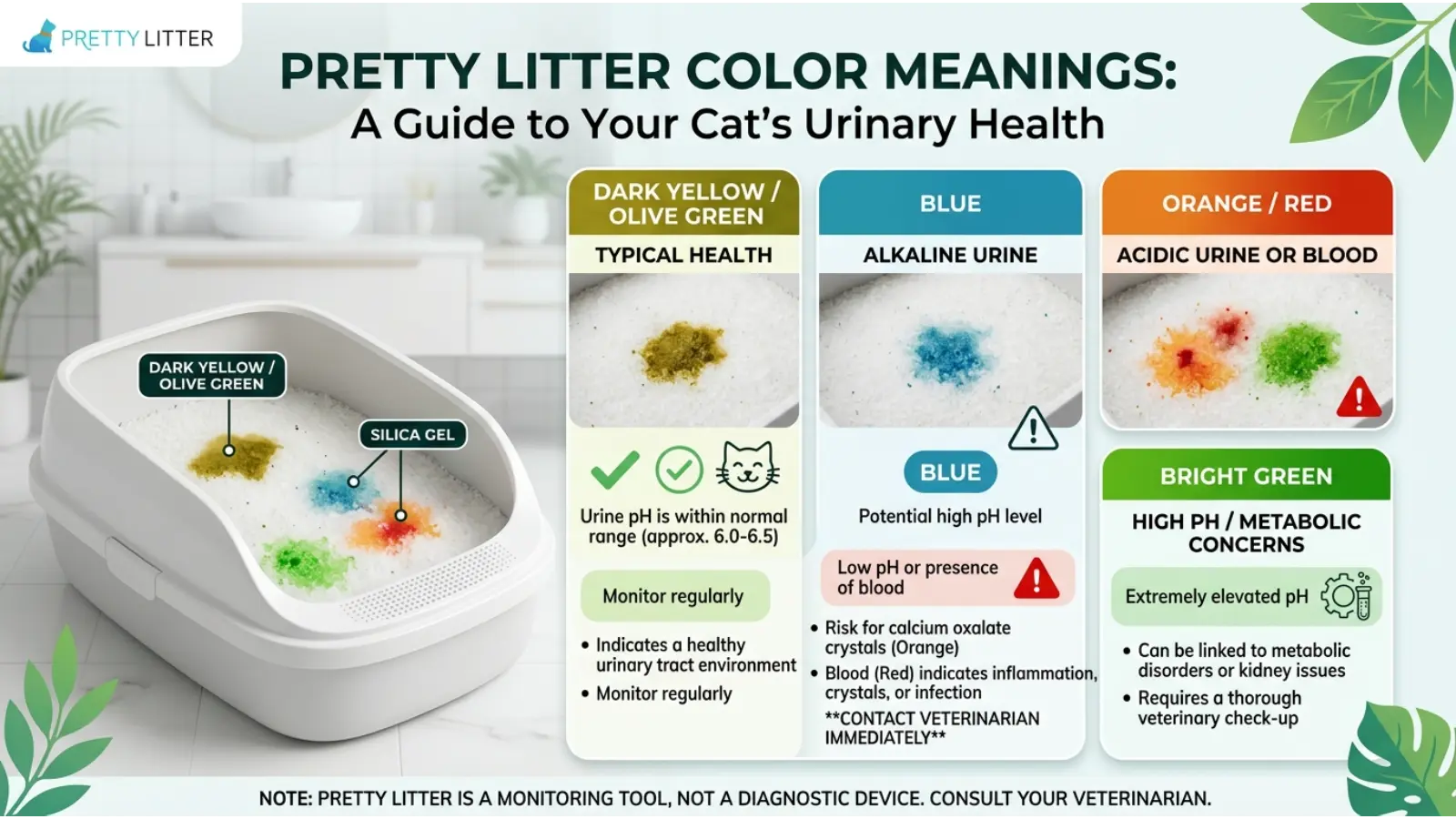
If you use PrettyLitter, a change in the color of the crystals can give you a useful clue about your cat’s urine. That is why searches for Pretty Litter color meanings, the PrettyLitter color chart, and cat urine color meanings have become increasingly common among cat owners.
Unlike ordinary litter, PrettyLitter is designed to react to certain properties of urine. In particular, its crystals can change color when urine is more acidic or alkaline than the typical range, while visible blood can appear red against the light-colored litter.
However, a color change is not a diagnosis. Several different health conditions can produce similar urinary changes, and a veterinarian must evaluate your cat to determine the actual cause. Therefore, the best way to use PrettyLitter is as a monitoring tool rather than a replacement for veterinary care.
This guide explains what each PrettyLitter color generally means, why the color changes, what different shades may suggest, and what you should do when an unusual color appears.
Quick Answer
Pretty Litter color meanings are generally:
- Dark yellow or olive green: urine is within PrettyLitter’s typical pH range.
- Blue or dark green: urine may be more alkaline than the typical range.
- Orange: urine may be more acidic than the typical range.
- Red: visible blood may be present in the urine.
A single unusual color does not prove that your cat has a particular disease. Instead, look for persistent changes and other symptoms, and contact a veterinarian when something seems abnormal.
Pretty Litter Color Meanings at a Glance
The easiest way to understand the PrettyLitter color chart is to separate normal-range monitoring from potential warning signs.
| Pretty Litter Color | General Meaning | What It May Indicate | What to Do |
|---|---|---|---|
| Dark Yellow / Olive Green | Typical pH range | Urine is within the expected range | Continue normal monitoring |
| Blue / Dark Green | Higher alkalinity | Urine is more alkaline than expected | Watch for persistence and urinary symptoms |
| Orange | Higher acidity | Urine is more acidic than expected | Monitor closely and consider veterinary advice |
| Red | Visible blood | Blood may be present in urine | Contact a veterinarian promptly |
These colors should be viewed as signals rather than diagnoses. Furthermore, lighting, the amount of urine, litter conditions, and how long the crystals have been exposed can affect what you see.
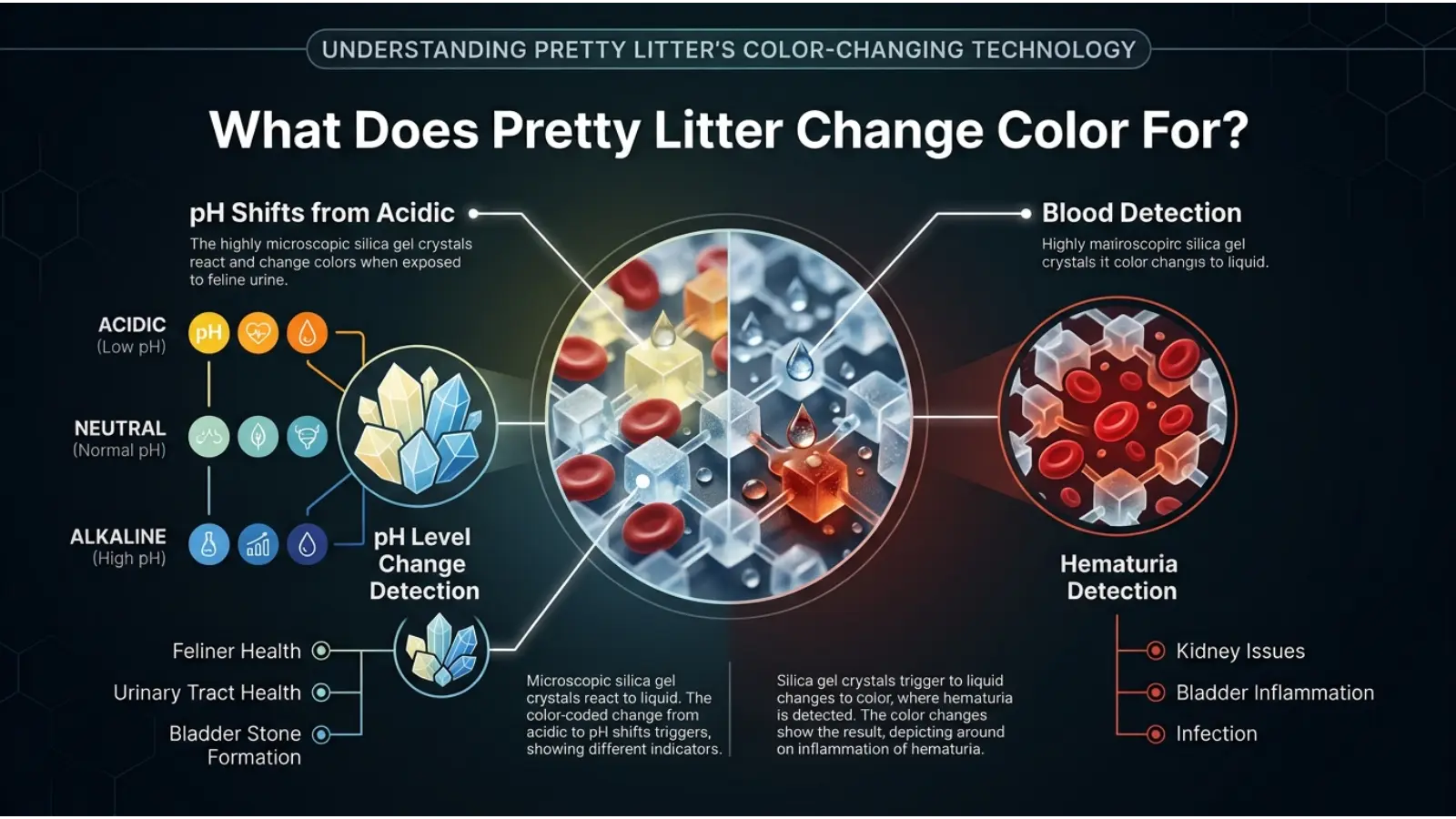
What Does Pretty Litter Change Color For?
PrettyLitter is different from traditional clay litter because its crystals are designed to respond to certain characteristics of cat urine.
The main changes relate to urine pH and the visible presence of blood.
pH describes how acidic or alkaline a substance is. PrettyLitter uses color-changing indicators within its litter so that certain urine chemistry changes become easier to see.
For example, urine that falls within the product’s typical range can produce a dark yellow or olive-green appearance. More alkaline urine can cause a blue or dark-green change, while more acidic urine can produce orange.
Red is different. It is associated with the visible presence of blood rather than simply representing an acidic or alkaline pH level.
Because of this, the Pretty Litter color chart should be read as a monitoring system, not as a traditional color symbolism chart.
Dark Yellow or Olive Green Pretty Litter Meaning
Dark yellow or olive green generally indicates urine within PrettyLitter’s typical pH range.
This is the color many cat owners want to see because it represents the expected range used by the product for routine monitoring.
However, “typical” does not mean that every aspect of your cat’s health is normal. PrettyLitter cannot identify every disease, infection, or health problem.
For example, a cat could have a health issue that does not significantly change urine pH. Therefore, you should still pay attention to appetite, drinking, urination frequency, behavior, energy, and other changes.
Why Does Pretty Litter Turn Green?
The color change occurs because the litter contains materials that respond to urine chemistry.
When the urine falls within the product’s expected range, the crystals can appear dark yellow, yellow-green, or olive green.
Consequently, the green shade acts as a useful baseline. If your cat’s litter normally looks olive green and suddenly begins showing a different color repeatedly, the change deserves attention.
Blue Pretty Litter Meaning
Blue or dark green generally indicates urine that is more alkaline than the typical range.
Alkaline urine means the urine has a higher pH. PrettyLitter uses this color change to alert owners that the urine chemistry has moved outside its expected range.
This can sometimes occur alongside urinary problems. For instance, certain urinary tract infections and conditions associated with struvite crystals or stones can be associated with alkaline urine.
Nevertheless, blue litter does not mean your cat definitely has a urinary tract infection.
What Should You Do If Pretty Litter Turns Blue?
First, don’t panic.
Instead, look at whether the blue color is isolated or continues to appear. Then observe your cat for signs such as:
- Frequent trips to the litter box
- Straining to urinate
- Producing only small amounts of urine
- Urinating outside the litter box
- Excessive licking around the urinary area
- Vocalizing during urination
- Changes in appetite or behavior
If these signs appear, veterinary advice becomes especially important.
Why Alkaline Urine Matters
Urine chemistry can influence the environment in which certain urinary crystals form. Highly alkaline urine can be associated with an increased risk of struvite crystal or stone formation.
Therefore, repeated blue changes should not simply be dismissed as a harmless color variation.
Orange Pretty Litter Meaning
Orange generally indicates urine that is more acidic than the typical range.
Acidic urine has a lower pH. PrettyLitter uses orange to make this change visible.
However, orange does not identify one specific illness. Several factors can influence urine chemistry, including diet and metabolic or urinary conditions.
PrettyLitter’s own health-monitoring information associates unusually acidic urine with conditions such as metabolic acidosis or kidney tubular acidosis and notes that acidic urine can be associated with an increased likelihood of calcium oxalate crystal formation.
That does not mean an orange color proves any of these conditions.
What If the Litter Turns Orange?
Start by checking whether the change happens repeatedly.
If your cat otherwise seems comfortable, continue observing the litter box and your cat’s behavior. However, if orange remains present or occurs together with changes in urination, drinking, appetite, energy, or comfort, speak with your veterinarian.
A veterinarian can use urine testing and other diagnostic tools to determine what is actually happening.
Red Pretty Litter Meaning
Red PrettyLitter can indicate the visible presence of blood in urine.
This is one of the most important colors to take seriously.
Blood in urine is called hematuria. It can occur for several reasons, including urinary tract inflammation, bladder stones or crystals, kidney problems, lower urinary tract disease, trauma, and other conditions.
Therefore, red litter should not be interpreted as simply “a little irritation.”
Does Red Pretty Litter Always Mean Blood?
Not necessarily.
The color should be interpreted in context, because substances introduced into the litter box can potentially affect its appearance. Also, PrettyLitter is designed to show visible blood, but it is not a complete laboratory blood test.
If you see an unexplained red area that appears to be associated with urine, contact your veterinarian for guidance.
When Red Urine Is an Emergency
Some urinary problems can become emergencies, especially in male cats.
If your cat repeatedly tries to urinate but produces little or no urine, cries or appears distressed while attempting to urinate, becomes extremely restless, weak, or lethargic, seek urgent veterinary care.
A urinary obstruction can become life-threatening.
Pretty Litter Color Chart: What Each Color Tells You
Here is a simple reference chart you can save for everyday use.
| Color | Pretty Litter Meaning | Main Signal |
|---|---|---|
| 🟢 Olive Green | Typical range | Normal-range urine pH according to the product |
| 🔵 Blue / Dark Green | Higher alkalinity | Urine pH is more alkaline |
| 🟠 Orange | Higher acidity | Urine pH is more acidic |
| 🔴 Red | Visible blood | Possible blood in urine |
The most important distinction is this: green represents the typical range, while blue and orange represent unusual pH conditions, and red signals possible blood.
How Pretty Litter Color Meanings Differ From Normal Cat Urine Color
There is an important difference between looking at the urine itself and looking at the PrettyLitter crystals.
Ordinary cat urine can naturally range from pale yellow to deeper yellow. Its appearance can also change with hydration and other factors.
PrettyLitter, however, is specifically designed to change color in response to urine chemistry.
So, if you search for “cat urine color meanings,” you may find information that does not directly apply to PrettyLitter.
For example, the meaning of dark yellow urine as a visual urine characteristic is not the same thing as PrettyLitter’s dark yellow or olive-green crystal color.
This distinction prevents one of the most common misunderstandings about Pretty Litter color meanings.
How Long Should a Pretty Litter Color Change Last?
A single colored spot is not necessarily enough to establish a pattern.
Instead, look at the litter box over time.
For example, suppose you notice one small blue area in the morning. Later that day, the rest of the litter looks normal and your cat behaves normally. That isolated observation provides less information than blue changes appearing repeatedly across multiple urinations.
Likewise, a persistent orange or red color deserves more attention than a brief, unexplained spot.
The key is to consider frequency, duration, and your cat’s behavior together.
Real-World Example: What a Blue Change Might Look Like
Imagine you clean the litter box at 7:00 a.m. and notice that most of the crystals are olive green.
At noon, you see a small blue area where your cat urinated.
Your first step should not be to assume your cat has an infection. Instead, you could monitor the next few urinations and watch for changes in litter-box behavior.
Later that evening, suppose you notice another blue area and your cat is making frequent trips to the box.
Now the situation is different. The repeated color change combined with unusual urination behavior provides a stronger reason to contact your veterinarian.
This example shows why color plus behavior is more useful than color alone.
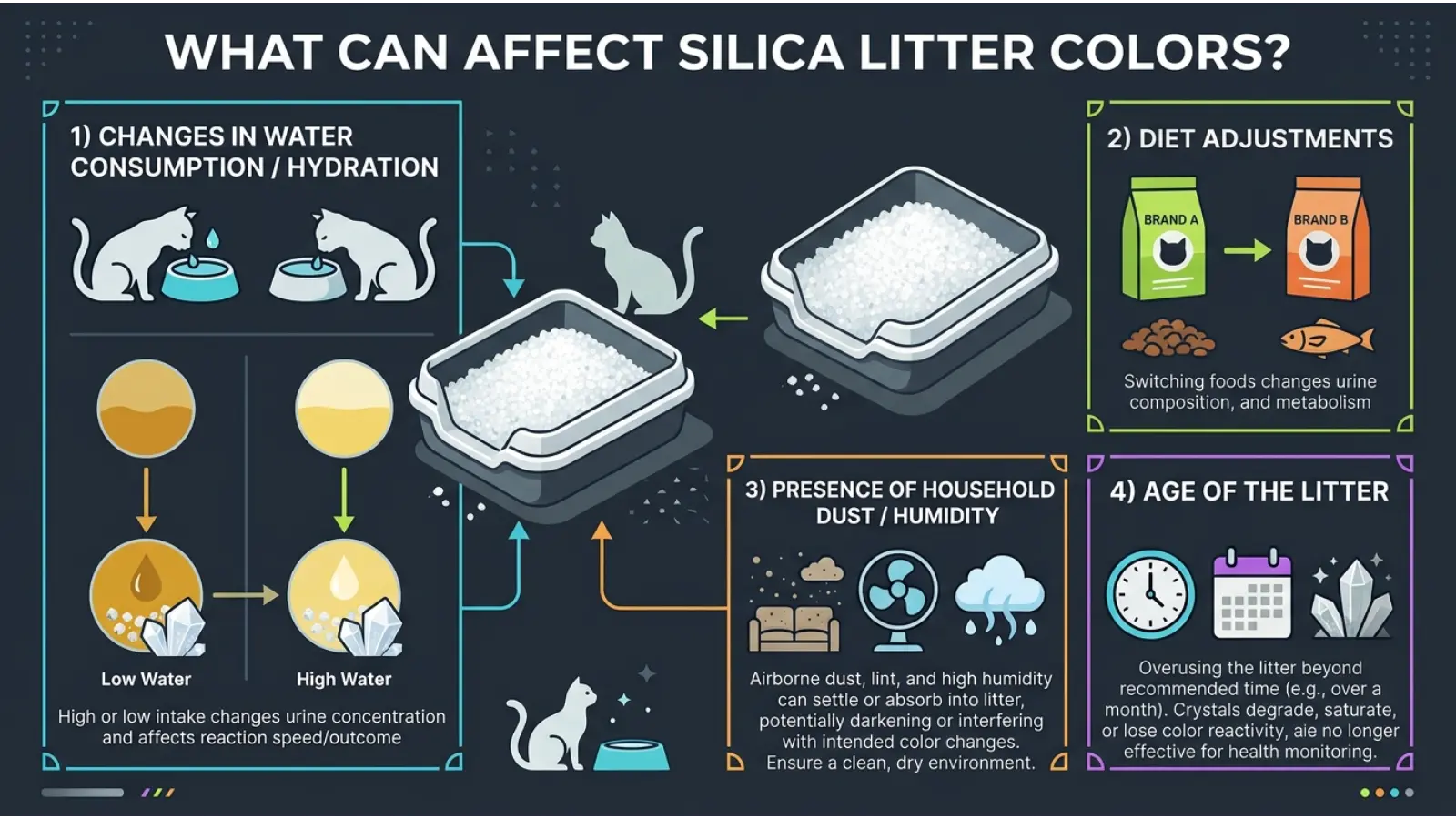
What Can Affect Pretty Litter Colors?
Several factors can influence what you see.
Urine pH
The primary factor monitored by PrettyLitter is urine acidity or alkalinity. This is why the same litter can change from olive green to blue or orange.
Blood
Blood can appear red against the white crystals, making it visually easier to notice.
Lighting
Lighting can dramatically change how colors appear.
Warm indoor bulbs may make green crystals look more yellow. Cool white lighting can make blue or green appear stronger.
Therefore, compare colors under similar lighting when possible.
Litter Box Conditions
Mixing PrettyLitter with another litter can make color changes harder to see and may affect how the product performs.
Keeping the litter box clean also makes unusual color patches easier to identify.
Diet and Individual Differences
A cat’s urine chemistry is influenced by more than one factor. Diet, hydration, metabolism, medications, and health conditions can all play roles.
As a result, two cats may not always produce exactly the same shade.
Why Context Matters More Than Color Alone
Color is useful because it gives you a quick visual signal. However, context gives that signal meaning.
Consider two cats with blue litter.
The first cat is eating normally, behaving normally, and has one isolated blue spot.
The second cat is repeatedly visiting the litter box, straining, and producing very little urine while the litter repeatedly turns blue.
The color is similar, but the situations are very different.
Therefore, responsible use of PrettyLitter means asking three questions:
- What color do I see?
- Is the color repeating?
- How is my cat behaving?
That simple approach can help you make better decisions without treating the litter as a diagnostic test.
Pretty Litter and Cat Health Monitoring
One of the biggest advantages of color-changing litter is that it can make an invisible change easier to notice.
Cats often hide signs of illness. In addition, many urinary problems may not be obvious during normal household activities.
A color-changing litter box gives owners another observation point.
For example, you may not notice a small change in urine chemistry by looking at the urine itself. PrettyLitter can make that change more visible.
Still, monitoring is not diagnosis.
A veterinarian may need to perform a physical examination, urinalysis, blood work, imaging, or other tests depending on the symptoms.
Pretty Litter Color Meanings and Psychology
Traditional color psychology is not the right framework for interpreting PrettyLitter.
Blue does not mean “sadness” here. Orange does not represent “energy.” Red does not mean “passion.”
Instead, these colors are functional indicators created by a chemical response.
That distinction matters because the same color can have completely different meanings in different contexts.
For example:
- Blue in branding may suggest trust.
- Blue in a traffic sign can provide information.
- Blue in PrettyLitter can indicate increased alkalinity.
- Red in fashion may communicate confidence.
- Red in PrettyLitter may indicate visible blood.
Thus, color meaning depends heavily on context, purpose, and the system using the color.
Common Misconceptions About Pretty Litter Colors
Myth 1: Blue Always Means a UTI
Not necessarily.
Blue indicates increased alkalinity within the product’s monitoring system. A urinary tract infection can be associated with alkaline urine, but the color itself cannot diagnose an infection.
Myth 2: Orange Means Kidney Disease
Orange indicates increased acidity, not a confirmed kidney disease diagnosis.
Certain medical conditions can be associated with acidic urine, but veterinary testing is necessary to determine the cause.
Myth 3: Green Means My Cat Is Completely Healthy
Green means the urine is within PrettyLitter’s typical pH range.
It does not test every aspect of feline health.
Myth 4: Red Always Means a Serious Disease
Red can indicate blood, and blood should be taken seriously. However, many different conditions can cause blood in urine.
The color cannot identify the underlying cause.
Myth 5: PrettyLitter Replaces a Vet
It does not.
PrettyLitter can help owners notice potential changes, but only a qualified veterinarian can diagnose a medical condition.
When Should You Contact a Veterinarian?
A color change deserves more attention when it is persistent, unusual for your cat, or accompanied by symptoms.
Contact your veterinarian if you notice:
- Repeated blue or orange changes
- Red areas associated with urine
- Frequent urination
- Straining
- Crying while urinating
- Urinating outside the litter box
- Very small amounts of urine
- Excessive genital licking
- Blood that appears repeatedly
- Changes in appetite
- Unusual tiredness
- Changes in drinking behavior
Furthermore, little or no urine production with repeated attempts to urinate can be an emergency, particularly in male cats.
Do not wait for the litter color to return to normal if your cat appears seriously ill or cannot urinate.
How to Use Pretty Litter Color Meanings Correctly
A simple monitoring routine can make the color chart much more useful.
1. Start With a Clean Baseline
Use the litter as directed and become familiar with its normal appearance.
2. Observe the Overall Pattern
Do not focus only on one tiny patch. Look at whether a particular color repeatedly appears.
3. Watch Your Cat
Litter-box behavior provides important context.
4. Record Unusual Changes
If you see repeated blue, orange, or red changes, noting when they occurred can help you explain the pattern to your veterinarian.
5. Avoid Self-Diagnosis
Use the color as a reason to investigate, not as proof of a specific disease.
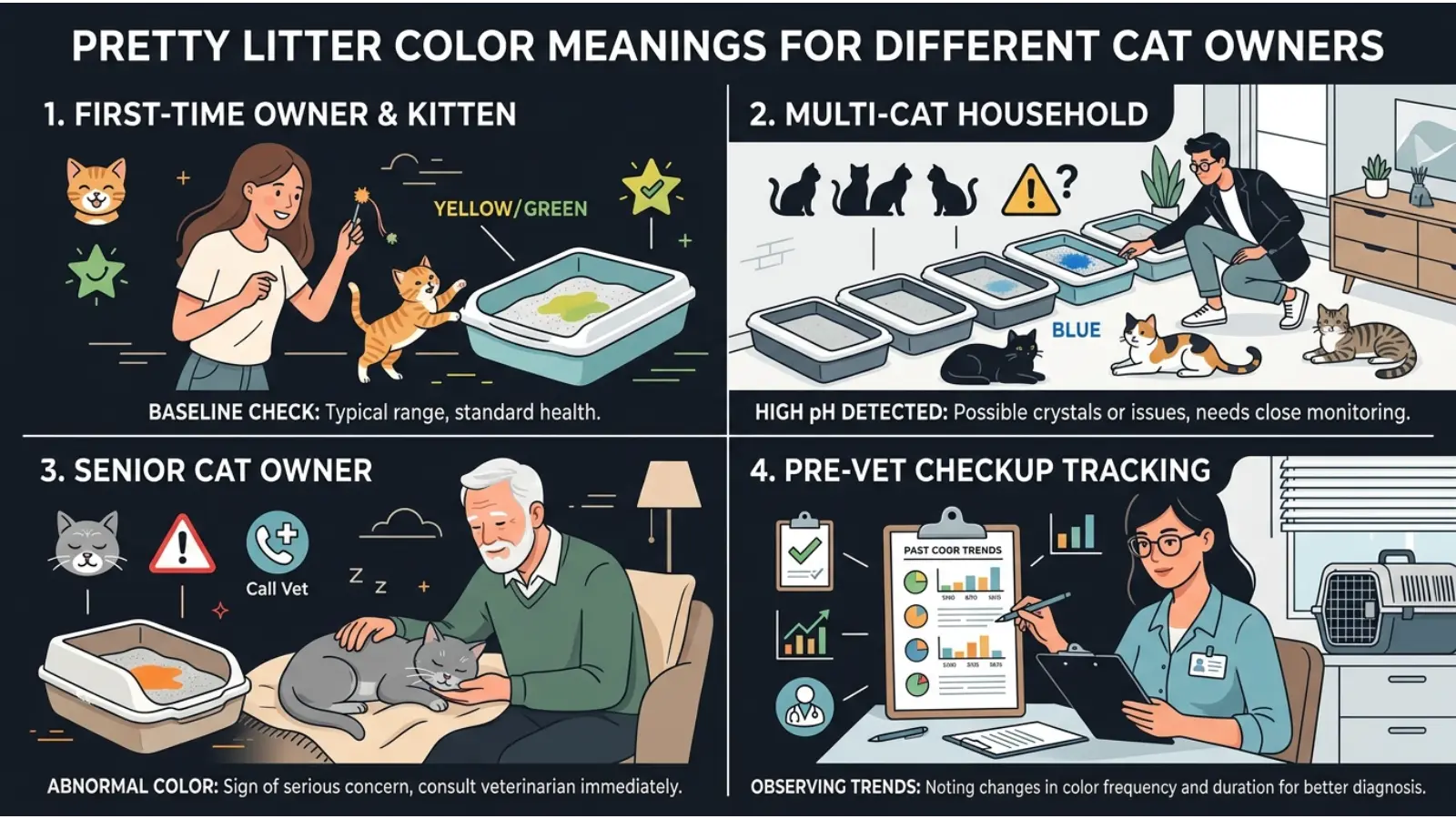
Pretty Litter Color Meanings for Different Cat Owners
For New Cat Owners
The chart provides a simple way to become familiar with your cat’s normal urinary pattern.
For Owners of Older Cats
Regular observation can be especially useful because health needs can change as cats age. However, routine veterinary examinations remain essential.
For Multi-Cat Homes
Color interpretation becomes more difficult if several cats share one litter box because you may not know which cat produced the urine.
Separate monitoring areas can make observations more useful when urinary health is a concern.
For Cats With Previous Urinary Problems
Color-changing litter may provide an additional monitoring tool, but your veterinarian’s recommended testing and treatment plan should remain the priority.
Pretty Litter Color Meanings and Everyday Cat Care
The litter box can tell you more than whether your cat has used it.
Daily observation can reveal changes in:
- Urination frequency
- Urine volume
- Stool appearance
- Litter-box habits
- Color patterns
- Digging behavior
- Avoidance of the litter box
Consequently, cleaning the litter box becomes part of routine health observation rather than simply household maintenance.
This does not mean you need to inspect every grain of litter. A quick daily check is often enough to notice a meaningful change.
Frequently Asked Questions About Pretty Litter Color Meanings
What color should PrettyLitter normally be?
PrettyLitter’s typical color is generally dark yellow to olive green, indicating urine within the product’s typical pH range.
What does blue PrettyLitter mean?
Blue or dark green generally indicates urine that is more alkaline than the typical range. It can be associated with certain urinary conditions, but it does not diagnose a UTI or bladder problem by itself.
What does orange PrettyLitter mean?
Orange generally indicates urine that is more acidic than the typical range. Several factors can influence urine acidity, so the color alone cannot identify the cause.
What does red PrettyLitter mean?
Red can indicate visible blood in the urine. Because blood can be associated with several urinary and other health conditions, veterinary advice is appropriate.
Is green PrettyLitter good?
Dark yellow or olive green represents the product’s typical urine pH range. However, it does not guarantee that your cat has no health problems.
How accurate are Pretty Litter color meanings?
PrettyLitter is designed to monitor certain urine characteristics, including acidity, alkalinity, and visible blood. However, it is a monitoring product rather than a complete diagnostic test.
Can PrettyLitter diagnose a UTI?
No. A blue color may indicate urine with increased alkalinity, which can occur with some urinary tract infections, but diagnosis requires veterinary evaluation and appropriate testing.
Why did my PrettyLitter turn blue once?
A single blue area does not automatically mean illness. Monitor subsequent urinations and your cat’s behavior. Persistent changes or urinary symptoms should be discussed with a veterinarian.
Why is my PrettyLitter orange?
Orange generally means the urine is more acidic than the product’s typical range. If the color persists or your cat shows other symptoms, contact your veterinarian.
Can PrettyLitter detect every cat health problem?
No. PrettyLitter is designed to monitor specific urine characteristics. Many feline diseases will not necessarily cause a detectable color change, so regular veterinary care remains important.
Final Thoughts on Pretty Litter Color Meanings
Pretty Litter color meanings are best understood as health-monitoring signals, not diagnoses. Dark yellow or olive green generally represents the typical range, while blue points toward increased alkalinity, orange toward increased acidity, and red toward visible blood.
The most useful habit is to watch for patterns rather than isolated colors. In addition, pay attention to your cat’s behavior, urination habits, appetite, energy, and comfort.
Color also shows an important lesson about perception: the meaning of a color depends on the system in which it appears. A blue logo, blue bedroom, and blue PrettyLitter crystal may look similar, but they communicate completely different information.
Ultimately, the PrettyLitter color chart can help you notice changes earlier. However, when an unusual color persists or your cat shows signs of urinary trouble, a veterinarian—not the color chart—should make the diagnosis.

Emma Wilson is a dedicated comparison writer and product researcher at ColorMystiic.com. She specializes in creating unbiased product comparisons, detailed reviews, and helpful buying guides. Her goal is to help readers make smarter purchasing decisions with confidence.