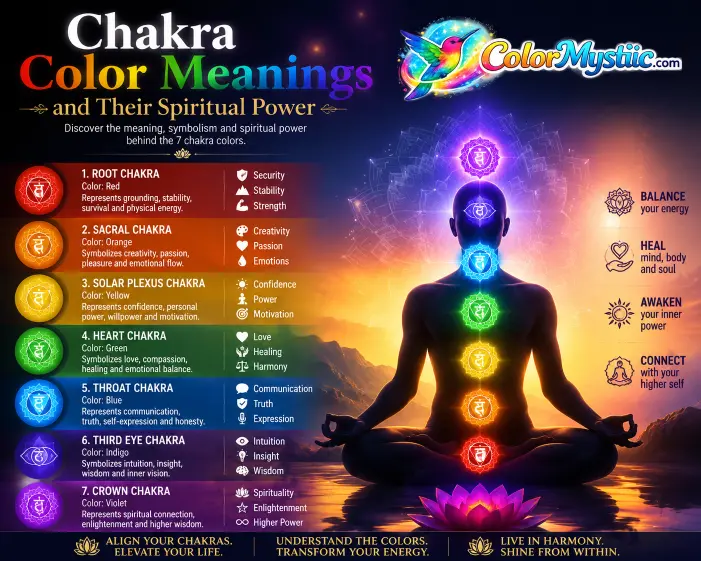
Colors have always carried meaning. They influence emotions, shape cultural traditions, and help people express ideas without words. In many spiritual practices, colors also represent different forms of energy within the body. This is where Real-World Applications of Chakra Color Meanings become especially interesting. Each chakra is associated with a specific color that symbolizes unique emotional, mental, and spiritual qualities.
People search for chakra color meanings for many reasons. Some want to deepen their meditation practice, while others hope to understand emotional imbalances or simply learn why these colors appear so often in yoga, wellness, and mindfulness. Although chakra interpretations are rooted in spiritual traditions rather than modern science, many people find them useful as tools for reflection and personal growth.
This guide explores the symbolism, psychology, cultural interpretations, and everyday applications of every chakra color. You’ll also discover how these colors influence design, fashion, branding, and emotional perception.
Quick Answer
Chakra color meanings connect seven major energy centers with seven symbolic colors. Red represents grounding, orange symbolizes creativity, yellow reflects confidence, green encourages love, blue supports communication, indigo inspires intuition, and violet represents spiritual awareness. These meanings come primarily from modern interpretations of ancient yogic traditions and are widely used in meditation, wellness, and holistic practices.
What Are Chakra Colors?
The word chakra comes from Sanskrit and means “wheel” or “disk.” In traditional yogic philosophy, chakras are believed to be spinning centers of energy located along the spine. Modern chakra systems commonly identify seven primary chakras, each represented by a different color.
These colors serve as visual symbols rather than scientifically proven energy frequencies. Nevertheless, they help practitioners focus during meditation and encourage emotional awareness.
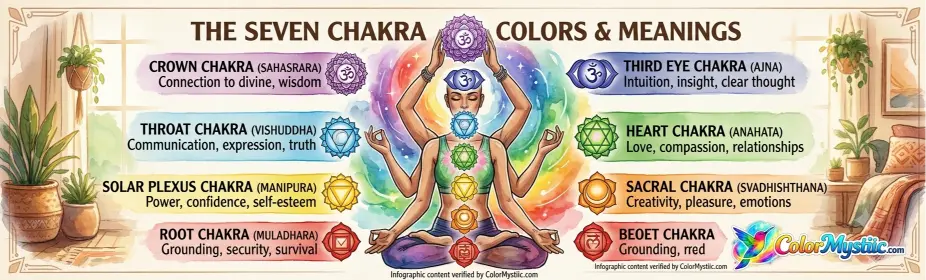
The seven chakra colors are:
- ❤️ Red – Root Chakra
- 🧡 Orange – Sacral Chakra
- 💛 Yellow – Solar Plexus Chakra
- 💚 Green – Heart Chakra
- 💙 Blue – Throat Chakra
- 💜 Indigo – Third Eye Chakra
- 🤍 Violet – Crown Chakra
Together, they create a symbolic map of personal development, from physical survival to spiritual connection.
Root Chakra Color Meaning (Red)
Symbolism
Red symbolizes survival, strength, grounding, courage, and physical security.
The Root Chakra sits at the base of the spine and represents our connection with the physical world. Consequently, red reminds us of stability and basic human needs like food, shelter, safety, and belonging.
Positive Meanings
- Security
- Stability
- Courage
- Strength
- Confidence
- Determination
Possible Negative Associations
When symbolic balance is lacking, red may represent:
- Fear
- Anxiety
- Anger
- Aggression
- Insecurity
Sacral Chakra Color Meaning (Orange)
Symbolism
Orange combines the energy of red with the warmth of yellow. As a result, it symbolizes creativity, pleasure, emotional expression, and healthy relationships.
The Sacral Chakra is linked with imagination, passion, artistic ability, and joy.
Positive Meanings
- Creativity
- Passion
- Emotional openness
- Pleasure
- Enthusiasm
- Confidence
Challenges
An imbalanced symbolic interpretation may include:
- Emotional instability
- Guilt
- Creative blocks
- Dependence
Solar Plexus Chakra Color Meaning (Yellow)
Symbolism
Yellow represents confidence, optimism, intelligence, and personal power.
Located above the navel, the Solar Plexus Chakra symbolizes self-esteem and decision-making.
Positive Meanings
- Motivation
- Leadership
- Confidence
- Optimism
- Personal growth
- Mental clarity
Negative Associations
Too much symbolic emphasis may suggest:
- Perfectionism
- Control issues
- Self-doubt
- Stress
Heart Chakra Color Meaning (Green)
Symbolism
Green is one of the most recognized healing colors.
It represents:
- Love
- Compassion
- Forgiveness
- Balance
- Harmony
- Growth
The Heart Chakra sits at the center of the chest and symbolizes connection with ourselves and others.
Emotional Meaning
Green encourages:
- Kindness
- Empathy
- Patience
- Generosity
- Emotional healing
Because green is strongly associated with nature, many people naturally connect it with renewal and hope.
Throat Chakra Color Meaning (Blue)
Symbolism
Blue symbolizes communication, honesty, truth, and self-expression.
This chakra reminds us to speak clearly while also listening carefully.
Positive Meanings
- Trust
- Communication
- Wisdom
- Calmness
- Authenticity
Possible Imbalances
Some symbolic traditions associate imbalance with:
- Fear of speaking
- Dishonesty
- Poor communication
- Social anxiety
Third Eye Chakra Color Meaning (Indigo)
Symbolism
Indigo is linked with intuition, perception, reflection, and inner wisdom.
It encourages people to look beyond appearances and trust thoughtful observation.
Positive Meanings
- Intuition
- Insight
- Imagination
- Reflection
- Awareness
Symbolic Challenges
- Confusion
- Lack of direction
- Overthinking
- Difficulty trusting intuition
Crown Chakra Color Meaning (Violet)
Symbolism
Violet represents higher consciousness, spiritual awareness, inspiration, and enlightenment.
Unlike lower chakras, the Crown Chakra focuses less on physical life and more on meaning, purpose, and connection.
Positive Meanings
- Wisdom
- Peace
- Spiritual growth
- Compassion
- Unity
Symbolic Imbalances
Some traditions associate imbalance with:
- Isolation
- Disconnection
- Lack of purpose
- Mental overwhelm
The Psychology of Chakra Color Meanings
Although chakras themselves belong to spiritual traditions, the colors connected with them often align with broader principles of color psychology.
For example:
- Red naturally attracts attention and suggests action.
- Orange feels energetic and playful.
- Yellow stimulates optimism and mental activity.
- Green creates a sense of calm and restoration.
- Blue encourages trust and relaxation.
- Indigo promotes reflection.
- Violet inspires imagination and contemplation.
Modern psychology studies how colors influence perception, while chakra symbolism uses colors as spiritual metaphors. Therefore, the two fields overlap in some areas but remain distinct.
Spiritual Meaning of Chakra Colors
Across many contemporary yoga and meditation practices, chakra colors symbolize different stages of personal development.
Generally speaking:
- Red supports grounding.
- Orange encourages creativity.
- Yellow strengthens confidence.
- Green nurtures compassion.
- Blue improves communication.
- Indigo develops intuition.
- Violet inspires spiritual connection.
However, different schools of yoga and spiritual traditions may interpret these meanings differently. Consequently, no single explanation represents every belief system.
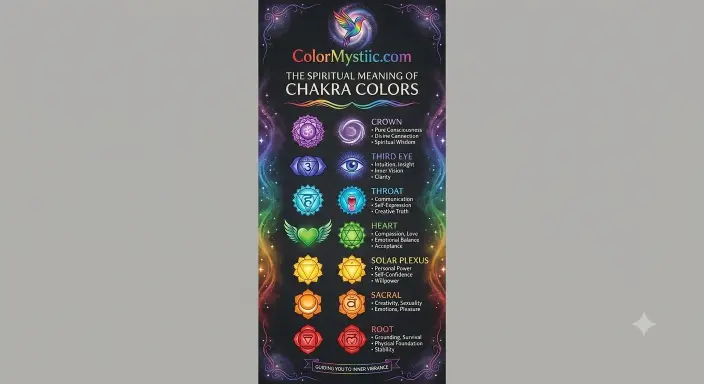
Cultural Perspectives on Chakra Colors
Chakra color meanings are widely recognized today, yet color symbolism changes across cultures.
Western Cultures
- Red often signals passion or danger.
- Green symbolizes nature and growth.
- Blue suggests trust and professionalism.
Eastern Traditions
Many Eastern philosophies connect colors with energy, balance, and meditation, although exact interpretations differ by tradition.
Modern Global Culture
Today, chakra colors appear in wellness products, yoga studios, artwork, jewelry, books, and digital media around the world.
Historical Background of Chakra Colors
Ancient Indian texts describe chakras as energy centers, but the familiar rainbow color system became standardized much later through modern spiritual movements.
This means the exact chakra color meanings used today are largely modern symbolic interpretations rather than direct translations from early Sanskrit texts.
Recognizing this historical development helps separate traditional philosophy from contemporary wellness practices.
Personality Associations
Some people believe favorite chakra colors reflect personality traits.
For example:
| Chakra Color | Common Associations |
|---|---|
| Red | Determined, practical |
| Orange | Creative, outgoing |
| Yellow | Confident, optimistic |
| Green | Compassionate, caring |
| Blue | Honest, thoughtful |
| Indigo | Reflective, intuitive |
| Violet | Spiritual, imaginative |
These associations are symbolic rather than scientific and should not be viewed as personality tests.
Chakra Colors in Branding and Marketing
Businesses carefully choose colors because consumers react emotionally to them.
For example:
- Red attracts attention and creates urgency.
- Orange encourages enthusiasm.
- Yellow feels cheerful.
- Green suggests health and sustainability.
- Blue builds trust.
- Purple often communicates luxury or wisdom.
Although companies rarely design entire brands around chakra systems, many wellness brands intentionally use chakra-inspired color palettes to reinforce themes of balance, healing, and mindfulness.
Chakra Colors in Interior Design
Interior designers often use color psychology to influence mood.
Examples include:
Living Room
Green creates a welcoming atmosphere.
Bedroom
Blue encourages relaxation.
Home Office
Yellow may boost motivation when used in moderation.
Meditation Room
Soft violet, indigo, or green can support a peaceful environment.
Lighting also changes how these colors appear. Warm lighting softens reds and oranges, while cool lighting strengthens blues and violets.
Chakra Colors in Fashion
Clothing colors communicate mood and personality.
People often choose chakra colors intentionally:
- Red for confidence
- Orange for creativity
- Yellow for optimism
- Green for balance
- Blue for professionalism
- Indigo for uniqueness
- Violet for elegance
Accessories, scarves, jewelry, and gemstones frequently incorporate chakra-inspired color combinations.
Best Chakra Color Combinations
Different color pairings create different emotional impressions.
Red + Black
Bold and powerful.
Green + White
Fresh and peaceful.
Blue + Silver
Professional and calming.
Purple + Gold
Elegant and spiritual.
Yellow + Gray
Balanced optimism.
Orange + Navy
Creative yet grounded.
Context always matters. The same colors can feel energetic in one setting and calming in another.
Common Misconceptions About Chakra Color Meanings
Chakra colors are scientifically proven.
No. Chakra systems are spiritual traditions, while scientific evidence focuses on color perception rather than invisible energy centers.
Every culture interprets chakra colors the same way.
False. Interpretations vary among traditions, teachers, and cultures.
One blocked chakra explains every problem.
Human emotions and health are complex. Chakra symbolism should not replace professional medical or psychological care.
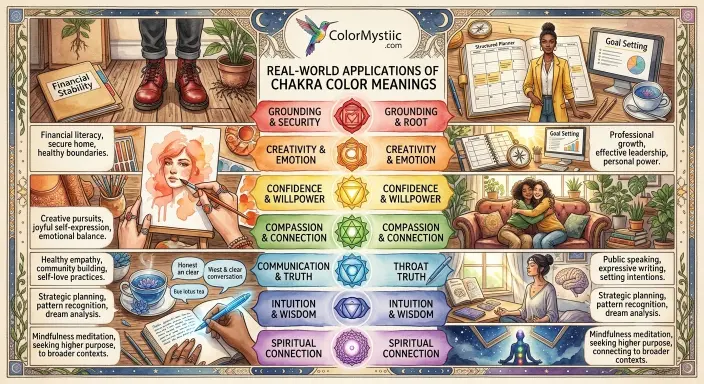
Real-World Applications of Chakra Color Meanings
People use chakra colors in many practical ways.
Meditation
Visualizing colors helps improve focus.
Yoga
Studios often organize classes around specific chakras.
Art
Artists use chakra colors to symbolize emotional journeys.
Home Decoration
Many people create relaxing spaces using calming chakra-inspired palettes.
Jewelry
Bracelets featuring seven colored stones remain popular symbols of mindfulness.
Wellness
Spa environments frequently use green, blue, and violet to encourage relaxation.
Factors That Influence Chakra Color Interpretation
Several elements change how people experience chakra colors.
Context
A bright red sports car communicates something different from a deep red meditation cushion.
Lighting
Natural daylight, warm bulbs, and cool LEDs all change color perception.
Culture
Personal experiences influence emotional reactions to colors.
Age
Children often prefer brighter colors, while adults may appreciate softer tones.
Personal Experience
Someone’s memories can shape how they emotionally respond to a particular chakra color.
Frequently Asked Questions
What are chakra color meanings?
They are symbolic associations between seven energy centers and seven colors used in many modern spiritual and wellness traditions.
Which chakra color represents love?
Green, the Heart Chakra, is most commonly associated with love, compassion, forgiveness, and emotional balance.
Is there scientific proof for chakra colors?
Modern science studies color perception, but it does not confirm the existence of chakra energy centers.
Why is the Crown Chakra violet?
Violet traditionally symbolizes wisdom, higher consciousness, and spiritual awareness in many contemporary chakra systems.
Can chakra colors affect mood?
Colors can influence perception and emotions, although individual responses vary and scientific evidence differs from spiritual interpretations.
Why do yoga studios use chakra colors?
They help create visual themes that encourage mindfulness, relaxation, and personal reflection.
Are chakra colors the same in every tradition?
No. Different teachers and spiritual schools sometimes use different colors or interpretations.
How can I use chakra colors at home?
You can incorporate them into artwork, meditation spaces, lighting, textiles, or decorative accessories to create different emotional atmospheres.
Which chakra color symbolizes confidence?
Yellow, associated with the Solar Plexus Chakra, commonly represents confidence, motivation, and personal power.
Do favorite chakra colors reveal personality?
Not necessarily. While symbolic traditions connect colors with personality traits, there is no scientific evidence that a favorite color determines character.
Conclusion
Understanding chakra color meanings offers more than a list of symbolic colors. It provides a framework that many people use to reflect on emotions, personal growth, creativity, communication, and spiritual awareness. At the same time, it is helpful to recognize the difference between established research on color psychology and the symbolic traditions of chakra philosophy. When viewed with curiosity and balance, chakra colors can become meaningful tools for meditation, design, fashion, wellness, and self-reflection. Rather than seeing them as fixed rules, consider them invitations to explore how color shapes your experiences, influences your surroundings, and enriches everyday life.

Emma Wilson is a dedicated comparison writer and product researcher at ColorMystiic.com. She specializes in creating unbiased product comparisons, detailed reviews, and helpful buying guides. Her goal is to help readers make smarter purchasing decisions with confidence.