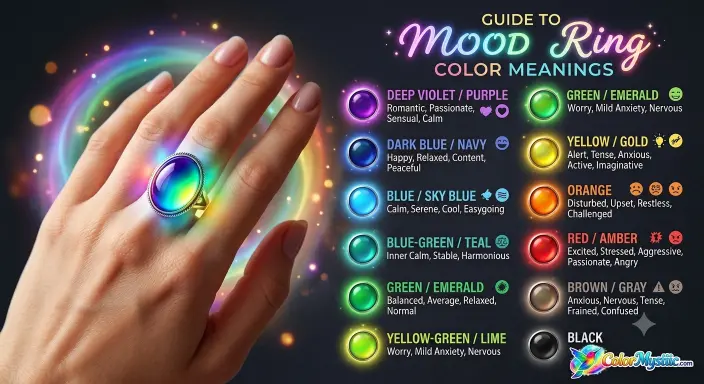
Mood rings have fascinated people for decades because they seem to reveal emotions through changing colors. While many people wear them as fun accessories, others are curious about the deeper symbolism behind each shade. This interest leads many to ask, what are the mood ring color meanings, and whether these colors truly reflect emotions or simply react to body temperature.
The answer is a little more complex than many people expect. Mood rings use special liquid crystals that change color in response to temperature. Since body temperature often changes alongside emotional states, the colors can sometimes appear to match how someone feels. However, mood ring color meanings are symbolic interpretations rather than scientifically proven emotion detectors.
Throughout this guide, you’ll discover how mood rings work, what each color commonly represents, how culture influences color symbolism, and why mood rings remain popular in fashion, psychology discussions, and gift giving.
Quick Answer:
Mood ring color meanings are based on the changing colors of thermochromic liquid crystals inside the ring. Each color is traditionally linked with emotional states such as calmness, excitement, stress, happiness, love, or anxiety. Although the colors respond to body temperature rather than directly reading emotions, they have become widely accepted symbols of different moods.
What Is a Mood Ring?
A mood ring is a piece of jewelry containing a thermochromic liquid crystal beneath a protective stone or glass. As the temperature of your finger changes, the liquid crystals twist into different formations. Consequently, they reflect different wavelengths of light, creating a variety of colors.
Because emotions can slightly influence blood flow and skin temperature, mood rings sometimes appear to change colors during emotional experiences. Nevertheless, many other factors—including room temperature, weather, illness, exercise, and circulation—also affect the color.
Therefore, mood rings should be viewed as entertaining accessories rather than scientific tools for measuring feelings.
The Science Behind Mood Ring Color Meanings
Understanding what are the mood ring color meanings starts with understanding how the ring actually functions.
Mood rings do not detect thoughts or emotions directly. Instead, they respond to tiny temperature differences.
When your body feels relaxed, blood vessels often widen, allowing warmer blood to reach your fingers. As a result, the ring may display colors associated with calmness or happiness.
On the other hand, stress, anxiety, or cold weather can reduce blood flow to your hands. Consequently, the ring often changes to darker colors.
Researchers recognize that emotions can influence body temperature to some degree. However, there is no scientific evidence showing that mood rings can accurately identify specific emotional states.
In other words, the technology measures temperature—not feelings.
Complete Mood Ring Color Meanings Chart
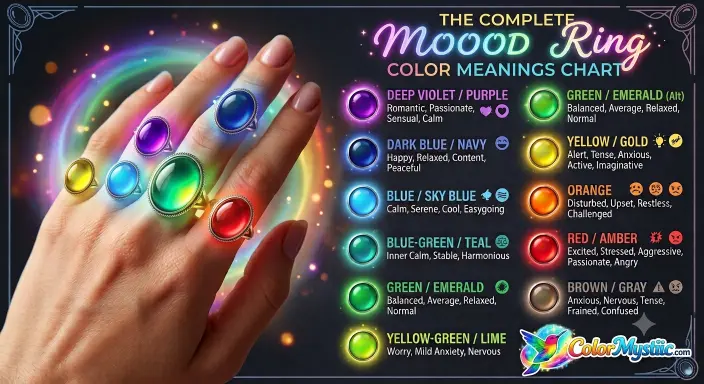
Although manufacturers sometimes use slightly different scales, the following interpretations are the most widely recognized.
Black Mood Ring Meaning
Black is usually the coolest color on a mood ring.
Common interpretations include:
- Stress
- Anxiety
- Fear
- Fatigue
- Tension
- Cold hands
- Emotional overload
In reality, black most often indicates that your finger temperature is too low for the liquid crystals to activate properly.
Symbolism
Symbolically, black often represents mystery, protection, seriousness, power, or emotional withdrawal.
Brown Mood Ring Meaning
Brown generally appears when the ring is warming but remains relatively cool.
It may symbolize:
- Restlessness
- Uncertainty
- Nervousness
- Physical discomfort
Some manufacturers associate brown with transition rather than a fixed emotional state.
Gray Mood Ring Meaning
If Gray is less common but may represent:
- Emotional exhaustion
- Indecision
- Neutral emotions
- Low energy
Gray also symbolizes balance between emotional extremes.
Amber or Yellow Mood Ring Meaning
Yellow often appears during moderate warmth.
Traditional meanings include:
- Curiosity
- Optimism
- Creativity
- Mental activity
- Excitement
However, some mood ring charts associate bright yellow with mild nervousness because increased alertness may slightly affect body temperature.
Symbolism
Yellow has long represented intelligence, learning, sunlight, and hope.
Green Mood Ring Meaning
Green is one of the most recognized and desired mood ring colors.
It commonly represents:
- Calmness
- Stability
- Relaxation
- Balance
- Normal emotional state
Many manufacturers consider green the “ideal” resting color because it often appears when body temperature falls within an average comfortable range.
Symbolism
Green symbolizes growth, harmony, renewal, health, and emotional balance.
Blue Mood Ring Meaning
Blue usually indicates warm fingers and relaxed circulation.
Traditional interpretations include:
- Happiness
- Peace
- Confidence
- Emotional security
- Patience
- Comfort
Light blue often suggests relaxation, while deeper blue may indicate emotional contentment.
Symbolism
Blue has long been associated with trust, honesty, wisdom, and tranquility.
Dark Blue Mood Ring Meaning
Dark blue is often considered the most positive mood ring color.
It frequently represents:
- Deep relaxation
- Love
- Satisfaction
- Confidence
- Inner peace
Many mood ring enthusiasts believe dark blue appears when someone feels emotionally comfortable.
Purple Mood Ring Meaning
Purple commonly symbolizes:
- Passion
- Romance
- Creativity
- Imagination
- Spiritual reflection
Because purple combines calm blue with energetic red, it often represents emotional complexity.
Violet Mood Ring Meaning
Violet is closely related to purple but often suggests:
- Inspiration
- Dreaming
- Artistic thinking
- Emotional depth
- Personal growth
Many people associate violet with intuition and imagination.
Pink Mood Ring Meaning
Pink usually appears at warmer temperatures.
It often symbolizes:
- Affection
- Romance
- Joy
- Kindness
- Playfulness
Pink is one of the most positive colors in traditional mood ring charts.
Red Mood Ring Meaning
Red may indicate:
- Excitement
- Energy
- Passion
- Determination
- Strong emotions
Since red usually appears at relatively high temperatures, physical activity can also produce this color.
Why Mood Ring Colors Change
Many people assume their ring changes only because of emotions. However, several everyday factors influence the colors.
These include:
- Body temperature
- Outdoor weather
- Air conditioning
- Exercise
- Fever
- Stress
- Anxiety
- Excitement
- Blood circulation
- Hand washing
- Holding a hot or cold drink
Consequently, interpreting a mood ring always requires considering the surrounding environment.
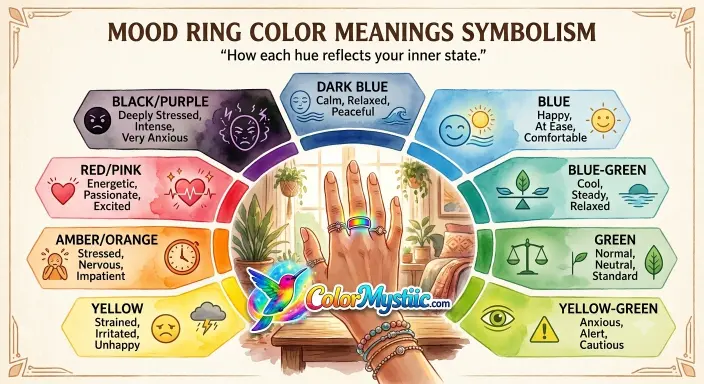
What Do Mood Ring Color Meanings Symbolize?
Even though the science is based on temperature, the symbolic meanings have become deeply rooted in popular culture.
People often associate mood ring colors with:
- Emotional awareness
- Personal reflection
- Communication
- Self-expression
- Energy shifts
- Relationships
- Emotional wellness
Rather than acting as medical devices, mood rings encourage conversations about feelings and emotional health.
Spiritual Meaning of Mood Ring Colors
Many spiritual traditions assign symbolic meanings to colors. However, there is no universal religious interpretation of mood ring colors.
Instead, different belief systems may view colors differently.
For example:
- Blue often represents wisdom or inner peace.
- Green commonly symbolizes healing and renewal.
- Purple is frequently linked with intuition and spiritual growth.
- Pink may represent unconditional love.
- Yellow often reflects optimism and personal power.
These interpretations vary across traditions and should be understood as symbolic rather than factual.
Cultural Interpretations of Mood Ring Colors
Color meanings are not the same everywhere.
Western Cultures
Many Western interpretations associate:
- Blue with trust
- Green with health
- Black with mourning
- Red with passion
These associations strongly influence modern mood ring charts.
Eastern Traditions
Several Eastern cultures may connect colors with:
- Balance
- Energy
- Prosperity
- Nature
- Celebration
However, meanings differ widely between countries and traditions.
Global Popular Culture
Today, mood ring color meanings have become largely standardized through jewelry manufacturers, magazines, and online guides. As a result, many people recognize similar interpretations regardless of where they live.
Personality Associations
Some people believe favorite mood ring colors reveal personality.
For example:
People attracted to blue may appreciate:
- Stability
- Honesty
- Calm environments
People drawn toward green may enjoy:
- Nature
- Balance
- Harmony
Purple lovers often appreciate:
- Creativity
- Originality
- Imagination
However, psychologists generally agree that favorite colors alone cannot determine personality traits. Individual preferences are influenced by culture, memories, experiences, and personal taste.
Mood Ring Color Meanings in Fashion
Mood rings remain popular because they combine jewelry with storytelling.
Fashion enthusiasts enjoy them because:
- They start conversations.
- They match multiple outfits.
- They add nostalgic charm.
- They express individuality.
- They appeal to vintage fashion trends.
Additionally, mood rings pair well with silver jewelry, casual outfits, bohemian styles, and colorful accessories.
Mood Rings in Branding and Marketing
Although companies rarely use actual mood rings in branding, the psychology behind changing colors influences marketing.
Brands understand that colors shape emotional expectations.
For instance:
- Blue builds trust.
- Green communicates health.
- Purple suggests luxury.
- Red creates urgency.
- Yellow attracts attention.
Therefore, marketers carefully choose color palettes to influence customer perception.
Mood Ring Colors in Everyday Life
Beyond jewelry, understanding what are the mood ring color meanings can encourage greater awareness of how color affects emotions.
People encounter color psychology in:
- Clothing
- Home décor
- Website design
- Product packaging
- Sports uniforms
- Photography
- Art
- Advertising
- Social media graphics
Although color symbolism is subjective, it plays a meaningful role in daily experiences.
Common Misconceptions About Mood Ring Color Meanings
Mood Rings Can Read Minds
False.
Mood rings respond to temperature changes, not thoughts.
Every Manufacturer Uses the Same Color Chart
Not exactly.
Different companies may assign slightly different meanings to identical colors.
Mood Rings Are Scientifically Accurate Emotion Detectors
No.
Current scientific evidence does not support this claim.
Black Always Means Someone Is Angry
Not necessarily.
Often, black simply means the ring is too cold.
Mood Rings Never Fail
Like any accessory, mood rings can stop functioning if the liquid crystals become damaged through age, moisture, or extreme heat.
Practical Tips for Reading Mood Ring Colors
For the best experience:
- Wear the ring indoors.
- Keep your hands dry.
- Avoid extreme temperatures.
- Compare color changes over time.
- Treat interpretations as fun guidance rather than factual emotional analysis.
Frequently Asked Questions
What are the mood ring color meanings based on?
They are based on temperature-sensitive liquid crystals that change color as skin temperature changes. The emotional meanings are traditional symbolic interpretations rather than scientific measurements.
Which mood ring color is considered the happiest?
Dark blue, blue, and pink are commonly associated with happiness, comfort, and emotional satisfaction.
Why does my mood ring stay black?
Your hands may be cold, the environment may be cool, or the ring may no longer function properly.
Can mood rings accurately detect emotions?
No. They respond to temperature changes, which may sometimes relate to emotions but are influenced by many other factors.
Why do different charts show different meanings?
Manufacturers often create their own interpretation guides, so meanings vary slightly.
Is green the normal mood ring color?
Yes. Green often represents a comfortable body temperature and a relaxed emotional state.
Do mood rings work better indoors?
Generally, yes. Stable temperatures reduce environmental effects and make color changes more consistent.
Are mood ring colors connected to chakra colors?
Some people draw symbolic comparisons, but mood rings were not designed using chakra systems. Any connection is interpretive rather than scientific.
Can children wear mood rings?
Yes, provided the jewelry is age-appropriate and free from materials that could cause allergies or safety concerns.
Why are mood rings still popular?
They combine science, symbolism, fashion, and nostalgia in a unique accessory that encourages conversation and personal reflection.
Final Thoughts
Understanding what are the mood ring color meanings involves appreciating both science and symbolism. The changing colors come from temperature-sensitive liquid crystals, while the emotional interpretations have developed through decades of popular culture. Together, these elements make mood rings both entertaining and meaningful.
Rather than viewing a mood ring as an emotion detector, think of it as a colorful reminder that feelings, environments, and personal experiences are constantly changing. By recognizing how colors influence perception, communication, and design, you gain a deeper appreciation for the subtle ways color shapes everyday life.
Emma Wilson is a dedicated comparison writer and product researcher at ColorMystiic.com. She specializes in creating unbiased product comparisons, detailed reviews, and helpful buying guides. Her goal is to help readers make smarter purchasing decisions with confidence.