A mood ring can turn an ordinary change in skin temperature into a colorful display. One moment, your ring may look blue; later, it might turn green, purple, or nearly black. These changes often inspire questions about feelings, personality, and emotional balance. The emotion mood ring color meanings people search for come from traditional mood ring charts, which connect different shades with states such as calmness, happiness, excitement, and stress.
However, mood rings do not directly read your emotions. Their colors change because of temperature-sensitive materials inside the ring, and your emotional state is only one possible influence on skin temperature.
In this guide, you will learn what each color traditionally represents, how mood rings work, and how to interpret their colors without confusing symbolism with science.
Quick Answer: What Do Mood Ring Colors Mean?
Mood ring colors traditionally represent different emotional states. Blue is associated with calmness, green with balance, purple with excitement or romance, yellow with nervousness, amber with mixed feelings, and black with cold skin or tension. However, exact meanings vary by chart and manufacturer. A mood ring responds to temperature changes rather than detecting emotions directly.
What Is a Mood Ring?
A mood ring is a piece of jewelry containing a temperature-sensitive material that changes color as its temperature changes. Most modern examples use thermochromic liquid crystals, which respond to heat by changing the wavelengths of light they reflect.
The ring usually contains a thin layer of these crystals beneath a protective surface. As your finger warms or cools, the material changes its appearance.
Mood rings became popular in the 1970s and remain popular as novelty jewelry, gifts, and fashion accessories. Their appeal comes from the idea that colors can offer a visual expression of how someone feels.
Although the emotional meanings are symbolic, the color changes themselves have a physical explanation. Understanding this difference makes mood rings more interesting and helps you interpret them realistically.
Emotion Mood Ring Color Meanings Chart
Traditional mood ring charts connect each color with a particular mood or emotional state. The following chart covers common interpretations, although the exact meanings can differ between products.
| Mood Ring Color | Traditional Meaning | Common Emotional Association |
|---|---|---|
| Blue | Calm and relaxed | Peace, comfort, ease |
| Dark Blue | Happy and content | Confidence, satisfaction |
| Green | Balanced or average | Stability, normal mood |
| Purple | Passionate or romantic | Excitement, affection |
| Violet | Intense emotions | Imagination, enthusiasm |
| Turquoise | Positive and playful | Creativity, openness |
| Pink | Affectionate or sensitive | Warmth, tenderness |
| Red | Excitement or energy | Passion, alertness |
| Yellow | Nervous or unsettled | Uncertainty, mental activity |
| Amber | Mixed or changing feelings | Uneasiness, anticipation |
| Orange | Emotional stimulation | Excitement, restlessness |
| Gray | Tension or uncertainty | Concern, discomfort |
| Black | Cold or tense | Reserved mood, discomfort |
| Brown | Uneasiness or restlessness | Agitation, uncertainty |
| White | Neutrality or unclear state | Calmness or emotional ambiguity |
These meanings are traditional interpretations, not scientifically validated emotional readings. Some charts assign different feelings to the same shade, so always check the guide supplied with your particular ring.
What Does Each Emotion Mood Ring Color Meanings?
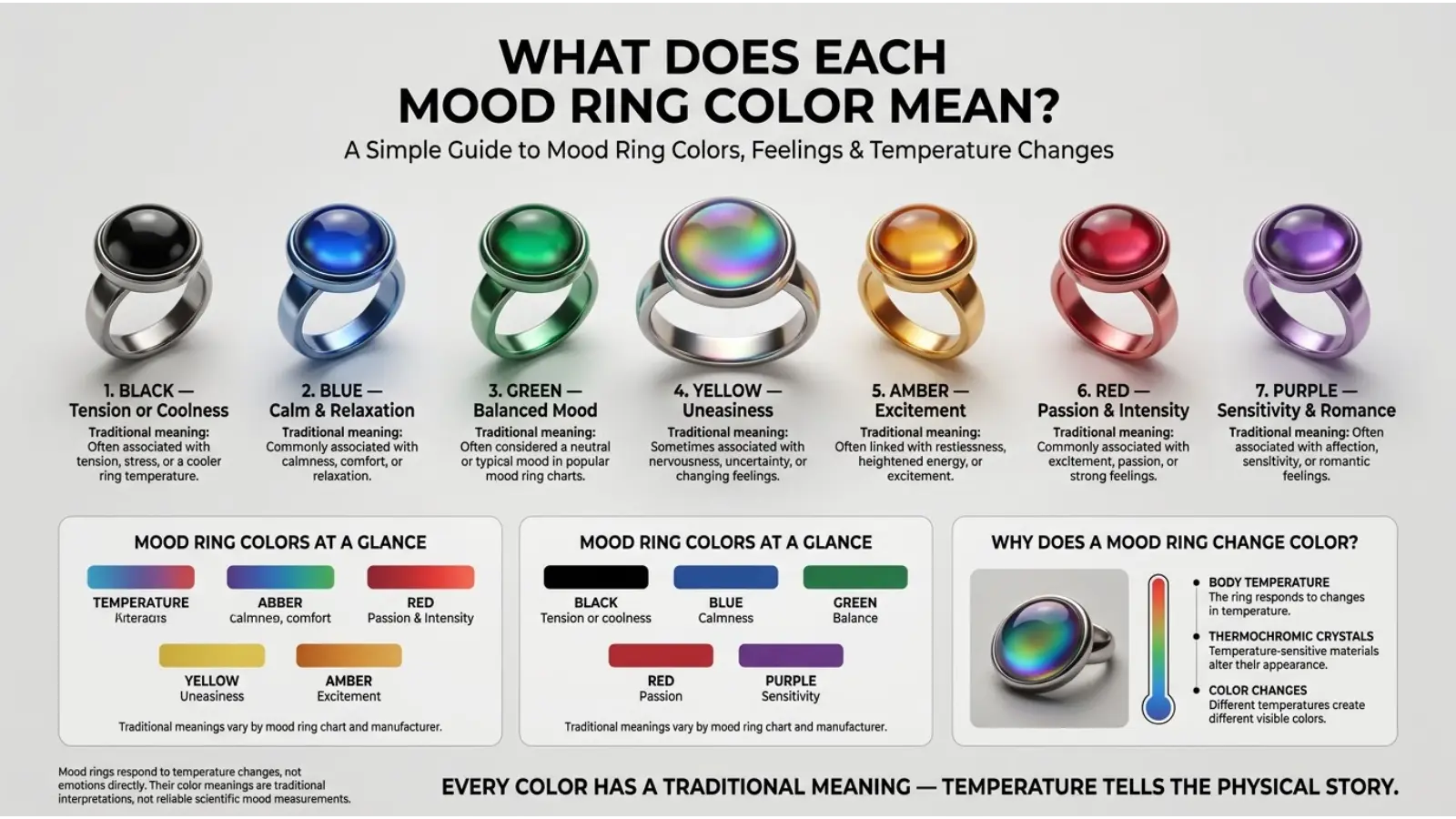
Blue Mood Ring Meaning
Blue is commonly associated with calmness, relaxation, and emotional comfort. On a traditional mood ring chart, a blue shade may suggest that someone feels peaceful or at ease.These distinctions are symbolic rather than universal.
Blue can also appear when the ring reaches a temperature that causes its crystals to reflect blue light. Therefore, a blue ring does not prove that you are happy or relaxed.
Practical insight: If your ring turns blue while you are resting, you can enjoy the traditional association with calmness without treating it as a reliable measurement of your feelings.
Green Mood Ring Meaning
Green usually represents balance, stability, and an ordinary emotional state. Many mood ring charts place green near the middle of the color range, making it a common reference point.
Symbolically, green also connects with nature, renewal, and growth. These wider associations may explain why people often interpret green as a sign of emotional steadiness.
However, a green mood ring simply indicates that the material has reached a temperature associated with that shade.
Purple Mood Ring Meaning
Purple is often linked with passion, romance, excitement, and strong feelings. Some charts associate it with affection, while others connect it with imagination or heightened emotional energy.
The shade matters in traditional interpretations. A light purple may suggest tenderness or a gentle mood, whereas a deeper violet may symbolize intensity and passion.
Purple also carries associations with creativity, mystery, and spirituality in different settings. These meanings come from broader color symbolism rather than the chemistry of the ring.
Violet Mood Ring Meaning
Violet is sometimes listed separately from purple on mood ring charts. It may represent intense affection, enthusiasm, imagination, or a highly engaged emotional state.
Because violet and purple can look similar, manufacturers do not always distinguish them consistently. One brand might use violet to represent romance, while another may associate it with excitement.
For this reason, the chart that comes with your ring is more useful than a universal online interpretation.
Turquoise Mood Ring Meaning
Turquoise is traditionally connected with friendliness, creativity, and positive energy. It combines the familiar symbolism of blue, which often suggests calmness, with green’s associations with balance and renewal.
Some mood ring guides describe turquoise as a cheerful or playful state. Others use it for a relaxed but alert mood.
In practice, turquoise may simply be the color your ring displays at a particular temperature. Its emotional interpretation depends on the chart you follow.
Pink Mood Ring Meaning
Pink is commonly associated with affection, tenderness, warmth, and sensitivity. On some traditional charts, it represents a gentle emotional state or growing romantic interest.
Pale pink may symbolize softness and comfort, while brighter pink can suggest excitement or playful affection.
Nevertheless, pink does not establish that someone is falling in love or thinking about another person. The ring cannot identify specific emotions, romantic intentions, or private thoughts.
Red Mood Ring Meaning
Red often symbolizes passion, excitement, energy, and strong emotions. Traditional mood ring charts may associate it with enthusiasm, stimulation, or heightened activity.
In general color symbolism, red can represent love, courage, danger, or anger depending on the setting.
Its appearance reflects the temperature response of the material. If the ring changes from purple to red, that change does not reveal a precise emotional transition.
Yellow Mood Ring Meaning
Yellow is frequently associated with nervousness, uncertainty, curiosity, or mental activity in traditional mood ring charts.The meaning varies significantly between manufacturers.
Yellow’s wider symbolism is equally flexible. It can represent sunshine and optimism, but it may also suggest caution.
Consequently, a yellow ring cannot tell you whether you are anxious, excited, or simply experiencing a change in finger temperature.
Amber Mood Ring Meaning
Amber is usually a yellow-orange or golden-brown shade. Traditional mood ring guides may connect it with mixed feelings, uncertainty, nervousness, or anticipation.
Its interpretation often falls between yellow and orange. This makes amber a useful example of why mood ring charts can be difficult to standardize: the exact shade may look different under different lighting conditions.
If your ring appears amber, use its color as a visual curiosity rather than a definite description of your emotional state.
Orange Mood Ring Meaning
Orange is often associated with excitement, stimulation, restlessness, or a desire for activity. In broader color symbolism, it can also represent enthusiasm, warmth, creativity, and sociability.
Some mood ring charts connect orange with nervous energy, while others treat it as a positive, energetic shade.
These differences show that color meanings depend on interpretation. The ring itself cannot distinguish between excitement, stress, and other experiences that may occur at the same time.
Gray Mood Ring Meaning
Gray is sometimes linked with tension, uncertainty, worry, or emotional discomfort. On certain traditional charts, it appears between black and lighter colors.
However, gray may also appear when the ring’s temperature falls within a range that produces that particular shade. The result does not mean you are unhappy or emotionally withdrawn.
Black Mood Ring Meaning
Black is commonly associated with tension, discomfort, or a negative mood in traditional mood ring charts. This interpretation has contributed to the belief that a black mood ring means someone is angry or upset.
In reality, black may appear when the ring is relatively cool or when its temperature-sensitive material cannot produce a more colorful reflection under the current conditions. Some rings also appear black when they are inactive or damaged.
Important: A black mood ring does not automatically mean anger, sadness, bad luck, or emotional distress. Check the ring’s condition and temperature before interpreting its appearance.
Brown Mood Ring Meaning
Brown is sometimes associated with restlessness, worry, uncertainty, or frustration. It may be included as a separate shade on some charts but omitted from others.
Because brown can resemble dark amber or muted orange, lighting and the material’s condition may affect how you identify it.
The traditional emotional meaning is not a reliable guide to someone’s actual mood. If your ring changes to brown, there is no reason to assume that something is wrong.
White Mood Ring Meaning
White is less consistently represented in traditional mood ring charts. Depending on the product, it may be associated with neutrality, relaxation, or an unclear emotional state.
Sometimes a pale or whitish appearance reflects the way the material responds to temperature or light. It can also result from wear, damage, or differences in the ring’s construction.
Check your product’s instructions before assigning white a specific meaning.
How Do Mood Rings Actually Work?
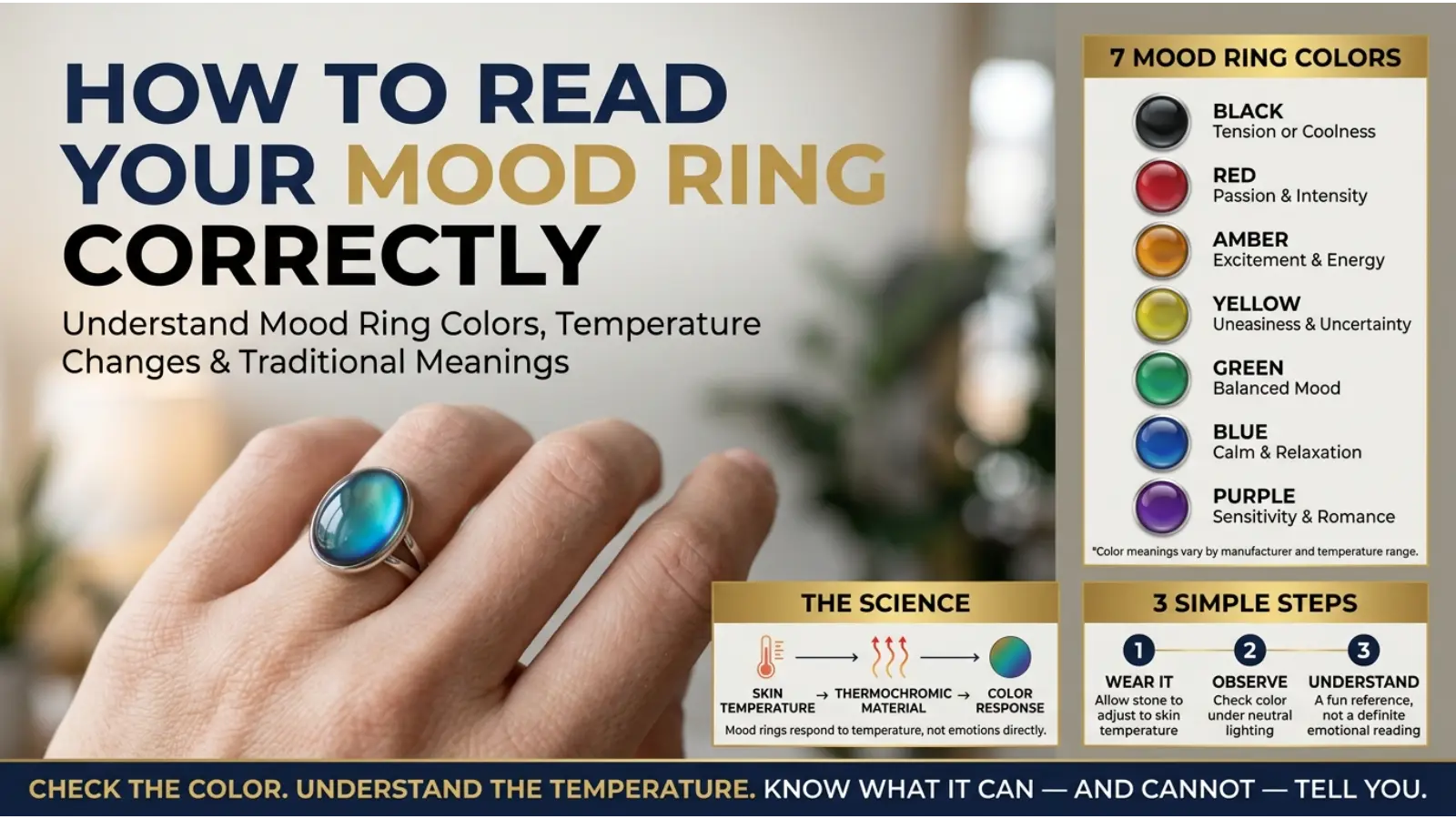
Mood rings work through a process called thermochromism, which means that a material changes color in response to temperature.
Many mood rings contain thermochromic liquid crystals. These crystals have structures that interact with light in temperature-dependent ways. As the temperature changes, the wavelengths of light they reflect can change too.
The result is a visible shift from one color to another.
Why Does Your Finger Temperature Matter?
Your fingers exchange heat with the surrounding environment. Their temperature can change with room temperature, blood flow, activity, and contact with warm or cold objects.
Because a mood ring sits directly against your finger, it responds to some of these changes. The ring’s own temperature also depends on the surrounding air and the materials used to make it.
This explains why the same ring can display different colors at different times, even when your emotional state has not changed.
Can Mood Rings Really Detect Emotions?
No. Mood rings do not directly detect emotions, thoughts, or personality traits.
Emotions and physical responses can sometimes influence each other. For example, stress may affect sweating or blood flow, which can influence skin temperature in certain circumstances. However, these effects are complex and vary from person to person.
A mood ring cannot separate emotional changes from environmental temperature, physical activity, or other causes. It also cannot reliably identify specific feelings such as love, jealousy, sadness, or anger.
Why Mood Ring Colors Change Throughout the Day
Your mood ring may change color several times during a normal day. These changes are usually easier to understand when you consider the conditions around the ring.
Room temperature: A warm room may cause the ring to display a different shade from the one it shows in a cool room.
Weather: Cold outdoor air can cool your fingers, while warm weather may contribute to warmer skin temperatures.
Physical activity: Walking, exercising, or moving around can affect circulation and body temperature.
Stress and excitement: Emotional responses can sometimes influence physical processes, but the effect is not consistent enough for a mood ring to identify a particular feeling.
Hand temperature: Holding a cold drink, washing your hands, or touching a warm surface may temporarily influence the ring’s color.
Ring design: Different brands use different materials and temperature ranges, so two rings may show different colors under similar conditions.
As a result, a changing mood ring is not necessarily showing a changing mood. It may simply be responding to a different temperature.
Emotion Mood Ring Color Meanings in Psychology
Color psychology examines how people perceive colors and how colors may influence associations, judgments, or behavior. It does not provide a universal code that can identify a person’s emotional state from a color.
Blue is often associated with calmness, red with energy or danger, and green with nature or balance. However, these associations are shaped by personal experience, cultural learning, context, and the way a color is presented.
Mood rings combine these familiar associations with temperature-sensitive technology. The color chart gives each shade an emotional label, which encourages people to connect the ring’s appearance with their feelings.
Do Colors Affect Everyone the Same Way?
No. A color that feels relaxing to one person may remind another person of an unpleasant experience.
Even within the same culture, people may disagree about the emotional meaning of a shade. Bright red, for example, might suggest romance, celebration, danger, or anger depending on the situation.
Mood ring charts simplify these complex associations into short labels. They are useful for entertainment, but they cannot represent every person’s experience.

Spiritual Emotion Mood Ring Color Meanings
Some people interpret mood ring colors through spiritual symbolism. In these interpretations, colors may represent energy, emotional awareness, personal growth, or a sense of inner balance.
These ideas belong to personal beliefs and symbolic traditions rather than established scientific explanations.
Common spiritual interpretations include:
- Blue: Peace, reflection, and inner calm.
- Green: Renewal, growth, and balance.
- Purple: Intuition, wisdom, and spiritual reflection.
- Pink: Compassion, affection, and kindness.
- Red: Vitality, courage, and passion.
- Yellow: Awareness, optimism, and mental clarity.
- Black: Protection, mystery, or the unknown.
A mood ring cannot measure spiritual energy or prove that a person is experiencing a particular spiritual state.
If you enjoy spiritual symbolism, you can use a ring’s changing colors as a reminder to pause and reflect. The meaning comes from your own interpretation rather than a hidden message produced by the ring.
Emotion Mood Ring Color Meanings in Fashion and Everyday Life
Mood rings are also fashion accessories. Their appeal comes from their changing appearance, nostalgic style, and ability to add color to an outfit.
A blue or turquoise ring can complement casual clothing and denim. Purple and pink shades pair well with playful or expressive styles, while black rings create a darker, more understated look.
You can also match mood rings with silver-toned jewelry, simple bracelets, or neutral clothing. Since the ring may change color throughout the day, it can add variety without requiring you to change accessories.
For a thoughtful gift, a mood ring can symbolize curiosity, friendship, affection, or self-expression. It is better to present it as a fun piece of jewelry than as a tool that reveals someone’s private emotions.
How to Read Your Mood Ring Correctly
Although mood rings cannot accurately identify emotions, you can still understand their color changes more clearly.
- Find the manufacturer’s chart. Use the guide that came with your ring because color labels differ between products.
- Allow the ring to adjust. After moving between warm and cold environments, give the material time to respond.
- Check the lighting. Indoor bulbs and daylight can make the same shade look different.
- Look at the actual color. A shade between blue and green may not fit neatly into a chart category.
- Consider the ring’s condition. Cracked, cloudy, or worn materials may not change color as expected.
- Avoid emotional assumptions. Do not use the ring to decide whether you or another person is angry, attracted, worried, or sad.
If you want to understand your emotions, direct reflection and honest conversation are more useful than interpreting a ring’s color.
Common Mood Ring Myths and Misconceptions
Myth 1: A Mood Ring Knows What You Are Feeling
A mood ring measures neither thoughts nor emotions. It responds to temperature, and emotional interpretations are added by traditional charts.
Myth 2: Purple Always Means Love
Purple is often associated with passion or romance, but other charts connect it with creativity, excitement, or imagination. The meaning is not universal.
Myth 3: Black Means Bad Luck
Black is sometimes linked with tension in mood ring charts, but there is no scientific basis for treating it as a sign of bad luck. A cool ring may simply display a dark shade.
Myth 4: Two People Wearing the Same Ring Will Show the Same Color
Not necessarily. Their fingers may have different temperatures, and their surroundings or activity levels may differ. Even identical rings can display different colors.
Myth 5: Mood Rings Can Diagnose Stress or Anxiety
Mood rings are not medical or mental health devices. Their color changes cannot diagnose a psychological condition or measure stress reliably.
Myth 6: Every Mood Ring Uses the Same Color Chart
Manufacturers may use different materials, temperature ranges, and printed guides. Always check the instructions for your specific ring rather than assuming that every chart is identical.
Frequently Asked Questions About Emotion Mood Ring Color Meanings
1. What is the most common mood ring color meaning?
Blue is commonly associated with calmness and relaxation, while green often represents balance or an ordinary mood. However, meanings vary by manufacturer.
2. What does blue mean on a mood ring?
Blue traditionally represents calmness, relaxation, or contentment. The ring displays blue because of its temperature-sensitive material, not because it can confirm your emotional state.These ideas belong to personal beliefs and symbolic traditions rather than established scientific explanations.
3. What does green mean on a mood ring?
Green commonly symbolizes balance, stability, or a neutral emotional state. It is often treated as a middle shade on traditional mood ring charts.
4. What does purple mean on a mood ring?
Purple is often linked with passion, romance, excitement, or imagination. The exact interpretation depends on the ring’s color guide.
5. What does a black mood ring mean?
Black is traditionally associated with tension or discomfort in some charts. In practice, it may indicate a cooler ring temperature or a material that is not displaying a brighter color.
6. Why does my mood ring keep changing colors?
The temperature-sensitive material responds to changes in heat. Weather, room temperature, finger temperature, physical activity, and contact with warm or cold objects can all influence its appearance.These ideas belong to personal beliefs and symbolic traditions rather than established scientific explanations.
7. Can a mood ring tell if someone loves you?
No. A mood ring cannot detect love, attraction, or romantic intentions. Pink, red, and purple may symbolize affection or passion, but these meanings are symbolic.
8. Are mood ring color meanings scientifically proven?
The physical color-changing effect is real, but the emotional labels are not scientifically validated as a way to identify specific feelings. Mood rings respond to temperature rather than emotions directly.
9. Why does my mood ring stay one color?
Your ring may remain within a similar temperature range, or its material may have limited sensitivity. Damage, age, or a change in the ring’s condition can also affect its response.
10. Do mood ring colors mean the same thing for everyone?
No. Color charts vary between manufacturers, and people interpret colors differently because of culture, experience, and personal associations. A ring’s temperature response also differs with its environment and the wearer’s skin temperature.
Conclusion
Emotion mood ring color meanings combine temperature-sensitive technology with familiar ideas about color and feelings.However, these interpretations are not reliable measurements of emotions.
The most useful way to enjoy a mood ring is to appreciate its changing colors while understanding what causes them. Treat the chart as a guide to symbolism, not a statement about your personality or mental state. After all, colors can inspire reflection and self-expression without needing to reveal exactly what someone feels.
These ideas belong to personal beliefs and symbolic traditions rather than established scientific explanations.
Emma Wilson is a dedicated comparison writer and product researcher at ColorMystiic.com. She specializes in creating unbiased product comparisons, detailed reviews, and helpful buying guides. Her goal is to help readers make smarter purchasing decisions with confidence.