Mood color chart meanings help explain the emotions and feelings commonly associated with different colors. Red may represent passion or anger, yellow often symbolizes happiness, and blue can suggest calmness or sadness. These associations appear in mood rings, emotional journals, art activities, and everyday color symbolism. However, colors do not reveal a person’s emotions with certainty.
Their meanings can change depending on personal experiences, cultural backgrounds, and the situation. In this guide, you’ll discover a complete mood color chart, explore the emotional meanings of individual colors, and learn how to use colors to reflect on your feelings.
Quick Answer: What Do Mood Colors Mean?
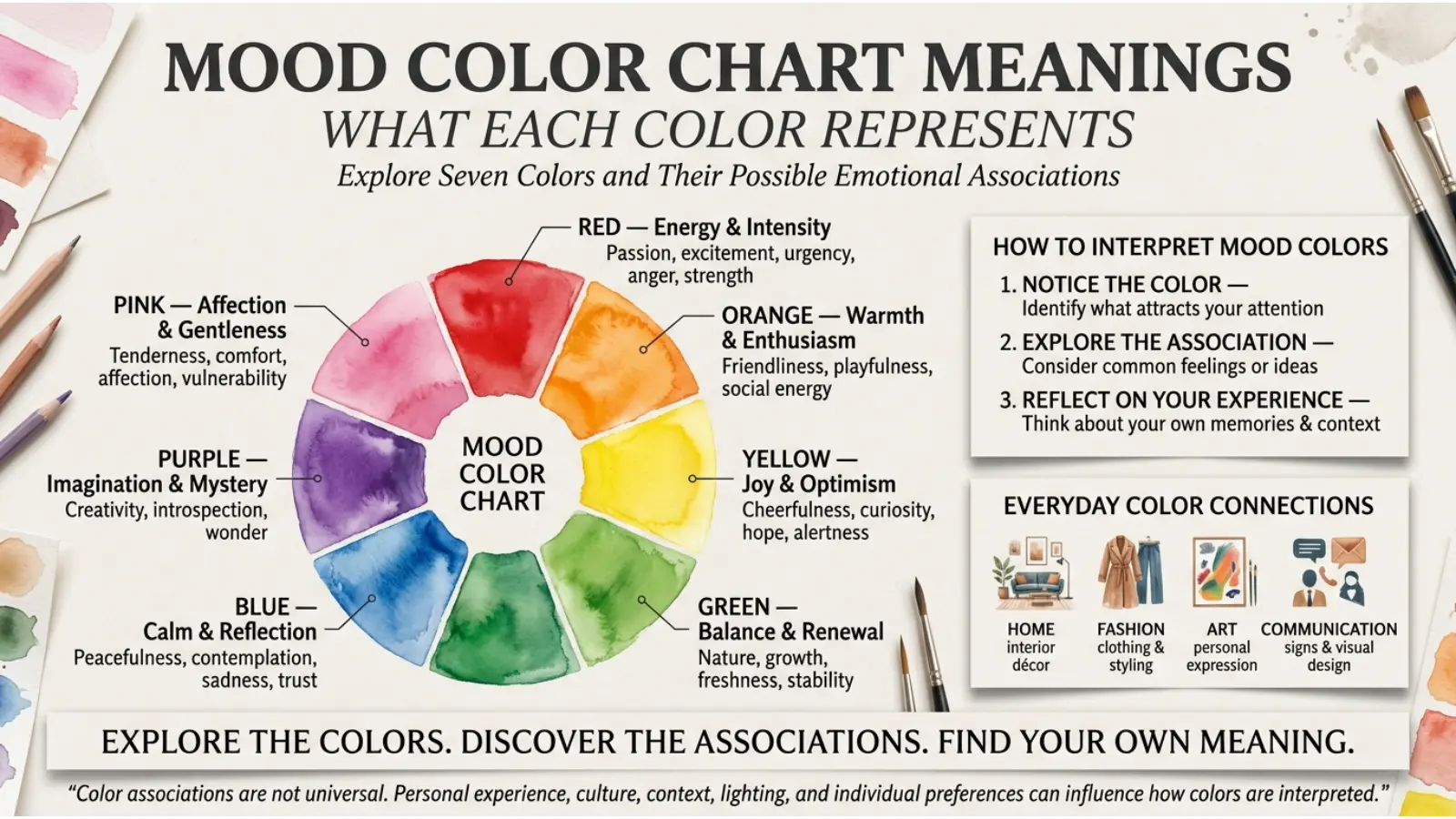
Mood colors are colors associated with common emotions, feelings, and symbolic meanings. Red often represents passion and energy, orange suggests enthusiasm, yellow symbolizes happiness, green represents balance, and blue is associated with calmness or sadness. Purple commonly represents creativity, while pink symbolizes affection. These meanings are general associations rather than scientifically reliable measurements of emotions.
Mood Color Chart Meanings
The following mood color chart provides a quick reference to the feelings and emotional associations commonly linked with different colors.
| Color | Common Mood Meaning | Emotional Associations |
|---|---|---|
| 🔴 Red | Energy and passion | Excitement, anger, love, intensity |
| 🟠 Orange | Enthusiasm | Warmth, creativity, confidence |
| 🟡 Yellow | Happiness | Joy, hope, optimism |
| 🟢 Green | Balance | Harmony, growth, renewal |
| 🔵 Blue | Calmness | Peace, trust, sadness |
| 🟣 Purple | Creativity | Imagination, mystery, reflection |
| 🩷 Pink | Affection | Love, kindness, tenderness |
| 🟤 Brown | Stability | Comfort, reliability, groundedness |
| ⚫ Black | Seriousness | Strength, protection, grief |
| ⚪ White | Fresh beginnings | Clarity, simplicity, peace |
| 🩶 Gray | Neutrality | Uncertainty, quietness, detachment |
| 🩵 Light Blue | Relaxation | Openness, tranquility, gentleness |
| 💚 Light Green | Refreshment | Renewal, ease, natural balance |
| 💜 Lavender | Gentleness | Calmness, sensitivity, imagination |
Remember: This chart describes common symbolic associations. It is not a universal emotional scale, and people may connect the same color with different feelings.
What Does Each Mood Color Mean?
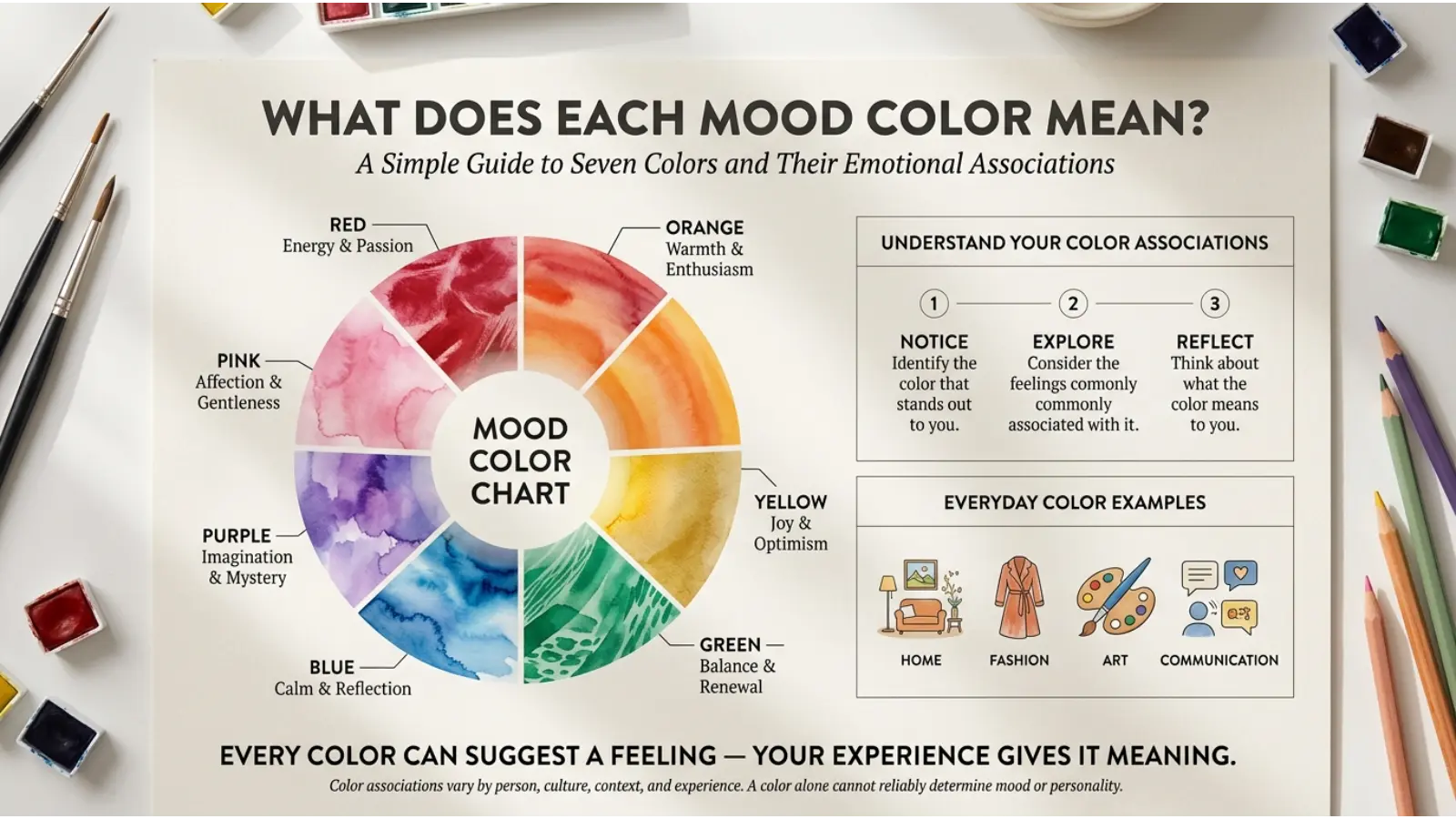
1. Red: Passion, Energy, and Anger
Red is one of the most noticeable colors and is often associated with strong emotions. It can symbolize love, excitement, courage, anger, or determination. Because red is visually intense, it is frequently used to attract attention and communicate urgency.
In a personal mood chart, red might represent a day when you feel highly motivated, excited, frustrated, or emotionally overwhelmed. The specific meaning depends on your experience.
Common associations of red:
- Passion and romantic love
- Energy and excitement
- Anger and frustration
- Courage and determination
- Urgency and intensity
Red does not always represent anger. A person may choose it because it reminds them of love, celebration, confidence, or a favorite memory.
2. Orange: Enthusiasm, Warmth, and Creativity
Orange combines the visual qualities of red and yellow, making it commonly associated with enthusiasm, warmth, and friendliness. It can suggest a lively, social, or adventurous mood.
Orange is also used in creative environments and branding to communicate energy and approachability. In a mood journal, it may represent a period when you feel inspired, optimistic, or ready to take action.
Common associations of orange:
- Enthusiasm and excitement
- Creativity and imagination
- Friendliness and sociability
- Warmth and comfort
- Adventure and confidence
Orange can also feel overwhelming when used excessively in a design. Like other colors, its effect depends on brightness, surrounding colors, and personal preference.
3. Yellow: Happiness, Joy, and Optimism
Yellow is often associated with sunshine, happiness, hope, and positive energy. Its connection with daylight makes it a familiar symbol of warmth and optimism.
In a mood color chart, yellow may represent a cheerful day, a hopeful attitude, or a moment when you feel motivated.
Common associations of yellow:
- Happiness and joy
- Hope and optimism
- Curiosity and learning
- Warmth and friendliness
- Mental alertness
Not everyone experiences yellow as a happy color. Very bright shades may feel intense, and personal memories can influence whether yellow feels comforting or unpleasant.
4. Green: Balance, Growth, and Renewal
Green is strongly associated with plants, forests, and natural environments. Because of these connections, it often symbolizes growth, harmony, renewal, and stability.
In a mood chart, green may represent feeling balanced, comfortable, or refreshed. It can also symbolize progress after a difficult period.
Common associations of green:
- Balance and harmony
- Growth and development
- Renewal and fresh starts
- Nature and environmental awareness
- Stability and comfort
Different shades can suggest different ideas.
Green is not proof that someone is emotionally balanced. It is simply a useful symbol when reflecting on personal experiences.
5. Blue: Calmness, Peace, and Sadness
Blue has several common emotional associations. It may represent peace, trust, relaxation, and reliability, but it is also connected with sadness and melancholy in some expressions and cultural traditions.
Light blue often feels open and gentle, while darker blue may suggest seriousness, confidence, or reflection.
Common associations of blue:
- Calmness and relaxation
- Trust and reliability
- Peace and quietness
- Sadness and melancholy
- Thoughtfulness and reflection
For example, someone might choose blue to describe a peaceful afternoon, while another person may associate it with loneliness. Both interpretations can be meaningful in a personal mood journal.
The important point is that blue does not have one fixed emotional meaning.
6. Purple: Creativity, Mystery, and Imagination
Purple is commonly associated with imagination, individuality, mystery, and luxury. Historically, some purple dyes were expensive to produce, helping establish associations between purple and wealth or status.
In mood tracking, purple may symbolize creative thinking, reflection, or a feeling that is difficult to describe.
Common associations of purple:
- Creativity and imagination
- Mystery and curiosity
- Luxury and elegance
- Reflection and individuality
- Spiritual symbolism in some traditions
Purple also appears in fantasy stories, art, and spiritual practices, where its meaning may differ from everyday color symbolism.
7. Pink: Love, Affection, and Kindness
Pink is often associated with affection, tenderness, care, and gentleness. It can communicate warmth and friendliness in clothing, decoration, and visual design.
In a mood chart, pink might represent feeling loved, supported, peaceful, or emotionally connected to someone.
Common associations of pink:
- Affection and romantic love
- Kindness and compassion
- Gentleness and tenderness
- Comfort and warmth
- Playfulness and sweetness
Different shades can create different impressions.
These associations are not limited to any particular gender. Personal and cultural meanings vary.
8. Brown: Stability, Comfort, and Reliability
Brown is associated with soil, wood, earth, and natural materials. These connections make it a common symbol of stability, practicality, simplicity, and groundedness.
In a mood journal, brown may represent a desire for comfort or a period when you want life to feel steady and predictable.
Common associations of brown:
- Stability and reliability
- Comfort and security
- Nature and earthiness
- Practicality and simplicity
- Warmth and familiarity
Brown can feel cozy in some settings and dull in others. Its effect often depends on the shade and the colors surrounding it.
9. Black: Strength, Protection, and Seriousness
Black has a wide range of meanings. It can symbolize strength, authority, elegance, mystery, grief, or formality.
In a mood color chart, black might represent seriousness, a need for privacy, or a difficult emotional experience. However, some people use black simply because they like its appearance.
Common associations of black:
- Strength and authority
- Elegance and sophistication
- Mystery and privacy
- Grief and mourning
- Seriousness and formality
Black clothing, for example, can communicate confidence or personal style without indicating sadness.
Never assume that someone is experiencing a negative emotion simply because they prefer black.
10. White: Peace, Clarity, and Fresh Beginnings
White is often associated with cleanliness, simplicity, peace, and new beginnings. It can create a sense of openness in visual design and is frequently used to represent a fresh start.
In a mood chart, white may symbolize clarity, a desire for simplicity, or a feeling of starting over.
Common associations of white:
- Peace and simplicity
- Cleanliness and clarity
- Fresh beginnings
- Openness and minimalism
- Innocence in some traditions
White also has different cultural meanings.
Its meaning depends on the cultural and personal context.
11. Gray: Neutrality, Uncertainty, and Quietness
Gray sits between black and white and is often associated with neutrality, subtlety, seriousness, and uncertainty.
Someone using a personal mood chart might select gray when they feel neutral, tired, emotionally distant, or unsure how to describe their day. However, the color itself cannot establish any of these conditions.
Common associations of gray:
- Neutrality and balance
- Uncertainty and indecision
- Quietness and restraint
- Seriousness and practicality
- Emotional distance in some contexts
Light gray may feel subtle and peaceful, while dark gray can appear more formal or heavy.
12. Light Blue: Relaxation and Openness
Light blue is a softer shade of blue that is commonly associated with calmness, openness, gentleness, and tranquility.
It may be useful in a personal mood chart to represent a quiet, comfortable, or relaxed moment.
Common associations of light blue:
- Relaxation
- Openness
- Gentleness
- Peacefulness
- Clear communication
These are symbolic associations rather than reliable indicators of someone’s emotional state.
13. Light Green: Refreshment and Natural Balance
Light green often suggests new growth, freshness, and renewal. It is commonly associated with young leaves, springtime, and natural environments.
In personal color tracking, it might represent a feeling of renewal or a small positive change.
Common associations of light green:
- Freshness and renewal
- Natural balance
- Growth and progress
- Comfort and ease
- New opportunities
The meaning can change with the shade. Pale green may feel soft and refreshing, while vivid green can appear energetic.
14. Lavender: Gentleness and Reflection
Lavender is a light purple shade commonly associated with softness, imagination, calmness, and elegance.
In a mood chart, it may represent a quiet moment, creative reflection, or a desire for a gentle atmosphere.
Common associations of lavender:
- Gentleness and softness
- Calmness and relaxation
- Imagination and creativity
- Reflection and sensitivity
- Elegance and grace
Mood Color Chart Meanings by Emotional Category
Looking at colors by emotional category can make a mood chart easier to understand. The following table groups colors by common associations, not by scientifically established emotional measurements.
| Emotional Category | Commonly Associated Colors | Typical Symbolic Meaning |
|---|---|---|
| Happiness | Yellow, orange, pink | Joy, warmth, enthusiasm |
| Calmness | Blue, green, lavender | Peace, relaxation, balance |
| Energy | Red, orange, bright yellow | Action, excitement, motivation |
| Love | Red, pink | Passion, affection, closeness |
| Sadness | Blue, gray, black | Melancholy, heaviness, reflection |
| Creativity | Purple, orange, yellow | Imagination, originality, curiosity |
| Stability | Green, brown, dark blue | Reliability, security, balance |
| Mystery | Purple, black | Privacy, the unknown, imagination |
| Fresh beginnings | White, light green | Clarity, renewal, simplicity |
| Neutral feelings | Gray, white | Neutrality, quietness, openness |
One color may belong to several categories because emotions are complex. Blue, for example, can symbolize both peacefulness and sadness.
How Mood Color Charts Work
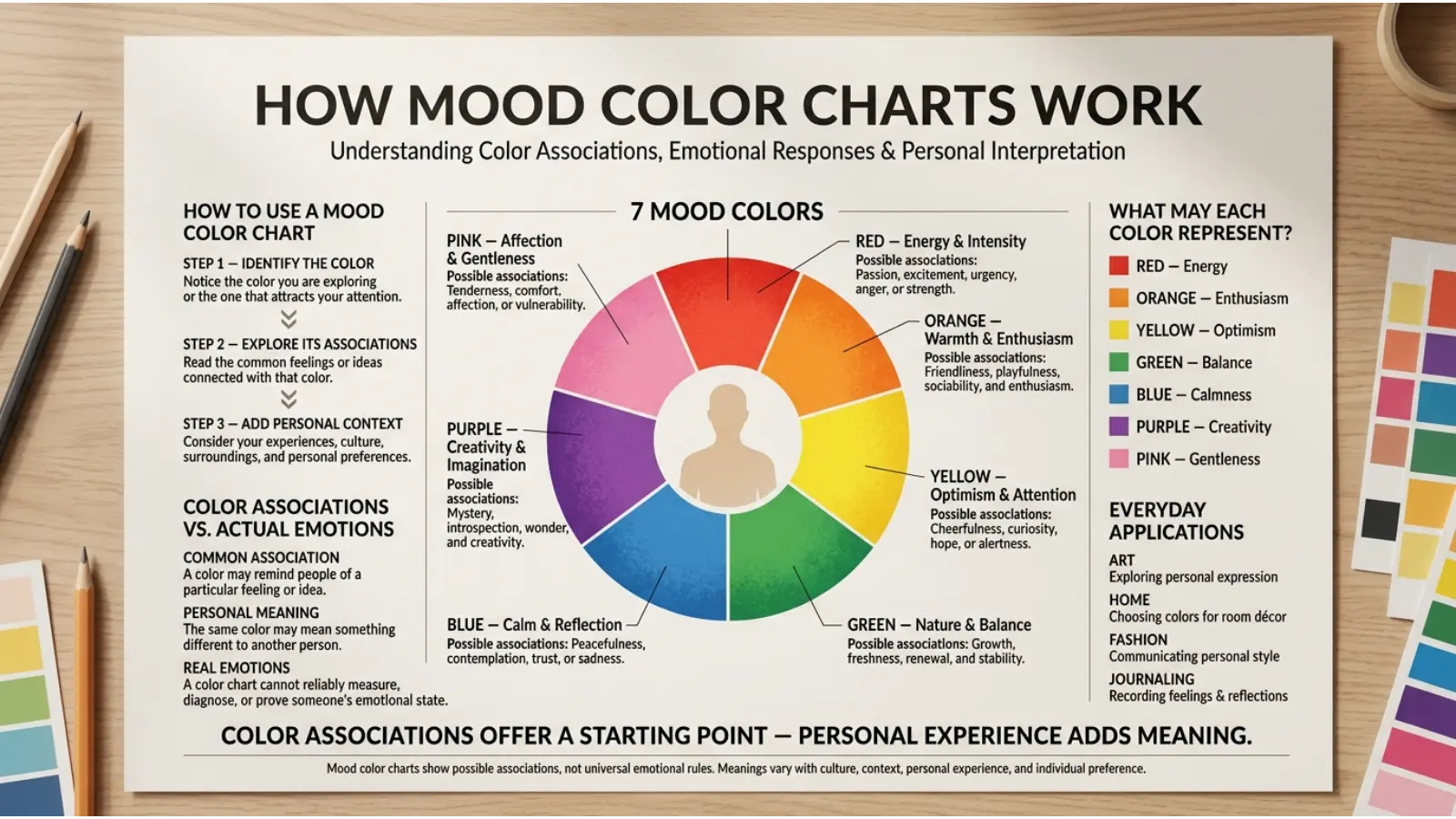
A mood color chart connects a selected color with an emotion or symbolic meaning. People use these charts in different ways, depending on their goals.
Mood Journals and Trackers
In a mood journal, you can assign a color to each emotional state and use it to record your experiences. At the end of a week, the colors may help you remember how you described different days.
For example, you could use yellow for happiness, green for balance, and blue for calmness. You can also create your own meanings instead of following a standard chart.
Classroom and Art Activities
Teachers and parents sometimes use color activities to encourage children to discuss feelings. A child might choose a color to represent how their day felt and then explain the choice in their own words.
The conversation is more important than the color itself.
Mood Rings
Mood rings are jewelry items that change color as their temperature-sensitive materials respond to changes in temperature. Traditional mood-ring charts assign emotional meanings to these colors.
However, the ring measures temperature-related changes, not emotions directly. Skin temperature can change because of the surrounding environment and other physical factors.
Art and Creative Expression
Artists may use color to communicate a feeling, atmosphere, or idea. A painting dominated by blue might feel peaceful or melancholy, depending on its subject, composition, and shade.
Art can help people express experiences that are difficult to describe with words, but the meaning of a color remains open to interpretation.
Mood Ring Color Chart Meanings
Mood ring color charts are related to mood color charts, but they are not exactly the same. A general color-symbolism chart connects colors with common associations, while a mood ring chart interprets the colors displayed by a temperature-sensitive ring.
Here is a simplified example of common mood-ring interpretations. Actual charts vary by manufacturer, and the color produced depends on the specific ring.
| Mood Ring Color | Common Traditional Interpretation |
|---|---|
| Black | Tension, discomfort, or a cold ring |
| Dark blue | Calmness or relaxation |
| Blue | Peacefulness or a positive mood |
| Green | Average or balanced mood |
| Yellow | Nervousness or mixed feelings |
| Orange | Restlessness or excitement |
| Red | Energy or strong feelings |
| Purple | Passion or heightened emotion |
These interpretations are not standardized. One manufacturer’s chart may assign different meanings to the same color.
Important distinction: A mood ring’s color is affected by temperature, so it cannot reliably identify anger, happiness, stress, love, or any other specific emotion.
What Is the Difference Between Light and Dark Mood Colors?
The shade of a color can change the impression it creates. Light shades are often described as softer or more delicate, while dark shades may appear more serious, intense, or formal.
| Color Family | Light Shade Association | Dark Shade Association |
|---|---|---|
| Red | Warmth, tenderness | Passion, intensity |
| Blue | Openness, calmness | Seriousness, depth |
| Green | Freshness, renewal | Stability, richness |
| Purple | Gentleness, softness | Mystery, luxury |
| Pink | Sweetness, tenderness | Confidence, boldness |
| Gray | Subtlety, quietness | Formality, heaviness |
These are common design and symbolic impressions, not fixed rules. A dark blue room, for example, may feel comforting to one person and gloomy to another.
Mood Color Meanings in Psychology
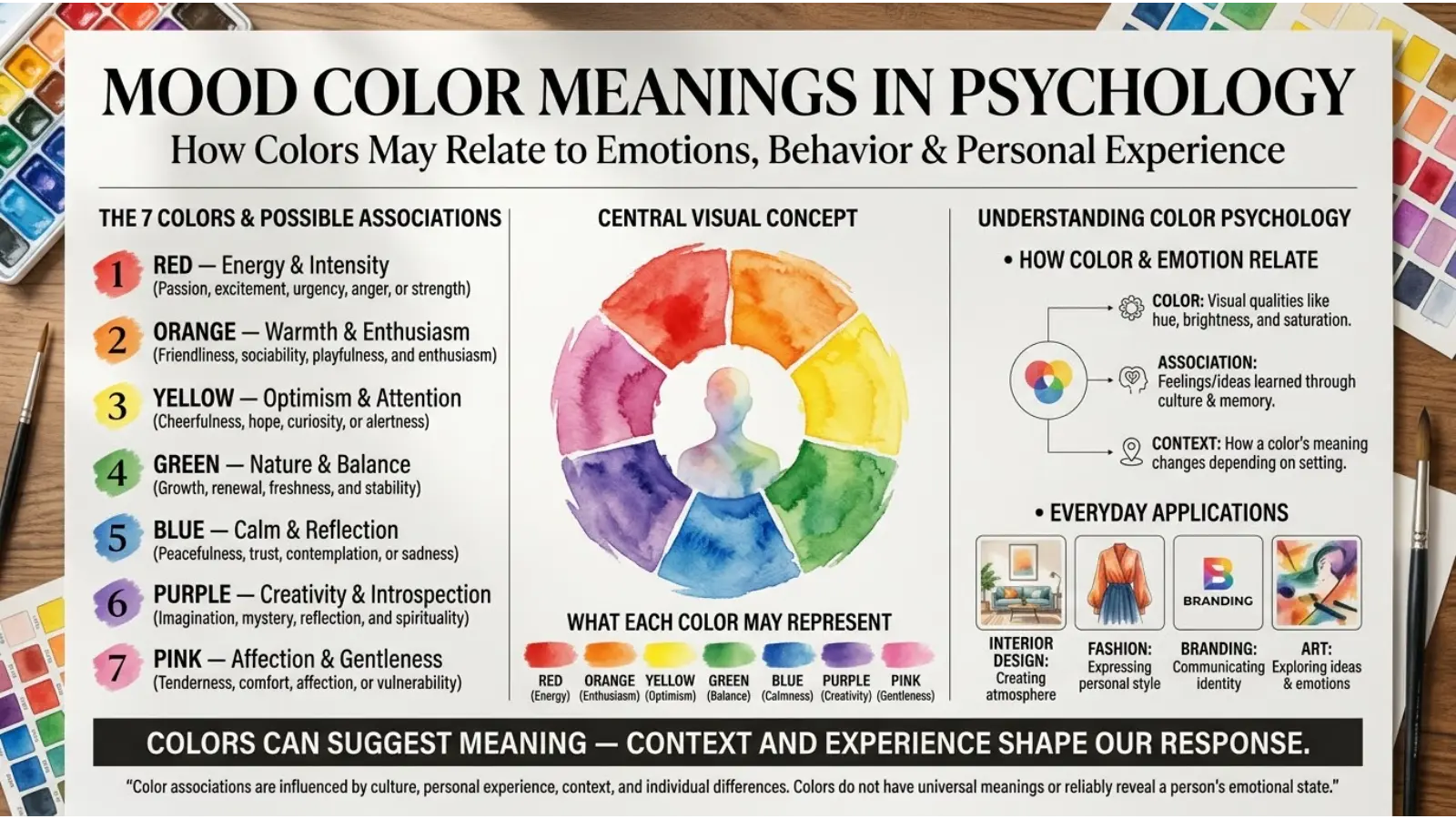
Color psychology explores how people perceive colors and how colors may influence attention, judgments, preferences, and emotional responses.
However, it is important to distinguish between a common color association and a proven psychological effect. The fact that people frequently connect yellow with happiness does not mean every person who sees yellow will become happy.
Several factors can influence a person’s response to color:
Personal experience: Someone may associate a color with a loved one, an important event, or a memorable place.
Culture: Colors can carry different meanings across societies, ceremonies, and traditions.
Context: A color used in a hospital, a celebration, a warning sign, or a bedroom may communicate different things.
Shade and brightness: A pale shade may create a different impression from a vivid or dark version of the same color.
Color combinations: Surrounding colors can change how a particular shade appears and feels.
For these reasons, mood color charts are best used as tools for reflection and communication rather than as psychological tests.
Cultural and Spiritual Interpretations of Mood Colors
Color symbolism also appears in cultural traditions, religious practices, spiritual systems, ceremonies, and works of art. These meanings can differ significantly depending on the tradition.
For example, white may symbolize purity or celebration in one setting and mourning in another. Purple may represent royalty in a historical context and spirituality in a particular symbolic system.
Green may be connected with nature, renewal, or religious symbolism, while red can represent celebration, danger, love, or power.
There is no single spiritual meaning that applies to every person or culture. When exploring a spiritual interpretation, it is important to identify the specific tradition rather than treating all interpretations as universal.
A mood color chart can include personal spiritual associations if they are meaningful to the person using it. Those interpretations should remain distinct from scientific claims about emotion.
How to Create Your Own Mood Color Chart
Creating a personal mood color chart is simple. The goal is to build a system that helps you describe your experiences, not to follow someone else’s definitions perfectly.
Step 1: Choose Your Colors
Start with a small group of colors, such as red, yellow, green, blue, purple, and gray. Add more colors if you find them useful.
Step 2: Assign Personal Meanings
Choose a feeling or experience for each color. For example, yellow might represent happiness, while blue could represent calmness.
You can follow common color associations or choose meanings based on your own memories and preferences.
Step 3: Record Your Mood
Select the color that best represents how you feel at a particular moment. Add a short note explaining why you chose it.
Step 4: Review Your Entries
After a week or a month, look back at your records. You may notice recurring experiences or discover that certain colors have personal meanings different from common interpretations.
Step 5: Change the Chart When Needed
Your personal color meanings do not have to remain the same forever. If a color no longer represents a feeling accurately, update your chart.
Consistency can help you compare entries, but flexibility allows the chart to remain useful.
Common Mistakes When Interpreting Mood Colors
Mood color charts can be useful, but several misunderstandings can limit their value.
Assuming one color has only one meaning: Blue can represent calmness, trust, sadness, or reflection. Context matters.
Treating a color as a diagnosis: Choosing gray does not prove that someone is depressed, and choosing red does not prove that they are angry.
Confusing mood rings with emotional tests: Mood rings respond to temperature-related changes rather than directly measuring emotions.
Ignoring personal associations: A color that feels cheerful to one person may remind someone else of an unpleasant experience.
Treating cultural symbolism as universal: The same color can communicate different meanings across traditions and situations.
A better approach is to use colors as conversation starters. Ask what a color means to the person who chose it instead of assuming you already know.
Frequently Asked Questions About Mood Color Chart Meanings
1. What is a mood color chart?
A mood color chart is a reference that connects colors with commonly associated emotions, feelings, or symbolic meanings. It is used in journaling, creative activities, mood rings, and personal reflection.
2. What color represents happiness?
Yellow is commonly associated with happiness, joy, sunshine, and optimism. Orange and pink may also represent positive feelings, warmth, and affection.
3. What color represents sadness?
Blue is often associated with sadness or melancholy, while gray and black may symbolize emotional heaviness or grief. These are general associations and do not reveal someone’s actual emotional condition.
4. What color represents anger?
Red is commonly associated with anger, passion, intensity, and strong emotions. However, a person may also connect red with love, confidence, or excitement.
5. What color represents calmness?
Blue, green, and lavender are frequently associated with calmness, relaxation, and peace. Personal preferences and context influence how these colors are experienced.
6. What does green mean on a mood chart?
Green often symbolizes balance, harmony, growth, and renewal. In a personal mood chart, it may represent feeling comfortable or refreshed.
7. What does purple mean on a mood chart?
Purple commonly represents creativity, mystery, imagination, and reflection. In some cultural or spiritual traditions, it has additional symbolic meanings.
8. What does black mean on a mood color chart?
Black can symbolize seriousness, strength, privacy, elegance, or grief. Its meaning depends on context and personal associations.
9. Are mood color chart meanings scientifically accurate?
Mood color charts are not standardized psychological tests. Although color perception and emotional associations are studied in psychology, a color alone cannot reliably determine a person’s emotional state.
10. Can I use a mood color chart every day?
Yes. You can use a personal chart in a journal, planner, or mood tracker to record feelings and reflect on daily experiences. It works best when you explain your color choices in your own words.
Conclusion
Mood color chart meanings offer an accessible way to explore how colors are associated with emotions, memories, and personal experiences. Red commonly symbolizes passion and energy, yellow represents happiness, green suggests balance, and blue can communicate either calmness or sadness. Purple, pink, brown, black, white, and gray also carry a variety of symbolic associations.
The most useful mood color chart is one that helps you express what you feel rather than one that tells you what you should feel. Use common meanings as a guide, consider your own experiences, and remember that no color can reveal someone’s emotions with certainty.

Emma Wilson is a dedicated comparison writer and product researcher at ColorMystiic.com. She specializes in creating unbiased product comparisons, detailed reviews, and helpful buying guides. Her goal is to help readers make smarter purchasing decisions with confidence.