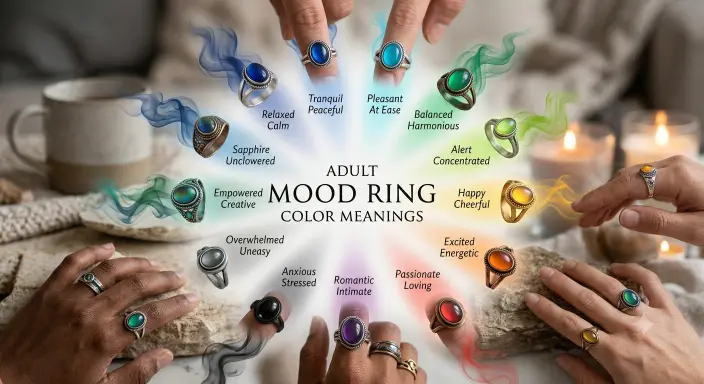
Mood rings have fascinated people for decades because they seem to reveal hidden emotions through changing colors. While many people see them as fun accessories, others are curious about the deeper symbolism behind each shade. That curiosity is exactly why mood ring color meanings for adults remain a popular topic.
The truth is that mood rings combine science, symbolism, and personal interpretation. Their colors change mainly because of temperature-sensitive liquid crystals inside the ring. However, over time, people have connected each color with specific emotions, personality traits, and even spiritual ideas.
This guide explains what each mood ring color may represent, how mood rings actually work, why interpretations vary, and how adults can use them as tools for self-reflection rather than scientific emotion detectors.
Quick Answer:
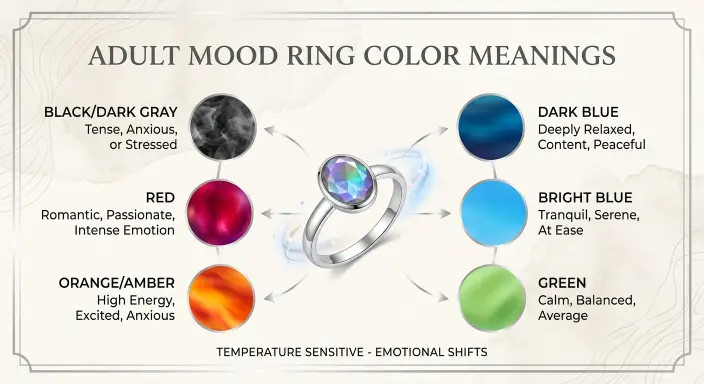
Mood ring color meanings for adults are symbolic interpretations based on the ring’s temperature-sensitive color changes. Blue often represents calmness, green suggests balance, black may indicate cold temperatures or stress, while warmer colors like amber or red are commonly linked to excitement or heightened emotions. Although mood rings are based on temperature changes, many people use their colors as prompts for emotional awareness.
What Is a Mood Ring?
A mood ring is jewelry that contains a special thermochromic liquid crystal. These crystals react to small temperature changes on your finger. As your skin temperature changes, the crystals reflect different wavelengths of light, causing the ring to display different colors.
Your finger temperature can change because of:
- Emotional responses
- Blood circulation
- Weather
- Physical activity
- Stress
- Illness
- Room temperature
Therefore, mood rings do not directly measure emotions. Instead, they respond to physical temperature changes that sometimes accompany emotional states.
How Mood Rings Work
The science behind mood rings is surprisingly simple.
Inside the stone is a layer of liquid crystals that twist differently depending on temperature. This twisting changes how light reflects from the surface, creating different colors.
For example:
- Warmer fingers usually produce blue or green shades.
- Cooler fingers often display black, gray, or brown.
- Intermediate temperatures create purple, amber, or yellow.
Because body temperature changes throughout the day, your mood ring may shift colors frequently.
Mood Ring Color Meanings for Adults
Black Mood Ring Meaning
Black is one of the most misunderstood mood ring colors.
Common symbolic meanings
- Stress
- Fatigue
- Emotional overload
- Anxiety
- Physical coldness
- Low energy
However, black usually appears simply because the ring has become too cold to display other colors.
For adults, black can also serve as a reminder to check in with themselves:
- Have you been sleeping enough?
- Are you feeling overwhelmed?
- Is your environment unusually cold?
Rather than predicting emotions, the color encourages awareness.
Blue Mood Ring Meaning
Blue is often considered the ideal mood ring color.
It commonly represents:
- Calmness
- Emotional stability
- Relaxation
- Confidence
- Peace
- Comfort
When your finger is comfortably warm, blue frequently appears because blood circulation is stable.
Many people associate blue with:
- Clear thinking
- Emotional balance
- Trust
- Inner peace
Psychologically, blue has long been connected with calm environments and reduced feelings of tension.
Dark Blue Mood Ring Meaning
A darker blue often symbolizes:
- Deep relaxation
- Confidence
- Emotional security
- Satisfaction
Some mood ring charts interpret dark blue as happiness combined with mental clarity.
Although interpretations differ, darker blue generally carries positive symbolism.
Green Mood Ring Meaning
Green usually represents balance.
It is commonly associated with:
- Stability
- Growth
- Optimism
- Patience
- Adaptability
Adults often view green as a sign that life feels manageable. Instead of intense excitement or sadness, green suggests emotional equilibrium.
Green also symbolizes renewal in many cultures, making it one of the most universally positive mood ring colors.
Purple Mood Ring Meaning
Purple combines the calmness of blue with the energy of warmer colors.
It may symbolize:
- Creativity
- Imagination
- Curiosity
- Romance
- Inspiration
Some people also associate purple with intuition and personal insight.
Because purple appears between temperature ranges, it is sometimes interpreted as emotional openness or thoughtful reflection.
Pink Mood Ring Meaning
Pink often represents:
- Affection
- Love
- Kindness
- Compassion
- Joy
- Friendship
Many adults associate pink with emotional warmth rather than romantic love alone.
Depending on the mood ring manufacturer, pink may also indicate excitement or playful energy.
Amber or Yellow Mood Ring Meaning
Yellow and amber shades often suggest increased mental activity.
Possible interpretations include:
- Curiosity
- Alertness
- Excitement
- Nervousness
- Restlessness
Unlike blue or green, yellow can represent both positive enthusiasm and mild anxiety.
Context matters greatly.
For example:
- During a creative project, yellow may reflect excitement.
- Before an important meeting, it could symbolize nervous anticipation.
Orange Mood Ring Meaning
Orange usually represents high energy.
It is often linked with:
- Ambition
- Motivation
- Adventure
- Confidence
- Enthusiasm
However, some charts also connect orange with emotional intensity or impatience.
Adults may interpret orange as motivation to take action while remaining mindful of impulsive decisions.
Red Mood Ring Meaning
Red generally symbolizes powerful emotions.
It may indicate:
- Passion
- Excitement
- Determination
- Physical energy
- Strong emotional responses
Because increased blood flow can warm the fingers, red may appear during exercise or emotional excitement.
Nevertheless, it does not automatically mean anger.
Brown Mood Ring Meaning
Brown is less common but may symbolize:
- Uncertainty
- Fatigue
- Rest
- Transition
Some mood ring guides interpret brown as confusion or emotional hesitation.
Scientifically, however, it often reflects a cooler temperature range.
Gray Mood Ring Meaning
Gray usually represents neutrality.
Possible meanings include:
- Emotional exhaustion
- Low energy
- Reflection
- Indifference
Like black, gray often appears because of lower temperatures rather than emotional changes alone.
Mood Ring Color Chart
| Color | Common Meaning |
|---|---|
| Black | Cold, stress, low energy |
| Gray | Neutral, tired, reflective |
| Brown | Uncertainty, transition |
| Amber | Alert, curious, nervous |
| Yellow | Excited, mentally active |
| Orange | Motivated, energetic |
| Red | Passion, excitement |
| Pink | Affection, happiness |
| Green | Balance, growth |
| Blue | Calm, relaxed |
| Dark Blue | Confidence, emotional stability |
| Purple | Creativity, intuition |
The Psychology Behind Mood Ring Colors
Although mood rings do not scientifically detect emotions, many of their color associations overlap with established color psychology.
For example:
- Blue environments often feel calming.
- Green is frequently associated with nature and restoration.
- Red tends to attract attention and increase emotional intensity.
- Yellow can stimulate alertness.
These psychological associations likely influenced how mood ring color charts developed over time.
However, researchers continue to debate how strongly colors influence emotions because personal experiences and culture also shape perception.
Can Mood Rings Really Tell Your Mood?
The short answer is no—not directly.
Mood rings measure temperature, not emotions.
Still, emotions sometimes affect body temperature through changes in blood flow.
For example:
- Anxiety may cool your fingers.
- Relaxation may warm them.
- Exercise raises body temperature.
- Cold weather lowers finger temperature.
As a result, mood rings sometimes appear surprisingly accurate.
Think of them as indirect indicators rather than emotional detectors.
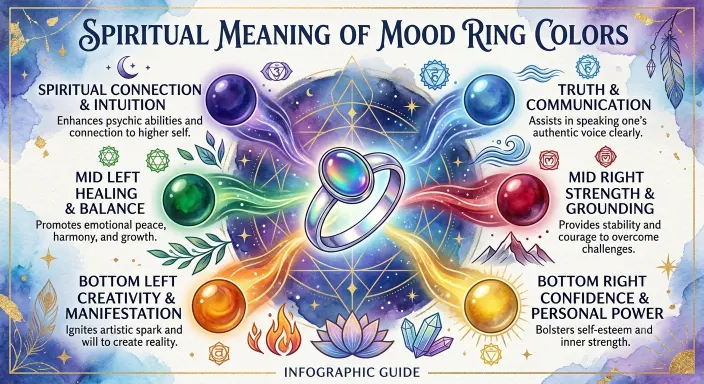
Spiritual Meaning of Mood Ring Colors
Many people enjoy assigning spiritual symbolism to mood ring colors, although these interpretations vary widely and are not tied to any single religion.
Common symbolic ideas include:
- Blue: Inner peace
- Green: Healing and renewal
- Purple: Wisdom and intuition
- Pink: Compassion
- Red: Life force and courage
- Yellow: Personal growth
- Black: Protection or introspection
These meanings come from modern spiritual traditions rather than scientific evidence.
Cultural Perspectives on Color Meanings
Color meanings differ around the world.
For instance:
- Blue often symbolizes trust in many Western countries.
- Red represents luck and celebration in much of East Asia.
- White may symbolize purity in some cultures but mourning in others.
- Green can represent nature, prosperity, or spiritual significance depending on the region.
Because mood ring charts are largely Western inventions, their interpretations may not match every cultural tradition.
Personality Associations
People sometimes wonder whether their favorite mood ring color reflects their personality.
While color preferences can reveal temporary tastes or emotional connections, they do not determine personality.
That said, common associations include:
- Blue lovers may value peace.
- Green enthusiasts often appreciate balance.
- Purple fans may enjoy creativity.
- Red admirers frequently like excitement.
- Pink supporters may value kindness.
These are broad tendencies rather than scientific personality assessments.
Mood Rings in Fashion
Today, mood rings have become stylish accessories rather than novelty toys.
Adults often wear them because they:
- Start conversations.
- Add vintage appeal.
- Complement casual outfits.
- Encourage mindfulness.
- Express individuality.
Modern mood rings are available in silver, gold, stainless steel, and minimalist designs that suit professional wardrobes as well as everyday fashion.
Everyday Uses Beyond Fashion
Many adults use mood rings as personal reminders rather than emotion readers.
For example, a changing color may encourage someone to pause and ask:
- Am I stressed?
- Have I been sitting too long?
- Is the room too cold?
- Do I need a break?
In this way, the ring becomes a mindfulness tool instead of a scientific device.
Common Misconceptions About Mood Rings
Mood rings can read minds
False.
They only respond to temperature.
Every brand uses the same color chart
No.
Manufacturers often assign different meanings to identical colors.
Black always means anger
Not necessarily.
Most often, it simply means the ring is cold.
Mood rings are scientifically proven emotion detectors
No.
There is no scientific evidence that mood rings can accurately identify emotions.
Practical Tips for Reading Your Mood Ring
- Wear the ring indoors for more consistent readings.
- Remember that weather affects color.
- Consider your activity level.
- Compare color changes over time instead of relying on a single reading.
- Treat the meanings as reflective prompts, not diagnoses.
Frequently Asked Questions
What is the happiest mood ring color?
Blue and dark blue are usually considered the happiest colors because they represent calmness, confidence, and emotional comfort.
Why does my mood ring stay black?
The ring may be too cold, damaged, or exposed to low temperatures for an extended period.
Is a green mood ring good?
Yes. Green commonly symbolizes balance, stability, and emotional harmony.
What does purple mean on a mood ring?
Purple is often linked with creativity, imagination, curiosity, and intuition.
Do mood ring colors mean the same thing for everyone?
No. Manufacturers use different color charts, and personal interpretation also varies.
Can mood rings predict emotions?
No. They react to skin temperature, which may sometimes change alongside emotions.
Why does my mood ring change colors quickly?
Your body temperature naturally changes throughout the day due to activity, stress, weather, and circulation.
Are mood rings accurate?
They accurately detect temperature changes but cannot accurately identify specific emotions.
Do expensive mood rings work better?
Higher-quality mood rings may last longer and display clearer colors, but they operate using the same basic thermochromic technology.
Can adults wear mood rings?
Absolutely. Many adults enjoy mood rings as fashionable accessories, nostalgic jewelry, or conversation starters.
Final Thoughts
Mood ring color meanings for adults blend science with symbolism in a unique way. The colors themselves come from temperature-sensitive crystals, while the meanings come from decades of cultural interpretation, color psychology, and personal reflection.
Instead of viewing a mood ring as an emotion detector, think of it as a gentle reminder to pay attention to your physical and emotional state.
Used this way, it becomes more than a nostalgic accessory—it becomes a small prompt to notice how you feel and how your environment may be influencing you.
Emma Wilson is a dedicated comparison writer and product researcher at ColorMystiic.com. She specializes in creating unbiased product comparisons, detailed reviews, and helpful buying guides. Her goal is to help readers make smarter purchasing decisions with confidence.