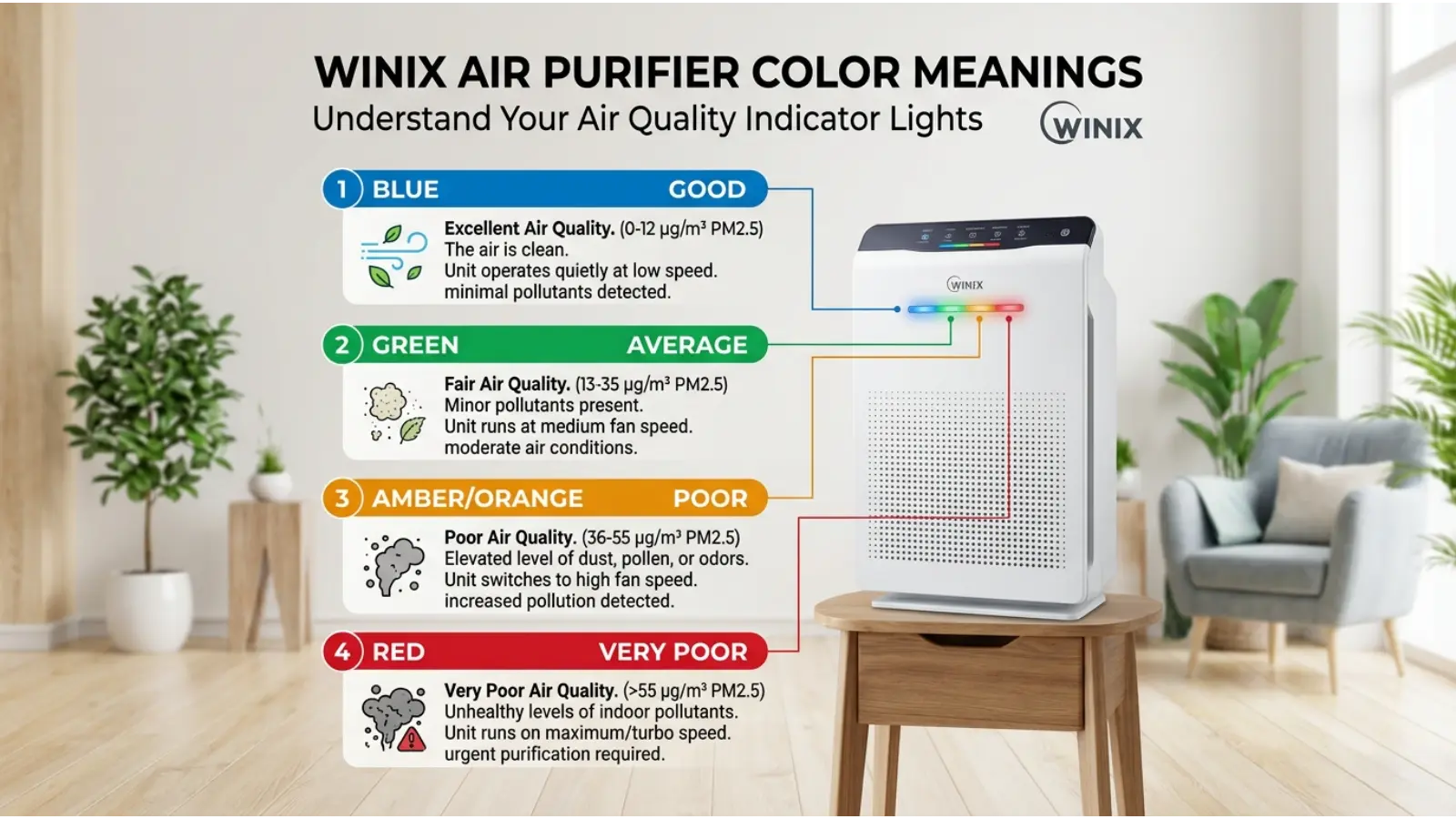
If you have a Winix air purifier, you may have noticed its air quality light changing from blue to amber or red during the day. These colors are not simply decorative. They are part of the purifier’s air-quality monitoring system and are designed to give you a quick visual idea of what its sensors are detecting.Understanding Winix air purifier color meanings can help you know when indoor air is relatively clean, when pollution has increased, and when the purifier may need to work harder.
However, the exact color system can vary by model. Most Winix models use three colors, while some newer models use four.
This guide explains what each color means, how Winix sensors use these readings, why the light can suddenly change, and how to interpret the colors in everyday situations.
Quick Answer: What Do Winix Air Purifier Colors Mean?
For most Winix air purifiers:
| Winix Light Color | Air Quality Meaning | What It Usually Indicates |
|---|---|---|
| 🔵 Blue | Good | Relatively clean indoor air |
| 🟠 Amber/Orange | Fair | Moderate level of detected pollution |
| 🔴 Red | Poor | Higher level of detected pollution |
Some four-color Winix models add green:
| Color | Meaning on Four-Color Models |
|---|---|
| 🔵 Blue | Excellent |
| 🟢 Green | Good |
| 🟠 Amber | Fair |
| 🔴 Red | Poor |
Winix states that its Air Quality Indicator uses smart sensors to monitor indoor air and display the result through color-coded LEDs. However, color meanings can differ between models, so your specific owner’s manual should be treated as the final reference.
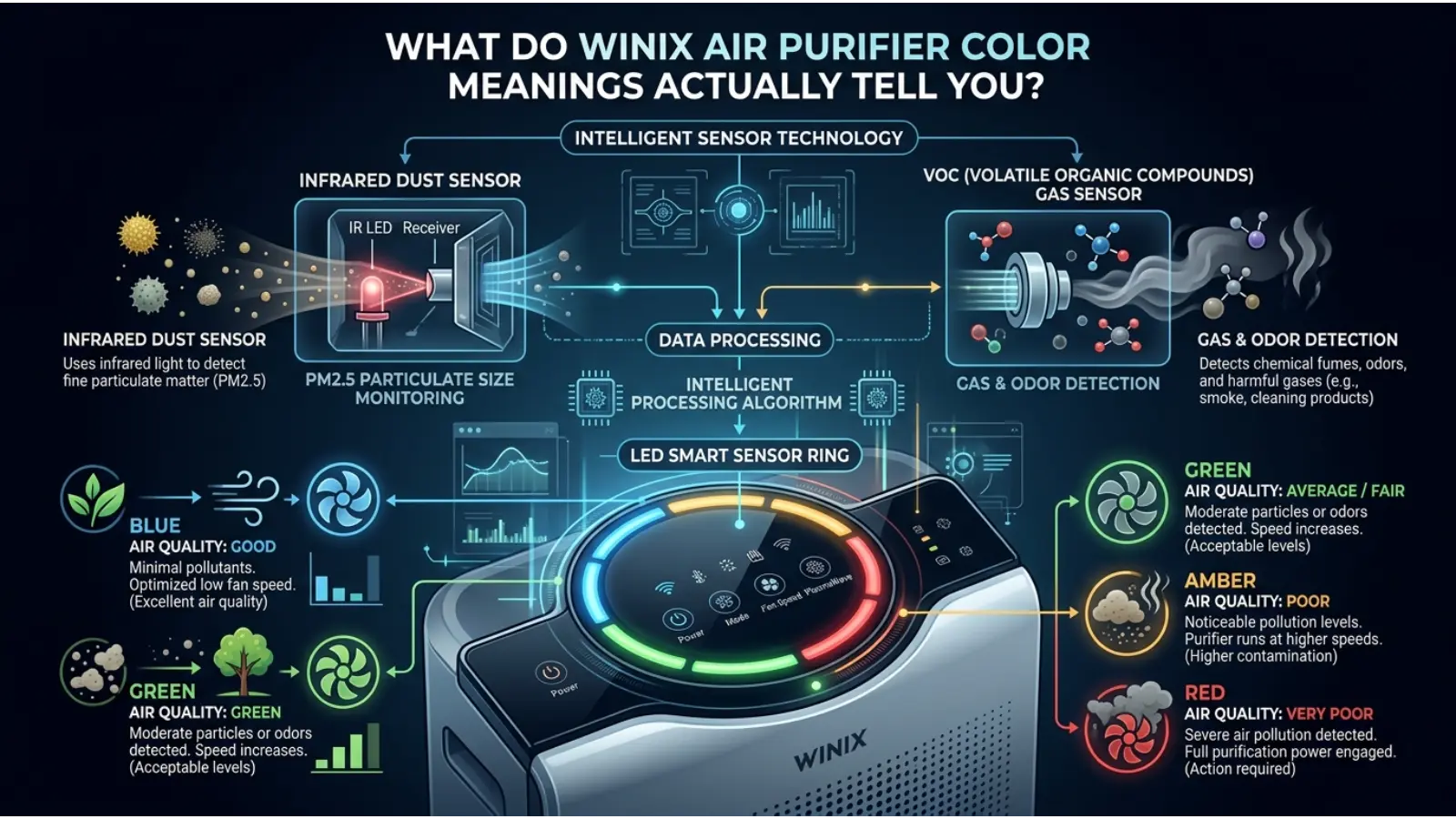
What Do Winix Air Purifier Color Meanings Actually Tell You?
The first thing to understand is that the light is an air-quality indicator, not a general health meter.
The purifier’s sensors detect certain airborne pollutants or gases, depending on the model. The system then uses those readings to determine an air-quality level and displays that level through the LED.
Therefore, a red light does not mean that your room is dangerous. Likewise, blue does not mean that every possible pollutant has disappeared.
Instead, think of the colors as a quick dashboard for the purifier’s sensor readings.
This distinction matters because indoor air contains many different substances. A purifier may respond strongly to particles, smoke, odors, or gases while being unable to detect every pollutant in the room.
Blue: Good Air Quality
Blue generally represents good air quality on standard three-color Winix models.
When the light is blue, the purifier’s sensors are detecting relatively low levels of the pollutants or gases they monitor.
For example, your purifier may remain blue when:
- The room has been cleaned.
- Windows have been closed during outdoor pollution.
- Cooking has stopped.
- Smoke is absent.
- Dust levels are relatively low.
- The purifier has been running for some time.
Blue is therefore the color most people want to see during normal operation.
However, blue should not be interpreted as a guarantee that the room contains no pollutants.
Amber or Orange: Fair Air Quality
Amber, often described as orange, indicates fair air quality on most three-color Winix systems.
This usually means the sensor has detected more contamination than it considers good.
You might notice amber after:
- Cooking food
- Frying
- Vacuuming
- Dusting
- Opening windows
- Using certain household products
- Bringing dust into the room
- Increased activity around pets
An amber light is not necessarily a reason to panic.
Instead, it is a useful reminder that the indoor environment has changed and the purifier is responding to that change.
Red: Poor Air Quality
Red indicates poor air quality according to the purifier’s sensor system.
This can happen when the purifier detects a significant increase in the types of particles or gases its sensors monitor.
Common triggers may include:
- Cooking smoke
- Burned food
- Cigarette smoke
- Heavy dust
- Strong odors
- Aerosol products
- Other airborne contaminants
When Auto Mode is available, the purifier can respond by increasing fan speed as the detected air pollution rises.
That makes the red indicator particularly useful: you can see the change while the machine works to reduce the detected pollution.
Winix Air Purifier Color Chart
Here is a simple Winix air purifier color meanings chart for quick reference.
| Color | Standard Meaning | Typical Interpretation | What You Can Do |
|---|---|---|---|
| 🔵 Blue | Good | Low detected pollution | Continue normal operation |
| 🟠 Amber/Orange | Fair | Moderate detected pollution | Let the purifier continue running |
| 🔴 Red | Poor | Higher detected pollution | Check for pollution sources and allow purification |
| 🟢 Green* | Good | Good air quality | Continue normal operation |
*Green is used on certain four-color Winix models rather than on the standard three-color system.
One important detail is that four-color models can use blue differently. For example, Winix’s XQ system uses blue for excellent and green for good, while its standard three-color system uses blue for good.
Why Does My Winix Air Purifier Change Color?
A changing light usually means the purifier’s sensors have detected a change in the indoor environment.
This is one of the most useful features of the system because indoor air quality is not constant.
Imagine cooking dinner.
Before cooking, your purifier may show blue. Once you begin frying food, airborne particles or gases can increase. The indicator may change to amber or red.
After cooking stops and the purifier continues filtering the room, the light may gradually return toward blue.
This real-time response is why the color should be viewed as a moving measurement, rather than a permanent rating of your home.
Real-Time Example: Why a Winix Light Turns Red
Consider a simple evening example.
At 6:00 p.m., your Winix purifier is running in the living room and shows blue.
At 6:20 p.m., you begin frying onions in the nearby kitchen. Within minutes, the purifier may change to amber and eventually red, depending on how much pollution reaches its sensors.
You stop cooking and turn on ventilation.
The purifier continues operating. As the detected pollution decreases, the indicator may move from red to amber and eventually back to blue.
This example shows why Winix air purifier color meanings are best understood as real-time indicators rather than permanent labels.
The color changed because the indoor environment changed.
Does Red Mean My Winix Air Purifier Is Broken?
Usually, no.
A red air-quality light generally means that the purifier’s sensor has detected a level of pollution categorized as poor.
In many cases, the red light is actually evidence that the air-quality monitoring system is responding to a change.
Try looking for a source of pollution first.
Check whether someone has:
- Started cooking
- Burned food
- Used an aerosol
- Disturbed dust
- Opened a window during polluted outdoor conditions
- Used a strong-smelling household product
If the red light remains for an unusually long time without an obvious reason, consult the instructions for your particular model and check the sensor area and filter condition.
Winix Air Purifier Color Meanings vs. Filter Light
One common mistake is confusing the air-quality light with the filter replacement indicator.
They serve different purposes.
Air Quality Indicator
The air-quality LED tells you about the air being detected by the purifier’s sensors.
Its color can change repeatedly during the day.
Filter Replacement Indicator
The filter indicator tells you that the filter needs attention or replacement according to the unit’s maintenance system.
Therefore, a red air-quality light does not automatically mean your HEPA filter needs replacement.
Likewise, a filter replacement light does not necessarily mean your room suddenly has poor air quality.
These are separate indicators with different jobs.
How Winix Sensors Determine Air Quality
The color does not come from a person visually examining your room.
Winix air purifiers use built-in sensors to detect specific aspects of indoor air quality. Depending on the model, these sensors can monitor particles and/or gases.
The purifier then interprets the sensor readings and assigns them to an air-quality category.
This is why two rooms can produce different colors at the same time.
A kitchen with active cooking may produce a different reading from a quiet bedroom.
Similarly, a dusty room may produce a different reading from a room that has recently been cleaned.
Why Auto Mode Matters
On compatible Winix models, Auto Mode works together with the smart sensors.
As the sensor detects changes, the purifier can adjust its fan speed.
This creates a simple cycle:
Detect → Interpret → Display → Adjust
The color tells you what the purifier detects, while the fan response helps the machine react to that condition.
Why Does My Winix Stay Red?
If your Winix purifier stays red, do not immediately assume that the machine is defective.
Start by looking for a continuing source.
1. Cooking
Cooking is one of the most obvious reasons indoor air readings can increase.
Frying, grilling, searing, and burned food can release airborne particles and odors.
2. Smoke
Cigarette smoke, fireplaces, candles, incense, and other smoke-producing activities can affect indoor air.
3. Dust
Cleaning activities can temporarily disturb settled dust.
Vacuuming, sweeping, changing bedding, or moving furniture can all change what is circulating in the room.
4. Household Products
Sprays, fragrances, aerosols, and some cleaning products can alter indoor air conditions.
5. Outdoor Pollution
Opening a window can sometimes improve ventilation, but it can also bring outdoor particles indoors when outside air quality is poor.
6. Sensor Location
The sensor needs appropriate airflow to provide useful readings. Blocking or covering the sensor area can interfere with normal operation.
Why Does My Winix Turn Blue After Running for a While?
This usually makes sense if the purifier has been successfully reducing the pollutants it detects.
For example, suppose cooking temporarily increases airborne contamination.
The purifier detects the increase and increases its cleaning response. As the concentration decreases, the sensor reading can move back toward the good range.
The light may then return to blue.
This is one reason it is useful to observe changes over time, rather than judging your air quality from one color at one moment.
Winix Air Purifier Color Meanings and Indoor Air Quality
Color provides a convenient visual summary, but it is not the same thing as a laboratory measurement.
This is an important point for anyone researching Winix air quality indicator colors.
A consumer air purifier’s built-in sensor is designed to help the machine monitor and respond to indoor conditions. It is not intended to replace professional environmental testing.
Therefore:
Blue ≠ every pollutant is absent
Red ≠ the room is automatically hazardous
Instead:
Blue = the purifier currently categorizes detected air quality as good
Red = the purifier currently categorizes detected air quality as poor
That distinction makes the indicator much easier to interpret correctly.
Do Winix Air Purifier Colors Have Psychological Meanings?
The colors themselves have familiar psychological associations.
Blue is often associated with calmness, cleanliness, trust, and stability. Red commonly attracts attention and can communicate urgency or warning. Amber sits visually between these extremes and can suggest caution or a middle condition.
However, in a Winix purifier, these colors are primarily functional indicators, not symbolic color psychology.
The manufacturer uses a familiar visual language:
- Blue = desirable condition
- Amber = middle condition
- Red = undesirable condition
This works because people already understand the basic progression from green/blue toward yellow/orange and red in many warning systems.
So, while color psychology helps explain why the system feels intuitive, the light should not be interpreted as a spiritual or personality message.
Why Does Winix Use Blue, Amber, Red, and Green?
The color choices make the information easy to understand without requiring users to read numbers.
Imagine checking your purifier from across the room.
A small blue light immediately communicates that conditions are currently good.
A red light catches your attention much faster.
This is a basic principle of visual communication: color can communicate status quickly, especially when people do not have time to study a display.
The system also creates a simple progression:
Good → Fair → Poor
On four-color models, the progression provides an additional level:
Excellent → Good → Fair → Poor
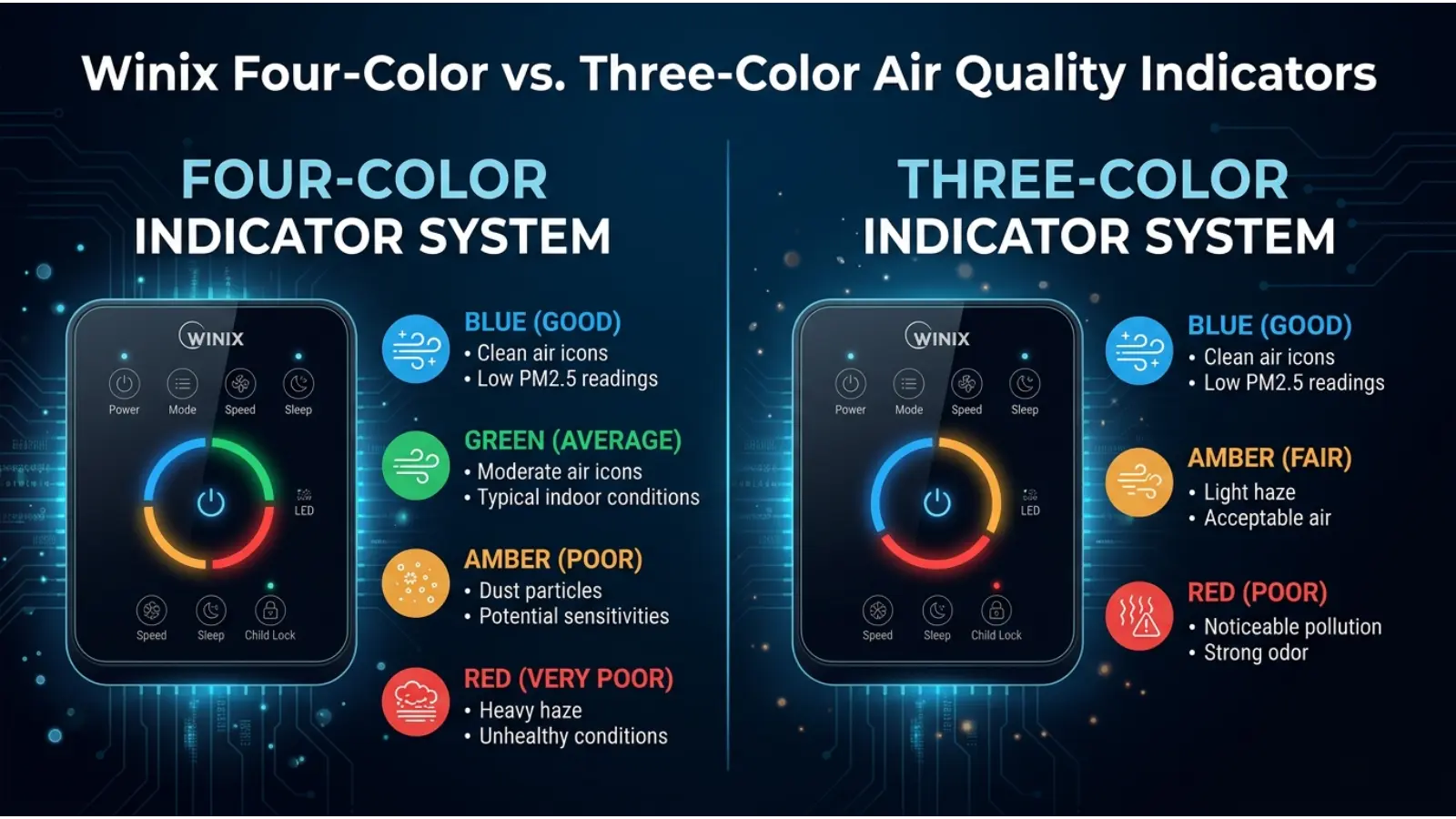
Winix Four-Color vs. Three-Color Air Quality Indicators
Not every Winix purifier uses exactly the same color system.
Most models use three levels:
Blue → Good
Amber → Fair
Red → Poor
Some models use four levels.
For example, Winix’s Tower XQ system uses:
Blue → Excellent
Green → Good
Amber → Fair
Red → Poor
This is why searching for a universal “Winix blue light meaning” can sometimes create confusion.
The correct meaning depends on the model.
The safest rule
If your purifier has four colors, use the four-color interpretation listed for that model.
If it has three colors, use the three-color system.
Does Winix Blue Light Mean Excellent Air?
Not necessarily.
On most standard three-color Winix models, blue means good, not excellent.
This small distinction matters.
Some four-color Winix models use blue for excellent, but that does not automatically apply to every Winix purifier.
Therefore, if you own an older or different model, do not assume that blue has exactly the same rating across the entire Winix product range.
Does Amber Mean Bad Air?
Amber generally means fair, not necessarily bad.
This is another common misunderstanding.
Amber represents an intermediate condition between good and poor on the standard three-color system.
It may appear because of temporary activity such as cooking or cleaning.
The best response is usually to let the purifier continue operating while you identify and control the source of the pollution.
Does Red Mean You Should Leave the Room?
Not automatically.
A red Winix air-quality indicator means the purifier has classified the detected air quality as poor according to its sensor system.
That does not, by itself, tell you that the room is unsafe to occupy.
If you know there is a significant pollution source, such as smoke or a chemical release, address the source and follow appropriate safety guidance.
For ordinary household situations, the red light is primarily a signal to investigate and allow the purifier to respond.
How Lighting Can Affect Your Perception of Winix Colors
The LED itself may look different depending on the surrounding environment.
A blue LED in a dark bedroom can appear brighter and more intense than the same LED in a sunlit living room.
Warm household lighting can also change how people visually perceive colors.
However, this is different from the purifier’s sensor reading.
The room lighting can affect how you see the LED, while the smart sensor is responsible for the air-quality classification.
Some Winix models also have light sensors and Sleep Mode features that reduce or turn off display lighting in dark conditions.
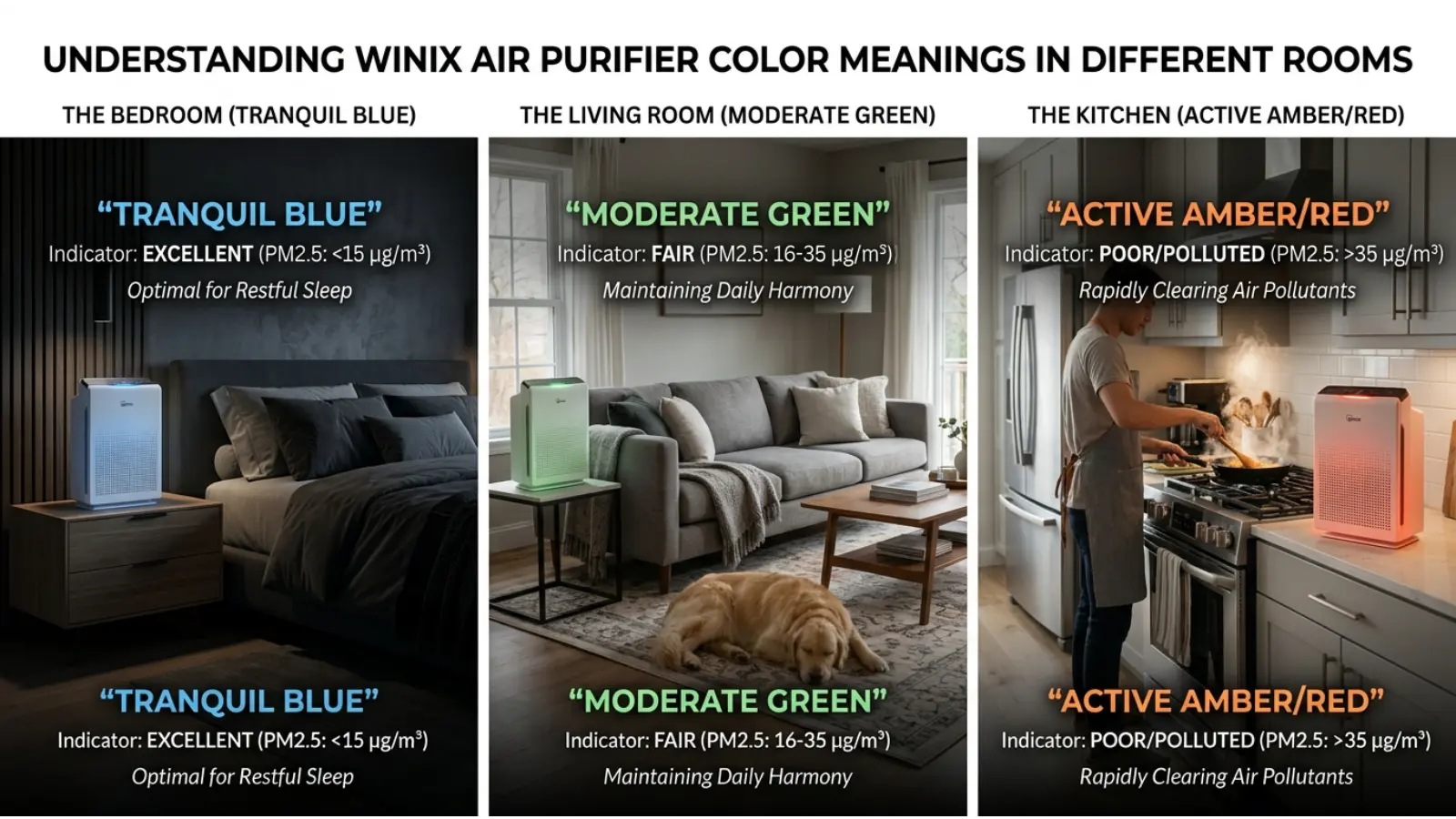
Winix Air Purifier Color Meanings in Different Rooms
The same purifier may behave differently depending on where you place it.
Kitchen
Expect more frequent changes because cooking creates particles and odors.
Bedroom
The indicator may remain stable if the room has little activity and few pollution sources.
Living Room
Changes can occur because of people, pets, cleaning, candles, fireplaces, and cooking nearby.
Home Office
Printers, sprays, dust, and ventilation changes can influence indoor conditions.
Pet Areas
Pet activity can disturb dust and other particles, particularly around bedding and carpets.
The key lesson is that location changes the context of the color.
How to Use Winix Air Purifier Colors in Daily Life
You can treat the indicator as a simple environmental feedback tool.
When the light is blue
Continue normal operation.
When the light becomes amber
Think about what recently changed.
Did you cook? Clean? Open a window? Use a spray?
When the light turns red
Look for an active pollution source and allow the purifier to operate.
This approach is more useful than simply staring at the light and wondering whether something is wrong.
Winix Air Purifier Colors and Home Design
Because Winix indicators are visible in many rooms, color also becomes part of the home’s visual environment.
Blue light can feel calm against neutral furniture.
Amber can create a warmer visual impression.
Red is much more noticeable, which is useful for an alert but may feel distracting in a bedroom.
If the LED bothers you at night, check whether your model provides a light-control or Sleep Mode feature.
This is a good example of functional design: the color is attractive only because it communicates useful information.
Winix Air Purifier Colors in Branding and Product Design
Winix’s use of blue, amber, red, and green follows a broader design principle found in technology products.
Users need to understand status quickly.
Blue and green are commonly perceived as positive states, while amber suggests caution and red signals attention.
This makes the interface easier to understand even for someone who has never read the manual.
The design is especially effective because the user does not need to remember complicated numbers.
One glance provides an immediate status signal.
Color Combinations That Work With Winix Indicator Lights
If you are designing a room around a Winix purifier, neutral colors usually work well.
White + Blue
Creates a clean, fresh appearance and works especially well in modern rooms.
Gray + Blue
Produces a calm, technology-focused look.
Beige + Amber
Creates a warmer and softer environment.
Black + Blue
Gives a sleek, contemporary appearance.
White + Green
Can create a fresh, natural feeling on models that use green as an air-quality status.
Remember, however, that these are design associations, not meanings assigned by Winix.
Common Misconceptions About Winix Air Purifier Colors
“Red means the purifier is broken.”
Not necessarily. Red normally represents poor detected air quality.
“Blue means the air contains nothing harmful.”
No. Blue means the purifier currently categorizes the detected air quality as good.
“Amber means the filter is dirty.”
Not automatically. Air quality and filter replacement are separate indicators.
“Every Winix uses the same colors.”
No. Different models can use different numbers of color levels.
“The color measures every pollutant.”
No. Sensors measure specific characteristics of air rather than every possible indoor contaminant.
“A red light always means the room is dangerous.”
No. It indicates poor air quality according to the purifier’s sensor classification, not a universal safety judgment.
What Should You Do When Your Winix Shows Red?
Use a simple three-step approach.
Step 1: Find the source
Think about recent activities such as cooking, smoking, cleaning, spraying products, or disturbing dust.
Step 2: Reduce the source
Stop or control the activity when possible.
Step 3: Let the purifier respond
Keep the purifier operating and monitor whether the indicator changes as the indoor conditions improve.
If the reading remains unexpectedly high, consult the owner’s manual for your exact model and inspect the purifier’s sensor area and maintenance indicators.
How Age and Culture Affect Color Interpretation
Color meanings are not universal in every cultural setting.
For example, red is often associated with warning in modern traffic and technology interfaces. Yet red can also represent celebration, luck, strength, or prosperity in some cultural traditions.
Blue may suggest calmness or trust in one context while carrying religious or cultural significance in another.
Winix’s air-quality system uses color in a functional international interface, where the main goal is rapid status recognition.
Therefore, the meaning of blue, amber, red, or green on a purifier should not be confused with broader cultural symbolism.
Frequently Asked Questions About Winix Air Purifier Color Meanings
What does blue mean on a Winix air purifier?
Blue generally means good air quality on most three-color Winix models. On certain four-color models, blue can represent excellent air quality.
What does red mean on a Winix air purifier?
Red means the purifier’s air-quality system has categorized the detected indoor air as poor.
What does orange mean on a Winix air purifier?
Orange, commonly called amber by Winix, generally means fair air quality on three-color models.
What does green mean on a Winix air purifier?
Green is used on some four-color Winix models to represent good air quality. It is not present on every model.
Why does my Winix air purifier change from blue to red?
The purifier may have detected an increase in particles or gases. Cooking, smoke, dust, aerosols, and other indoor activities can cause the indicator to change.
Why does my Winix stay red after cooking?
Airborne pollution can remain in the room after cooking stops. Allow the purifier to continue running and investigate ventilation and other possible pollution sources.
Does a red Winix light mean I need a new filter?
Not necessarily. The air-quality indicator and filter replacement indicator have different functions.
Does blue mean my air is completely clean?
No. Blue means the purifier considers the detected air quality good according to its sensor system. It does not prove that every pollutant is absent.
Can Winix air purifier colors be trusted?
They are useful as a relative, real-time indication of the air conditions detected by the purifier. They should not be treated as a complete laboratory analysis of indoor air.
Why does my Winix have different colors from another model?
Winix uses different air-quality indicator systems across its product range. Some models use three colors, while others use four.
Final Thoughts on Winix Air Purifier Color Meanings
The easiest way to understand Winix air purifier color meanings is to treat the LED as a real-time communication tool.
Blue generally means good. Amber means fair. Red means poor. Green appears on certain four-color models and generally represents good air quality.
The colors are not decorative symbols, personality indicators, or universal measurements of every pollutant. They are visual summaries generated from the purifier’s sensor readings.
Most importantly, look at changes in color rather than one isolated reading. If your purifier changes from blue to red after cooking, cleaning, smoke, or another activity, the change provides useful information about what is happening in your indoor environment.
And when the light eventually returns toward blue, it shows that the conditions detected by the purifier have improved.
In that sense, the most useful meaning of a Winix light is simple: watch the change, understand the cause, and use the information to make better decisions about your indoor air.

Emma Wilson is a dedicated comparison writer and product researcher at ColorMystiic.com. She specializes in creating unbiased product comparisons, detailed reviews, and helpful buying guides. Her goal is to help readers make smarter purchasing decisions with confidence.