Mood rings have fascinated people for decades because they appear to reveal emotions through changing colors. However, the truth behind a color meanings real mood ring chart is more interesting than many people realize. While mood rings respond to body temperature rather than directly reading emotions, the colors have become linked with symbolic meanings that many people enjoy exploring.
People search for a real mood ring chart because they want to understand what each color represents, why the ring changes throughout the day, and whether the meanings have any scientific basis. In reality, mood ring colors combine science, symbolism, psychology, and popular culture.
This guide explains how mood rings work, what every color commonly means, the psychology behind each shade, common myths, and practical tips for using a mood ring.
Quick Answer: A real mood ring chart connects different colors with emotional states based on changes in body temperature. Although mood rings cannot truly detect feelings, their colors are traditionally interpreted as symbols of calmness, stress, excitement, love, confidence, relaxation, and other emotional experiences.
What Is a Real Mood Ring Chart?
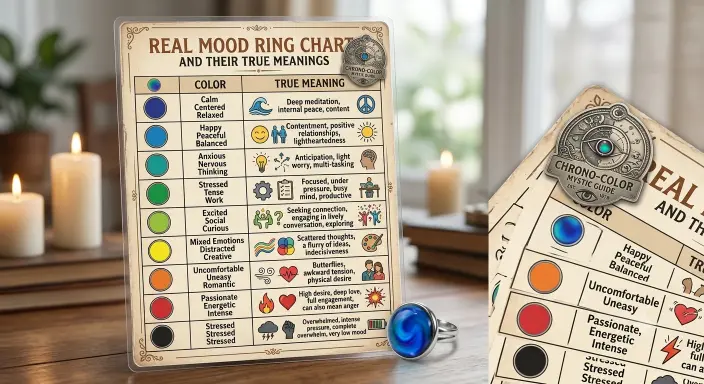
A real mood ring chart is a reference guide that explains what each mood ring color traditionally represents. The chart is based on the thermochromic liquid crystals inside the ring.
These crystals react to tiny temperature changes in your skin. As your finger becomes warmer or cooler, the crystals reflect different wavelengths of light, causing the stone to change color.
Although many people think the ring reads emotions directly, it actually measures temperature. Since emotions often influence body temperature through blood circulation, mood changes can indirectly affect the ring’s color.
Therefore, mood ring meanings should be viewed as symbolic interpretations rather than scientific measurements.
How Mood Rings Actually Work
Mood rings contain a layer of liquid crystals beneath a transparent stone.
These crystals twist into different patterns depending on temperature.
As a result, different wavelengths of light are reflected, creating changing colors.
Several factors influence these changes:
- Body temperature
- Weather
- Indoor temperature
- Physical activity
- Stress
- Relaxation
- Blood circulation
- Holding hot or cold objects
Consequently, your mood ring may change color even when your emotions remain the same.
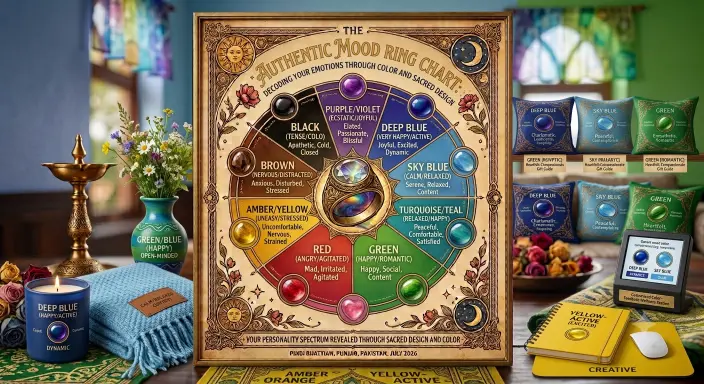
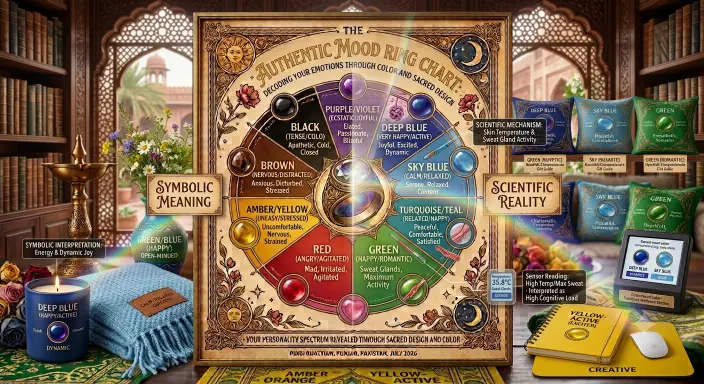
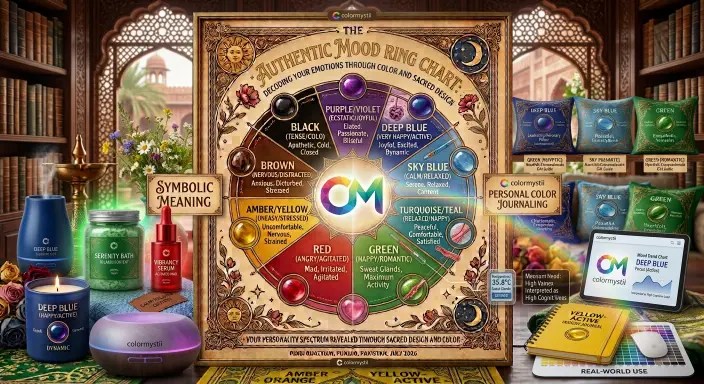
Real Mood Ring Color Meanings Chart
| Mood Ring Color | Traditional Meaning |
|---|---|
| Black | Stress, cold temperature, tension |
| Gray | Anxiety, uncertainty, emotional fatigue |
| Brown | Restlessness, nervousness |
| Amber | Mixed emotions, curiosity |
| Yellow | Alertness, creativity, excitement |
| Green | Calm, balance, average emotional state |
| Blue-Green | Relaxed, optimistic, friendly |
| Blue | Peace, happiness, confidence |
| Dark Blue | Deep relaxation, emotional stability |
| Purple | Passion, imagination, romance |
| Violet | Inspiration, intuition, creativity |
| Pink | Affection, joy, excitement |
| Red | Energy, determination, strong emotions |
Keep in mind that different manufacturers may use slightly different color charts.
Black Mood Ring Meaning
Black is often the default color when the ring becomes cold.
Traditionally, black symbolizes:
- Stress
- Fatigue
- Emotional overload
- Worry
- Low energy
However, it does not necessarily mean someone is unhappy. Cold weather alone can turn a mood ring black.
Gray Mood Ring Meaning
Gray generally represents emotional uncertainty.
It is commonly associated with:
- Feeling overwhelmed
- Mental exhaustion
- Caution
- Emotional distance
- Temporary confusion
Additionally, gray may simply indicate a cooler skin temperature.
Brown Mood Ring Meaning
Brown often appears during transitional temperatures.
Its symbolic meanings include:
- Nervousness
- Restlessness
- Uneasiness
- Mild frustration
Again, these interpretations are symbolic rather than medically proven.
Amber Mood Ring Meaning
Amber is a warm transitional color.
People often associate it with:
- Curiosity
- Anticipation
- Personal growth
- Open-mindedness
- Exploration
Because amber sits between cooler and warmer shades, it often represents emotional change.
Yellow Mood Ring Meaning
Yellow traditionally symbolizes active thinking.
Common interpretations include:
- Creativity
- Optimism
- Curiosity
- Excitement
- High mental activity
Nevertheless, excitement and nervousness can produce similar temperature changes, making yellow open to interpretation.
Green Mood Ring Meaning
Green is one of the most common mood ring colors.
Many charts describe it as representing:
- Balance
- Calmness
- Stability
- Comfort
- Emotional neutrality
Since average skin temperature often produces green, many people see it throughout the day.
Blue-Green Mood Ring Meaning
Blue-green combines the calming qualities of blue with the balance of green.
It often symbolizes:
- Contentment
- Friendliness
- Emotional comfort
- Confidence
- Positive social interaction
Blue Mood Ring Meaning
Blue is one of the most desirable mood ring colors.
Traditionally, it represents:
- Happiness
- Peace
- Trust
- Relaxation
- Confidence
- Emotional security
Many mood ring guides consider blue a sign of emotional balance.
Dark Blue Mood Ring Meaning
Dark blue usually appears when the ring reaches one of its warmest stable temperatures.
It commonly symbolizes:
- Deep relaxation
- Satisfaction
- Inner peace
- Confidence
- Emotional stability
However, body warmth from exercise may also produce this color.
Purple Mood Ring Meaning
Purple has long been associated with imagination and mystery.
Mood ring interpretations include:
- Romance
- Creativity
- Passion
- Inspiration
- Emotional richness
Furthermore, purple often appeals to people who enjoy artistic expression.
Violet Mood Ring Meaning
Violet is closely related to purple but often carries a more spiritual symbolism.
It may represent:
- Wisdom
- Intuition
- Reflection
- Personal insight
- Inspiration
These meanings come mainly from symbolic traditions rather than scientific evidence.
Pink Mood Ring Meaning
Pink usually represents positive emotions.
Traditional meanings include:
- Love
- Kindness
- Affection
- Joy
- Warm relationships
Many people consider pink one of the happiest mood ring colors.
Red Mood Ring Meaning
Red is associated with warmth and intensity.
It commonly symbolizes:
- Passion
- Determination
- Energy
- Motivation
- Excitement
Because physical activity also increases body temperature, exercise can sometimes produce red tones.
The Psychology Behind Mood Ring Colors
Color psychology studies how colors influence perception and emotional responses. Although researchers agree that colors can affect mood and behavior in certain contexts, there is no scientific evidence that mood ring colors directly reveal a person’s emotional state.
Instead, mood rings combine two separate ideas:
- Science: Temperature-sensitive liquid crystals change color.
- Symbolism: People assign emotional meanings to those colors.
As a result, the experience feels personal even though the ring is reacting to temperature rather than thoughts.
Why Mood Ring Colors Change
Several everyday situations affect mood ring colors.
For example:
- Drinking coffee may warm your hands.
- Cold weather may darken the ring.
- Anxiety can reduce blood flow to fingers.
- Exercise increases skin temperature.
- Relaxation may improve circulation.
Therefore, both physical and emotional factors can influence the ring indirectly.
Symbolic Meaning vs Scientific Reality
Understanding the difference helps avoid misconceptions.
Symbolic Interpretation
Mood rings encourage self-reflection and playful emotional awareness.
Scientific Explanation
Mood rings measure temperature, not emotions.
Both ideas can coexist, provided we understand the difference.
Mood Rings in Popular Culture
Mood rings became extremely popular during the 1970s.
Since then, they have appeared in:
- Fashion accessories
- Gift shops
- Jewelry collections
- Movies
- Television
- Social media trends
Today, many people wear them more for nostalgia and fun than for emotional analysis.
How Lighting Changes Mood Ring Colors
Lighting can dramatically change how a mood ring appears.
For example:
- Sunlight produces brighter colors.
- Indoor lighting may soften shades.
- LED lights sometimes enhance blues.
- Warm lighting can emphasize greens and yellows.
Consequently, the same ring may look different throughout the day.
Common Myths About Mood Rings
Myth 1: Mood Rings Read Minds
They do not.
They only respond to temperature.
Myth 2: Every Brand Uses the Same Chart
Different manufacturers often use different color scales.
Myth 3: One Color Always Means One Emotion
Context matters.
Temperature, environment, and activity all influence the result.
Myth 4: Mood Rings Predict Personality
They cannot determine personality traits.
Instead, the meanings are symbolic and intended for entertainment and self-reflection.
Real-World Uses of Mood Ring Colors
Although mood rings are mostly novelty jewelry, their colors inspire many creative fields.
Fashion
People choose colors that match outfits or express personal style.
Jewelry Design
Mood rings remain popular as conversation starters.
Marketing
Brands sometimes use mood-inspired colors to create emotional connections.
Education
Teachers occasionally use mood rings to introduce basic concepts of color psychology and temperature-sensitive materials.
Gifts
Mood rings make meaningful presents because each color carries a symbolic story.
Tips for Getting Accurate Mood Ring Colors
To see colors more consistently:
- Wear the ring indoors at room temperature.
- Avoid placing it under direct sunlight.
- Remove it before washing hands with hot water.
- Wait a few minutes after coming inside from cold weather.
- Clean the stone regularly for better visibility.
Frequently Asked Questions
What is the most common mood ring color?
Green is often the most common because it corresponds to average skin temperature.
Does a black mood ring always mean stress?
No. Cold fingers are the most common reason for a black mood ring.
Are mood ring meanings scientifically proven?
No. The colors are caused by temperature, while the emotional meanings are symbolic traditions.
Why does my mood ring stay blue?
Your skin temperature may remain within the range that produces blue, especially if you’re comfortable and warm.
Can mood rings detect anxiety?
Not directly. Anxiety can influence body temperature, but the ring cannot identify emotions on its own.
Why do different charts show different meanings?
Manufacturers create their own interpretation guides, so meanings vary slightly.
Do mood rings stop working?
Yes. Over time, moisture, age, and heat can damage the liquid crystals.
Are expensive mood rings more accurate?
Not necessarily. Higher-quality rings may last longer, but they still respond to temperature rather than emotions.
Can children wear mood rings?
Yes, although adults should ensure the jewelry is made from safe, skin-friendly materials.
Why does my mood ring change so quickly?
Small changes in skin temperature happen throughout the day, causing the crystals to react almost immediately.
Final Thoughts
A color meanings real mood ring chart blends science, symbolism, and imagination into one fascinating piece of jewelry. While mood rings cannot truly measure emotions, they offer a fun way to reflect on how temperature, environment, and feelings often overlap. Understanding the science behind thermochromic crystals, along with the traditional meanings assigned to each color, helps you appreciate mood rings for what they are: creative accessories that encourage curiosity about color, perception, and human emotion. Whether you wear one for style, nostalgia, or simple enjoyment, a mood ring remains a colorful reminder that context shapes how we interpret both colors and emotions.
Emma Wilson is a dedicated comparison writer and product researcher at ColorMystiic.com. She specializes in creating unbiased product comparisons, detailed reviews, and helpful buying guides. Her goal is to help readers make smarter purchasing decisions with confidence.